
SLIDE 1
Education for Sustainable Development (ESD) – The Nature can be a classroom
Conference of the European RCEs RCE Bretagne - Vannes
City of Nuremberg, Department of Education, Schools and Sports
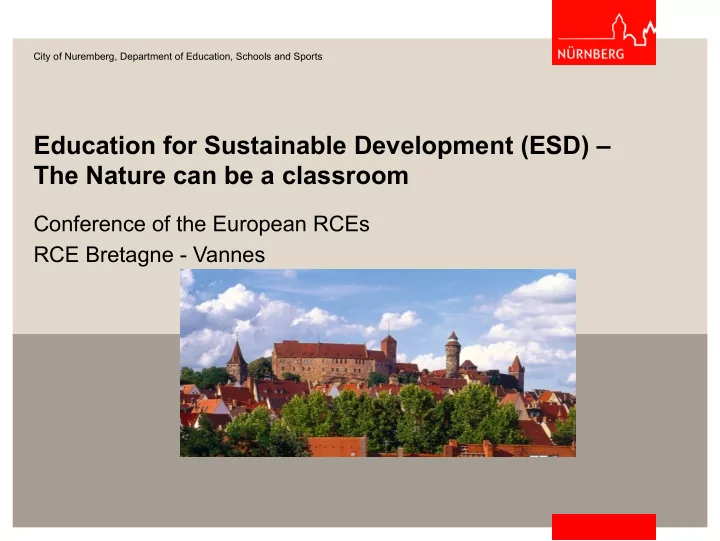
Education for Sustainable Development (ESD) The Nature can be a - - PowerPoint PPT Presentation
City of Nuremberg, Department of Education, Schools and Sports Education for Sustainable Development (ESD) The Nature can be a classroom Conference of the European RCEs RCE Bretagne - Vannes ESD and enviromental education in Bavarian
City of Nuremberg, Department of Education, Schools and Sports
§ Enviromental education is a main topic in the curricula. § Enviromental education is taking part inside and outside of the
2
3
§ Idea and Vision: Students and Teacher save and reduce the
§ Yearly schools can apply with projects and can get up to 2.000,00
§ Information: https://www.nuernberg.de/internet/keim/
4
§ Birkenwald-Schule:
§ Bauernfeind-Schule:
5
6
7
8
9
10
11
City of Nuremberg Department for Education, Schools and Sport Hauptmarkt 18 90403 Nürnberg
+49 (0)9 11 / 2 31-5709 christian.büttner@stadt.nuernberg.de http://www.schulen-in-nuernberg.de
Raising problem solving Global Citizens
Hanns Seidel Foundation Shanghai Leino@hss.de
Primary school pupils be made aware of environmental and climate issues. Pupils will learn how to identify and to actively take part in environment protection actions Chinese partners develop in-house further training courses for primary school teachers and respective educational target groups in Education for Sustainable Development
Establish a German-Chinese universities cooperation framework for climate change and environmental education
Sino-German Network for Education for Sustainable Development (ESD)
Establishment
Center of Expertise for ESD Hangzhou (UN RCE ESD)
15 Modules with teaching and learning materials
Qualified teachers from 27 schools in ESD – continues training for same teachers for 3 years
1
Awareness building
3
Transfer of results
2
Implementation in curriculas
– 50 % of head masters said they have no competences in ESD – 36 % of teachers said that they do not contribute to environmental problems – 45 % of schools in Zhejiang do not implement ESD in class room teaching (compared to 13 % in Shanghai) – 23 % of teachers cooperate on ESD with non-school partners – 12 % of pupils said they protect environment in their schools (28 % do this with their families)
based learning on ESD in core curriculars?
developed and rural areas?
LEINO@HSS.DE