Effective Collaboration within the Free Zone: The Roles of - - PowerPoint PPT Presentation

effective collaboration within the free zone the roles of
SMART_READER_LITE
LIVE PREVIEW

Effective Collaboration within the Free Zone: The Roles of - - PowerPoint PPT Presentation

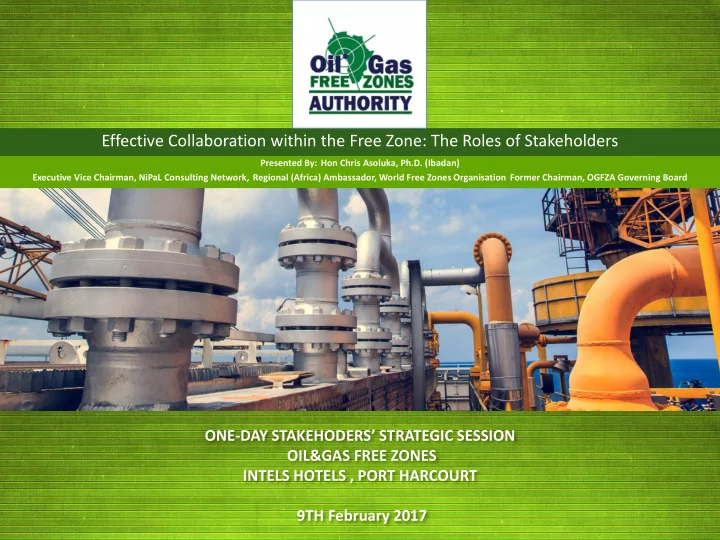
Effective Collaboration within the Free Zone: The Roles of Stakeholders Presented By: Hon Chris Asoluka, Ph.D. (Ibadan) Executive Vice Chairman, NiPaL Consulting Network, Regional (Africa) Ambassador, World Free Zones Organisation Former Chairman,


slide-1
SLIDE 1

ONE-DAY STAKEHODERS’ STRATEGIC SESSION OIL&GAS FREE ZONES INTELS HOTELS , PORT HARCOURT 9TH February 2017

Effective Collaboration within the Free Zone: The Roles of Stakeholders

Presented By: Hon Chris Asoluka, Ph.D. (Ibadan) Executive Vice Chairman, NiPaL Consulting Network, Regional (Africa) Ambassador, World Free Zones Organisation Former Chairman, OGFZA Governing Board

slide-2
SLIDE 2

QUOTES

“It is impossible to solve today’s problems by thinking the way we thought when we created the problems”

Albert Einstein

“The wise man does at once what the fool does at last”

Balstasar Gracian

slide-3
SLIDE 3

Objectives of the discourse

  • An overview of the Nigerian Oil and Gas Free Zone Authority (OGFZA) model with its history,

investment, management and operation;

  • A tentative grasp of the relevant stakeholders’ roles and collaboration for competitiveness of SEZ; and
  • Touch on the way forward for the realization of OGFZA Growth Strategy.
slide-4
SLIDE 4

Introduction

  • Special Economic Zones (SEZs) are increasingly used as policy tool of choice for governments seeking to

attract foreign investment, promote export oriented growth, and generate employment. The operation

  • f an SEZ includes the roles of zone owner, zone developer, zone manager or operator, and zone
  • regulator. A prominent feature of competitive markets (more than 3,000 free zones, each offering

extremely tempting incentives and excellent services to their investors) is that the entities involved must continuously find new ways of improving their performance in order to stay in the race.

  • In both the private and public sector, this entails ensuring that all stakeholders in an entity, including

customers, employees, strategic partners, suppliers, and society, are satisfied.

slide-5
SLIDE 5

Foundation issues 1

  • Stakeholders Collaboration as a process of interactive learning and empowerment that enables

stakeholders’ with common goal to be collectively innovative and resilient when faced with emerging risks, crises and opportunities of a complex and changing environment.

  • Other terminologies include Social Learning, Interactive Policy Process, Citizens engagement,

collaborative Action etc.

  • Reasons for Stakeholders Collaboration – ethical people rights to be involved, political, pragmatic or

systemic

  • No Silver Bullet – cultivate common goals, devote time, develop capacities/power, need to integrate

with government process etc.

slide-6
SLIDE 6

Foundation issues 2

  • From Milton Friedman to Freeman/Key Questions include: 1. Who are the stakeholders to include in

the analysis? 2. What are the stakeholders’ interests and beliefs? 3. Who controls critical resources? 4. With whom do stakeholders form coalitions? 5. What strategies and venues do stakeholders use to achieve their objectives? In general, stakeholder analysis helps policymakers conceptualize the dynamics of a policy subsystem.

  • One theoretical framework to ground a stakeholder analysis is the advocacy coalition framework

(Sabatier 1988; Sabatier and Jenkins-Smith 1993, 1999).2 The advocacy coalition framework is frequently used to explain stakeholder behavior and policy outcomes in intense political conflicts over periods of a decade or more (Sabatier and Weible 2005).

slide-7
SLIDE 7

Case presentation - OGFZA

Two Types of Free Trade Zones

  • Free Zone established in Calibre and reinforced by Nigerian Export Processing Free Zone Authority Act,

1992 which established Nigerian Export Processing Authority (NEPZA) ; and

  • Free Zone established in Onne via Decree No. 8 of 29th March 1996 - Oil & Gas Free Zone (OGFZ)

dedicated solely to the Oil & Gas Free Zone and logistics activities in Nigeria and the Sub-Saharan African region. Note - the Difference between the two; and justification for Oil and Gas Special Zone – Location potential, comparative advantage, market benchmarking and appropriate legal and regulatory framework.

slide-8
SLIDE 8

Features/location

Strategically located in the Gulf of Guinea – hub of oil and gas activities in Sub-Saharan Africa. Accessibility:

  • Road (challenging situation with road accessibility)
  • Deep Sea Port
  • International Airport
  • Helipad to sustain offshore daylight operation
  • Heliport/Cargo Airport is planned.

Features:

  • World Class Deep Sea Port
  • Container Terminal
  • Well Integrated Oil Service Center
  • Access Channel
  • Bonny River

The purpose of OGFZ is to address specific needs and requirements of companies in the Oil and Gas industry with both general and specific measures

slide-9
SLIDE 9

Location

Strategic location

To Support Sub-Saharan Oil & Gas Industry Market Access: Optimum Location Serve Sub-Sahara African Region Nautical miles Abidjan 708 Accra 478 Lome 410 Cotonou 347 Lagos 315 Warri 301 Malabo 140 Sao Tome 270 Principe 190 Port Gentil 342 Pointe Noire 665 Cabinda 717 Soyo 756 Luanda 909 Lobito 1,104 Walvis Bay 1,778 Cape Town 2,478

slide-10
SLIDE 10

West Africa E&P trend

Espoir-Phillips 1980 30 MMBO abandoned Bonga Shell 1995 1 billion bbl Agbami-Famfa 1998 1 billion bbl Zafiro-Mobil/UMC 1995 500 million bbl Moho-Elf 1995 400 million bbl N’Kossa-Elf 1995 500 million bbl Quito-Chevron 1997 500 million bbl. Dalia-Elf 1996 1,250 million bbl. Girassol-Elf 1996 1,250 million bbl

slide-11
SLIDE 11

Regional Production/Reserve Values

(SOURCE: IHT, OCT 2004)

Country Production Oil Gas Reserve Oil Gas BOPD MCFD BBLS TCF Angola 1,000,000 1,200,000 12.5 9.5 Cameroon 100,000 200,000 0.2 3.9 Congo 213,000 850,000 1.5

  • Dem. Rep. Congo

28,000 52,000

  • Ivory Coast

30,000 160,000 0.14

  • Eq. Guinea

325,000 539,000 3

  • Gabon

267,000 260,000 2.5

  • Nigeria

2,400,000 4TCF 33

  • S & Principe
slide-12
SLIDE 12

OGFZA: A case presentation growth strategy

OGFZ Onne as the biggest FZ fully dedicated to Oil and Gas with size of about 20sqKM and structured on a Three-phased development strategy is being implemented:

  • Phase one: Free Port Phase serving as logistics/distribution center
  • Phase two: Progressed and established into a Free Trade Zone with a manufacturing and processing

centre catering for oil and gas industry needs with facilities such as machine shops, pipe coating and fabrication yards.

  • Phase three: The zone will undergo extensive development to establish more complex downstream

industries such as refining and petrochemical industry.

  • Ikpokiri Island directly opposite the main land is a vast expanse of virgin land (11.6 million square

meters) scheduled to provide ample infrastructure for the downstream sector.

  • Other approved OGFZ are in Warri, Lagos and Olokola in Ogun State
slide-13
SLIDE 13

Who are OGFZA’s stakeholders?

  • Before discussing how the stakeholders’ role could be catalyzed for effective collaboration within the

zones, it is important to define/understand who they possibly are - Stakeholders in an issue or matter, following Edward Freeman, can be defined as “any group or individual who can affect or is affected by the achievement of a firm’s objectives” And how do populate this group?

  • Answers to the following questions below would help to identify such groups or individuals: - Who is

affected by the policy?, Who has an interest in the policy?, Who is in a position to effect the policy formulation or execution?, Who has expressed opinion on the matter? And Who, based on the demographics or other characteristics, ought to care about the policy outcome?

slide-14
SLIDE 14

Effective Collaborations within the Free Trade Zone:

The Role of Stakeholders

Federal/State local Govts/Agenciies Investors Management Clients/Tenants/L andlord Comm Oil Service Centres Developers DMS Board Nigerian Exporting Processing Zone Authority Nigerian Port Authority Employees NCS//NIS/FIRS Oil and Gas Companies (IOCs, NOC)

Onne Oil and Gas Free Trade Zone

slide-15
SLIDE 15

In Managing Free Zones the OGFZA (Coordinating Role) is to ensure that:

  • Advantages/privileges get to clients in the zone;
  • Interface between Free Zone Clients and other Government agencies;
  • Undertakes resolution of disputes;
  • Liaises between investors and host community;
  • Identifies relevant industries/businesses in line with the Free Zones objectives.
slide-16
SLIDE 16

Other Roles of Government

  • Provide legislation to protect long term investment of potential investors.
  • Provision of basic infrastructure – land, short bridge, internal roads, power supply,

telecommunications, water

  • Serves to provide an enabling environment for business and encourages private sector participation.
  • Can be done on PPP basis.
  • Security of life and property.
  • Empowerment of locals - Awareness/orientation programmes at local/State levels.
  • Training plan/Work experience after training.
slide-17
SLIDE 17

Stakeholders roles

  • They must sign off and take ownership of each deliverable, thus allowing the zone to proceed on the

right track.

  • Keeping abreast of project progress and cascading information to others who need to know: the

stakeholder must not skip meetings and rely upon others to keep them up to speed

  • Similarly, they must also keep affected others or teams up to date with frequent progress reports.

This is probably the most often reported symptom of failed projects where key stakeholders become disassociated with a venture and it starts to drift, stray from the requirements and fall apart.

  • Establish the training and support requirements: the stakeholder must identify any effected

individuals of their projects and establish the necessary training and support requirements. This will be done in harness with the relevant departments but the stakeholder is responsible for it.

  • Identify and resolve issues and risks, especially those associated with managing change - It’s up to

the stakeholder to identify and acknowledge any potential risk and change associated with their project during the proposal stages.

  • Communicating throughout the life of the project: I cannot stress enough the need for strong
  • communication. The least successful projects are the ones that are done in isolation, that people

forget about until an email gets sent around heralding its imminent implementation
slide-18
SLIDE 18

Collaborations work best They are based around strong common (or at least complementary) interests and objectiveViVs

Key Success Factors

 Alignment – Common or at least complementary interest in the underlying objective and the activity

being undertaken

 Understanding – Understanding of individual organisation objectives and attributes and the impact

that they have on the way that they will engage in the collaboration

 Coordination – Clear coordination framework and ‘rules of engagement’ that define how the

collaboration will operate

 Resourcing – Adequate resourcing to support coordination and delivery of activity (so that there is

both alignment of objectives and capacity to deliver against objectives)

 Role Clarity – Clear definition of roles and responsibilities  Commitment – Clear commitment to roles and responsibilities  Accountability – Clear accountability framework (process controls) to manage delivery against

commitments

 Communication – Clear, open communication practices

slide-19
SLIDE 19

Conclusion

  • The increasing scope and ambition of free zones initiatives will require a commitment to dialogue and collaboration

with a diverse range of stakeholders.

  • The goals of any collaboration venture must be clarified before engaging stakeholders. Goals help identify and target

those interests that need to be represented in collaboration processes and those that can be left out.

  • Stakeholder collaboration is a process that requires the opportunity and space for participants to listen to and learn

from each other. Dialogue that is open and transparent is critical to long-term success.

DON’T LET THE DREAM DIE!

slide-20
SLIDE 20

Contact Us

OGFZA Onne Port Complex Onne RIV Nigeria +234-700-OGFZA Visit our website at www.ogfza.gov.ng for more details.