Effectiveness of PCV13 in Adults Hospitalized with Pneumonia Using - - PowerPoint PPT Presentation

effectiveness of pcv13 in adults hospitalized with
SMART_READER_LITE
LIVE PREVIEW

Effectiveness of PCV13 in Adults Hospitalized with Pneumonia Using - - PowerPoint PPT Presentation

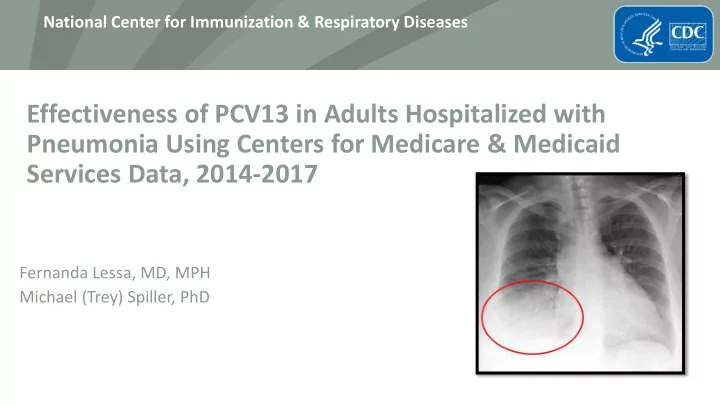
National Center for Immunization & Respiratory Diseases Effectiveness of PCV13 in Adults Hospitalized with Pneumonia Using Centers for Medicare & Medicaid Services Data, 2014-2017 Fernanda Lessa, MD, MPH Michael (Trey) Spiller, PhD


slide-1
SLIDE 1

National Center for Immunization & Respiratory Diseases

Effectiveness of PCV13 in Adults Hospitalized with Pneumonia Using Centers for Medicare & Medicaid Services Data, 2014-2017

Fernanda Lessa, MD, MPH Michael (Trey) Spiller, PhD

slide-2
SLIDE 2

Project Question

What is the direct effect of new adult PCV13 recommendation on pneumonia hospitalizations among adults ≥ 65 years of age?

slide-3
SLIDE 3

METHODS

  • CMS Medicare Part A/B Data
  • Study Cohort

– – – – – U.S. Medicare beneficiaries ≥ 65 years old enrolled in part A/B on September 1, 2014 After September 1, 2014, only beneficiaries who got part A/B coverage within 6 months

  • f their 65th birthday were included

Cohort observed until December 31, 2017 Beneficiaries dropped from the cohort before the end of study if they:

  • died
  • moved out of the United States
  • dis-enrolled from part A/B
  • developed the outcome of interest
  • Pneumococcal vaccination categories

PCV13 only, PPSV23 only, both vaccines (PCV13+PPSV23), no pneumococcal vaccine

slide-4
SLIDE 4

High Risk Groups

  • Four mutually exclusive groups based on underlying conditions

High Risk Group* High Risk Group* Conditions Conditions

High risk 1 (HR1) only Asplenia , CKD, generalized malignancy , HIV, hematologic malignancies, iatrogenic immunosuppression, immunodeficiencies , nephrotic syndrome, sickle cell anemia, solid organ transplant High risk 2 (HR2) only Alcoholism, chronic heart disease , chronic liver disease, chronic lung disease** , cigarette smoking, diabetes** High risk 1 + 2 (Both) At least one HR1 and one HR2 condition Low risk None of the conditions in HR1 or HR2

* Based on https://www.cdc.gov/mmwr/preview/mmwrhtml/mm6140a4.htm ** prevalence of 42% among beneficiaries Underlying conditions captured using inpatient (IP) and outpatient (OP) hospital facility claims for malignancies and IP+OP+ Physician/supplier part B (PB) for non-cancer conditions

slide-5
SLIDE 5

Outcomes of Interest

  • Based on inpatient claims
  • CAP: Community-Acquired Pneumonia (Griffin et al algorithm*)
  • Primary diagnosis of pneumonia
  • Primary diagnosis of meningitis, septicemia, empyema, or acute respiratory failure with a

pneumonia diagnosis in any secondary position

  • Non-HA CAP: Non-healthcare associated CAP
  • CAP in a patient without admission to hospital or skilled nursing facility in the prior 30 days and

without a prior healthcare-associated pneumonia hospitalization (SUBSET OF CAP)

  • Lobar Pneumonia
  • Inpatient hospital claim with a diagnosis of lobar/pneumococcal pneumonia ( ICD9:481/ICD10:

J13/J181) in any discharge diagnosis position

* Griffin et al. NEJM. 2013 369:155-63

slide-6
SLIDE 6

Statistical Approach

  • Discrete time survival model
  • Instantaneous hazard ratio ≡ Incidence rate ratio
  • Outcome: hospitalization with outcome of interest occurred in given

month (yes/no)

  • Generalized estimating equations (GEE) to adjust for correlations
  • Incidence rate ratios and 95% confidence intervals

Vaccine effectiveness (VE) = (1-IRR)*100

slide-7
SLIDE 7

Four Separate Models

  • Stratified by influenza season and influenza vaccination status
  • Influenza season (October-April)

Non-influenza season (May-September) Rationale: a) Biological interaction between flu vaccine and outcome of interest b) Pneumococcal and influenza vaccines are not independent observations c) Flu vaccinated individuals ≠ flu unvaccinated individuals*

* Jackson ML Lancet. 2008

Flu vaccinated person-months Flu unvaccinated person-months Flu vaccinated person-months Flu unvaccinated person-months

slide-8
SLIDE 8

Model Adjustment Variables

– – – – – – – – – – – – Age group (5-year bands) High risk condition category State Race Gender Hospital visits in prior year Outpatient non-ER visits in prior year Charlson comorbidity index Reason to enter CMS (Age, ESRD, Disabled, other) Month of year (e.g., January, February) Year Interactions: vaccine and age group, vaccine and risk group, age and risk group

slide-9
SLIDE 9

Number of Hospitalizations Averted by PCV13

  • Estimated the number of hospitalizations for each outcome in the absence
  • f PCV13 based on model results

– – Observed/IRR

  • Number of hospitalizations averted

Expected – Observed

slide-10
SLIDE 10

RESULTS

slide-11
SLIDE 11

Characteristics Sept 2014

N=26,598,266 n (%)

Dec 2017

N=24,121,625 n (%)

65- 74 14,428,556 (54.2) 13,312,649 (55.2) 75-84 8,230,539 (30.9) 7,481,999 (31.0) 85+ 3,939,171 (14.8) 3,326,997 (13.8) Male 11,546,396 (43.4) 10,527,650 (43.6) PCV13 use 210,567 (0.8) 10,018,855 (41.5) High Risk 1 1,473,002 (5.5) 1,451,503 (6.0) High Risk 2 9,967,701 (37.5) 8,521,792 (35.3) Both HR1 and HR2 8,111,269 (30.5) 7,980,206 (33.1) Low risk 7,046,294 (26.5) 6,168,124 (25.6) Charlson score≥3 7,692,162 (28.9) 6,521,748 (27.0) Outpatient visit ≥5 7,224,776 (27.2) 6,961,482 (28.9)

Patients Characteristics at Start and End of Cohort

57.6% of 65+ US population

slide-12
SLIDE 12

Are there differences in characteristics among PCV13 vaccinated seniors compared to unvaccinated*?

0% 10% 20% 30% 40% 50% 60% 70% 80% 75+ HR1+HR2 Charlson Score 3+ Outpatient Visit 5+ Flu vaccine receipt PCV13 Vaccinated (N=10,018,855) PCV13 Unvaccinated (N=10,646,220)

*Based on Dec 2017 data

slide-13
SLIDE 13

Incidence per 100,000 Beneficiary-Months by Outcome of Interest, Sept 2014- Dec 2017

148 115 6

CAP Non-HA CAP Lobar Incidence per 100,000 person-month

slide-14
SLIDE 14

CAP Incidence per 100,000 Beneficiary-Months by Age Group, 2014-2017

86 170 334

65-74 75-84 85+ Age Groups

Incidence per 100,000 person-month

slide-15
SLIDE 15

CAP Incidence per 100,000 Beneficiary-Months by Risk Group, 2014-2017

21 62 115 303

Low Risk High Risk 1 Only High Risk 2 Only Both HR1 + HR2

Incidence per 100,000 person-month

slide-16
SLIDE 16

Model Results – PCV13 VE Estimates

slide-17
SLIDE 17

Characteristics of Beneficiaries in Each Model Across Entire Study Period (40 months)

Flu season/ Flu Vac Flu Season/ Flu Unvac Non-flu season/ Flu Vac Non-flu season/ Flu Unvac

Total person

  • months

234,757,324 366,014,989 189,023,134 182,313,686 % 65-74 years 48.3% 58.9% 47.8% 62.3% % 75-84 years 34.9% 28.3% 35.2% 26.2% % HR1+HR2 37.1% 28.3% 37.7% 26.0% % Low Risk 19.2% 30.1% 18.6% 33.1% Healthier elderly Healthier elderly

slide-18
SLIDE 18

Adjusted for age, risk condition, healthcare utilization, state, race, gender and month

u Seaso

Percent Decline

5 10 15

Flu season/ Flu Vac Fl n/ Flu Unvac

6.0%

Non-flu season/ Flu Unvac

CAP

VE CAP : 6.0%–11.4%

Non-flu season/ Flu Vac

CAP CAP

11.4% 10.2% 9.3%

CAP

VE and 95% Confidence Interval for PCV13 only vs. Unvaccinated Against CAP Across the FOUR Models

slide-19
SLIDE 19

VE and 95% Confidence Interval for PCV13 only vs. Unvaccinated Against Non-HA CAP Across the FOUR Models

Adjusted for age, risk condition, healthcare utilization, state, race, gender and month

Percent Decline

0.0 5.0 10.0 15.0

Flu season/ Flu Vac Flu Season/ Flu Unvac

Non-HA CAP

5.0% 11.0%

Non-flu season/ Flu Unvac

Non-HA CAP

VE Non-HA CAP: 5.0%–11.0%

Non-flu season/ Flu Vac

Non-HA CAP Non-HA CAP

6.4% 9.4%

slide-20
SLIDE 20

Adjusted for age, risk condition, healthcare utilization, state, race, gender and month

VE and 95% Confidence Interval for PCV13 only vs. Unvaccinated Against LOBAR Pneumonia Across the FOUR Models

Percent Decline

  • 5

5 10 15 20

Flu season/ Flu Vac Flu Season/ Flu Unvac

1.3% 11.0%

Lobar

Non-flu season/ Flu Unvac

Lobar Lobar

VE Lobar Pneumonia: 1.3%–11.0%

Non-flu season/ Flu Vac

6.2% 7.8%

Lobar

slide-21
SLIDE 21

Hospitalizations Averted Due to PCV13 From September 2014 – December 2017 in the Study Cohort

Outcome Outcome Episodes Averted Episodes Averted during 40 during 40 Months of Study Months of Study n (95% CI) n (95% CI)

CAP CAP 28,600 28,600

(21,000 (21,000– 36,600) 36,600)

Non Non-HA CAP HA CAP

18,700 18,700

(12,000 (12,000– 25,800) 25,800)

Lobar Lobar

1,100 1,100

(190 (190 – 1900) 1900)

18,700

(13,000-25,000) from Jan-Dec2017

slide-22
SLIDE 22

Changes in risk group distribution among PCV13 vaccinated individuals

PCV13 only PCV13 +PPSV23

Sept 2014 Dec 2017 Sept 2014 Dec 2017

slide-23
SLIDE 23

Limitations

  • Residual confounding

– – – ICD codes fail to remove all confounding in pharmocoepidemiologic studies among seniors1-3

  • Lack of reliable ICD codes to measure functional status
  • Adjustment for chronic diseases and healthcare utilization can reduce

biases but do not completely eliminate them

  • Misclassification of vaccination status

Influenza vaccine: ~30% of individuals with documentation of flu vaccine based on HAIVEN* misclassified as unvaccinated in CMS Pneumococcal vaccine: adequate capture of PCV13 status but ~30% of misclassification of PPSV23 status based on ABCs data

  • 1. Jackson LA, Int J Epidemiol. 2006
  • 2. Nelson JC, J Clin Epidemiol.2009
  • 3. Jackson ML Pharmacoepidemiol Drug Saf. 2011

*US hospitalized Influenza Vaccine Effectiveness Network

slide-24
SLIDE 24

Summary

  • CAP incidence is highest among individuals >=85 years of age and those with

HR1+HR2 conditions

  • Individuals who got PCV13 were older, sicker and had more healthcare

exposures

  • Effectiveness of PCV13 observed against first episode of CAP, non-HA CAP and

lobar pneumonia

slide-25
SLIDE 25

Conclusion

  • PCV13 VE for all-cause CAP: 6.0%–11.4%

– – Similar to Gessner et al (clinical trial)*: PCV13 VE of 8.1% (1.0%– 14.6%) against all-cause CAP

  • ~28,600 CAP hospitalizations averted within 40 months after

implementation of new adult PCV13 recommendation 18,700 (65%) prevented in 2017

  • Likely related to the characteristics of the individuals who are receiving

the vaccine in more recent years

  • Represents 5.1% of all CAP hospitalizations in 2017 being prevented

*Gessner et al (Pfizer funded). Vaccine 2018

slide-26
SLIDE 26

Acknowledgements

  • Acumen Team

Zoe Wu Rongrong Wang Yoganand Chillarige Shruti Parulekar Yuchen Li Liz Wartella Thomas E. MaCurdy Michael Wernecke Robert Warnock

  • CMS

Jeffrey Kelman Steve Chu

  • CDC

Trey Spiller Tamara Pilishvili Nong Shang Cynthia Whitney Almea Matanock Brendan Flannery

  • Elif Alynak
  • Yale

Dan Weinberger

  • Harvard

Marc Lipsitch

slide-27
SLIDE 27

For more information, contact CDC 1-800-CDC-INFO (232-4636) TTY: 1-888-232-6348 www.cdc.gov The findings and conclusions in this report are those of the authors and do not necessarily represent the

  • fficial position of the Centers for Disease Control and Prevention.

THANK YOU!