Effects of salinity on seed yield and nutritional quality of Quinoa - - PowerPoint PPT Presentation

effects of salinity on seed yield and nutritional quality
SMART_READER_LITE
LIVE PREVIEW

Effects of salinity on seed yield and nutritional quality of Quinoa - - PowerPoint PPT Presentation

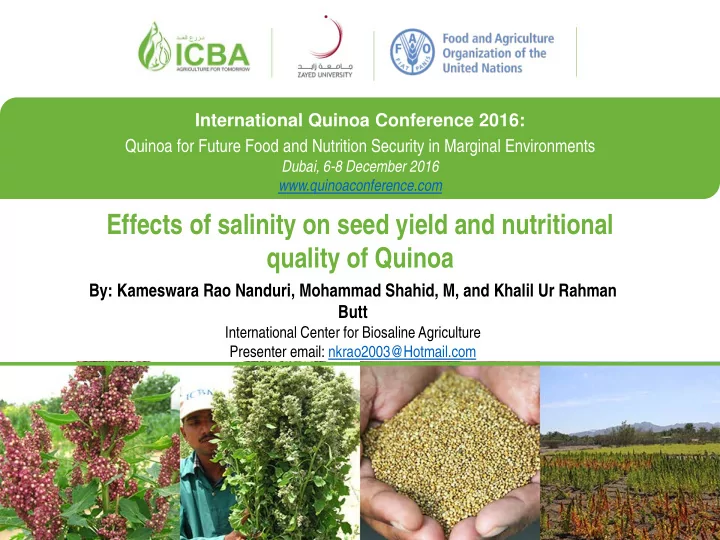
International Quinoa Conference 2016: Quinoa for Future Food and Nutrition Security in Marginal Environments Dubai, 6-8 December 2016 www.quinoaconference.com Effects of salinity on seed yield and nutritional quality of Quinoa By: Kameswara


slide-1
SLIDE 1

International Quinoa Conference 2016: Quinoa for Future Food and Nutrition Security in Marginal Environments

Dubai, 6-8 December 2016 www.quinoaconference.com

Effects of salinity on seed yield and nutritional quality of Quinoa

By: Kameswara Rao Nanduri, Mohammad Shahid, M, and Khalil Ur Rahman Butt

International Center for Biosaline Agriculture Presenter email: nkrao2003@Hotmail.com

slide-2
SLIDE 2

Outline

  • Background - Production systems in the UAE
  • Quinoa R&D at ICBA
  • Multi-location yield trials
  • Growing environment and nutritional

quality

  • Conclusions
slide-3
SLIDE 3
  • Harsh climate - severe limitation to productivity
  • Scarcity of fresh water and increasing ground water

salinity  Some 30-40% of the farms have groundwater salinity of >4dS/m

  • Many of the currently grown major crops are water-

thirsty (e.g. Alfalfa, Rhodes grass) and salt-sensitive (vegetables)

  • Likely to become hotter and drier due to climate

change - increased water scarcity and salinity further impacting agricultural production

  • Diversification of production systems through

introduction of new salt-tolerant and water-use efficient crops needed to sustain agricultural production

Production systems in the UAE

slide-4
SLIDE 4

Forages

  • Pearl millet
  • Sorghum
  • Barley
  • Triticale
  • Fodder beet
  • Buffel grass
  • Sesbania

Other crops

  • Quinoa
  • Mustard
  • Safflower
  • Cowpea
  • Guar
  • Amaranth
  • Castor

Among food crops, Quinoa ranked high in terms of local adaptation and grain yield potential – hence regarded as a promising alternative crop for the region

Crops investigated

slide-5
SLIDE 5

121 accessions from USDA 20 top- yielding accessions 8 best- performing accessions 4 High yielding lines Preliminary evaluation for adaptation and yield potential (2006-07) Evaluation of yield potential

  • ver two seasons (2007-09)

Yield Trials (2009-13) Q1, Q3, Q4, Q5

Quinoa R&D at ICBA

Mass Selection to improve seed yield

slide-6
SLIDE 6
  • Locations: 5

Northern Emirates (3): Dibba, Hamraniah, Al Dhaid Western region, Abu Dhabi (2): Ghayathi, Madinat Zayed

  • Genotypes: 4 (Q1, Q3, Q4, Q5)
  • Design: RCBD
  • Plot size: 14-30 m2
  • Irrigation water salinity 2-20 dS/m
  • Sampled: 1 x 1 m
  • Reps: 3
  • Collaborators:

Ministry of Environment and Water (MOEW) Abu Dhabi Farmer’s Service Center (ADFSC)

  • 1. Multi-location yield trials (2013-14)

Line No. Derived from Q1 Ames 13727 Q3 Ames 13761 Q4 Ames 22157 Q5 NSL 106398

slide-7
SLIDE 7

Location Water Soil Salinity (dS/m) Texture Class pH ECe (dS/m) Clay Silt Sand Dibba 6.1 Sand 7.55 35.86 2.83 4.87 92.30 Hamraniah 4.5 Sandy loam 7.49 48.50 8.53 18.83 72.63 Al Dhaid 2.3 Loamy sand 8.34 2.49 4.20 9.30 86.50

Northern Emirates: Agricultural Res. Stations with Varying biophysical environments

Water quality -Variable Unit Tolerant limit Madinat Zayed Ghayathi EC w dS/m 3 20.5 14.1 Sodium (Na

+)

Meq/l 40 146.28 129.66 Chloride (Cl

  • )

Meq/l 30 172.5 108.5 Calcium (Ca

+2)

Meq/l 25 52.56 14.58 Magnesium (Mg

+2)

Meq/l

  • 37.56

27.56 Sulfate (SO4

  • 2)

Meq/l 20 65.9 64.9 Bicarbonate (HCO3

  • 1)

Meq/l 10 0.4 0.26 Carbonate (CO3

  • 2)

Meq/l 0.1 SAR mmoles/l x 0.5 10 21.79 28.25 pH ‒ 6.0 ‒ 8.5 6.92 7.32

Western Region: Abandoned farms - Soil and water quality rather poor to support the production of the traditionally grown forages and vegetables

Soil and water characteristics of the farms

slide-8
SLIDE 8
  • Significant differences among locations for seed and

biomass yields (p>0.001)

  • Differences among genotypes were insignificant

(p>0.05)

  • Mean seed yield of Locations: 1.9 t/ha in Dibba to

10.4 t/ha in Ghayathi

  • Mean seed yield of genotypes: 5.6 t/ha in Q4 to 6.0

t/ha in Q1

Grand mean: 5.8 t/ha

2 4 6 8 10 12 14 Q1 Q3 Q4 Q5

Seed Yield (t/ha)

Dibba Hamraniah Dhaid Ghayathi MZ 602 567 561 580 540 550 560 570 580 590 600 610 Q1 Q3 Q4 Q5

Seed yield (g/m2)

Genotype means

190 398 541 1044 714 200 400 600 800 1000 1200 Dibba Hamraniah Al Dhaid Ghayathi

  • M. Zayed

Seed yield (g/m2)

Location means

Multilocation trial - Seed Yields

slide-9
SLIDE 9

2: Effect of growing conditions on nutritional quality

Nutritional quality of seeds harvest from low to highly saline environments assessed

  • Locations: 3
  • Al Dhaid (2.3 dS/m)
  • Ghayathi (14.1 dS/m)
  • Madinat Zayed (20.1 dS/m)
  • No. of Genotypes: 4 (Q1, Q3, Q4, Q5)
  • Replicates: 3
  • Parameters studied
  • Proximate composition
  • Amino acid content
  • Mineral content
  • Methods/Protocols: Association of Official Analytical

Chemists (AOAC, 1995)/Standard procedures

  • Collaborator: McGill University, Canada
slide-10
SLIDE 10

Results - Nutritional assays

Al Dhaid Ghayathi Madinat Zayed

ALA 4.63 4.99 4.25 ARG 2.11 3.07 3.62 ASN 6.49 7.74 6.45 ASP 23.23 26.74 27.79 GLN 5.17 7.03 3.24 GLU 21.29 9.99 11.07 GLY 3.38 3.82 2.64 ILE 4.75 5.03 5.41 LEU 3.11 3.26 1.91 LYS 3.1 4.3 3.42 PHE 11.99 12.95 13.49 SER 4.38 4.91 4.83 VAL 7.46 6.17 7.17 LSD (0.05) A.Acid 2.324 Location 1.117 A.acid x Location 4.026

Amino acid content (mg/g Protein) Amino acid

  • Carbos. Starch Protein

Fat Fiber Ash Na K Ca Mg Fe P Cu Zn Al Dhaid

Q1 (Ames 13727) 74.6 55.5 14.4 5.3 19.1 5.7 56.4 1635.1 241.8 685.2 84.7 471.7 0.2 1.5

(2.3 dS/m)

Q3 (Ames 13761) 74.7 55.5 14.2 5.3 19.2 5.9 72.6 1652.3 296.4 710.9 97.4 453 0.3 1.6 Q4 (Ames 22157) 74 53.8 14.1 5.8 20.2 6.1 60.1 1534.4 257.2 824.2 128.7 456.6 0.3 1.6 Q5 (NSL 106398) 75.6 58 14.3 5.3 17.6 4.8 62 1412.9 179.8 572.5 68.6 435.1 0.6 1.3 Mean 74.7 55.7 14.3 5.4 19.0 5.6 62.8 1558.7 243.8 698.2 94.9 454.1 0.4 1.5

Ghayathi

Q1 (Ames 13727) 74.6 57.7 15.4 5.4 17 4.6 141.9 1721 57.4 344.4 0.5 472.4 0.4 2.4

(14.1 dS/m)

Q3 (Ames 13761) 77.4 63.1 14.1 4.7 14.3 3.7 24.2 1280.5 39.3 283.1 2.8 406.6 0.4 2.3 Q4 (Ames 22157) 73.5 53.3 15.3 6.6 20.2 4.6 328.4 1900.8 112.3 399.2 1.9 491.1 0.1 2.1 Q5 (NSL 106398) 76 61.4 14.8 6 14.6 3.1 137.5 1008.6 81.1 228.6 7 441.9 0.2 1.9 Mean 75.4 58.9 14.9 5.7 16.5 4.0 158.0 1477.7 72.5 313.8 3.1 453.0 0.3 2.2

Madinat Zayed

Q1 (Ames 13727) 75.6 60.2 14.8 5.8 15.4 3.8 111 1490.9 57.4 256 3.7 465.9 0.3 1.9

(20.1 dS/m)

Q3 (Ames 13761) 75.3 60.4 15.5 5.3 14.9 3.9 137.2 1233.2 64.7 321.9 14.6 545.6 0.2 1.5 Q4 (Ames 22157) 77.7 66.7 14.1 4.6 11 3.5 96.3 1066.9 32.9 279.9 4.6 408.4 0.2 2.5 Q5 (NSL 106398) 74.3 62.4 14.6 7.4 11.9 3.8 230.6 1327.8 63.5 334.7 2.4 437.4 0.3 2.1 Mean 75.7 62.4 14.8 5.8 13.3 3.8 143.8 1279.7 54.6 298.1 6.3 464.3 0.3 2.0 LSD (0.05) n.s. 5.14 n.s. n.s. 3.37 n.s. n.s. n.s. 55.14 122.1 24.21 n.s. n.s. 0.45 Proximate composition (g/100 g DW) Minerals (mg/100 g DW)

Location Line
slide-11
SLIDE 11

Proximate composition of the seeds not greatly altered by growing environment

Nutritional quality – Proximate composition

0.0 10.0 20.0 30.0 40.0 50.0 60.0 70.0 80.0 Carbos. Starch Protein Fat Fiber Ash

g/100 g DW Madinat Zayed (20.1 dS/m) Ghayathi (14.1 dS/m) Al Dhaid (2.3 dS/m)

** *

slide-12
SLIDE 12

5 10 15 20 25 30 ALA ARG ASN ASP GLN GLU GLY ILE LEU LYS PHE SER VAL mg/g protein Al Dhaid Ghayathi Madinat Zayed

* *

Nutritional quality – Amino acid content

Amino acid content of the seeds from the three locations largely similar except for Asparagine and Glutamine

slide-13
SLIDE 13

200 400 600 800 1000 1200 1400 1600

Na Ca Mg Fe K P mg/100 g Al Dhaid (2.3 dS/m) Gayathi (14.1 dS/m) Madinat Zayed (20.5 dS/m)

*** *** ***

Nutritional quality – Mineral content

Seeds harvested from Ghayathi and Madinat Zayed had higher Na and Zn content, but significantly lower levels of Ca, Fe compared the harvest from Al Dhaid

slide-14
SLIDE 14

Conclusions

  • Quinoa has good adaptation to the hyper-arid

desert environments - excellent candidate for crop diversification in the UAE and other countries with similar climatic conditions

  • Quinoa’s ability to withstand high salinity

confirmed - excellent potential as an alternative crop to rehabilitate salt-affected farms.

  • Salt-stress has deeply altered the mineral

composition, especially calcium, magnesium and Iron

  • Further studies recommended in order to

enhance our understanding of the response, especially to higher levels of salinity and help in selectiing nutritionally stable genotypes

slide-15
SLIDE 15

Northern Emirates, UAE

slide-16
SLIDE 16

Western Region, Abu Dhabi Emirate, UAE

slide-17
SLIDE 17

Thank you