Efficiency-Improvement Techniques Overview Reading: Ch. 11 in Law - - PowerPoint PPT Presentation

efficiency improvement techniques
SMART_READER_LITE
LIVE PREVIEW

Efficiency-Improvement Techniques Overview Reading: Ch. 11 in Law - - PowerPoint PPT Presentation

Efficiency-Improvement Techniques Efficiency-Improvement Techniques Overview Reading: Ch. 11 in Law & Ch. 10 in Handbook of Simulation Common Random Numbers Antithetic Variates Conditional Monte Carlo Peter J. Haas Control Variates


slide-1
SLIDE 1

Efficiency-Improvement Techniques

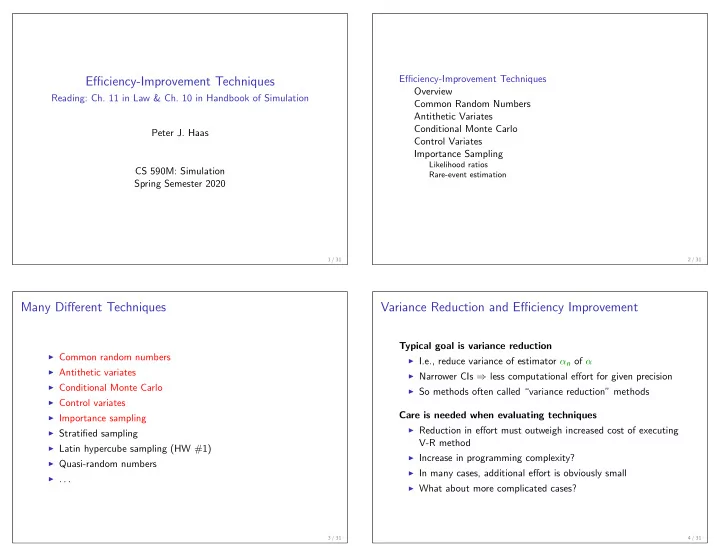
Reading: Ch. 11 in Law & Ch. 10 in Handbook of Simulation Peter J. Haas CS 590M: Simulation Spring Semester 2020

1 / 31

Efficiency-Improvement Techniques Overview Common Random Numbers Antithetic Variates Conditional Monte Carlo Control Variates Importance Sampling

Likelihood ratios Rare-event estimation

2 / 31

Many Different Techniques

◮ Common random numbers ◮ Antithetic variates ◮ Conditional Monte Carlo ◮ Control variates ◮ Importance sampling ◮ Stratified sampling ◮ Latin hypercube sampling (HW #1) ◮ Quasi-random numbers ◮ . . .

3 / 31

Variance Reduction and Efficiency Improvement

Typical goal is variance reduction

◮ I.e., reduce variance of estimator αn of α ◮ Narrower CIs ⇒ less computational effort for given precision ◮ So methods often called “variance reduction” methods

Care is needed when evaluating techniques

◮ Reduction in effort must outweigh increased cost of executing

V-R method

◮ Increase in programming complexity? ◮ In many cases, additional effort is obviously small ◮ What about more complicated cases?

4 / 31

slide-2
SLIDE 2

Comparing Efficiency-Improvement Schemes

Trading off statistical and computational efficiency

◮ Suppose α = E[X] = E[Y ] ◮ Should we generate i.i.d. replicates of X or Y to estimate α? ◮ Assume large but fixed computer budget c ◮ Let τX(i) be (random) time to generate Xi ◮ Assume that

  • X1, τX(1)
  • ,
  • X2, τX(2)
  • , . . . are i.i.d.

◮ Number of X-observations generated within budget c is

Nx(c) = max{n ≥ 0 : τX(1) + · · · + τX(n) ≤ c}

◮ So estimator based on budget is αX(c) = 1 NX (c)

NX (c)

i=1

Xi

5 / 31

Comparing Efficiency-Improvement Schemes, Continued

Hammersley-Handscomb Efficiency Measure

◮ Can show: limc→∞ N(c)/c = λX a.s., where λX = 1/E[τX] ◮ Hence

αX(c) − α = 1 NX(c)

NX (c)

  • i=1

Xi − α ≈ 1 ⌊λXc⌋

⌊λX c⌋

  • i=1

Xi − α

D

  • Var[X]

λXc N(0, 1) = 1 √c

  • E[τX] · Var[X] N(0, 1)

◮ Similarly,

αY (c) − α

D

∼ 1 √c

  • E[τY ] · Var[Y ] N(0, 1)

◮ Efficiency measure: 1 E[τY ]·Var[Y ] (holds fairly generally)

6 / 31

Efficiency-Improvement Techniques Overview Common Random Numbers Antithetic Variates Conditional Monte Carlo Control Variates Importance Sampling

Likelihood ratios Rare-event estimation

7 / 31

Common Random Numbers (CRN)

Applies when comparing alternate systems

◮ Intuition: Sharper comparisons if systems experience same

random fluctuations More precisely:

◮ Goal: Compare two perf. measures distributed as X and Y ◮ Estimate α = E[X] − E[Y ] = E[X − Y ] ◮ Generate i.i.d. pairs (X1, Y1), . . . , (Xn, Yn) ◮ Point estimate: αn = (1/n) n i=1(Xi − Yi)

Var[αn] = 1 nVar[X − Y ] = 1 n

  • Var[X] + Var[Y ] − 2 Cov[X, Y ]
  • ◮ So want Cov[X, Y ] > 0

◮ Note that Cov[X, Y ] = 0 if X and Y simulated independently 8 / 31

slide-3
SLIDE 3

CRN, Continued

Simple case: One random number per sample of X and of Y

◮ Use same random number: Xi = Xi(Ui) and Yi = Yi(Ui) ◮ If X(u), Y (u) both ↑ (or both ↓) in u, then Cov[X, Y ] > 0 ◮ True for inversion method: Xi = F −1 X (Ui) and Yi = F −1 Y (Ui)

In practice

◮ Sync random numbers between systems as much as possible ◮ Use multiple random number streams, one per event ◮ Jump-head facility of random number generator is crucial

9 / 31

CRN, Continued

Example: Long-run waiting times in two GI/G/1 queues

◮ Suppose that

◮ Interarrival times are i.i.d according to cdf G for both systems ◮ Service times are i.i.d. according to cdf Hi for queue i (i = 1, 2)

◮ Use one sequence (Uj : j ≥ 0) to generate a single stream of

interarrival times for use in both systems

◮ Use one sequence (Vj : j ≥ 0) to generate service times in

both systems: S1,j = H−1

1 (Vj) and S2,j = H−1 2 (Vj) for j ≥ 1 ◮ Note: Need two streams {Ui} and {Vi}

◮ Systems get out of sync with only one stream 10 / 31

Efficiency-Improvement Techniques Overview Common Random Numbers Antithetic Variates Conditional Monte Carlo Control Variates Importance Sampling

Likelihood ratios Rare-event estimation

11 / 31

Antithetic Variates

Applies when analyzing a single system

◮ Intuition: Combat “luck of the draw” by pairing each realized

scenario with its opposite More precisely:

◮ Goal: Estimate E[X] ◮ Generate X1, . . . , X2n and set αn = ¯

X2n

◮ Suppose pairs (X1, X2), (X3, X4), . . . , (X2n−1, X2n) are i.i.d.

(possible corr. within pairs)

Var[α2n] = 1 4n2

  • Var[X1] + · · · + Var[X2n] +

2 Cov[X1, X2] + · · · + 2 Cov[X2n−1, X2n]

  • ◮ So want Cov[X2j−1, X2j] < 0 for j ≥ 1

12 / 31

slide-4
SLIDE 4

Antithetic Variates, Continued

Simple case: One random number per sample of X and of Y

◮ Use same random number: Xi = Xi(Ui) and Yi = Yi(1 − Ui) ◮ If X(u), Y (u) both ↑ (or both ↓) in u, then Cov[X, Y ] < 0 ◮ E.g., inversion method: Xi = F −1 X (Ui) and Yi = F −1 Y (1 − Ui)

Ex: Avg. waiting time of first 100 cust. in GI/G/1 queue

◮ Interarrival times (service times) i.i.d according to cdf G (H) ◮ Replication 2k − 1: (Ij, Sj) =

  • G −1(Uj), H−1(Vj)
  • ◮ Replication 2k: (Ij, Sj) =
  • G −1(1 − Uj), H−1(1 − Vj)
  • Ex: Alternative method for GI/G/1 queue (Explain?)

◮ Replication 2k − 1: (Ij, Sj) =

  • G −1(Uj), H−1(Vj)
  • ◮ Replication 2k: (Ij, Sj) =
  • G −1(Vj), H−1(Uj)
  • Warning: CRN + AV together can backfire! [Law, p. 609]

13 / 31

Efficiency-Improvement Techniques Overview Common Random Numbers Antithetic Variates Conditional Monte Carlo Control Variates Importance Sampling

Likelihood ratios Rare-event estimation

14 / 31

Conditional Monte Carlo

Example: Markovian GSMP

  • X(t) : t ≥ 0
  • ◮ All events are simple w. exponential clock-setting dist’ns

◮ Simulation algorithm (up to nth state transition time Tn)

◮ Generate states S0, . . . , Sn−1

D

∼ DTMC w. transition matrix R

◮ Generate holding time in each Sk: Hk

D

∼ exp

  • λ(Sk)
  • ◮ Goal: Estimate α = E[Z] with

Z = Tn f

  • X(u)
  • du = n−1

k=0 f (Sk)Hk ◮ Variance reduction trick:

◮ Generate states S0, . . . , Sn−1 as above ◮ Set holding time in Sk = mean holding time = 1/λ(Sk)

◮ Q: Why does this work?

15 / 31

Conditional Monte Carlo, Continued

Law of total expectation E

  • E[U|V ]
  • = E[U]

Variance decomposition Var[U] = Var

  • E[U|V ]
  • + E
  • Var[U|V ]
  • ≥ Var
  • E[U|V ]
  • Key Idea

◮ Simulate V and compute ˜

U = E[U|V ]

◮ Then ˜

U has same mean as U but smaller variance

◮ So generate i.i.d replicates of ˜

U to estimate α = E[U] Markovian GSMP example revisited

◮ U = Z = n−1 k=0 f (Sk)Hk and V = (S0, . . . , Sn−1) ◮ So estimate E[ ˜

Z] from i.i.d replicates ˜ Z1, . . . , ˜ Zm, where

˜ Z = E[Z|S0, . . . , Sn−1] = n−1

k=0 f (Sk)E[Hk|Sk] = n−1 k=0 f (Sk) 1 λ(Sk)

16 / 31

slide-5
SLIDE 5

Efficiency-Improvement Techniques Overview Common Random Numbers Antithetic Variates Conditional Monte Carlo Control Variates Importance Sampling

Likelihood ratios Rare-event estimation

17 / 31

Control Variates

Intuition: Exploit extra system knowledge

◮ Goal: Estimate α = E[X] ◮ Suppose that there exists a random variable Y such that

◮ Y is strongly correlated with X ◮ E[Y ] can be computed analytically

◮ Control variable: C = Y − E[Y ] ◮ Controlled estimator: X(λ) = X − λC ◮ E[X(λ)] = ◮ v(λ) = Var[X(λ)] = Var[X] − 2λ Cov[X, C] + λ2 Var[C] ◮ v(λ) is minimized at λ∗ = ◮ Minimizing variance is v(λ∗) = (1 − ρ2) Var[X], where

ρ =

Cov[X,C]

Var[X]·Var[C]

= correlation coefficient of X and C

18 / 31

Control Variates, Continued

The method

  • 1. Simulate i.i.d. pairs (X1, C1), . . . , (Xn, Cn)
  • 2. Estimate λ∗ by

λ∗

n =

1 n − 1

n

  • i=1

(Xi − ¯ Xn)Ci 1 n

n

  • i=1

C 2

i

  • 3. Apply usual estimation techniques to Z1, . . . , Zn, where

Zi = Xi − λ∗Ci for 1 ≤ i ≤ n Ex: E[avg delay] for first n customers in GI/G/1 queue

◮ Xi = average delay in ith replication ◮ Vi,k = kth service time in i replication, with E[Vi,k] = 5 ◮ Take Ci = (1/n) n k=1 Vi,k − 5 ◮ Q: Why is this a good choice?

19 / 31

Control Variates, Continued

Internal and External Controls

◮ Ci in queueing example is an internal control, generated

internally to the simulation

◮ Example of an external control:

◮ Simplify original simulation model M to a version M′ where

performance measure α′ can be computed analytically

◮ Generate replications of M and M′ using common random

numbers to obtain (X1, X ′

1), . . . , (Xn, X ′ n)

◮ Take Ci = X ′

i − α′

Multiple controls

◮ X(λ1, . . . , λm) = X − λ1C (1) − · · · − λmC (m) ◮ Can compute (λ∗ 1, . . . , λ∗ m) by solving linear syst. of equations ◮ Essentially, we fit a linear regression model and simulate the

leftover uncertainty (i.e., the residuals)

20 / 31

slide-6
SLIDE 6

Efficiency-Improvement Techniques Overview Common Random Numbers Antithetic Variates Conditional Monte Carlo Control Variates Importance Sampling

Likelihood ratios Rare-event estimation

21 / 31

Importance Sampling

Likelihood ratios for i.i.d. random variables

◮ Goal: Estimate α = E[gn(X0, X1, . . . , Xn)] ◮ X0, . . . , Xn are i.i.d. replicates of X with pmf p(s) = P(X = s) ◮ Let Y be another RV with pmf q(s) = P(Y = s) ◮ Suppose that Y is “easier” to simulate than X ◮ We will estimate α by simulating Y and then “correcting”

Likelihood ratio for i.i.d. random variables

Ln = n

i=0 p(Yi)

n

i=0 q(Yi)

(rel. likelihood of seeing Y under p vs under q)

◮ To avoid blowups, define 0/0 = 0 and assume that

q(x) = 0 ⇒ p(x) = 0 (“absolute continuity”)

22 / 31

Importance Sampling, Continued

Likelihood-ratio identity for i.i.d. random variables

E[gn(Y0, Y1, . . . , Yn)Ln] = E[gn(X0, X1, . . . , Xn)] Proof

E[gn(Y0, . . . , Yn)Ln] =

  • s0∈S

· · ·

  • sn∈S

gn(s0, . . . , sn) n

i=0 p(si)

n

i=0 q(si)

  • P(Y0 = s0, . . . , Yn = sn)

=

  • s0∈S

· · ·

  • sn∈S

gn(s0, . . . , sn) n

i=0 p(si)

n

i=0 q(si)

  • n
  • i=0

q(si) =

  • s0∈S

· · ·

  • sn∈S

gn(s0, . . . , sn)

n

  • i=0

p(si) = E[gn(X0, . . . , Xn)]

23 / 31

Importance Sampling, Continued

General guidance for choosing q

◮ Somewhat of an art (depends on details of model) ◮ But if gn(s0, . . . , sn) = n i=0 g(si) for some g ≥ 0 and we take

q(s) = g(s)p(s)/α, then gn(Y0, . . . , Yn)Ln ≡ α and var = 0

◮ Can’t actually choose q as above (since α is unknown) but

can guide choice

◮ q(s) is large if s is “important”, i.e., g(s) and/or p(s) is large

Implementation

◮ Set L = 1 initially & update whenever new Yi is generated:

L ← L × p(Yi) q(Yi) for i ≥ 1

24 / 31

slide-7
SLIDE 7

Importance Sampling, Continued

Importance sampling for DTMCs

◮ Goal: Estimate E[gn(X0, . . . , Xn)] where M = (Xi : i ≥ 0) is a

DTMC with initial dist’n µ and transition matrix P

◮ Simulate DTMC ˜

M = (Yi : i ≥ 0) w. building blocks ˜ µ and ˜ P

Ln = µ(Y0) n

i=1 P(Yi−1, Yi)

˜ µ(Y0) n

i=1 ˜

P(Yi−1, Yi)

◮ Assume absolute continuity: if initial state or a jump has zero

probability in ˜ M, it has zero probability in M

◮ Can be computed incrementally: set L = 1 and then

L ← L × µ(Y0) ˜ µ(Y0) and L ← L × P(Yi−1, Yi) ˜ P(Yi−1, Yi) for i ≥ 1

◮ Can generalize to E[gN(X0, . . . , XN)] where N is random

25 / 31

Importance Sampling, Continued

Importance sampling for GSMPs

◮ Goal: Estimate E[gt(X(u) : 0 ≤ u ≤ t)] where

G =

  • X(t) : t ≥ 0
  • is a GSMP with bldg blocks ν, F0, p, F

◮ Simulate GSMP ˜

G = ˜ X(t) : t ≥ 0

  • with building blocks ˜

ν, ˜ F0, ˜ p, ˜ F (all other building blocks, e.g., S and E(s), the same)

◮ Assume that cdfs F0, F, ˜

F0, ˜ F have pdf’s f0, f , ˜ f0, ˜ f

◮ Assume absolute continuity: if jump or clock reading has zero

  • prob. in ˜

G, it has zero prob. in G

26 / 31

Importance Sampling, Continued

Simulation algorithm for GSMPs: as usual except

◮ Set L = 1 initially ◮ After generating initial state ˜

S0, set L ← L × ν( ˜

S0) ˜ ν( ˜ S0) ◮ After generating ˜

C0,i for ei, set L ← L × f0( ˜

C0,i;ei, ˜ S0) ˜ f0( ˜ C0,i;ei, ˜ S0) ◮ After generating ˜

Cn,i for ei, set L ← L × f ( ˜

Cn,i; ˜ Sn,ei, ˜ Sn−1,e∗

n )

˜ f ( ˜ Cn,i; ˜ Sn,ei, ˜ Sn−1,e∗

n )

◮ After generating a jump ˜

Sn−1 → ˜ Sn, set L ← L × p( ˜

Sn; ˜ Sn−1,e∗

n )

˜ p( ˜ Sn; ˜ Sn−1,e∗

n ) 27 / 31

Efficiency-Improvement Techniques Overview Common Random Numbers Antithetic Variates Conditional Monte Carlo Control Variates Importance Sampling

Likelihood ratios Rare-event estimation

28 / 31

slide-8
SLIDE 8

Application to Rare-Event Estimation

Example: DTMC model of machine reliability

◮ State space of (Xn : n ≥ 0): S = {0, 1, 2, 3}

◮ Xn = 0: machine fully operational at nth inspection ◮ Xn = 1 or 2: machine operational but degraded ◮ Xn = 3: machine has failed

◮ ν(0) ∆

= P(X0 = 0) = 1

P =     1 2 3 1 1

µ λ+µ λ λ+µ

2

µ λ+µ λ λ+µ

3 1    

◮ µ ≫ λ, so failures take a long time to occur

29 / 31

Rare-Event Estimation, Continued

◮ Set N = min{n > 0 : Xn = 3} (time to failure) ◮ Goal: Estimate α = P(N ≤ j) = E[I(N ≤ j)] with j small ◮ Challenge: Event A = {N ≤ j} is very rare ◮ Can write α = E[gj(X0, . . . , Xj)], where

gj(x0, . . . , xj) =

  • 1

if xi = 3 for some 0 ≤ i ≤ j;

  • therwise

◮ Use importance sampling with λ = µ ◮ I.e., simulate DTMC ( ˜

Xn : n ≥ 0) with

˜ P =     1 2 3 1 1 0.5 0.5 2 0.5 0.5 3 1     and ˜ ν = ν

30 / 31

Rare-Event Estimation, Continued

Rare-Event Estimation Algorithm for Machine Reliability

  • 1. Choose sample size n
  • 2. Simulate ( ˜

Xn : n ≥ 0) up to time T = min(j, N)

  • 3. Compute W = I(N ≤ j)

T

i=1 P( ˜

Xi−1, ˜ Xi) T

i=1 ˜

P( ˜ Xi−1, ˜ Xi)

  • 4. Repeat Steps 2–3 n times, independently, to produce i.i.d.

replicates W1, . . . , Wn

  • 5. Compute point estimates and confidence intervals as usual

Extensions of basic method include dynamic importance sampling

31 / 31