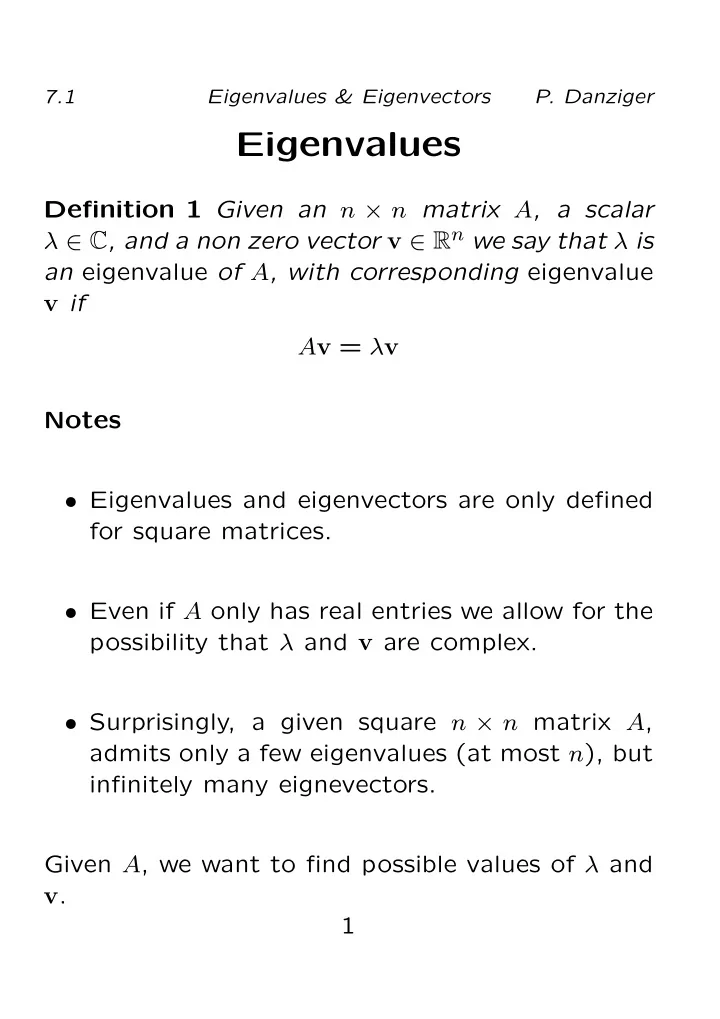
Eigenvalues Definition 1 Given an n n matrix A , a scalar C , and - - PDF document

eigenvalues
SMART_READER_LITE
LIVE PREVIEW

Eigenvalues Definition 1 Given an n n matrix A , a scalar C , and - - PDF document

7.1 Eigenvalues & Eigenvectors P. Danziger Eigenvalues Definition 1 Given an n n matrix A , a scalar C , and a non zero vector v R n we say that is an eigenvalue of A , with corresponding eigenvalue v if A v = v Notes


slide-1
SLIDE 1

7.1 Eigenvalues & Eigenvectors

  • P. Danziger

Eigenvalues

Definition 1 Given an n × n matrix A, a scalar λ ∈ C, and a non zero vector v ∈ Rn we say that λ is an eigenvalue of A, with corresponding eigenvalue

v if

Av = λv Notes

  • Eigenvalues and eigenvectors are only defined

for square matrices.

  • Even if A only has real entries we allow for the

possibility that λ and v are complex.

  • Surprisingly, a given square n × n matrix A,

admits only a few eigenvalues (at most n), but infinitely many eignevectors. Given A, we want to find possible values of λ and

v.

1

slide-2
SLIDE 2

7.1 Eigenvalues & Eigenvectors

  • P. Danziger

Example 2 1.

  • 2

1 1 1

  • =
  • 2
  • = 2
  • 1
  • So 2 is an eigenvalue of
  • 2

1 1

  • with corre-

sponding eigenvector

  • 1
  • .
  • 2. Is u = (1, 0, 1) an eigenvector for

A =

  

2 1 −1 −1 2 1 1

  ?

Au =

  

2 1 −1 −1 2 1 1

     

1 1

   =   

1 2 1

  

(1, 0, 1) = λ(1, 2, 1) has no solution for λ, so (1, 0, 1) is not an eigenvector of A.

Eigenspaces

2

slide-3
SLIDE 3

7.1 Eigenvalues & Eigenvectors

  • P. Danziger

Theorem 3 If v is an eigenvector, corresponding to the eigenvalue λ0 then cu is also an eigenvector corresponding to the eigenvalue λ0. If v1 and v2 are an eigenvectors, both correspond- ing to the eigenvalue λ0, then v1 + v2 is also an eigenvector corresponding to the eigenvalue λ0. Proof: A(cv) = cAv = cλ0v = λ0(cv) A (v1 + v2) = Av1+Av2 = λ0v1+λ0v2 = λ0 (v1 + v2) Corollary 4 The set of vectors corresponding to an eigenvalue λ0 of an n × n matrix is a subspace

  • f Rn.

Thus when we are asked to find the eigenvectors corresponding to a given eigenvalue we are being asked to find a subspace of Rn. Generally, we describe such a space by giving a basis for it. 3

slide-4
SLIDE 4

7.1 Eigenvalues & Eigenvectors

  • P. Danziger

Definition 5 Given an n×n square matrix A, with an eigenvalue λ0, the set of eigenvectors corre- sponding to λ0 is called the Eigenspace corre- sponding to λ. Eλ0 = {v ∈ Rn | Av = λ0v} The dimension of the eigenspace corresponding to λ, dim(Eλ0), is called the Geometric Multiplicity of the Eigenvalue λ0 4

slide-5
SLIDE 5

7.1 Eigenvalues & Eigenvectors

  • P. Danziger

Characteristic Polynomials

Given square matrix A we wish to find possible eigenvalues of A. Av = λv ⇒ = λv − Av ⇒ = λIv − Av ⇒ = (λI − A)v This homogeneous system will have non trivial so- lutions if and only if det(λI − A) = 0. Example 6 Find all eigenvalues of A =

  • 1

1 1 1

  • det(λI − A)

= det

  • λ
  • 1

1

  • 1

1 1 1

  • =
  • λ − 1

−1 −1 λ − 1

  • =

(λ − 1)2 − 1 = λ2 − 2λ = λ(λ − 2) 5

slide-6
SLIDE 6

7.1 Eigenvalues & Eigenvectors

  • P. Danziger

So det(λI − A) = 0 if and only if λ = 0 or 2. Definition 7 Given an n × n square matrix A, det(λI − A) is a polynomial in λ of degree n. This polynomial is called the characteristic polynomial

  • f A, denoted pA(λ).

The equation pA(λ) = 0 is called the characteristic equation of A. Example 8 Find the characteristic polynomial and the charac- teristic equation of the matrix A =

  

1 2 1 2 −1 1

  

pA(λ) = det(λI − A) =

  • λ − 1

−2 −1 λ − 2 1 λ − 1

  • =

(λ − 1)(λ − 2)(λ − 1) = (λ − 1)2(λ − 2) 6

slide-7
SLIDE 7

7.1 Eigenvalues & Eigenvectors

  • P. Danziger

If A is an n × n matrix, pA(λ) will be a degree n polynomial. By the Fundamental Theorem of Algebra, a degree n polynomial has n roots over the complex numbers. Note that some of these roots may be equal. Given an n×n square matrix A, with distinct eigen- values λ1, λ2, . . . , λk, then pA(λ) = (λ − λ1)r1(λ − λ2)r2 . . . (λ − λk)rk for some positive integers r1, r2, . . . , rk. Definition 9 For a given i the positive integer ri is called the algebraic multiplicity of the eigenvalue λi. Theorem 10 For a given square matrix the geo- metric multiplicity of any eigenvalue is always less than or equal to the algebraic multiplicity. 7

slide-8
SLIDE 8

7.1 Eigenvalues & Eigenvectors

  • P. Danziger

Example 11 Find the distinct eigenvalues of A above and give the algebaraic multiplicity in each case. pA(λ) = (λ − 1)2(λ − 2) So the distinct eigenvalues of A are λ = 1 and λ = 2. The algebraic multiplicity of λ = 1 is 2. The algebraic multiplicity of λ = 2 is 1. 8

slide-9
SLIDE 9

7.1 Eigenvalues & Eigenvectors

  • P. Danziger

Finding Egenvalues & Eigenspaces

Note if we are asked to find eigenvectors of a ma- trix A, we are actually being asked to find eigenspaces. Given an n × n matrix A we may find the Eigen- values and Eigenspaces of A as follows:

  • 1. Find the characteristic polynomial

pA(λ) = |λI − A|.

  • 2. Find the roots of pA(λ) = 0, λ1, . . . , . . . λk,

n roots with possible repetition. pA(λ) = (λ − λ1)r1(λ − λ2)r2 . . . (λ − λk)rk

  • 3. For each distinct eigenvalue λi in turn solve

the homogeneous system (λiI − A)x = 0 The solution set is Eλi. 9

slide-10
SLIDE 10

7.1 Eigenvalues & Eigenvectors

  • P. Danziger

Example 12

  • 1. Find all eigenvalues and eigenvectors of

A =

  • 1

1 1 1

  • pA(λ) = |λI − A| =
  • λ − 1

−1 −1 λ − 1

  • = λ(λ − 2)

Solutions are λ = 0 or 2. λ = 0 Solving −Ax = 0.

  • −1

−1 −1 −1

  • R2 → R2 − R1
  • −1

−1

  • Let t ∈ R, x2 = t, x1 = −t, so

E0 = {t(−1, 1) | t ∈ R}. λ = 2 Solving (2I − A)x = 0.

  • 1

−1 −1 1

  • R2 → R2 + R1
  • 1

−1

  • Let t ∈ R, x2 = t, x1 = t, so

E2 = {t(1, 1) | t ∈ R}. In both cases Algebraic Multiplicity = Geomet- ric Multiplicity = 1 10

slide-11
SLIDE 11

7.1 Eigenvalues & Eigenvectors

  • P. Danziger
  • 2. Find all eigenvalues and eigenvectors of

A =

  

1 2 1 2 −1 1

  

We proved earlier that pA(λ) = (λ − 1)2(λ − 2) So eigenvalues are λ = 1 and λ = 2. λ = 1 has algebraic multiplicity 2, while λ = 2 has algebraic multiplicity 1. λ = 1 Solving (I − A)x = 0.

  

1 1 1

  

  

1 2 1 2 −1 1

  

=

  

−2 −1 −1 1

  

  

1 −1 1

  

Let t ∈ R, set x1 = t and x3 = 0, x2 = 0. E1 = {t(1, 0, 0) | t ∈ R} geometric mutiplicity = 1 = algebraic multi- plicity. 11

slide-12
SLIDE 12

7.1 Eigenvalues & Eigenvectors

  • P. Danziger

λ = 2 Solving (2I − A)x = 0.

  

2 2 2

  

  

1 2 1 2 −1 1

  

=

  

1 −2 −1 1 1

  

R3 → R3 − R2

  

1 −2 −1 1

  

Let t ∈ R, set x2 = t and x3 = 0, x1 = 2t. E2 = {t(2, 1, 0) | t ∈ R} Theorem 13 If A is a square triangular matrix, then the eigenvalues of A are the diagonal entries

  • f A

Theorem 14 A square matrix A is invertible if and

  • nly if λ = 0 is not an eigenvalue of A.

12

slide-13
SLIDE 13

7.1 Eigenvalues & Eigenvectors

  • P. Danziger

Theorem 15 Given a square matrix A, with an eigenvalue λ0 and correspoonding eigenvector v, then for any positive integer k, λk

0 is an eigenvalue

  • f Ak and Akv = λk

0v.

Theorem 16 If λ1, . . . , λk are distinct eigenvalues

  • f a matrix, and v1, . . . , vk are corresponding eigen-

vectors respectively, then the are linearly indepen- dent. i.e. Eigenvectors corresponding to distinct eigenvalues are linearly independent. Corollary 17 If A is an n × n matrix, A has n lin- early independent eigenvectors if and only if the algebraic multiplicity = geometric multiplicity for each distinct eigenvalue. 13