Elected Member Briefing 13 February Notes Time and date: 13 - - PDF document

elected member briefing 13 february notes
SMART_READER_LITE
LIVE PREVIEW

Elected Member Briefing 13 February Notes Time and date: 13 - - PDF document

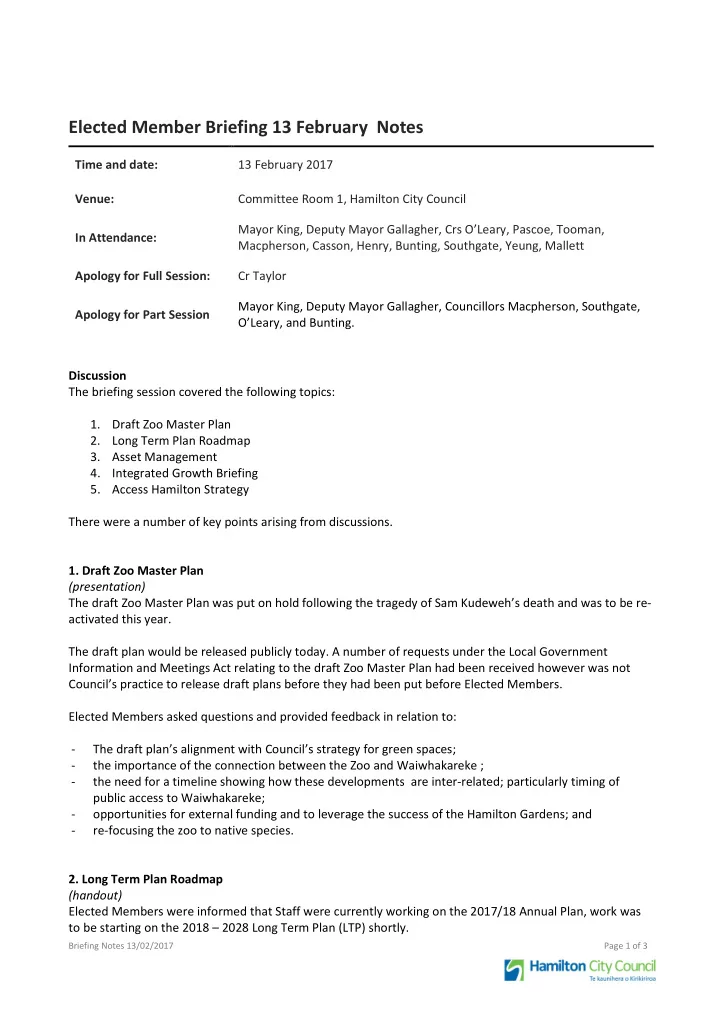
Elected Member Briefing 13 February Notes Time and date: 13 February 2017 Venue: Committee Room 1, Hamilton City Council Mayor King, Deputy Mayor Gallagher, Crs OLeary, Pascoe, Tooman, In Attendance: Macpherson, Casson, Henry, Bunting,


slide-1
SLIDE 1

Elected Member Briefing 13 February Notes

Time and date: 13 February 2017 Venue: Committee Room 1, Hamilton City Council In Attendance: Mayor King, Deputy Mayor Gallagher, Crs O’Leary, Pascoe, Tooman, Macpherson, Casson, Henry, Bunting, Southgate, Yeung, Mallett Apology for Full Session: Cr Taylor Apology for Part Session Mayor King, Deputy Mayor Gallagher, Councillors Macpherson, Southgate, O’Leary, and Bunting. Discussion The briefing session covered the following topics: 1. Draft Zoo Master Plan 2. Long Term Plan Roadmap 3. Asset Management 4. Integrated Growth Briefing 5. Access Hamilton Strategy There were a number of key points arising from discussions.

  • 1. Draft Zoo Master Plan

(presentation) The draft Zoo Master Plan was put on hold following the tragedy of Sam Kudeweh’s death and was to be re- activated this year. The draft plan would be released publicly today. A number of requests under the Local Government Information and Meetings Act relating to the draft Zoo Master Plan had been received however was not Council’s practice to release draft plans before they had been put before Elected Members. Elected Members asked questions and provided feedback in relation to:

  • The draft plan’s alignment with Council’s strategy for green spaces;
  • the importance of the connection between the Zoo and Waiwhakareke ;
  • the need for a timeline showing how these developments are inter-related; particularly timing of

public access to Waiwhakareke;

  • pportunities for external funding and to leverage the success of the Hamilton Gardens; and
  • re-focusing the zoo to native species.
  • 2. Long Term Plan Roadmap

(handout) Elected Members were informed that Staff were currently working on the 2017/18 Annual Plan, work was to be starting on the 2018 – 2028 Long Term Plan (LTP) shortly.

Briefing Notes 13/02/2017 Page 1 of 3

slide-2
SLIDE 2

Initial conversations with Elected Members would cover critical considerations such as the components of the financial strategy and revenue options available to Council, Hamilton’s growth mix, levels of service, and asset management plans. The cost of the programme of work for the LTP would come to Council through the Annual Plan.

  • 3. Asset Management Update

(presentation) Staff gave a general presentation on Council’s approach to asset management as a platform for further discussions through the Long Term Plan process. Elected Members’ strategic contribution to this function was outlined and an overview of key was provided. These considerations included:

  • Council’s financial strategy;
  • Setting levels of service and performance measures;
  • Addressing growth;
  • Decisions on plans and strategies; and
  • Understanding the risks and consequences of decisions.

Staff reported briefly on the role of external audits and quality assurance processes in tge asset management process and the competence of those agencies and experts involved.

  • 4. Integrated Growth Briefing

(presentation and handout) Staff presented on important considerations for Elected Members in relation to Council’s response to the city’s growth. Key discussion points included: Growth demands:

  • The opportunities and impacts of debt and borrowing to invest in growth;
  • NPS targets, Hamilton’s growth needs, and opportunities to encourage competition amongst

developers; and

  • Council’s draft Housing Infrastructure Fund proposal

Futureproof, in particular:

  • Council’s desire to ensure flexibility around the timing and conditions for bringing land outside

Hamilton’s boundaries into the city; and

  • recognising that Hamilton’s communities of interest do not necessarily reside solely within the city’s

boundaries. Strategic Infrastructure, noting:

  • land supply, the work and investment underway on Integrated Catchment Management Plans (ICMPs),

transport and waste water for the Rototuna, Rotokauri, Peacocke, and Ruakura growth cells; and

  • increasing compliance standards and community expectations related to managing the effects of

urbanisation.

Briefing Notes 13/02/2017 Page 2 of 3

slide-3
SLIDE 3

6. Access Hamilton Strategy (handouts) The General Manager City Infrastructure led Elected Members through short brainstorming session to gather their views on current and future challenges for transport and access for the city. Staff will take Elected Members’ feedback to the Access Hamilton Taskforce which is charged with reviewing the Access Hamilton Strategy. Staff aim to have the Access Hamilton Taskforce signed off as a strategic business case (utilising Government’s Better Business Case and New Zealand Transport Association processes as best practice).

Briefing Notes 13/02/2017 Page 3 of 3

slide-4
SLIDE 4

Draft Hamilton Zoo Master Plan

 Council briefing

slide-5
SLIDE 5
  • Zoos, wildlife parks and aquariums care for wild animals so

that people can have memorable experiences with wildlife.

  • Good zoos focus on Animal Welfare, Conservation,

Education, Recreation and Research.

What is a Zoo?

slide-6
SLIDE 6
  • 21 hectares of landscaped grounds with another 7

hectares available for future use.

  • More than 600 exotic and native New Zealand

animals.

What we do

 We are a recreational resource for Hamilton, working to conserve wildlife.

slide-7
SLIDE 7
  • Over 120,000 people visit the Zoo each year (nearly

130,000 in 2015/16)

  • 40% are Hamilton City residents and less than 10%

are international tourists.

What we do

 We are a recreational resource for Hamilton, working to conserve wildlife.

slide-8
SLIDE 8

Why we do it

 The wild isn’t safe for wild life anymore, we make a difference

slide-9
SLIDE 9
  • $4.25 million, based on 2016/17 budget.

($4.75 million in 2017/18)

  • Offset by revenue of approx. $1.65 million,

primarily through Zoo admissions.

  • 62% of the Zoo’s annual operating cost this

year will be funded by rates.

How much do we cost?

 …and how are we funded?

slide-10
SLIDE 10
  • Hamilton Zoo Development Plan: approved by Council in December 2008

but never funded.

  • Strong links with Waiwhakareke Natural Heritage Park (WNHP) identified

in both the Business Plan (2008) and Reserves Act Management Plan for the Park, adopted by Council in August 2011.

Draft Zoo Master Plan

 The journey to date

Boundaries indicative only

slide-11
SLIDE 11

– Elected members: Cr O’Leary (Chair), Mayor Hardaker, Crs Gallagher, Yeung and Pascoe. – External members: Bruce Clarkson (University of Waikato, Chair WNHP), Karen Fifield MNZM (CEO Wellington Zoo, ZAA President), Kiri Goulter (CEO HWT). – Staff: Sean Murray, Stephen Standley, Jeremy Froger (Parks & Open Spaces), Jennie Lavis (executive support), Gareth Cartwright (Strategic Policy Analyst – Environment). – Studio Hanson Roberts: Becca Hanson, David Roberts, Lindsey Gadbois. (contracted Seattle based international zoo architects)

Hamilton Zoo Working Group

 Established by Council in July 2014

slide-12
SLIDE 12
  • Produce a plan that sets Council and community

expectations, future direction and development goals for Hamilton Zoo.

  • Incorporate current and ongoing management activities

within the Zoo, including how it interacts with the WNHP.

  • Cover future developments within the Zoo for the next 30

years.

  • Shape a physical master plan.

Working Group Purpose

slide-13
SLIDE 13
  • Vision: All people value wildlife.
  • Purpose: Creating unique experiences that inspire people to love and

protect wildlife.

  • Outcomes

Care – our animals have quality care. Animal Welfare Fun – people have fun and feel connected with wildlife. Visitor Experience Inspire – people are inspired to value wildlife. Education Protect – people take action to protect their local wildlife. Conservation Successful – Premier tourist attraction for the region. Financial Sustainability

Draft Plan strategic objectives

slide-14
SLIDE 14
slide-15
SLIDE 15

Concept image

slide-16
SLIDE 16

Concept image

slide-17
SLIDE 17

Concept image

slide-18
SLIDE 18

Concept image

slide-19
SLIDE 19

Concept image

slide-20
SLIDE 20
  • Sets the strategic direction for the Zoo.
  • Formal endorsement for the strategic direction of

Hamilton Zoo is recommended before the development of the 2018-28 10 Year Plan.

Why do we need a plan?

slide-21
SLIDE 21

Options:

  • 1. Progress the Draft Hamilton Zoo Master Plan for

consideration at Community and Services Committee.

  • 2. Establish Taskforce Group to review / revisit direction of the

Master Plan.

a) Tweak the draft plan, or b) Relook at the whole strategic direction

  • 3. Do nothing.

Next steps

slide-22
SLIDE 22

Questions?

slide-23
SLIDE 23

Asset Management

 Council Update

13 February 2017

slide-24
SLIDE 24

Purpose of update

  • Asset management concepts and structure
  • Overview of elected member and staff roles
  • Asset management in the context of 10-YP

development

  • Maturity: Where we've come from and

future targets

  • Improvement focus
slide-25
SLIDE 25

Some necessary words

Asset Service

Level of service

Activity Activity Management Plan Asset Management Plan

Groups of activities

slide-26
SLIDE 26

What is Asset Management?

Service levels Risk Demand

Forecasted to provide

Financial Forecasts for budget prioritisation Asset data / information

Affordability – Financial Strategy

slide-27
SLIDE 27

Life cycle approach

CREATE MAINTAIN OPERATE RENEW

EFFECTIVE LIFE

COST

REPEAT CYCLE

slide-28
SLIDE 28

Strategic Tactical Operational

What’s and Who’s involved

Government, Community, Elected members, Management Management, asset managers Operational staff, Asset managers Strategies and Plans 10-Year Plan and Long-Term Infrastructure Strategy Asset Management Plans Asset data Operational / maintenance plans etc E X T E R N A L A U D I T O R S

slide-29
SLIDE 29

AM – how we do it

Strategic Tactical Operational

Baseline AMP Prioritisation and trade off:

  • levels of service
  • risk
  • cost

Budget confirmation and final AMP Confirm and plan AM programme

  • f work

Prepare detailed schedule of action (e.g.

maintenance shedules, project plans)

Undertake works

(e.g. condition assessments, maintenance works, construction)

slide-30
SLIDE 30

 Decision making based on:

– the overall benefit of the city – meeting the current and future needs – Delivering good-quality local infrastructure and local public services, in a way that is most cost-effective for households and businesses

 Accountable to community and ratepayers for exercising good stewardship over substantial assets

Role of Elected members

slide-31
SLIDE 31

So what is an AMP?

slide-32
SLIDE 32

AM structure

slide-33
SLIDE 33

AM structure

slide-34
SLIDE 34
slide-35
SLIDE 35

Our recent organisational investments

slide-36
SLIDE 36
slide-37
SLIDE 37
  • Establishing the CoE approach to asset management
  • Scoping and implementing asset data / information

improvements

  • Streamlining capitalisation of new assets
  • Improving completeness / robustness of AMPs and

Infrastructure strategy

  • Improving information and systems for capital works

planning

  • Strengthening internal relationships and processes

Our improvement programme focus areas

slide-38
SLIDE 38
  • Overview of assets

Finance committee – 28 Feb 17

  • Baseline AMPs

mid-2017 updates

Next steps

slide-39
SLIDE 39

Growth Briefing

13 February 2017

slide-40
SLIDE 40
  • Geographic location
  • Availability of land relative to other growth centres
  • Affordability of land relative to other growth centres
  • Strong, diversified economy
  • Competitive wage rates relative to major centres for both

employees and employers

  • Younger, highly qualified, workforce
  • To maintain these advantages Council must open new growth

cells which will require a significant strategic financial investment

Hamilton competitive advantage

slide-41
SLIDE 41

Growth over time

General Residential Industrial/ Commercial Infrastructure

1980 2010 2000 1990 2016 Rototuna The Base Centre Place Ring Road Pukete Bridge Flagstaff Pukete WW Plant Fairview Downs Western Heights Chinaman Hill Reservoir K Mart Popn: 113,500 Popn: 94,811 Popn: 145,600 Lake Walkway Pukete WW 2 Rototuna Water Treatment Upgrade Chartwell Square CentrePlace Hospital Development Claudelands Downtown Plaza Popn: 161,200 Council Building & Car Park Southern Links Designation Rototuna Reservoir Popn: 134,800 Peacocke Stg 1 Ruakura Rotokauri Stg 1

slide-42
SLIDE 42
  • Hamilton grown significantly since 1980s, majority of growth since 2000
  • Accelerating since 2015.
  • 2008 - Council determined growth to occur on a number of city wide

fronts

  • 2010 - Financial Strategy meant infrastructure implementation has been

“just in time” or funds bought forward from within LTP to meet growth.

  • The increasing rate of growth and introduction of the NPS necessitates

the opening and funding of new growth cells is sooner than expected.

  • To maintain Hamilton’s competitive advantages Council need to invest

significantly to bring forward capacity for development.

Key messages

slide-43
SLIDE 43

Key messages

slide-44
SLIDE 44

What has Changed?

  • Changes to Legislation
  • National Policy Statement on Urban Development Capacity

(NPS-UDC)

  • Special Housing Areas/ Accord
  • New Growth Projections
  • Faster rate means growth cells come forward in LTP
  • Auckland Halo Effect
  • Housing Affordability
  • Compliance – eg Healthy Rivers
  • Housing Infrastructure fund
slide-45
SLIDE 45
  • Economy driven by external factors eg

– access and cost of financing, – Migration-fueled population growth

  • Changing household composition preferences
  • Auckland housing affordability and its halo effect duration
  • Debt to income levels - LGA Financial limits
  • Limited construction capacity – materials and skills
  • Increase in the cost of Growth
  • Ability to fund growth AND amenity aspects with same

revenue streams

Challenges

slide-46
SLIDE 46

External Influencing Factors

Our strategic approach to growth (2008)

  • Inflation and interest rates
  • High net migration numbers -returning Kiwis and new migrants
  • Increasing cost of growth relative to revenue
  • Materials, labour, skills shortage
  • Asset market and returns of NZ housing compared to other

markets

  • Inexpensive finance but access harder due to national debt

levels on housing

slide-47
SLIDE 47

Resource Consents

Our strategic approach to growth (2008)

slide-48
SLIDE 48

Freehold sections (224c)

Our strategic approach to growth (2008)

slide-49
SLIDE 49

Building consents

Our strategic approach to growth (2008)

slide-50
SLIDE 50

Building consents

Our strategic approach to growth (2008)

slide-51
SLIDE 51

Composition of Certified Code Compliant

Our strategic approach to growth (2008)

slide-52
SLIDE 52

Affordable Housing

slide-53
SLIDE 53

Affordable Housing

slide-54
SLIDE 54

Affordable Housing

slide-55
SLIDE 55

Growth projections

slide-56
SLIDE 56

Growth projections

slide-57
SLIDE 57

 What is required?

  • The NPS requires HCC to provide an additional margin of feasible

development capacity over and above projected demand of at least 20%.

  • Council needs to provide feasible, zoned and serviced capacity with

development infrastructure in the short (3 years) and medium term (3-10 years).

  • The Hamilton Housing Accord has consent targets for building

consents and subdivisions of

  • 1,300 dwellings and lots in 2017
  • 1,400 dwellings and lots in 2018
  • 1,500 dwellings and lots in 2019
slide-58
SLIDE 58

 How do we respond?

  • HUGS
  • Housing Infrastructure Fund application
  • Housing Accord and Special Housing Areas
  • Strategic Infrastructure
  • Long Term Plan/30 year infrastructure strategy
  • Financial strategy
  • To be discussed in separate presentation today
  • Future Proof update
  • Future District Plan changes?
slide-59
SLIDE 59
  • HUGS sequencing
  • Medium and High

Growth scenarios

  • Demand and Supply

HUGS settlement pattern - the 30 year settlement pattern for the City

HUGS Settlement pattern

slide-60
SLIDE 60

HUGS Settlement pattern

slide-61
SLIDE 61

NIDEA Low Decade 1: 2015- 2025 (Existing cells – Rototuna, Rotokauri, Peacocke 1, Ruakura) Decades 2 and 3 : 2026-2045 (Residual of existing cells, plus Peacocke 2)

Greenfield Demand and Supply

slide-62
SLIDE 62

NIDEA Medium Decade 1: 2016- 2025 (Existing cells – Rototuna, Rotokauri, Peacocke 1, Ruakura) Decade 2: 2026-2035 (Residual of existing cells, plus Peacocke 2) Decade 3: 2036-2045 (Rotokauri 2) Under a high, sustained growth scenario, a further growth cell would be needed during the third decade.

Greenfield Demand and Supply

slide-63
SLIDE 63

Growth Cell Capacity Sections Consented but untitled

Rototuna 3587 799 Peacocke 8500 252 Rotokauri 5690 199 Ruakura 2200 58

Capacity Map

slide-64
SLIDE 64

Housing Infrastructure Fund

  • The Housing Infrastructure Fund (HIF) is a $1 billion government

fund available to advance infrastructure projects important to increasing housing supply

  • HCC’s indicative application was for $240m to advance Peacocke

and Rotokauri

  • Final proposals close on 31 March 2017 and decisions be end of

June 2017

slide-65
SLIDE 65
  • This is no free lunch
  • The HIF allocation (even without interest) will impact significantly
  • n our current financial strategy, debt to income limits.
  • The HIF allocation may impact Council’s current Financial Strategy

and Councils ability to fund other projects

  • Staff are working urgently on this with Auckland and Tauranga

councils and MBIE.

  • Before the final HIF proposal is submitted to MBIE, staff will

report on the full financial implications of the HIF proposal.

HIF - Key messages

slide-66
SLIDE 66

Housing Accord and Special Housing Areas

  • Hamilton’s Housing Accord was signed on 22 December 2016
  • The Hamilton Housing Accord has consent targets for

building consents and subdivisions of

  • 1,300 dwellings and lots in 2017
  • 1,400 dwellings and lots in 2018
  • 1,500 dwellings and lots in 2019
  • A Special Housing Area (SHA) Policy will be drafted and

brought to Council - will contain criteria for identifying and selecting future SHA candidate sites.

slide-67
SLIDE 67

National Policy Statement Urban Development Capacity

  • Legislative (RMA) requirement that local authorities ensure

there is:

  • Sufficient land with feasible development capacity for

housing and business land to meet projected demand

  • ver the short, medium and long term (3, 10, and 30

years)

  • The NPS requires us to plan collaboratively over an area

which is greater than just the existing HCC boundaries.

slide-68
SLIDE 68

National Policy Statement Urban Development Capacity

  • A joint housing and business land demand and capacity

assessment with Future Proof Partners (every 3 years)

  • Monitor supply and demand indicators – quarterly
  • Provide for growth in Plans by:
  • Setting minimum targets for sufficient, feasible

development in Regional Policy Statement and District Plan (by end 2018)

  • Developing a ‘Future Development strategy’ - (Future

Proof/HUGS update)

slide-69
SLIDE 69

Future Proof background

  • A sub-regional growth strategy adopted in 2009
  • A guide for the future development of the area for the

next 50 years

  • A voluntary collaboration
  • Why Future Proof?
  • At the time - little collaboration and leadership in

the management of growth across the territorial boundaries

  • Transit (now NZ Transport Agency) Board 2008

resolution: “Funding for Waikato Expressway contingent upon Hamilton, Waikato and Waipa councils developing an integrated transport and growth strategy…”

  • Cross boundary issues
slide-70
SLIDE 70

Future Proof value proposition

  • Certainty for public and private sector investment
  • Minimise surprises
  • Confidence to take action - one view on the significant issues
  • Opportunity to provide central government direction for Future Proof area

and wider Waikato region

  • Under the NPS the ‘Hamilton Urban Area’ includes Hamilton and parts of

Waikato and Waipa Districts

  • Future Proof provides a mechanism to meet the requirements of the NPS –

Central Government has mandated planning across this area and recognised the value of Future Proof as a best practice tool for implementing the NPS.

  • The NPS now requires development of a Strategy and Future Proof is

already set up to do this.

slide-71
SLIDE 71

Future Proof principles

  • Effective Governance, Leadership, Integration, Implementation and

Productive Partnerships

  • Diverse and Vibrant Metropolitan Centre linked to Thriving Town

and Rural Communities and Place of Choice – Live, Work, Invest and Visit

  • Protection of Natural Environments, Landscapes and Heritage and

Healthy Waikato River as Heart of Region’s Identity

  • Affordable and Sustainable Infrastructure
  • Sustainable Resource Use
  • Tāngata Whenua
slide-72
SLIDE 72

Future Proof update

Phase One - Future Proof Strategy Update 2017

  • Guiding principles and context
  • Updated NIDEA low and medium

projections

  • Northern Waikato
  • Settlement pattern
  • Auckland impact

Phase Two - NPS Future Development Strategy 2018

  • Address NPS requirements
  • Residential, industrial and commercial

land supply

Growth Strategies and RPS

  • HUGS, Waipa 2050 Waikato District

Development Strategy, RPS change

slide-73
SLIDE 73

Future residential growth cells Strategic Agreement

WA HT1 R2

slide-74
SLIDE 74

Strategic Agreement – Waikato District

  • R2, HT1, WA unlikely to be

needed until towards the end

  • f thirty year period.
  • Preferred approach would be to

keep the land within WDC in the interim but talk to WDC about re-assessing triggers - the ability to bring land into HCC earlier than 2039/45 if needed.

  • Discuss pros and cons of this

approach.

Strategic Agreement with Waikato District

slide-75
SLIDE 75

Strategic Agreement – Waikato District (continued)

  • No need to make changes to HUGS staging at this point.
  • But prudent to ensure new growth cells are available in

time should they be needed. – Risks if land comes into the City earlier than required. – Recommend: WA/R2/HT1 land remains within Waikato DC at this stage but seek to review the trigger points in the Strategic Agreement to allow review at each LTP and a 5-year transfer window.

slide-76
SLIDE 76

Future Strategic Agreement – Waipa

Potential for future strategic agreement with Waipa DC - Southern Links land (long-term land resource)

slide-77
SLIDE 77

Future Strategic Agreement – Waikato

Waikato DC land – Tamahere/Matangi

slide-78
SLIDE 78

Growth in Waikato and Waipa

  • Tamahere
  • Villages surrounding

Hamilton

  • Huntly
  • Meremere
  • Pokeno/Tuakau
  • Hautapu
  • Other

Growth in

  • ther

Waikato and Waipa areas

slide-79
SLIDE 79

Growth in Waikato and Waipa

slide-80
SLIDE 80

Strategic Infrastructure

Wastewater, Storm Water, Water Plant Reservoirs, Treatment Plants Bulk City-wide e.g. WW Interceptors, Ring Mains Trunk Services multiple areas Local Services individual properties Roading Major Arterial Major roads e.g. Ring Road Minor Arterial e.g. Borman Road Collector e.g. Moonlight Drive Local Low volume/high access roads

What it means

Council Funded Developer Funded Council Funded Developer Funded

slide-81
SLIDE 81

HUGS

slide-82
SLIDE 82

Rototuna Land Use

slide-83
SLIDE 83

Rototuna Transport Network

slide-84
SLIDE 84

Rotokauri Land Use

slide-85
SLIDE 85

Rotokauri Transport and Staging Network

slide-86
SLIDE 86

Rotokauri Open Plan Network

slide-87
SLIDE 87

Peacockes Land Use

slide-88
SLIDE 88

Peacockes Staging and Transport Network

slide-89
SLIDE 89

Ruakura Land Use

slide-90
SLIDE 90

Ruakura Strategic Infrastructure Transport

slide-91
SLIDE 91

Ruakura Strategic Infrastructure Three Waters

slide-92
SLIDE 92

Comments?