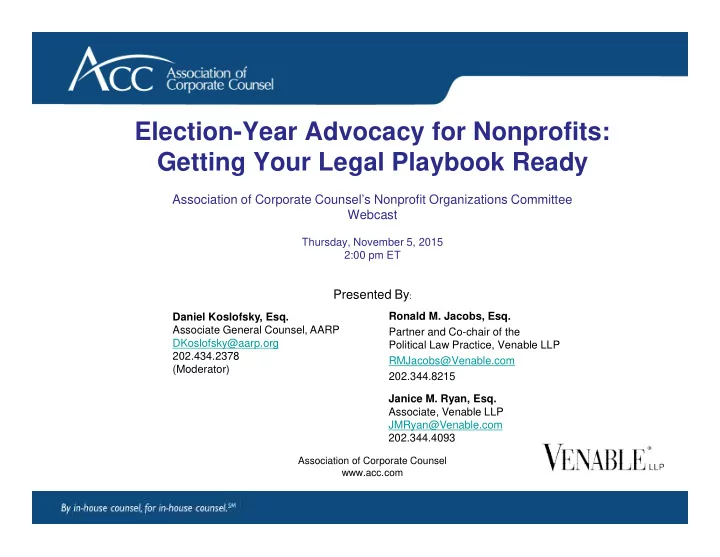
Election-Year Advocacy for Nonprofits: Getting Your Legal Playbook - - PowerPoint PPT Presentation

election year advocacy for nonprofits getting your legal
SMART_READER_LITE
LIVE PREVIEW

Election-Year Advocacy for Nonprofits: Getting Your Legal Playbook - - PowerPoint PPT Presentation

Election-Year Advocacy for Nonprofits: Getting Your Legal Playbook Ready Association of Corporate Counsels Nonprofit Organizations Committee Webcast Thursday, November 5, 2015 2:00 pm ET Presented By : Ronald M. Jacobs, Esq. Daniel


slide-1
SLIDE 1

Election-Year Advocacy for Nonprofits: Getting Your Legal Playbook Ready

Association of Corporate Counsel’s Nonprofit Organizations Committee Webcast

Thursday, November 5, 2015 2:00 pm ET

Presented By:

Association of Corporate Counsel www.acc.com

Daniel Koslofsky, Esq. Associate General Counsel, AARP DKoslofsky@aarp.org 202.434.2378 (Moderator) Ronald M. Jacobs, Esq. Partner and Co-chair of the Political Law Practice, Venable LLP RMJacobs@Venable.com 202.344.8215 Janice M. Ryan, Esq. Associate, Venable LLP JMRyan@Venable.com 202.344.4093

slide-2
SLIDE 2
  • Part I: 501(c)(3) Activities

– Basic Rules – Organization Activities

  • Debates
  • Forums
  • Questionnaires
  • Scorecards

– Communications – Executive Activities

  • Being involved in a

campaign

  • Fundraising

– Official Events

  • Part II: 501(c)(4) Activities

– Basic Rules

  • Campaign Intervention
  • Primary Purpose
  • Tax Issues

– Federal Independent Expenditures – State Political Activity

  • Contributions
  • Independent Expenditures
  • Disclosure

– PACs – Super PACs

Topics for Today

slide-3
SLIDE 3

PART I: 501(c)(3) Organizations

Lots of Opportunity

slide-4
SLIDE 4
  • No Campaign Intervention

No contributions to candidates No use of corporate resources to support candidates No events/activities designed to benefit a candidate No endorsements

Basic 501(c)(3) Rule

slide-5
SLIDE 5

Lots That Can Be Done

  • Interact with office-holders who are candidates
  • Host debates and forums
  • Communicate on issues
  • Send scorecards and questionnaires
slide-6
SLIDE 6

Hosting Debates

  • Invite all candidates

– Or use objective criteria (polling)

  • Primary

– May be just one party

  • Equal time
  • Neutral audience
  • Neutral moderator
  • Wide range of topics
slide-7
SLIDE 7

Forums

  • Invite all candidates
  • Equal time
  • Equally good time
  • Neutral questions
  • Variety of questions
  • NOTE: Federal campaign finance law limits events with
  • ne candidate; debate format generally required for

events open to the public (member-only events okay)

slide-8
SLIDE 8

Other Issues for Forums and Debates

  • Provide equal opportunity to respond/present views
  • Don’t use agree/disagree questions
  • Don’t comment on questions
  • Don’t imply approval or disapproval
  • No fundraising
  • Maintain neutral atmosphere
slide-9
SLIDE 9

Candidate Questionnaires

Approach

  • All Candidates for
  • ffice sent

questionnaire

  • Unbiased

structure

  • No endorsement
  • No pledge of

support

  • No grading

responses (+/-) Questions

  • Clear and

unbiased

  • Subjects cover

major areas of interest

  • Clear issue

descriptions

  • Don’t ask to

accept a pledge Answers

  • Reasonable time

to respond

  • If limited answers

allowed (support/oppose),

  • pportunity to

explain position Format

  • Questions the

same in the guide as provided to candidates

  • Answers the

same as provided

  • r edited for

space only

  • Answers

presented close to the question

slide-10
SLIDE 10

Legislative Scorecards

  • Regular activity

– Not timed with election – End of each legislative session

  • Track a variety of issues
  • Include all legislators

– Don’t include candidates who are not incumbents – Don’t mention which incumbents are candidates

  • Don’t editorialize
slide-11
SLIDE 11

Public Communications

  • Issue ads
  • Facts and circumstances

– Timing – Reference to candidate – Reference to party – Reference to election

slide-12
SLIDE 12

Indicia of Intervention

ID’s one or more candidates Approves or disapproves of positions or actions Proximity in time to election Reference to voting or the election Ongoing communications irrespective of election Reference to non-electoral event

IRS Test

slide-13
SLIDE 13

Websites

  • Treated as any other communication
  • Risk of taking information from one section and

linking it to a candidate on another

PDF Scorecard Blog post criticizing vote Intervention?

slide-14
SLIDE 14

Blogs/Third-Party Postings

  • Not clear what IRS thinks
  • Include disclaimer
  • Comments may be okay
slide-15
SLIDE 15

Links

  • Links to candidate sites

– Context and purpose important – Voter education/all candidates v. advocacy

  • Links to other sites

– Purpose – Relation to advocacy – Number of clicks

  • Links to related 501(c)(4) site okay

– But, do not merge the two sites

slide-16
SLIDE 16

Executive Activities

  • Do not lose First Amendment rights
  • Must act in personal capacity
  • Must not use 501(c)(3) resources
  • Position okay for identification purposes
  • Include disclaimers
slide-17
SLIDE 17

Citizens for Joe Blow

John Jones, President Friendly Foundation

Title for Identification Purposes Only

Examples

slide-18
SLIDE 18

Fundraising by Executives

  • No use of 501(c)(3) resources

– No facilities/space – No mailing lists/email lists – May use personal contacts

  • Home fundraisers

– FEC: $1,000 per person per candidate for food and beverage/above that in-kind contribution – States: varies – Candidate may pay

slide-19
SLIDE 19

Visits by Candidates in Official/Other Capacity

Other than candidacy Reason

  • Sitting official
  • Expert
  • Community leader

No mention of candidacy Organization

  • Communications refer to official position
  • Invitations/introductions do not refer to candidacy

No mention of candidacy Guest/Speaker

  • Speaks in other official role
  • Does not talk about campaign

No campaign activity Event

  • Non-partisan atmosphere
  • No fundraising
slide-20
SLIDE 20

PART II: 501(c)(4) Organizations

Actual Campaign Intervention

slide-21
SLIDE 21

501(c)(4) Organizations

  • Primary purpose must be promoting social welfare
  • Campaign intervention is not promoting social welfare

NOTE: Remember other laws may restrict corporate activity (e.g., federal campaign finance law prohibits direct contributions to candidates)

slide-22
SLIDE 22

Primary Purpose

Social Welfare Political Safe Harbor: 60%/40%

slide-23
SLIDE 23

What Gets Counted?

  • Expenditures
  • Staff time
  • Volunteer time
slide-24
SLIDE 24

What Is Campaign Intervention?

  • Facts and circumstances

– Timing, content, background

  • IRS tried to define it in rulemaking
  • Intervention includes:

– Express advocacy/independent expenditures – Campaign contributions – Endorsements – Supporting a connected PAC

slide-25
SLIDE 25

Facts and Circumstances

Timing

  • Proximity to

election

  • History of

communications Content

  • Candidate name
  • Candidate

picture

  • Party

Background

  • Issues of

importance to election

  • Legislative

votes

slide-26
SLIDE 26

Tax on Political Activity

  • 527(f) Tax
  • Lessor of net investment income or political

expenditures

  • 35% tax
  • Unless paid for from segregated fund

– Fund must be registered with state, FEC, or IRS – Donors must be disclosed

slide-27
SLIDE 27

Tax on Transfers from 501(c)(4)s

  • Reasonable control on transfers
  • Restrictions on use for political activity
  • Cannot donate to another (c)(4) for purposes of

making political expenditures or subject to tax

  • Cannot transfer (c)(4) funds to 527 political

committee without tax

slide-28
SLIDE 28

Tax Disclosures

  • 990 Schedule C

– Total amount of political activity expenditures – Volunteer hours on political activity – Amount of direct and indirect expenditures

  • Payments to candidates, committees, and other political
  • rganizations itemized
  • 1120-POL

– Must be filed if political expenditures – Pay tax on lesser of net investment income or political expenditures

slide-29
SLIDE 29

Contributions & Expenditures

Contribution

  • Payment to candidate
  • In-kind contribution
  • Coordinated expenditure

Expenditure

  • Independent of candidate
  • No coordination
  • Unlimited
slide-30
SLIDE 30

Federal Corporate Contributions

  • Federal law prohibits corporate contributions to:

– Federal Candidates – Federal PACs – Federal Political Parties – Federal Accounts of State Parties

slide-31
SLIDE 31

Keeping IEs Independent

  • May not coordinate with candidates supported
slide-32
SLIDE 32

Types of Coordination

  • Providing something of value to a candidate (e.g.,

voter file developed through IEs)

  • Making a coordinated communication
slide-33
SLIDE 33

Coordinated Communications

Content Conduct Coordinated Communication

slide-34
SLIDE 34

Content

Electioneering Communications

  • Broadcast/radio/cable
  • Targeted to relevant

electorate

  • Contains reference to

candidate

  • 30 days before primary
  • 60 days before general

Express Advocacy in Public Communication

  • Broadcast/cable/satellite
  • Newspaper
  • Magazine
  • Outdoor advertising
  • Mass mailing (500 pieces)
  • Telephone bank (500

calls)

  • Other form of general

public political advertising References to Candidates in Public Communications

  • References a House or

Senate candidate in the relevant jurisdiction 90 days or less before primary or general

  • References a presidential

candidate from 120 days before the primary up through the election Republication in a Public Communication

  • Disseminates
  • Republishes
  • Distributes
slide-35
SLIDE 35

What’s Not a “Public Communication”?

  • Anything on the Internet that is not paid for on a

third-party site – Email – Blogs – Social media

  • What is included:

– Banner ads – Targeted advertising – Paid social media NOTE: Any expenditure for republication of candidate materials is an in-kind contribution

slide-36
SLIDE 36

Conduct

Request/Suggestion

  • Candidate asks
  • Candidate assents to

suggestion Material Involvement

  • Non-public

information shared

  • Content
  • Audience
  • Means or mode
  • Outlets
  • Timing/frequency
  • Size, prominence,

duration Substantial Discussion

  • Non-public material

information

  • Plans
  • Projects
  • Activities
  • Needs

Common Vendor

  • Same vendor within

120 days uses material nonpublic information

  • Media strategy
  • Audience selection
  • Polling
  • Fundraising
  • Content

development

  • Production
  • Voter list

development

  • Consulting or media

advice

  • May establish a

firewall Former Employee

  • Employee or vendor

worked for both entities within 120 days

  • Uses material, non-

public information Republication

  • Republish or

broadcast candidate’s materials

  • May use small

sections to create ads

slide-37
SLIDE 37

Disclosure of Independent Expenditures

End of next reporting period Periodic Reports

  • Required of all entities that make more than $250 in IEs for any election in a calendar year
  • Disclose all payments for the IEs (name and mailing address, amount, date, purpose, whether supporting or
  • pposing a candidate)
  • Disclose contributions >$200 received for the “purpose of furthering the reported independent expenditure”

20 days or more before election 48-Hour Reports

  • Required if spend more than $10,000 for a given election
  • Additional reports required for each additional $10,00 spent
  • Same information as periodic reports

Between 24 hours and 19 days before election 24-Hour Reports

  • Required if spend more than $1,000 between 19 days and 24 hours before election
  • Additional reports required for each additional $1,000 spent
  • Same information as periodic reports
slide-38
SLIDE 38

State Political Activity

  • Independent expenditures

– Coordination rules vary widely – Disclosure rules vary widely

  • Direct contributions

– State law varies

  • Supporting a PAC
slide-39
SLIDE 39

State Disclosure: California

  • Multipurpose Committees:

– Entity that receives donations or payments for purposes

  • ther than making political expenditures

– One of the following:

  • Raise funds of $1,000 or more for political activity

– Solicited for purposes of making IEs or contributions – Accepted based on agreement or understanding $ used for IEs or contributions – Reach subsequent agreement or understanding $ will be used for IEs or contributions

  • Make IEs or contributions of $50,000 in 12-month period or

$100,000 in four consecutive years

  • Are a federal or out-of-state political committee
  • Must register as a “recipient committee”
slide-40
SLIDE 40

State Disclosure: California (Part 2)

  • Multipurpose Committee Disclosure

– Disclose donors of $100 or more in a calendar year if: – If expenditure not fully funded: – Unless funded with non-dues revenue or interest income

  • Donor made payments for political purposes
  • Donor knew all or some would be used for

political purposes

  • Donor reached subsequent understanding
  • Last-in-first-out disclosure of any donor of

$1,000 or more

  • Unless donor prohibits contribution from

being used for political purposes

slide-41
SLIDE 41

State Disclosure: California (Part 3)

  • Upstream Disclosure

– Multipurpose Organizations must notify:

  • Nonprofit donors of $50,000 or more that they may be multipurpose
  • rganizations subject to the rules
  • Donors of $5,000 or more of potential Major Donor ($10,000 or more)

status and further disclosure

– Donors to multipurpose organizations will be one of the following:

  • Major Donors (contribute $10,000 or more statewide in calendar year;

no further donor disclosure required; businesses and individuals)

  • Recipient Committees (raise more than $1,000 for political purposes;

must register and report donors)

  • Multipurpose Organizations (must register and report as described

above)

  • Other/Nothing (businesses or individuals who contribute less than

$10,000; no disclosure)

slide-42
SLIDE 42

What It Means

Disclosed: Major Donors Disclosed: MPO/Major Donors Disclosed: MPO/Major Donors MPO

501(c)(4) makes IEs Individual Donors Business Donors 501(c)(4) Donors Individual Donors Business Donors 501(c)(4) Donor Individual Donor Business Donor Super PAC Donor Individual Donor Business Donor 501(c)(6) Donors Business Members

slide-43
SLIDE 43

California Coordination Rules

Presumption of Coordination

Communication made based on information about needs/plans provided by campaign Communication made by or through an agent of campaign Person making communication retains services

  • f someone

providing services to campaign within 12 months Communication reproduces campaign materials Candidate participates in fundraising or appears as speaker at fundraiser Entity making communication is established, run, or staffed in leadership role by person who worked for campaign within 12 months

slide-44
SLIDE 44

Political Action Committees

  • Fund to hold individual contributions
  • Used to make contributions directly to candidates
  • Federal law:

– $5,000 per donor per year to PAC – $5,000 per election per candidate

  • Restricted Class

– Members of 501(c)(4)

  • Non-Connected PAC

– May solicit general public – No corporate support

slide-45
SLIDE 45

Super PACs

  • Used to fund Independent Expenditures only

– Unlimited contributions – Individual or corporate donation

  • Fully disclosed to FEC (or states)
  • 501(c)(4) may donate to Super PACs
  • Useful way to engage in IE activity by 501(c)(4)
slide-46
SLIDE 46

Related Organizations

  • 501(c)(3) may have a related 501(c)(4)
  • 501(c)(4) may have a connected PAC
  • 501(c)(4) may fund a Super PAC and its operations

501(c)(3) 501(c)(4) Connected PAC Super PAC

slide-47
SLIDE 47

Considerations

  • 501(c)(3) funds may not go to political activities of

501(c)(4)

  • Allocate costs
  • Maintain corporate formalities
  • Maintain distinct branding
  • Consider which organization will be primary public

face – May be easier to have 501(c)(4) play this role – 501(c)(4) can support the 501(c)(3), but not vice versa

slide-48
SLIDE 48

Moderator

– Dan Koslofsky

  • 202.434.2378
  • Dkoslofsky@AARP.org

Speakers

– Ron Jacobs

  • 202.344.8215
  • RMJacobs@Venable.com

– Janice Ryan

  • 202.344.4093
  • JMRyan@Venable.com

Questions?

To view an index of Venable’s articles and presentations or upcoming programs on nonprofit legal topics, see www.Venable.com/nonprofits/publications or www.Venable.com/nonprofits/events. To view recordings of Venable’s nonprofit programs on our YouTube channel, see www.YouTube.com/VenableNonprofits or www.Venable.com/nonprofits/recordings. Follow @NonprofitLaw on Twitter for timely posts with nonprofit legal articles, alerts, upcoming and recorded speaking presentations, and relevant nonprofit news and commentary.

slide-49
SLIDE 49

Thank you for attending another presentation from ACC’s Webcasts Please be sure to complete the evaluation form for this program as your comments and ideas are helpful in planning future programs. If you have questions about this or future webcasts, please contact ACC at webcast@acc.com This and other ACC webcasts have been recorded and are available, for one year after the presentation date, as archived webcasts at http://webcasts.acc.com.