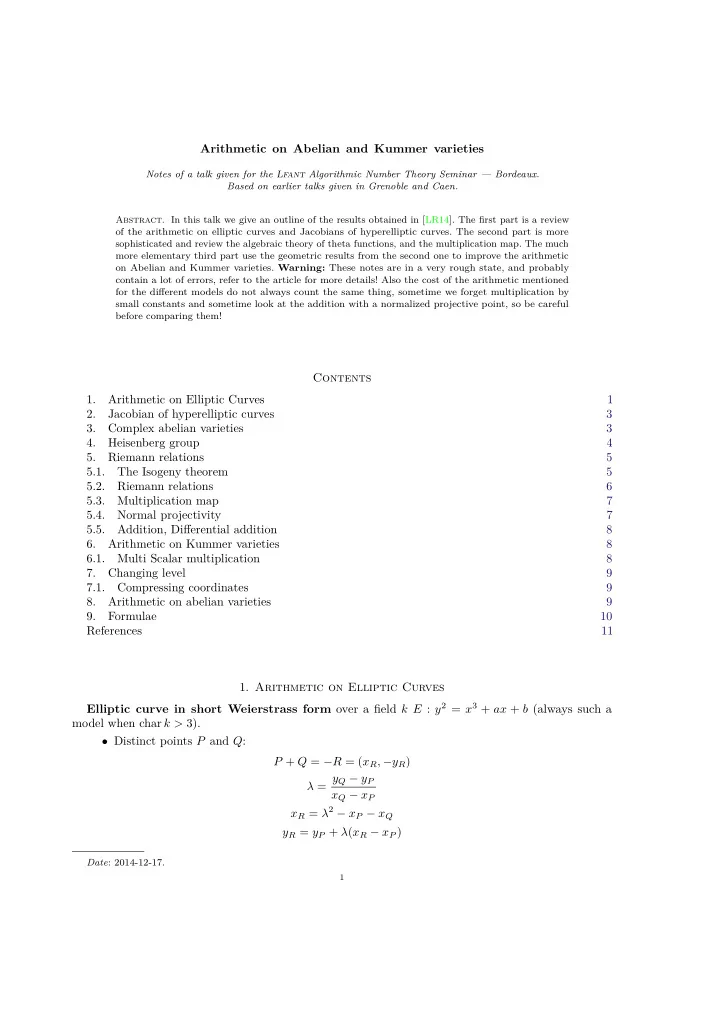
Elliptic curve in short Weierstrass form over a field k E : y 2 = x 3 - - PDF document

elliptic curve in short weierstrass form over a field k e
SMART_READER_LITE
LIVE PREVIEW

Elliptic curve in short Weierstrass form over a field k E : y 2 = x 3 - - PDF document

Arithmetic on Abelian and Kummer varieties 7. 7 Notes of a talk given for the Lfant Algorithmic Number Theory Seminar Bordeaux. Normal projectivity 7 5.5. Addition, Differential addition 8 6. Arithmetic on Kummer varieties 8 6.1.


slide-1
SLIDE 1

Arithmetic on Abelian and Kummer varieties

Notes of a talk given for the Lfant Algorithmic Number Theory Seminar — Bordeaux. Based on earlier talks given in Grenoble and Caen.

  • Abstract. In this talk we give an outline of the results obtained in [LR14]. The first part is a review
  • f the arithmetic on elliptic curves and Jacobians of hyperelliptic curves. The second part is more

sophisticated and review the algebraic theory of theta functions, and the multiplication map. The much more elementary third part use the geometric results from the second one to improve the arithmetic

  • n Abelian and Kummer varieties. Warning: These notes are in a very rough state, and probably

contain a lot of errors, refer to the article for more details! Also the cost of the arithmetic mentioned for the different models do not always count the same thing, sometime we forget multiplication by small constants and sometime look at the addition with a normalized projective point, so be careful before comparing them!

Contents 1. Arithmetic on Elliptic Curves 1 2. Jacobian of hyperelliptic curves 3 3. Complex abelian varieties 3 4. Heisenberg group 4 5. Riemann relations 5 5.1. The Isogeny theorem 5 5.2. Riemann relations 6 5.3. Multiplication map 7 5.4. Normal projectivity 7 5.5. Addition, Differential addition 8 6. Arithmetic on Kummer varieties 8 6.1. Multi Scalar multiplication 8 7. Changing level 9 7.1. Compressing coordinates 9 8. Arithmetic on abelian varieties 9 9. Formulae 10 References 11

  • 1. Arithmetic on Elliptic Curves

Elliptic curve in short Weierstrass form over a field k E : y2 = x3 + ax + b (always such a model when char k > 3).

  • Distinct points P and Q:

P + Q = −R = (xR, −yR) λ = yQ − yP xQ − xP xR = λ2 − xP − xQ yR = yP + λ(xR − xP )

Date: 2014-12-17.

1

slide-2
SLIDE 2

2 ARITHMETIC ON ABELIAN AND KUMMER VARIETIES

(If xP = xQ then P = −Q and P + Q = 0E).

  • If P = Q, then λ comes from the tangent at P:

λ = 3x2

P + b

2yP xR = λ2 − 2xP yR = yP + λ(xR − xP ) One can avoid divisions by working with projective coordinates (X : Y : Z): E : Y 2Z = X3 + aXZ2 + bZ3. Cost for an addition: 11M+7S in Extended Jacobian coordinates (not counting multiplication by small constants). The scalar multiplication P → n.P is computed via the standard double and add algorithm, on average log n doubling and 1/2 log n additions. Standard tricks to speed-up include NAF form, windowing…The multiscalar multiplication (P, Q) → n.P + m.Q can also be computed via doubling and the addition of P, Q or P + Q according to the bits of n and m, on average log N doubling and 3/4 log N additions where N = max(n, m). GLV idea: if there exists an efficiently computable endomorphism α such that α(P) = u.P where u ≈ √n, then replace the scalar multiplication n.P by the multiscalar multiplication n1P + n2α(P). One can expect n1 and n2 to be half the size of n ⇒ from log n doubling and 1/2 log n additions to 1/2 log n doubling and 3/8 log n additions. Edwards curves: E : x2 + y2 = 1 + dx2y2, d = 0, −1, char k > 2. Addition of P = (x1, y1) and Q = (x2, y2): P + Q = x1y2 + x2y1 1 + dx1x2y1y2 , y1y2 − x1x2 1 − dx1x2y1y2

  • Neutral element: (0, 1); −(x, y) = (x, y); T = (1, 0) has order 4, 2T = (0, 1). (Conversely every elliptic

curve with a point of 4-torsion has an Edwards curve model). When d = 0 we get a circle (a curve of genus 0) and we find back the addition law on the circle coming from the sine and cosine laws. If d is not a square in K, then there are no exceptional points: the denominators are always nonzero (for rational points in K) so we have a complete addition law (very useful to prevent some Side Channel Attacks). Cost for an addition: 10M+1S (Projective coordinates), 9M+1S (Inverted coordinates). Twisted Edwards curves: E : ax2 + y2 = 1 + dx2y2. Addition of P = (x1, y1) and Q = (x2, y2): P + Q = x1y2 + x2y1 1 + dx1x2y1y2 , y1y2 − ax1x2 1 − dx1x2y1y2

  • Neutral element: (0, 1); −(x, y) = (x, y); T = (0, −1) has order 2 (conversely if all points of 2-torsion of

an elliptic curve E are rational then E is 2-isogenous to a twisted Edwards curve). Extensively studied by Bernstein and Lange, still complete addition if a is a square and d not a square. Cost for an addition: 10M+1S (Projective coordinates), 9M (Extended coordinates), 8M (Extended coordinates with a = −1). Montgomery curves: E : By2 = x3 + Ax2 + x (birationally equivalent to twisted Edwards curves). The map E → A1, (x, y) → (x) maps E to the Kummer line KE = E/±1. We represent a point ±P ∈ KE by the projective coordinates (X : Z) where x = X/Z. Differential addition: Given ±P1 = (X1 : Z1), ±P2 = (X2 : Z2) and ±(P1 − P2) = (X3 : Z3); then one can compute ±(P1 + P2) = (X4 : Z4) by X4 = Z3 ((X1 − Z1)(X2 + Z2) + (X1 + Z1)(X2 − Z2))2 Z4 = X3 ((X1 − Z1)(X2 + Z2) − (X1 + Z1)(X2 − Z2))2 Cost: 2M+2S for a doubling and 4M+2S for a differential addition.

slide-3
SLIDE 3

Arithmetic on Abelian and Kummer varieties 3

Montgomery’s scalar multiplication: The scalar multiplication ±P → ±n.P can be computed through differential additions if we can construct a differential chain. If ±[n]P = (Xn − Zn), then Xm+n = Zm−n ((Xm − Zm)(Xn + Zn) + (Xm + Zm)(Xn − Zn))2 Zm+n = Xm−n ((Xm − Zm)(Xn + Zn) − (Xm + Zm)(Xn − Zn))2 Montgomery’s ladder use the chain nP, (n + 1)P: from nP, (n + 1)P the next iteration computes 2nP, (2n + 1)P or (2n + 1)P, (2n + 2)P via one doubling and one differential addition.

  • 2. Jacobian of hyperelliptic curves

H : y2 = f(x), deg f = 2g + 1: hyperelliptic curve of genus g with a rational point at infinity. Every divisor D can be represented by a reduced divisor

  • D =

r

  • i=1

(Pi) − r(∞) where r g and Pi = −Pj for i = j. The divisor D is represented by its Mumford coordinates (u, v) where if Pi = (xi, yi): u(x) =

  • (x − xi)

v(xi) = yi deg v < deg u g u(x) | v(x)2 − f(x); The last condition encodes that y − v(x) has multiplicity mi = vPi(D) at Pi. From (u, v), D is recovered by D = div(u(x)) ∧ div(v(x) − y). Algorithm 2.1 (Cantor’s algorithm). Input: D1 = (u1, v1), D2 = (u2, v2); Output: D = (u, v) such that D ∼ D1 + D2; (1) Semireduce: Compute the extended gcd of u1, u2, v1 + v2 d = s1u1 + s2u2 + s3(v1 + v2) u = u1u2 d2 v = s1u1v2 + s2u2v1 + s3(v1v2 + f) d modulo u (2) Reduce: u = f − v2 u

(Use the function f − v2 to reduce the current divisor)

v = −v modulo u until deg u g. Cost in genus 2: 32M + 7S for a doubling and 36M + 5S for an addition in weighted coordinates [Lan05]; 21M + 12S for a doubling and 29M + 7S for an addition in Jacobian coordinates [HC14].

  • 3. Complex abelian varieties

A = (V/Λ, H) where V is a C-ev of dimension g, Λ is a lattice of rank 2g and E = ℑH is symplectic, E(ix, iy) = E(x, y) and E(Λ, Λ) ⊂ Z. If Λ = Zg + ΩZg where Ω ∈ Hg (ie Ω symmetric, ℑΩ > 0), Ω determines a principal polarisation H0 = (ℑΩ)−1. Definition 3.1 (Theta functions with characteristics a, b ∈ Qg). ϑ [ a

b ] (z, Ω) =

  • n∈Zg

eπi t(n+a)·Ω·(n+a)+2πi t(n+a)·(z+b).

slide-4
SLIDE 4

4 ARITHMETIC ON ABELIAN AND KUMMER VARIETIES

Montgomery Level 2 Twisted Edwards (Inverted) Jacobians coordinates Doubling 5M + 4S + 1m0 3M + 6S + 3m0 3M + 4S + 1m0 3M + 5S Mixed Addition 8M + 1S + 2m0 7M + 6S + 1m0 Mumford (Jacobian coordinates) Level 2 Level 4 Doubling 21M + 12S + 2m0 7M + 12S + 9m0 49M + 36S + 27m0 Mixed Addition 29M + 7S

Table 1. Multiplication cost in dimension 1 and 2 (one step). To get coordinates, we need a projective embedding, which corresponds to an (ample) line bundle L. The sections of L correspond to functions f such that f(z + λ) = aL(z, λ)f(z) where aL is the automorphic factor associated to L, satisfying the cocycle condition aL(z, λ1 + λ2) = aL(z, λ1)aL(z + λ1, λ2). Theorem 3.2 (Appell-Humbert). aL(z, λ) = χ(λ)eπH(z,λ)+ π

2 H(λ,λ)

where χ(λ) = ±1 (when L is symmetric). If L = Ln

0 ie if the polarisation H is nH0, the sections are called theta functions of level n. If n = n1n2

a basis is given by ϑ

  • a/n1

b/n2

  • (n1z, n1

n2 Ω). A choice of basis is uniquely determined (up to a constant) by a

representation of the action by translation by points of n-torsions. Proposition 3.3 (Lefschetz).

  • If n 3 we get an embedding of A into projective space;
  • If n = 2 and L0 is indecomposable, we get an embedding of the Kummer variety A/ ± 1;

Example 3.4. Let E1 and E2 be two elliptic curves, L1 and L2 be the corresponding canonical polarisation coming from 0Ei and Let L0 = L1 ⋆ L2 be the product polarisation on E1 × E2. Then the embedding given by the sections of L = L2

0 give a projective embedding of E1/ ± 1 × E2/ ± 1 which is a

quotient of the Kummer variety ((E1 × E2)/ ± 1). (Note: some terminology call the Kummer variety the quotient of A by all the automorphisms; here we only quotient by ±1. Generically this give the same definitions but not always as the example of product varieties show).

  • 4. Heisenberg group

(A, L)/k polarised abelian variety over an algebraically closed field k. Assume for simplicity that L is ample, and L=Ln

0 where L0 is principal and n is prime to the characteristic of k.

We note ΦL : A → Ak, x → τ ∗

xL ⊗ L−1 the corresponding polarisation. The kernel K(L) of ΦL is

then A[n]. Theta group:

  • G(L) := {(x, ϕ) | x ∈ K(L), ϕ : L

→ τ ∗

xL}.

  • Group law: (y, ψ).(x, ϕ) = (x + y, τ ∗

xψ ◦ ϕ):

L

ϕ

− − → τ ∗

xL τ ∗

− − − → τ ∗

y τ ∗ xL.

  • The theta group fits into the exact sequence

k∗ G(L) K(L) 0 .

slide-5
SLIDE 5

Arithmetic on Abelian and Kummer varieties 5

  • The commutator pairing eL(x, y) =

x y x−1 y ∈ k∗ is non degenerate (Weil pairing), so G(L) is an Heisenberg group. If ψ : K(L)2 → k∗ is the 2-cocycle corresponding to the central extension G(L), then eL(x, y) = ψ(x,y)

ψ(y,x).

  • Action of G(L) on Γ(L):

(x, ϕ).f = τ ∗

−x(ϕ(f)).

Standard Heisenberg group: K(n) := (Z/nZ)g ⊕ ( Z/nZ)g. The Heisenberg group G(n) is the central extension k∗ G(n) K(n) given by the 2-cocycle ψ(x, y) = x2(y1). Concretely (α, x1, x2).(β, y1, y2) = (αβx2(y1), x1 + y1, x2 + y2). The symplectic isomorphism (K(n), en) ≃ (K(L), eL) extends (not uniquely in general) to an isomorphism ΘL : G(n)

→ G(L) (Theta structure of level n). Theorem 4.1 (Mackey). G(n) has a unique irreducible representation V (n) of weight 1 (ie k∗ acts by the natural character). If V is a representation of weight 1, then V = V (n)r where r = dimk V

K and K

is a maximal isotropic subgroup of K(n). Moreover the action of K on V (n) is the standard adjoint representation, so V (n) has dimension ng.

  • Proof. See [Mum66; Mum91].
  • Descent: If K ⊂ K(L) is isotropic, f : A → B = A/K then

level subgroup K ⊂ G(L) (ie a section of K) ⇔ descent data of L ⇔ M ample bundle on B such that f ∗M = L. Theorem 4.2. The action of G(L) on Γ(L) is irreducible.

  • Proof. If

K is maximal, by descent theory L descends to a principal line bundle M on A/K. Γ(L)

K =

Γ(M) is then of dimension 1.

  • In particular Γ(L) G(L) is isomorphic to V (n) G(n) (where G(n) acts by the standard action)

via ΘL. Explicitly if we note Z(n) = (Z/nZ)g, V (n) = Hom(Z(n), k), (α, x1, x2).f = y → αx2(y)f(x1 + y). So there exists a unique basis (ϑi)i∈K1(L) of Γ(L) such that the action of G(L) is given by (α, x1, x2).ϑi = αx2(i)ϑi−x1. (Abuse of notation: we see G(L) = k∗ × K1(L) × K2(L) as a set, where K(L) = K1(L) ⊕ K2(L) is the decomposition into maximal isotropic subgroups coming from ΘL, and x2(i) is the action coming from the 2-cocycle.) Concretely, ϑ0 is a non trivial section in Γ(L)

K2(L) and if i ∈ K1(L), ϑi = s(i).ϑ0 where s is the

canonical section coming from the theta structure and K2 = s(K2) is the level subgroup above K2.

  • 5. Riemann relations

5.1. The Isogeny theorem. Theorem 5.1 (Isogeny Theorem). Let f : (A, L) → (B, M) be an isogeny between polarised abelian varieties, M corresponds to a section K ⊂ G(L) of the kernel K = Ker f. G(M) = K⊥/ K and the decomposition K(L) = K1(L) ⊕ K2(L) induces via f a decomposition K(M) = K1(M) ⊕ K2(M) (if we assume that K = K1 K ⊕ K2 K). Likewise the theta structure on G(L) induces a compatible theta structure on G(M). We then have for i ∈ K1(L) K⊥ (up to a constant) ϑM

f(i) =

  • j−i∈K

K1(L)

ϑL

j =

  • j∈K1(L),f(j)=i

ϑL

j = Trace of ϑL i under the action of

K.

slide-6
SLIDE 6

6 ARITHMETIC ON ABELIAN AND KUMMER VARIETIES

5.2. Riemann relations. Let ξ : A × A → A × A, (x, y) → (x + y, x − y) be the isogeny coming from the group law, with kernel diag A[2]. We now assume that L is totally symmetric, ie L = Ln

0 with L0

symmetric and 2 | n. We have ξ∗(L ⋆ L) = L2 ⋆ L2 where L ⋆ M := p∗

1L ⊗ p∗ 2M.

Proposition 5.2. For the natural product theta structure, the isogeny theorem applied to ξ yields ϑL

i+j(x + y)ϑL i−j(x − y) =

  • t∈K1(L)[2]

ϑL2

i+tϑL2 j+t.

This formula is easily inversible if we do a Fourier transform: for χ ∈ ˆ Z(2) and i ∈ Z(2n), let U L

χ,i = t∈Z(2) χ(t)ϑL2 i+t. Then we obtain the duplication formulae

ϑL

i+j(x + y)ϑL i−j(x − y) = 1

2g

  • χ∈ ˆ

Z(2)

U L2

χ,i(x)U L2 χ,j(y)

U L2

χ,i(x)U L2 χ,j(y) =

  • t∈Z(2)

χ(t)ϑL

i+j+t(x + y)ϑL i−j+t(x − y)

Remark 5.3. In term of analytic theta functions, we have ϑL

i (z) = ϑ i/l

  • (z, Ω

ℓ ), ϑL2 i (z) = ϑ

  • i/2l
  • (z, Ω

2ℓ),

U L2

χ,i(z) = ϑ

  • χ/2

i/l

  • (2z, 2Ω

ℓ ).

Theorem 5.4 (Riemann relations). Let x1, x2, x3, x4, z ∈ Cg, such that 2z = x1 + x2 + x3 + x4 and let y1 = z − x1, y2 = z − x2, y3 = z − x3, y4 = z − y4. Then for all characters χ ∈ ˆ Z(2) and all i1, i2, i3, i4, m ∈ Z(n) such that i1 + i2 + i3 + i4 = 2m, if j1 = m − i1, j2 = m − j2, j3 = m − i3, j4 = m − i4 then (1)

t∈Z(2)

χ(t)ϑi1+t(x1)ϑi2+t(x2)

  • .

t∈Z(2)

χ(t)ϑi3+t(x3)ϑi4+t(x4)

  • =

t∈Z(2)

χ(t)ϑj1+t(y1)ϑj2+t(y2)

  • .

t∈Z(2)

χ(t)ϑj3+t(y3)ϑj4+t(y4)

  • .

In particular, we have the addition formulae for z1, z2 ∈ Cg (with χ, i1, i2, i3, i4 like before): (2)

t∈Z(2)

χ(t)ϑi1+t(z1 + z2)ϑi2+t(z1 − z2)

  • .

t∈Z(2)

χ(t)ϑi3+t(0)ϑi4+t(0)

  • =

t∈Z(2)

χ(t)ϑj1+t(z2)ϑj2+t(z2)

  • .

t∈Z(2)

χ(t)ϑj3+t(z1)ϑj4+t(z1)

  • .
  • Proof. Using the duplication formulae the left term of eq. (1) is equal to Uχ,m1(z1)Uχ,m2(z2)Uχ,m3(z3)Uχ,m4(z4)

while the right term is equal to Uχ,m1(z1)Uχ,m4(z4)Uχ,m3(z3)Uχ,m2(z2) where z1 = x1+x2

2

, z2 = x1−x2

2

, z3 = x3+x4

2

, z4 = x3−x4

2

and m1 = i1+i2

2

, m2 = i1−i2

2

, m3 = i3+i4

2

, m4 = i3−i4

2

. The differential addition comes by plugging z1 + z2, z1 − z2, 0, 0 | −z2, z2, z1, z1 another useful application is the three way affine addition with z1 + z2 + z3, z1, z2, z3 | 0, z2 + z3, z1 + z3, z1 + z2.

  • Question: For χ, i1 and i2, we need to find i3, i4 such that
  • χ(t)ϑL

i3+t(0)ϑL i4+t(0) = U L2 χ, i3+i4

2

(0)U L2

χ, i3−i4

2

(0) is not null. Then by eq. (2) we can recover all

t∈Z(2) χ(t)ϑL i1+t(z1 + z2)ϑL i2+t(z1 − z2) and by doing

appropriate sums of characters we recover all products ϑL

i1(z1 + z2)ϑL i2(z1 − z2). This is needed for

slide-7
SLIDE 7

Arithmetic on Abelian and Kummer varieties 7

projective addition or affine differential additions. Remark: we can translate m3 = i3+i4

2

and m4 = i3−i4

2

by t1, t2 in 2Z(2n). Example 5.5. Using n = 2 and analytic theta functions for visibility, the duplication formulae above are given by ϑ

  • i

2

  • (z1 + z2, Ω/2)ϑ

j 2

  • (z1 − z2, Ω/2) =
  • t∈ 1

2 Zg/Zg

ϑ

  • t

2 i+j n

  • (2z1, Ω)ϑ
  • t

2 i−j n

  • (2z2, Ω)

ϑ

  • χ/2

i/2

  • (2z1, Ω)ϑ
  • χ/2

j/2

  • (2z2, Ω) =

1 2g

  • t∈ 1

2 Zg/Zg

e−2iπ tχ·tϑ

i+j 4 +t

  • (z1 + z2, Ω/2)ϑ
  • i−j

4 +t

  • (z1 − z2, Ω/2).

To compute the addition law, given χ, i1, i2 we need to find i3, i4 such that ϑ

  • χ

2 i3+i4 2

  • (0, Ω)ϑ
  • χ

2 i3−i4 2

  • (0, Ω) = 0.

5.3. Multiplication map. Let m : A → A × A, x → (x, x) which induces the multiplication map m∗ : Γ(A, L) ⊗ Γ(A, L) → Γ(A, L2). The following diagram show that m∗ = S∗ξ∗. (X, L2) (X × X, L2 ⋆ L2) (X × X, L ⋆ L). ξ S m By the duplication formulae, m∗ is then given by ϑL

i ⊗ϑL j → χ∈ ˆ Z(2) U L2 χ,uU L2 χ,v(0) for any u, v ∈ Z(2n)

such that i = u+v, j = u−v, or via a change of variable

t χ(t)ϑL u+v+t(x)⊗ϑL u−v+t(x) → U L2 χ,i(x)U L2 χ,j(0).

So the rank of the multiplication map is closely linked to the non annulation of the theta null points. Remark 5.6 (Even and odd theta null points). If n = 2, Uχ,i(−x) = χ(2i)Uχ,i(x) for i ∈ Z(4), equivalently ϑ

  • a/2

b/2

  • (−2z, Ω) = (−1)

ta·bϑ(2z, Ω). There is 2g−1(2g + 1) even theta null points vs

2g−1(2g − 1) odd theta null points. Ex: g = 1, 3 vs 1; g = 2, 10 vs 6; g = 3, 36 vs 28. Theorem 5.7 (Mumford-Koizumi-Kempf). L0 is principal symmetric.

  • Γ(A, Ln

0) ⊗ Γ(A, Lm 0 ) → Γ(A, Ln+m

) is surjective when n 2 and m 3.

  • Γ(A, L2n

0 )+ ⊗ Γ(A, L2 0) → Γ(A, L2(n+1)

)+ is surjective when n 2. Here Γ(A, L2n

0 )+ denotes the

even sections of Γ(A, L2n

0 ). Equivalently, since L2n

is totally symmetric, it descends to an ample line bundle M+ on the Kummer variety KA = A/ ± 1, and Γ(A, L2n

0 )+ = Γ(KA, M+).

  • The rank of Γ(A, L2

0) ⊗ Γ(A, L2 0) → Γ(A, L4 0)+ is equal to the number of non null even theta null

points. 5.4. Normal projectivity. A line bundle L on a variety X is projectively normal if Γ(X, Ln) ⊗ Γ(X, L) → Γ(X, Ln+1) is surjective for all n or equivalently if S(Γ(X, L)) ։

n>0 Γ(X, Ln). (And so if

X is normal, its projective homogeneous ring in the embedding given by L is normal). Remark: L is very ample iff the map above is surjective for n ≫ 0. Corollary 5.8.

  • If n 3, (A, L) is projectively normal, and we have a projective embedding of A;
  • If n = 2, the projective embedding of KA is projectively normal iff the even theta null points are

not null. We now assume that this is the case whenever n = 2. Example 5.9. The product of the even theta null points is null whenever A is not absolutely simple or when it is the Jacobian of an hyperelliptic curve of genus g 3.

slide-8
SLIDE 8

8 ARITHMETIC ON ABELIAN AND KUMMER VARIETIES

5.5. Addition, Differential addition. Given ϑi(x), ϑi(y) we can recover (n even)

  • ϑi(x + y)ϑj(x − y) when n > 2 (⇒ projective addition, affine differential addition)
  • κij := ϑi(x + y)ϑj(x − y) + ϑj(x + y)ϑi(x − y) if n = 2, the “symmetric sum” (⇒ differential

projective or affine addition). Algorithm 5.10. Differential addition with g = 1, n = 2. Input: zP = (x0, x1), zQ = (y0, y1) and zP −Q = (z0, z1) with z0z1 = 0; z0 = (a, b) and A = 2(a2 + b2), B = 2(a2 − b2). Output: zP +Q = (t0, t1). (1) t′

0 = (x2 0 + x2 1)(y2 0 + y2 2)/A

(2) t′

1 = (x2 0 − x2 1)(y2 0 − y2 1)/B

(3) t0 = (t′

0 + t′ 1)/z0

(4) t1 = (t′

0 − t′ 1)/z1

Return (t0, t1) Cost: 3M+6S+3m0 for a step of the scalar ladder, compared to 5M+4S+1m0 for the Montgomery

  • model. In genus 2 the cost of one step is 7M+12S+9m0.
  • 6. Arithmetic on Kummer varieties

We assume here that n = 2 and that the even theta null points are non zero. The polynomial Piα := X2 − 2 κiα

καα X + κii καα has for roots { ϑi(x+y) ϑα(x+y), ϑi(x−y) ϑα(x−y)}. Once a root is chosen,

some two by two linear equations involving the κij and the roots allows to recover the theta coordinates

  • f x + y. This gives equations for the degree two scheme {x + y, x − y}.

Lemma 6.1 (Compatible additions). Given x, y, z, t ∈ A(k) such that x + y = z + t but x − y = ±z − t then one can compute x + y (= z + t) on the Kummer (from the points on the Kummer).

  • Proof. This is just the intersection of the two schemes of degree two defining {x ± y} and {z ± t}; in

practice this is just a gcd of two degree two polynomials.

  • Proposition 6.2 (Multiway additions). Let ±P0 ∈ KA(k) be a point not of 2-torsion. Then from

±P1, . . . , ±Pn ∈ KA(k) and ±(P0 + P1), . . . , ±(P0 + Pn) ∈ KA(k), one can compute ±(P1 + · · · + Pn) and ±(P0 + P1 + · · · + Pn). Remark 6.3. A reformulation of the proposition is that the data of P0 + Pi ∈ KA(k) “fixes” the sign

  • f Pi relatively to the one of P0, and so we can compute the additions since we have “compatible” signs.
  • Proof. This reduces to the case n = 2, which uses (in the generic case) (P1)+(P2) = (P1 −P0)+(P2 +P0)

and (P0 + P1) + P2 = P1 + (P0 + P2). And a verification shows that in the non generic case a direct computation is possible.

  • 6.1. Multi Scalar multiplication. To speed up the scalar multiplication P → nP, the GLV trick

[GLV01] is to use an endomorphism α and reduces the scalar multiplication to a multi scalar multiplication m1P1 + m2P2 (for instance if αP = tP, fix P1 = P, P2 = α(P), and n = m1 + tm2). The doubling and add method works again, with the addition being either P1, P2 or P1 + P2 according to the bits of (m1, m2). On the Kummer variety a Montgomery ladder mP, (m+1)P → 2mP, (2m+1)P or (2m+1)P, (2m+2)P computes the scalar multiplication. The two dimensional scalar multiplication uses a square ±(mP +nQ), ±((m + 1)P + nQ), ±(mP + (n + 1)Q), ±((m + 1)P + (n + 1)Q) and depending whether the current bits

  • f (m1, m2) is (0, 0), (1, 0), (0, 1) or (1, 1), adds ±(mP + nQ), ±((m + 1)P + nQ), ±(mP + (n + 1)Q) or

±((m + 1)P + (n + 1)Q) to the four points. But this is not interesting, we expect to halve the length of the chain by two, but each steps is twice as costly. A better approach from [Ber06] uses a triangle. But via the compatible additions, we just need to keep two points! Example 6.4. Given m1P1+(m2+1)P2, (m1+1)P1+m2P2, we can compute (2m1+1)P1+(2m2+1)P2 = (m1P1 + (m2 + 1)P2) + (P1) = ((m1 + 1)P1 + m2P2) + (P2).

slide-9
SLIDE 9

Arithmetic on Abelian and Kummer varieties 9

  • 7. Changing level

For an elliptic curve y2 = f(x), the map (x, y) → x maps the elliptic curve to the Kummer line. Going back to the elliptic curve involve a square root. For abelian variety, a similar map to the Kummer is (A, L2) level 4 → (KA, L+) level 2 via the duplication formula. We want to go back from level 2 to level 4, using only one square root. We would also like to be able to describe a point on A using just the point on KA and an extra coordinate to encode the sign, like is possible on elliptic curve (going back to the full level 4 adds a lot of coordinates). This will be described in section 8 The theta constants of level 4 on A gives the points of 4 torsion, so we have the coordinates U L2

χ,i(T)

for T a point of four torsion. The duplication formulae gives Uχ,i(x)Uχ,i(0) = χ(t)ϑ2i+t(x)ϑt(x), but Uχ,i(0) = 0 for odd coordinates, so we don’t recover all level 4 coordinates given the level 2 ones. But 0 = Uχ,0(0) = Uχ,i(Ti) for an (explicit) point of four torsion T. So we can use Uχ,i(x)Uχ,i(Ti) = χ(t)ϑ2i+t(x + Ti)ϑt(x − Ti). We thus need to compute x + Ti via a square roots, then we can recover all the other ones via x + Tj = (x + Ti) + (Ti − Tj). 7.1. Compressing coordinates. Another way to descend level is via the isogeny theorem: π(ϑi(x))i∈Z(ℓn) → (ϑi(x))i∈Z(n) is the isogeny of kernel K2(L)[ℓ].

  • Proof. The isogeny sends Cg/(Zg + ΩZg) → Cg/(Zg + Ω

ℓ Zg). Looking at the level ℓn and n theta

functions we indeed have for b ∈ Z(n) ϑ

  • ℓb/ℓn
  • (z, Ω

ℓn) = ϑ

  • b/n
  • (z, Ω/ℓ

n ).

  • Let e1, . . . , eg be a basis of K1(L). Then from

π(x + λiei), where λi ∈ {0, . . . , ℓ − 1} we can recover x (here π is the affine lift of π). Example 7.1. g = 1, ℓ = 3, n = 2. π(x0, . . . , x5) = (x0, x3). x + e1 = (x1, . . . , x5, x0) so π(x + e1) = (x1, x4) and π(x + 2e1) = (x2, x5). But π(x + λiei) = π(x) + λi π(ei) so we can recover everything using multiway affine additions (which are just a composition of differential and three way affine additions). Corollary 7.2.

  • 0 is uniquely determined by

π(0), π(ei) and π(ei + ej) ((1 + g + g(g + 1)/2)ng coordinates).

  • x is uniquely determined by

π(x), π(x + ei) ((1 + g)ng coordinates).

  • 8. Arithmetic on abelian varieties

Level (2, 4): this gives an embedding of A (if A is absolutely simple), and the compression of coordinates from above show that we can use the coordinates π(x), π(x + T) = π(x) + π(T) where T is

  • f 4-torsion.

More generally, for T ∈ A(k) such that 2T = 0, we represent x ∈ A(k) by x ∈ KA(x), x + T ∈ KA. Addition: (x, x + T) + (y, y + T) = (x + y = (x + T) + (y − T), x + y + T) (this is a three way addition and a compatible addition on the Kummer so this is quite costly). Doubling is just a doubling and a differential addition on the Kummer so this is a lot less costly. The standard scalar multiplication costs too much because of the additions. One can instead do a Montgomery scalar multiplication with (nx, (n + 1)x, (n + 1)x + T) which uses a doubling and two differential additions on the Kummer at each step. Even better, just do a Montgomery scalar multiplication (nx, (n + 1)x) on the Kummer and at the last step compute (n + 1)x + T = nx + (x + T). This also works for multi-exponentiation. Finally this representation is very compact, x + T is simply represented by a root of the polynomial Piα. So we have a representation that only needs one extra coordinate compared to the Kummer one, and has a scalar multiplication (almost) as efficient, but we can still compute additions. Remark 8.1. Changing representation: (x, x + T1) → (x, x + T2) via x + T2 = (x + T1) + (T2 − T1). This needs a choice of T1 + T2 in {±T1 ± T2}, but this choice is necessary since [−1] is an automorphism.

slide-10
SLIDE 10

10 ARITHMETIC ON ABELIAN AND KUMMER VARIETIES

A KA A [−1]

  • 9. Formulae

Let (ai)i∈Z(2) be the level two theta null point representing a Kummer variety KA of dimension 2. Let x = (xi)i∈Z(2) and y = (yi)i∈Z(2), we let X = x + y and Y = x − y. We will give formulae for the coordinates 2κij = XiYj + XjYi. Let i ∈ Z(2), χ ∈ ˆ Z(2) and let zχ

i = t∈Z(2)

χ(t)xi+txt

t∈Z(2)

χ(t)yi+tyt

  • /

t∈Z(2)

χ(t)ai+tat

  • .
  • t χ(t)ai+tat is simply the classical theta null point ϑ
  • χ/2

i/2

  • (0, Ω)2. Then theorem 5.4 gives

4X00Y00 = z00

00 + z01 00 + z10 00 + z11 00;

4X01Y01 = z00

00 − z01 00 + z10 00 + z11 00;

4X10Y10 = z00

00 + z01 00 − z10 00 − z11 00;

4X11Y11 = z00

00 − z01 00 − z10 00 + z11 00;

2(X10Y00 + X00Y10) = z00

10 + z01 10;

2(X11Y01 + X01Y11) = z00

10 − z01 10;

2(X01Y00 + X00Y01) = z00

01 + z10 01;

2(X11Y10 + X10Y11) = z00

01 − z10 01;

2(X11Y00 + X00Y11) = z00

11 + z11 11;

2(X01Y10 + X10Y01) = z00

11 − z11 11;

We describe the degree two scheme {X, Y } by the polynomial Pα(Z) = Z2 −2 κα0

κ00 Z + καα κ00 whose roots

are { Xα

X0 , Yα Y0 } (where α is such that XαY0−X0Yα = 0). To compute κ00 and καα we need 4M +8S +3M0,

and to compute κα0 we need 2M + 4S + 2M0; so in total to compute Pα, we need 6M + 12S + 5M0 + 2I. Once we have a root Z, if we let Z′ = 2 κα0

κ00 − Z be the conjugate root (corresponding to Yα Y0 ), we can

recover the coordinates Xi, Yi by solving the equation 1 1 Z Z′ Yi/Y0 Xi/X0

  • =

2κ0i/κ00 2καi/κ00

  • ;

We find Xi = 2(Zκ0i−καi)

κ00(Z−Z′) = Zκ0i−καi Zκ00−κα0 for i = 0, α (here we have X0 = 1, Xα = Z). But usually we

will express Z = (X0 : Xα) ∈ P1 as a point in the projective line, and we find that Xi = Xακ0i − X0καi Xακ00 − X0κα0 . Recovering the projective coordinates of X then costs 8M (given the κij). To sum up, given Z = (X0 : Xα) recovering X costs in total (10M + 20S + 9M0) + 8M = 18M + 20S + 9M0.

slide-11
SLIDE 11

REFERENCES 11

For a compatible addition, where x + y = z + t, we can find Z as the common root between Pα and the similar polynomial P′

α(Z) = Z2 − 2 κ′

α0

κ′

00 Z + κ′ αα

κ′

00 coming from the symmetric coordinates zitj + tizj.

Computing the coefficients needed for P′

α costs 6M + 12S + 5M0. The common root is

Z =

κ′

αα

κ′

00 − καα

κ00

−2 κα0

κ00 + 2 κ′

α0

κ′

00

= κ′

αακ00 − καακ′ 00

2(κ′

α0κ00 − κα0κ′ 00).

Computing Z projectively costs 4M. In the end, a compatible addition costs (18M + 20S + 9M0) + (6M + 12S + 5M0) + 4M = 28M + 32S + 14M0. References [Ber06]

  • D. J. Bernstein. “Differential addition chains”. 2006. url: http://cr.yp.to/ecdh/

diffchain-20060219.pdf (cit. on p. 8). [BL07]

  • D. Bernstein and T. Lange. Explicit-formulas database. 2007. url: http://hyperelliptic.

%20org/EFD. [GLV01]

  • R. P. Gallant, R. J. Lambert, and S. A. Vanstone. “Faster Point Multiplication on Elliptic

Curves with Efficient Endomorphisms”. In: CRYPTO. Ed. by J. Kilian. Vol. 2139. Lecture Notes in Computer Science. Springer, 2001, pp. 190–200. isbn: 3-540-42456-3 (cit. on p. 8). [HC14]

  • H. Hisil and C. Costello. “Jacobian Coordinates on Genus 2 Curves”. 2014. eprint: 2014/385

(cit. on p. 3). [Lan05]

  • T. Lange. “Formulae for arithmetic on genus 2 hyperelliptic curves”. In: Applicable Algebra

in Engineering, Communication and Computing 15.5 (2005), pp. 295–328 (cit. on p. 3). [LR14]

  • D. Lubicz and D. Robert. “Arithmetic on Abelian and Kummer Varieties”. June 2014. url:

http://www.normalesup.org/~robert/pro/publications/articles/arithmetic.pdf. HAL: hal-01057467, eprint: 2014/493. (Cit. on p. 1). [Mum66]

  • D. Mumford. “On the equations defining abelian varieties. I”. In: Invent. Math. 1 (1966),
  • pp. 287–354 (cit. on p. 5).

[Mum91]

  • D. Mumford. Tata lectures on theta III. Vol. 97. Progress in Mathematics. With the

collaboration of Madhav Nori and Peter Norman. Boston, MA: Birkhäuser Boston Inc., 1991,

  • pp. viii+202. isbn: 0-8176-3440-1 (cit. on p. 5).

INRIA Bordeaux–Sud-Ouest, 200 avenue de la Vieille Tour, 33405 Talence Cedex FRANCE E-mail address: damien.robert@inria.fr URL: http://www.normalesup.org/~robert/