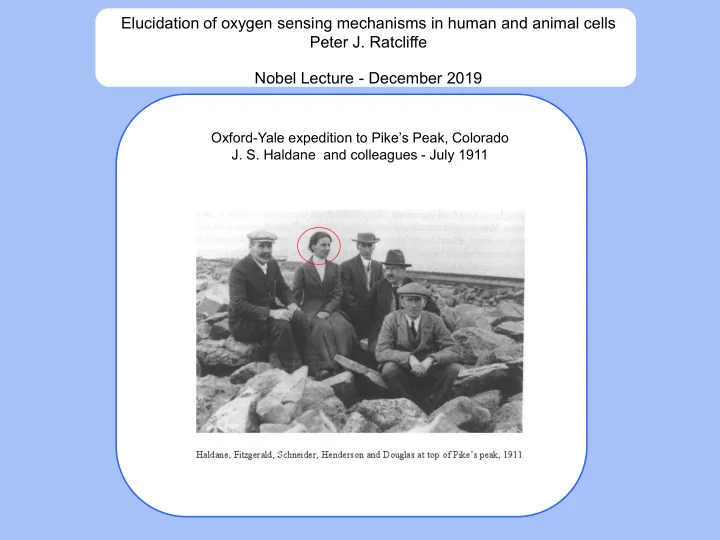
SLIDE 1 Oxford-Yale expedition to Pike’s Peak, Colorado
- J. S. Haldane and colleagues - July 1911
Elucidation of oxygen sensing mechanisms in human and animal cells Peter J. Ratcliffe Nobel Lecture - December 2019
SLIDE 2
SLIDE 3 Epo Sensor
O2
Extra-ordinary sensitivity of the erythropoietin response to changes in blood
availability – responses to donation of blood Lorentz et al. Transfusion 31 650-654 (1991)
SLIDE 4
Transgenic marker gene strategy indicates that erythropoietin producing cells are Interstitial fibroblasts
Development of a cellular model for study of Epo regulation by Oxygen
SLIDE 5 Mouse Epo gene Mapping of oxygen regulated oxygen sequences by transient transfection
reporter gene
Widespread operation of hypoxia signalling pathways
Oxygen sensitive cell
//
Oxygen insensitive cell
SLIDE 6
HIF
EPO
SLIDE 7
HIF-α
Gal4 DNA binding domain HSVP16 transactivator
Regulation of HIF by oxygen
Regulated protein stability Oxygen availability Cellular iron/cobalt HIF-α Regulated activity Signal
SLIDE 8 Sequencing the human genome suggests existence
Making anti-EPAS antibodies (PM9) proves regulation by oxygen Multiple hypoxia inducible transcripts identified Transcripts constitutively upregulated in VHL defective cells
VHL+ VHL-
Distortion from HIF-1 to HIF-2 during RCC development Role in Cancer Treatment by HIF-2 antagonists
Oxygen sensing pathway
SLIDE 9
HIF peptide
VHL
Treatment with cell extract
Signalling modification is prolyl hydroxylation
Biochemical analysis Heat labile extract Non-enzymatic oxidation NADH/NADHoxidase Oxygen Iron ATP
SLIDE 10
Iron
Proteolysis
O2
HIF-α Pro Hyp
VHL ubiquitin ligase Cobalt 2- oxoglutarate HIF prolyl hydroxylase HIF prolyl hydroxylation implies a mechanism of oxygen sensing
SLIDE 11
HIF prolyl hydroxylases - a set of Fe(II) and 2-oxoglutarate dioxygenases that are conserved throughout the animal kingdom
2 1 8 7 4 3 5 6
Fe(II)
SLIDE 12
O2
SLIDE 13
HIF-2 IHC HIF-2 mRNA
SLIDE 14
SLIDE 15 Funghi
Schizosaccharomyces pombe
Ofd1 - Prolyl 3 hydroxylase
SRE proteolysis Sterol response Protists
Dictyostelium discoideum
Prolyl 4 hydroxylase
Skp1 ubiquitin ligase Culmination factors Plants
Arabidopsis thaliana
Cysteine
MCxxx N-end rule Ethylene response factors
All eukaryotic kingdoms use protein oxidation and proteolysis to signal oxygen levels
Animals
Homo sapiens
Prolyl 4 hydroxylase
VHL ubiquitin ligase Hypoxia inducible factors
Protein Oxidation in Signalling hypoxia Evolutionary Origins?
SLIDE 16 A conserved oxygen sensing mechanism in plants and animals?
A.t. RAP2.12 GFP-V5
Oxygen dependent destabilizing sequences from Arabidopsis thaliana ERF transcription factor RAP-2.12 operate in human cells
SLIDE 17
Oxygen sensing by enzymatic protein oxidation
A conserved N-terminal cysteine dioxygenase regulates G-protein signalling in human cells
SLIDE 18 Pro
HI
HIF Prolyl Hydroxylases HIF tfs
ERF tfs
Cys N-terminal Cysteine Dioxygenases
R4
R4 - RGS
Cys G-protein (Gα) Signalling
Modulation and integration of oxygen sensing systems employing enzymatic protein oxidation linked to degradation
Acute oxygen sensing mechanisms?
SLIDE 19 Roxadustat, Fibrogen Vadadustat, Akebia Daprodustat, GSK
Clinical trials show efficacy of prolyl hydroxylase inhibitors in raising haemoglobin levels in pre-dialysis and dialysis patients HIF prolyl hydroxylase inhibitors (so far) show powerful effects on renal anaemia with little evidence of general activation of HIF
‘You can't always get what you want But if you try sometime you find You get what you need’
SLIDE 20
With grateful thanks!