SLIDE 1
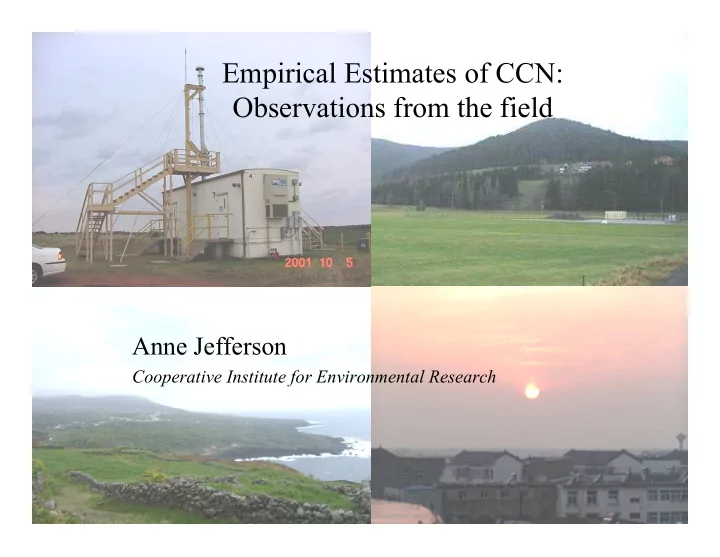
Empirical Estimates of CCN: Observations from the field
Anne Jefferson
Cooperative Institute for Environmental Research
SLIDE 2 Haywood and Boucher 2000
The aerosol influence on cloud radiative forcing (indirect forcing) is the largest uncertainty in current climate forcing models. Which aerosols activate to form cloud droplets is an important factor in reducing the indirect forcing uncertainty.
SLIDE 3 Cloud Condensation Nuclei (CCN) activation to water droplets Köhler Equation:
ln pw D
( )
p
# $ % & ' = ln S
( ) = 4Mw(w
RT)wD * 6nsMw +)wD
3
size chemistry
Need the size-dependent aerosol composition to determine the CCN activation properties Single hygroscopicity parameter: κ Petters and Kreidenweiss, ACP, 2007.
SLIDE 4 Observations of CN, CCN and scattering coefficient
CN and CCN number concentrations
- ften don’t correlate well.
CN number concentrations are highest at the smallest particle sizes which also have the shortest lifetime and are least likely to live long enough to form CCN.
SLIDE 5 The aerosol scattering coefficient, which follows the aerosol surface area and larger accumulation mode particles correlates better with CCN number concentrations.
CN and CCN number concentrations
- ften don’t correlate well.
CN number concentrations are highest at the smallest particle sizes which also have the shortest lifetime and are least likely to live long enough to form CCN.
SLIDE 6
Empirical methods for estimating CCN concentrations
Twomey power law, Pure Appl. Geophys., 1959
CCN(%ss) = C(%ss)
k
“C” scales with CCN number concentration. “k” scales with the particle solubility such that high k values have low solubility and highly soluble particles like sea salt have low k values. The power law fit doesn’t work well at high %ss as k increases with %ss. At low %ss values <0.1% the CCN instrument has kinetic limitations. Model CCN over range of %ss from ~0.2 to 0.8%ss.
SLIDE 7 Model approach: correlate CCN power law fit parameters to aerosol optical properties
C/σsp(450 nm) = m·BSF(450nm)+b Normalize C to σsp. Use backscatter fraction (BSF) as proxy
large small dark light
k =p·SSA(450 nm)+d Use single scatter albedo (SSA) as a proxy of the aerosol composition
SLIDE 8
Model results for Oklahoma (SGP)
Model predicts the measured CCN values using only the measured optical properties. Uncertainty is highest at low CCN concentrations when uncertainty in optical data is is highest. SGP is an agricultural region. The aerosol is mostly organic mixed with sulfate and nitrates. The aerosol is well behaved in that aerosol size and albedo are closely correlated. Other regions?
SLIDE 9
Correlation of C parameter to backscatter fraction
China has a high fraction of large dust particles The slope of C/σsp vs BSF is significantly smaller for marine aerosol and indicates an aerosol with a high scattering efficiency.
SLIDE 10
Correlation of k parameter to single scatter albedo
Changes in the aerosol absorption or “effective black carbon” have a weak influence on CCN formation for dust and sea salt aerosol.
Location k value (stdev) Oklahoma 0.73 (0.26) Black Forest 1.06 (0.65) China 0.76 (0.33) Azores 0.43 (0.42)
SLIDE 11
Model results from other sites
Method uses surface measurements of aged aerosol. Needs to be tested with remote measurements. Similar correlation of CCN to the aerosol index (AI) has been observed with surface and HSRL lidar measurements.