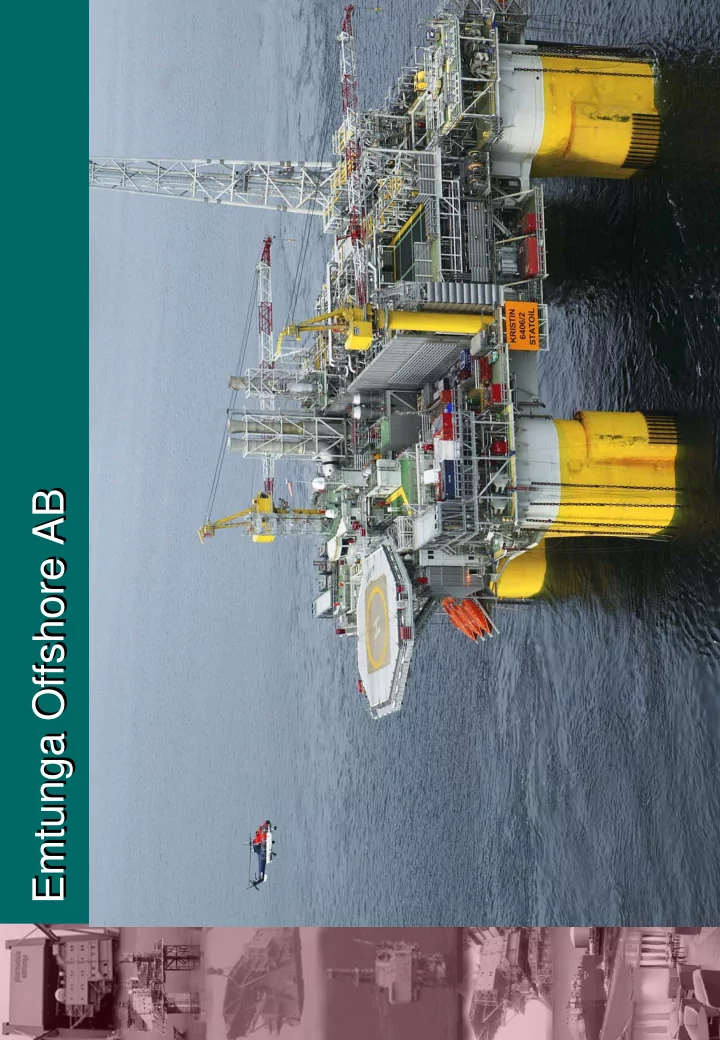
SLIDE 1
Emtunga Offshore AB Emtunga Offshore AB
SLIDE 2 Emtunga Offshore AB Emtunga Offshore AB
Lightweight construction application at sea LÄSS Lightweight in Living Quarters
SP, Borås, Sweden
31-OCTOBER-2007
Peo Svärd
SLIDE 3 Emtunga Offshore AB Emtunga Offshore AB
- What is a Living Quarter
- Fabrication - Modular concept
- Why lightweight
- Weight of a Living Quarter
- Weight saving in a Living Quarter
- Aluminum design
SLIDE 4 What is a Living Quarter? What is a Living Quarter?
- A living Quarter consists of:
– Accommodation for crew – Safe area (Fire/gas/blast) – Dining area – Recreation – Central Control Room – Airport (baggage handling, sky lobby, etc) – Medical center – Office – Galley – Laundry – 20-250 POB – 500-4000m2 – 250-2000 metric ton
SLIDE 5 What is a Living Quarter? What is a Living Quarter?
- Characteristics
- Assembly phase
- Load out
- Sea transport
- Installation (Lifting/skidding/etc.)
SLIDE 6 What is a Living Quarter? What is a Living Quarter?
Load out Helideck On barge
Installation
Testing
Sea tranport
SLIDE 7
Overview – Modular concept Overview – Modular concept
SLIDE 8
Overview – Modular concept Overview – Modular concept
SLIDE 9
Overview – Modular concept Overview – Modular concept
SLIDE 10
Overview – Modular concept Overview – Modular concept
SLIDE 11
Overview – Modular concept Overview – Modular concept
SLIDE 12
Overview – Modular concept Overview – Modular concept
SLIDE 13
Overview – Modular concept Overview – Modular concept
SLIDE 14
Overview – Modular concept Overview – Modular concept
SLIDE 15
Overview – Modular concept Overview – Modular concept
SLIDE 16
Overview – Modular concept Overview – Modular concept
SLIDE 17
Overview – Modular concept Overview – Modular concept
SLIDE 18
Overview – Modular concept Overview – Modular concept
SLIDE 19
Overview – Modular concept Overview – Modular concept
SLIDE 20
Overview – Modular concept Overview – Modular concept
SLIDE 21
Overview – Modular concept Overview – Modular concept
SLIDE 22
Overview – Modular concept Overview – Modular concept
SLIDE 23
Overview – Modular concept Overview – Modular concept
SLIDE 24
Overview – Modular concept Overview – Modular concept
SLIDE 25
Overview – Modular concept Overview – Modular concept
SLIDE 26 Why lightweight? Why lightweight?
– Increased capacity – POB – Modification – New regulations – HSE requirements (regulations/Company)
- Challenge – Cover all new requirements using
same support structure.
- This trend are global – Lightweight is
important
SLIDE 27 Why lightweight Why lightweight
- Investment in modification project in Norway
are expected to increase by near 100% next 8 years.
Modification market in Norway only
5 000 10 000 15 000 20 000 25 000 30 000 35 000 40 000 1996 1997 1998 1999 2000 2001 2002 2003 2004 2005 2006 2007 2008 2009 2010 2011 2012 2013 2014 2015 Million [SEK]
- This trend are global – Lightweight design has a
market
50% Production increase 25% HSE 25% Maintain integrity
SLIDE 28 Weight of a Living Quarter Weight of a Living Quarter
– Temporary construction phases – Blast requirements – Deformations – Fire and Gas requirements – Wall panels – External items (HD, staircases, walkways, platforms, laydown areas.
SLIDE 29 Weight of a Living Quarter Weight of a Living Quarter
Weight distribution in a LQ (typical)
– Structure – Temporary phases – Architectural – wall panels
Reference project 1000 ton Stressed skin by Emtunga Structure Archutect ural HVAC EIT Piping Total Exteral Items Helideck UDW 180 125 20 15 5 345 % 52 36 6 4 1 100 Weight 470 326 52 39 13 1000 40 60
SLIDE 30 Weight saving in a Living Quarter Weight saving in a Living Quarter
– High strength steel
- Applicable in a few areas since deformation is the
driver.
- Possible items is limited to lifting points/support
points.
– Aluminum
- 1/3:rd weight and 1/3 stiffness - equal?
- Form section properties that is suitable for
- deformation. d=5*qL^4/384/E/I
- The structure is approximately a factor of 3 more
expensive compared to steel
- Longer lead time
- Require more Passive Fire Protection
- Typical structural weight saving is 25% compared to
- steel. Overall weight saving is 12-13%
SLIDE 31 Weight saving in a Living Quarter Weight saving in a Living Quarter
– Saving is up to approximately 3 % – Generates questions from customer regarding references, certification, etc. but possible – Rule of thumb – heavy material good acoustic properties…….! – Can be adopted for both aluminum and Steel alternative
SLIDE 32 Weight saving in a Living Quarter Weight saving in a Living Quarter
- Temporary construction phases
– Newer accept that temporary phases adds on structural material that are dead weight during in-place operation – Focus on (Spend money on):
- temporary structures
- Lifting aids
- Installation aids
- Bottom lift
– Weight saving is ~6%
SLIDE 33 Weight saving in a Living Quarter
UPPER LATERAL SUPPORT FOR SEA FASTENING DURING TRANSPORT LOWER LATERAL SUPPORT FOR SEA FASTENING DURING TRANSPORT BASEFRAME VERTICAL SUPPORT FOR SEA TRANSPORT BARGE
Loadout Sea transport Installation
- Temporary construction phases
SLIDE 34 Weight saving in a Living Quarter
Bad example !!
- Temporary construction phases
SLIDE 35 Weight saving in a Living Quarter Weight saving in a Living Quarter
- Weight saving on hot spots
– Using aluminum structure ~13% – Temporary construction phases ~6% – Using light weight wall panels ~3% Total: ~22%
- It should be noted that additional weight
saving is possible in the support structure.
SLIDE 36 Aluminum design Aluminum design
- Focus on aluminum solution and wall
panels in LÄSS project
– New structural design adopted to modular construction (Emtunga) – Development in conjunction with SAPA
SLIDE 37 Aluminum design Aluminum design
- Basic panel alternatives investigated
– Extruded panels 400mm – FS welded – Both alternatives can be used as wall panel as well as floor
- panel. Final design decided in each individual project.
SLIDE 38 Aluminum design Aluminum design
- Basic panel alternatives investigated
– Both alternatives meet following criteria’s.
- Shear load of 550 kN/m
- Blast load of 30 kN/m2 as shown below
SLIDE 39 Aluminum design Aluminum design
- Basic panel alternatives investigated
Reference - Steel Solid panel Alt A Solid panel Alt B
SLIDE 40 Aluminum design Aluminum design
- Basic panel alternatives investigated
– Structural calculations and production feasibility study performed by SAPA shows following
- Possible weight saving of 40-50% in the panel
- Possible embedded feasibility to decrease fabrication time
SLIDE 41 Emtunga Offshore AB Emtunga Offshore AB
– Improve/verify/approve PFP design – Detail design – Temporary support structure for lifting and handling of each module
SLIDE 42
End of presentation! Questions? Thanks for listening!