Encouraging a Different View of Writing: Transitioning to a - - PowerPoint PPT Presentation

encouraging a different view of writing transitioning to
SMART_READER_LITE
LIVE PREVIEW

Encouraging a Different View of Writing: Transitioning to a - - PowerPoint PPT Presentation

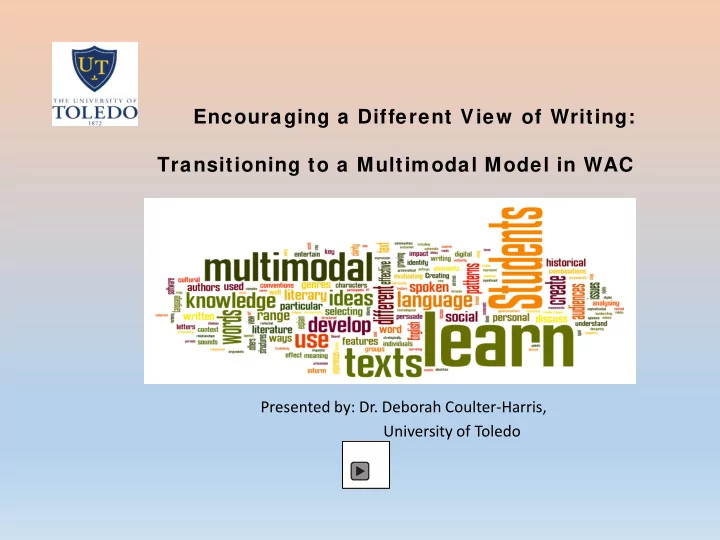
Encouraging a Different View of Writing: Transitioning to a Multimodal Model in WAC Presented by: Dr. Deborah Coulter-Harris, University of Toledo https://youtu.be/nDkkG0cEpHw 2 Introduction Increased focus on multimodal elements prepare


slide-1
SLIDE 1

Presented by: Dr. Deborah Coulter-Harris, University of Toledo

Encouraging a Different View of Writing: Transitioning to a Multimodal Model in WAC

slide-2
SLIDE 2

https://youtu.be/nDkkG0cEpHw

2

slide-3
SLIDE 3

Introduction

  • Increased focus on multimodal elements prepare students for jobs in

the real world.

  • How to meet these demands? redesign curriculums/assignments,

implement professional development workshops, take strategic action to educate faculty

  • Mr. Paul Conner: will argue that the subject matter in multimodal

WAC classrooms should be action-oriented: a poster session, website,

  • r graphic memoir.
  • connect with local communities in a call for action.
  • Dr. Anthony Edgington: Director of Composition at the University of

Toledo, will discuss methods writing program administrators can use to better educate experienced and novice writing instructors, along with themselves, about the value in creating a stronger focus on multimodal writing assignments in writing classrooms.

3

slide-4
SLIDE 4

The Argument: Writing to Compete

  • Generate innovative projects that engage creative, techno-literate, organic

capacities of new generation of writers.

  • Train relevant writers in competitive global environment.
  • New writing opportunities in future electronically-based.
  • Writers should incorporate new modes across WAC curriculums.
  • Future workplace writing demands multimodal inventions, integration of

visual genres/technologies.

  • Increased focus on multi-modal methods necessary for today’s classrooms:
  • Ability to synthesize/express ideas in exciting new ways.
  • Boosts students’ creativity and strengthens writing voice.

4

slide-5
SLIDE 5

Experiment beyond Conventional

  • Multimodal composition utilizes media other than print on

paper for communication and structure.

  • Blogs, PP presentations, poster sessions, creating and

writing about YouTube videos, Podcasts, visual arguments via PP slides, brochures etc.: other ways to make arguments and enter critical discourse. In multimodal composition, printed essay does not govern communications.

  • Multimodal composing: uses wide range of semiotic

resources, includes combination of images, sound, color, animation and text (Takayoshi, Hawisher, & Selfe, 2007,

  • pp. 1-12).
  • Cognitive and socially situated choices students

make in compositions today.

5

slide-6
SLIDE 6

Experiment beyond Conventional

  • Students across disciplines: knowing in literacy

capabilities:

  • embraced rapid changes in human

communication.

  • Future employments demand experiential learning:

focus on real world writing:

  • hyper-textual/multimodal in nature.

6

slide-7
SLIDE 7

Experiment beyond Conventional

  • Innovative, multimodal projects for business writing class:
  • Advertising portfolio includes: unsolicited sales

proposal, all types of original marketing documents, brochures, magazines, a DVD video mock-sales pitch, and PowerPoint presentations that includes music and YouTube videos of Toledo.

  • Another multimodal activity: advertising campaign to sell

product on the Home Shopping Network.

  • Students created sales pitch, wrote/filmed ad, posted to

YouTube, uploaded to new class Facebook page.

  • Process memo.

7

slide-8
SLIDE 8

Experiment beyond Conventional

  • Specialized Facebook pages for specific courses:
  • growing library of open-source information on specialized topics,
  • training ground in summarizing and analyzing information,
  • place to upload students’ self-produced videos on specified subject

matter,

  • tool to develop sophisticated, cogent, and respectful responses to
  • thers’ analytic comments and summaries of electronic texts,
  • place to build community among students,
  • lesson to analytically summarize the articles in preparation for

longer analytic research assignments.

  • Comments/responses to Facebook postings engaged students in further

analysis/ debate and taught them to take rhetorical position.

8

slide-9
SLIDE 9

Expe peri rimen ental F Faceb cebook Pages es

https://www.facebook.com/Composition-I-Global-Food-Water-and- Demographic-Crisis-419693638068075/ ** https://www.facebook.com/International-Information-Agency- 309947025711357/ https://www.facebook.com/CompIINaturalSciencesAndMedicine/ ** https://www.facebook.com/ScientificTechnicalWriting/

9

slide-10
SLIDE 10

Experiment beyond Conventional

  • Ancient orators knew importance of visual vividness.
  • In his Rhetoric, Aristotle describes importance of words/graphic

metaphors that “set the scene before our eyes,” defines graphic as “making your hearers see things.”

  • Aristotle defines rhetoric primarily as invention, “discovering the

best available means of persuasion,” and multimodal composing fosters expanded array of available means.

10

slide-11
SLIDE 11

Nurturing a Unique Voice

  • Cultivate authentic, organic, unique, creative writing voice.
  • Young writers force themselves to write in voice that is

pretentious, unnatural; perceived is expected in college classes.

  • Introduce multimodal discourse: Personal memory-narrative:

relies on a student’s unique avenue of expression, personal experience, and remembrance of past while employing alphabetic with other modes of expression.

  • original drawings that represented the scenes they had painted with their

words, blending painting and written expression together, or inserted graphic images from the Internet.

11

slide-12
SLIDE 12

Nurturing a Unique Voice

Multimodal Narratives teach students to:

  • embrace their linguistic

differences, but elevate linguistic choices;

  • develop a consciousness of

ethos and pathos;

  • select topics unique to their
  • wn experience;
  • write in a conversational

style;

  • develop creative visual texts

that respond to and integrate with the written word.

12

slide-13
SLIDE 13

Evolving Pedagogy

  • Coevolution among multimodal forms of communication and

writing projects in our WAC/WID courses that emphasizes varied modes of linguistic expression.

  • Addition of multimodal projects:
  • enriches student knowledge/analytic skills,
  • improves ability to convey meaning,
  • prepares them for real-world employment in a variety of disciplines,
  • allows students to compress meaning (i.e. to integrate the alphabetic with the

graphic).

13

slide-14
SLIDE 14

Evolving Pedagogy

  • Multi-modal writing should express:
  • an awareness of context, purpose, audience in students’ major disciplines and

selected future occupations.

  • Social contexts should also be a component in assessing a

multimodal assignment’s “effectiveness” (Inoue, 2005).

  • Faculty can grow standards for multimodal assignments;

assessment tools can evaluate the multi-elemental interrelationship of modes in a multimodal text such as:

  • clarity, persuasiveness, arrangement, choice of medium, use of imagery,

animation, layout, use of hyperlinks, use of and appeal to senses, and relevance within a specific social context.

14

slide-15
SLIDE 15

Evolving Pedagogy

  • Instructors should:
  • assess proficiencies students already possess regarding available,

multimodal means.

  • assist students in acquiring multimodal metalanguage that enhances,

improves, and coordinates with their basic literacy competencies.

  • Multimodal classroom - zone that connects to students’ real worlds.

15

slide-16
SLIDE 16

Evolving Pedagogy

  • Palmeri (2012, p. 156) concluded that multimodal writing:
  • stimulates innovative expression,
  • instructors should add multimodal composing into every class in students’

majors.

  • Palmeri defended multimodal composing as unique because it “employs a

process-based pedagogy that is specifically informed by the field of composition studies”(p. 157).

16

slide-17
SLIDE 17

Multimodal within Social Context

  • Encourages students to form perspectives and analyze

issues in contemporary society via multiple communication modes.

  • Writing from a multimodal perspective: “may well encourage

a critical rethinking and reformulation of the relationship between text and society” (Baldry and Thibault, 2006, p. 1).

  • Graphic elements in multimodal composing constitutive of

contemporary reality, but, according to Machin and Mayr (2015), they influence and preserve a society‘s ideologies (p.19).

17

slide-18
SLIDE 18

Multimodal within Social Context

  • Multimodal practice:
  • activates awareness of relationship among modes, learning, and identity.
  • allows pedagogy of multimodal composing to respond to the needs of students

from diverse backgrounds.

  • aligns with student-centered approach to teaching/learning that justifies fresh

forms of rhetorical invention that influence contemporary writing pedagogy.

18

slide-19
SLIDE 19

Concluding Argument: Suggesting Experimentation

  • Never been time in history when students had so many

rhetorical choices.

  • Multimodal writing:
  • amends concepts of scholarship in universities and colleges, particularly in

WAC/WID writing classes,

  • engagement in this form of writing elevates students’ interests and digital

abilities, validates their rhetorical choices, and amplifies social change and its influence on academia (Simon, Acostic, & Houtman, 2014, p. 66).

  • “Instead of writing to learn, composing to learn gives

space for multimodalities and engagements in the composing process that could support content engagement across disciplines” (Cole, 2015, p. 205).

19

slide-20
SLIDE 20

Concluding Argument: Suggesting Experimentation

  • Not proposing every WAC/WID or other course engage

every assignment as a multimodal activity.

  • Proposing that multimodal experimentation is needed.

Fin

20

slide-21
SLIDE 21

Contac act I t Information

  • Dr. Deborah M. Coulter-Harris

Department of English Language and Literature Telephone: 419-530-4416 Email: Deborah.coulter-harris@utoledo.edu Amazon Author’s Page with Bio: http://www.amazon.com/Deborah- M.-Coulter-Harris/e/B00E5LY54M

21