Endoscopic Carpal Tunnel Release Dr David Hildreth , Houston, TX. - - PDF document

endoscopic carpal tunnel release
SMART_READER_LITE
LIVE PREVIEW

Endoscopic Carpal Tunnel Release Dr David Hildreth , Houston, TX. - - PDF document

With Thanks to Endoscopic Carpal Tunnel Release Dr David Hildreth , Houston, TX. Dr Stuart Kirkham MBBS FRACS FAOrthA Hand & Upper Limb Surgeon Sydney, Australia . CTS epidemiology CTS Definition : MN compression neuropathy who


slide-1
SLIDE 1

Endoscopic Carpal Tunnel Release

Dr Stuart Kirkham

MBBS FRACS FAOrthA

Hand & Upper Limb Surgeon Sydney, Australia .

With Thanks to Dr David Hildreth , Houston, TX.

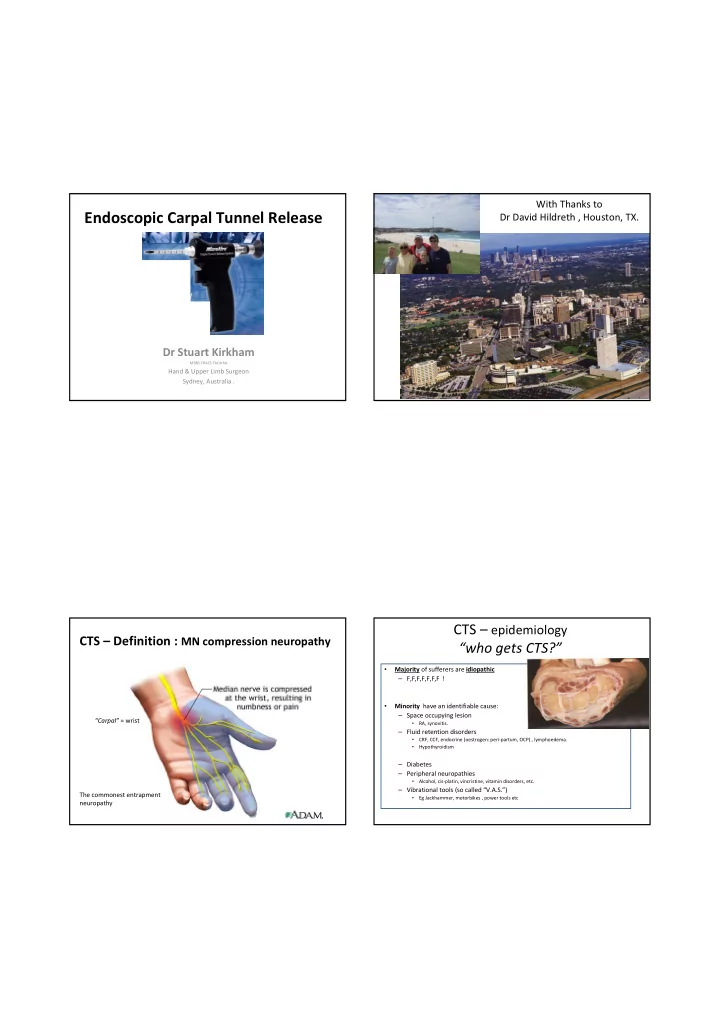
CTS – Definition : MN compression neuropathy

“Carpal” = wrist The commonest entrapment neuropathy

CTS – epidemiology “who gets CTS?”

  • Majority of sufferers are idiopathic

– F,F,F,F,F,F,F !

  • Minority have an identifiable cause:

– Space occupying lesion

  • RA, synovitis.

– Fluid retention disorders

  • CRF, CCF, endocrine (oestrogen: peri-partum, OCP) , lymphoedema.
  • Hypothyroidism

– Diabetes – Peripheral neuropathies

  • Alcohol, cis-platin, vincristine, vitamin disorders, etc.

– Vibrational tools (so called “V.A.S.”)

  • Eg Jackhammer, motorbikes , power tools etc
slide-2
SLIDE 2

CTS pathology

  • Either:
  • Tunnel gets smaller

– (attachments : scaphoid, trapezium, HH & pisiform).

  • Contents get bigger
  • Mismatch in size ; nerve suffers first
  • Compressed nerve

– Macro :

  • hyper, hypo – aemia
  • Thickened gritty FR/TCL.

– Micro

  • Demyelination – slower conduction of AP’s
  • Axonal degeneration
  • Axonal fibrosis

Idiopathic CTS – aetiology

  • Fuchs et al –

– biopsied tenosynovium from 177 wrists – = non inflammatory D

  • SK personal view
  • “multiplanar carpal chondral

degeneration” MCCD

  • decrease in size of

carpal tunnel.

Multiplanar Carpal Chondral Degeneration (MCCD)

Hypothesis :

  • Tunnel is reduced in 3D volume
  • Contents become compressed
  • Excitable tissue (median N) suffers first.
  • Sensory symptoms precede motor, +

assoc electrical changes.

  • Path changes eg demyelination are

reversible at first

  • Later become irreversible , eg axonal

fibrosis

  • Symptoms may even subside in the later

stages.

Clinical Findings

Dx is largely clinical & takes some experience:

Recognised variation in Dx accuracy between hand surgeons, orthopods, hand therapists, students, physios, nurses & GP’s & other allied.

  • History

– Nocturnal, sleep, shakes, car, kitchen, clumsy – Responds to splinting – Duration worth noting.

  • Physical

– Derkan’s, Phalen’s , Tinel’s. – Locates mechanical irritation of MN @ wrist. – Quite likely correlates with Px.

  • NCS

– I Ix on (a) malingerers/WC, (b) diagnostic dilemnas, (c) re-dos. – Sensory : N=55m/s; 45 bad ; 35 severe. – Motor : late changes. severe CTS disease.

slide-3
SLIDE 3

Physical findings

Sensitivity Specificity Derkan’s compression test 0.87 0.90 Phalen’s test 0.75 0.47 Tinel’s sign 0.60 0.67

  • Diagnosis is clinical.
  • Semmes-Weinstein 2-point sensory mapping has

limited value in diagnosis or monitoring of CTS .

  • The likelihood of a correct diagnosis correlates with

the experience of the examiner.

Non operative Rx

  • Splints

– Good data , provides relief but cumbersome.

  • Steroids
  • Short term relief with high recurrence rates

BMC Fam Pract. 2010 Jul 29;11:54. Randomised controlled trial of local corticosteroid injections for carpal tunnel syndrome in general practice. Peters-Veluthamaningal C, Winters JC, Groenier KH, Meyboom-de Jong B

  • Not supported by Fuchs et al

J Hand Surg Am. 1991 Jul;16(4):753-8. Synovial histology in carpal tunnel syndrome. Fuchs PC, Nathan PA, Myers LD.

  • NSAID’s
  • Rest/activity modification

Surgical Rx

  • More cost effective than a trial of Non-op-Rx

in NCS + proven cases of CTS.

J Hand Surg Am. 2009 Sep;34(7):1193-200. The cost-effectiveness of nonsurgical versus surgical treatment for carpal tunnel syndrome. Pomerance J, Zurakowski D, Fine I.

  • OCTR
  • ECTR

–Single portal –eg Agee/Microaire CTRS –Double Portal

OCTR vs ECTR

  • Single portal ECTR Avoids

incision at Glabrous skin

  • ECTR associated with

– Less post op pain

  • Less use of analgesics

– Faster recovery times

  • In WC & non WC patients
slide-4
SLIDE 4

Movie : Open neurolysis OCTR before & after tourniquet release Open vs Endoscopic

Glabrous skin Greater post op induration Non- glabrous skin Less pain Faster recovery (WC & non WC pts)

slide-5
SLIDE 5

Dr John Agee ; Sacramento CA Microaire Pty Ltd

Single portal ECTR:

  • Mark 1 instruments c 1995 ??
  • Mark 2 instruments c 1998 ??

Prior to TCL/FR division.

Post TCL/FR division

“The safe zone”

Surgical technique The safe zone

slide-6
SLIDE 6

The safe .

  • The surface anatomy is only a rough guide.
  • The blunt instruments are passed blind using

surface anatomy & palpation.

  • The endoscope is advanced under vision - only

as far as the distal edge of the TCL.

  • the scalpel is deployed under endoscopic vision

which allows you to avoid the nerves and vessels.

  • Do not cut what you cannot see !
  • If you lose vision, convert to OCTR. Eg severe

tenosynovitis.

Single portal ECTR technique

  • Surgical goals :
  • 1. Completely Divide TCL (FR),distal to

proximal .

  • 2. Avoid :
  • SPA
  • MN- Branch to 3rd web space
  • Superficial palmar veins

Surface anatomy ; planning skin incision.

Palmar veins are variable. Can bleed post op causing potential adhesions.

Kaplan’s line safe zone surg technique

slide-7
SLIDE 7

Kaplan’s Cardinal Line

Finds :

  • Thenar motor br
  • Hook of hamate
  • Distal edge of the TCL

(FR).

Surface anatomy ; planning skin incision.

PCBMN is most likely pranged during skin incision and not by the endoscope. Incision is ulnar to PL. The diagram exaggerates true position of PCBMN.

Video: JS Video: Mrs NH

slide-8
SLIDE 8

2 weeks

Bruising is common

4 weeks 6 months 6 months

slide-9
SLIDE 9

6 months Post op regime

  • Naropin ; & +/- Celestone .
  • Soft bandage , no slab or splint.
  • No hand therapy
  • Active ROM
  • Drive car on day 1
  • RTW

– Office : 3 days – Manual labour : 4 weeks. – Self employed pts : RTW 1-2 days.

  • ROS 2 wks
  • Only see again if having problems.

3 phases of “getting better” after ECTR

  • 1. Nerve decompression
  • Immediate
  • “I slept better that night & ever since”
  • 2. Wound healing
  • Measured in weeks
  • Skin, TCL wound, bruise,
  • Gripping & leaning sore for ~ 3-4 weeks.
  • 3. Nerve regeneration
  • Slow; measured in 1-2 years.
  • Cell bodies at DRG manufacture proteins ; axonal transport.
  • Limited by :

– (a) pre-op severity of CTS – (b)Duration of CTS – (c) comorbidities.

Variations of thenar motor branch.

All of these should be avoided by the suggested ECTR single portal technique. I personally have had nil iatrogenic nerve lacerations. The nerve most likely to lac is the CDN to the 3rd web space , not the thenar motor br.

slide-10
SLIDE 10

Ulnar nerve Variations

A : Riche-Cannieu anastamosis – motor fibres of

UN & MN communicate at wrist. FPB supplied by UN in 77% cases.

B: communicating sensory brr between UN & MN at the palm. C: variant lumbrical motor supply A>B, but not C : could pose problems during either ECTR or OCTR.

Variations in Arterial anatomy

35%

39%

4%

1% 16% 5%

Problematic aa in up to 10% of pts.

Variations in tendons –FCR

Type D is the

  • nly type likely

to be relevant to CTS .

Variations in tendons – PL

PL is a highly variable m. Absent in 10% population Palmaris profundus (F) may pass through the C tunnel & attach to the deep surface of palmar aponeurosis.

slide-11
SLIDE 11

Abberant PL muscle

Feint blue discolouration pre op = m

Abberant PL muscle Mrs Marion B 45 yo F

Outcomes

  • 95-99% G/E results:

– Mild will often fully recover median n sensation – Mod some full, some partial – Severe usually partial ; will usually report less nocturnal sx

  • Outcomes are probably determined by :

– Pre op severity of CTS – Pre op duration of Sx – Comorbidities , ….ability for n regeneration – Surgical avoidance of iatrogenic injury – Post op bleeding & adhesions *

  • 2002
  • 192 hands
  • Prospective RCT

multicenter

  • 1 year f/u
  • ECTR :
  • better functional
  • Less pain
  • Less symptoms

severity score

  • Shorter Return to

work

slide-12
SLIDE 12

Complications of ECTR (& OCTR)

Short-lived :

  • Bruising, bleeding . (palmar vv)
  • Pain on gripping , opposing – rel N.
  • Pillar Pain
  • RSD

More problematic/ongoing :

  • Scarring , tethering, fibrosis – progressive nerve strangulation !!
  • Iatrogenic injury to anatomy : nn,aa,tt,vv.

» Everything has been reported for ECTR & for OCTR

  • Infxn – uncommon.

“Pillar pain”

  • Can occur after ECTR or OCTR.
  • FR/TCL has been divided.
  • Thenar & hypothenars take partial
  • rigin from FR.
  • Muscles are de-stabilised.
  • Altered resting tension, resting

sarcomere lengths.

  • Typical symptom is pain/ache with

active use eg gripping.

  • Improves typically at 6-8 weeks, due

to ? Re-scarring , re-forming a new elongated TCL/FR. ????

Re-do’s after ECTR

  • 6 / 1200 cases
  • 3 had abberant muscles

» 1 revised , improved . » 2 observed, improved. » slower than ave pts ; recommend observe 12 /12

  • All others (n= 5) for scarring , bleeding
  • Of the 6 revised to OCTR :

– 5 improved cf 1st op – happy. – 1 not improved ; remains unhappy after 2 ops – (after that he had a successful contra-lateral ECTR) !!

How I Mx a failed ECTR or OCTR

  • Important : acknowledge pts ongoing sx .
  • Re-assess for
  • neck, pronator,
  • other medical causes.
  • MRI –

– to see if you’ve missed a Dx – Space occ lesion . Ganglion. Etc – Comments about nerve unreliable ?

  • NCS – baseline for future
  • Re-explore via OCTR, not ECTR.
slide-13
SLIDE 13

Interestingly

  • We believe that the TCL/FR regenerates or

heals in some newly elongated fashion, maintaining the newly dilated , more- voluminous carpal tunnel.

  • In majority of cases this causes no problem.

Thank you. Dr Stuart Kirkham Endoscopic carpal tunnel surgery