Energy Savings & Reduced Emissions in Combined Natural & - PowerPoint PPT Presentation
Energy Savings & Reduced Emissions in Combined Natural & Engineered Systems for Wastewater Treatment & Reuse: The WWTP of Antiparos Island, Greece P M. M. St Statha hatou, P . Dedousis, G. Arampatzis, H. Grigoropoulou & D.
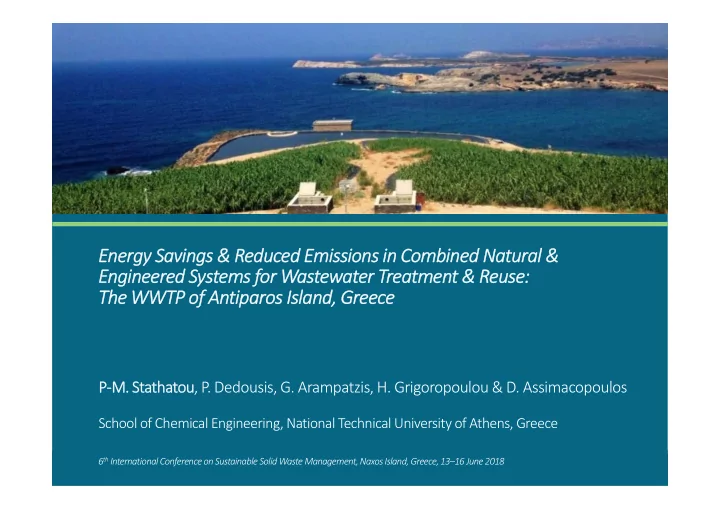
Energy Savings & Reduced Emissions in Combined Natural & Engineered Systems for Wastewater Treatment & Reuse: The WWTP of Antiparos Island, Greece P ‐ M. M. St Statha hatou, P . Dedousis, G. Arampatzis, H. Grigoropoulou & D. Assimacopoulos School of Chemical Engineering, National Technical University of Athens, Greece 6 th International Conference on Sustainable Solid Waste Management, Naxos Island, Greece, 13–16 June 2018
Europe’s water service providers struggling to deliver improved & affordable water services ◦ Continuous population growth Why ◦ Climate change Combining Natural & Natural water treatment processes Engineered Ecological & socio ‐ economic advantages over purely • engineered systems Treatment ◦ Lower operational costs & energy requirements Systems? ◦ Conservation of natural environment ◦ Zero visual obstruction Performance limitations • ◦ Low temperatures ◦ Space restrictions ◦ Long residence times ◦ Flow variations during floods and droughts Combination of natural with engineered treatment processes to overcome limitations, improve performance & increase treatment resilience of natural processes
Research on Combined Natural & Engineered Treatment Systems (cNES) Investigating & assessing the potential advantages of cNES over purely engineered treatment systems in delivering safe, reliable and efficient water services Aim of the study ◦ Assess cNES advantages for wastewater treatment and reuse, focusing on the energy savings and the reduction of GHG emissions ◦ Demonstrate the feasibility of cNES to obtain water for irrigation of public spaces in isolated insular communities and small municipalities
The Study Site Area
Antiparos Island, Greece Location & Administration ◦ Located in the Cyclades complex of the Aegean sea ◦ Area: 35.10 km 2 ◦ Permanent population: 1,211 inh. (cencus 2011) ◦ Seasonal residents & tourists: 1,000 (2012) ◦ Administration: Municipality of Antiparos ◦ Public entity ◦ Part of the Regional Unit of Paros The Problem of Untreated WW ◦ Drivers ◦ Lack of infrastructure ◦ Isolated location ◦ Rapid tourism development ◦ Impacts on natural & socio ‐ economic environment Location of Antiparos Island, Greece ◦ Groundwater & marine contamination ◦ Development issues & impacts on tourism ◦ Suggested Solution ◦ The WWTP of Antiparos
The WWTP of Antiparos Island ◦ Constructed in May 2015 for the treatment & reuse of municipal wastewater ◦ Located at Sifneikos Gyalos ◦ Area: 28,400 m 2 ◦ Mean daily design capacity (year 2035) ◦ 240 m 3 /d during winter (1,500 p.e.) ◦ 480 m 3 /d during Location of the Antiparos WWTP (Source: Google Earth, 2018) summer (3,000 p.e.)
Flow Scheme of the Antiparos cNES
The Adopted Methodology
1. Modeling of the Antiparos cNES (Baseline Scenario) ◦ Integrating software modelling & Hydraulic and Pollution Loads Entering the Antiparos cNES simulation environment (Source: Egnatia S.A, 2012) ◦ Building a cNES by integrating libraries Parameter Unit Winter Summer for the modeling of engineered & P.E. # 1,500 3,000 natural treatment processes & their interactions m 3 /d Mean daily flow 240 480 ◦ Evaluating the quantity & quality of kg/d 90 180 BOD 5 wastewater, the generated sludge & mg/L 375 375 emissions, the energy consumed & the chemicals used kg/d 105 210 TSS mg/L 438 438 kg/d 18 36 ◦ Model assumptions TN mg/L 75 75 ◦ Winter duration: 8 months (245 days) kg/d 3 6 ◦ Summer duration: 4 months (120 days) TP mg/L 13 13 ◦ Generated sludge at pre ‐ treatment E. Coli #/100 mL 10,000,000 10,000,000 stage: 0.03 L/m 3 T o C 14 22 ◦ Primary sedimentation: 55% reduction of TSS and 35% reduction of BOD 5
The Model of the Antiparos cNES (Baseline Scenario)
Assessment of the Antiparos cNES (Baseline Scenario) ◦ Treatment performance was Provisions of the Greek Water Reuse Legislation for the reuse of treated effluents for unrestricted irrigation assessed in both winter & summer (Source: CMD 145116/2011) conditions Reuse of treated effluents for restricted irrigation ◦ Estimation of pollutant removal of Minimum each treatment process Required Secondary biological treatment Treatment & disinfection ◦ Assessment of the ability of the Level system to achieve the required quality limits E. Coli ≤ 200 EC/100mL • ◦ Greek Water Reuse Legislation (CMD (median) Required 145116/2011) for the reuse of BOD5 ≤ 25 mg/L treated effluents for unrestricted Quality • irrigation Limits TSS ≤ 35 mg/L • TN ≤ 45 mg/L •
2. Design of an Activated Sludge Process for the Antiparos WWTP (Alternative Scenario) Biological Kinetic Parameters Set for the Design of the CAS System (Adapted from Dimopoulou, 2011) ◦ Substitution of CWs & Parameter Unit Winter Summer stabilization pond with a conventional activated Cell residence time in aeration tank, θ C,A days 10.00 5.00 sludge process (CAS) Mixed liquor suspended solids, MLSS mg/L 3,500.00 3,500.00 ◦ Anoxic tank for effluent nitrification / denitrification Dissolved oxygen, DO mg/L 2.50 2.50 ◦ Aeration tank ‐ bioreactor days ‐ 1 Max het. growth rate for T 20 oC, μ H,max,20 7.00 7.00 ◦ Submerged aeration diffusers Constant, k H ‐ 0.07 0.07 ◦ Secondary clarifier ‐ settling Monod saturation constant, K SH mg/L 120.00 120.00 tank days ‐ 1 Het. decay rate coef. in endogenous resp., b H 0.06 0.06 Het. yield coe ffi cient, Y H kgVSS/kgBOD 5 0.65 0.65 ◦ The CAS was designed to achieve the same effluent Max. autot. growth rate for T 20 oC, μ N,max,20 days ‐ 1 0.60 0.60 quality with the CWs Constant, k N ‐ 0.12 0.12 ◦ BOD5, TSS, TN and TP Monod saturation constant, K SN mg/L 0.50 0.50 Monod half ‐ saturation constant of DO, K DO mg/L 0.50 0.50 ◦ The whole system was Autotrophic decay rate coefficient, b N days ‐ 1 0.05 0.05 modelled to reach the same Autotrophic yield coe ffi cient, Y N kgVSS/kgBOD 5 0.15 0.15 effluent quality at the outlet with the baseline scenario % of inert SS entering the biological reactor, α kgVSS/kgBOD 5 0.10 0.10 % of inert suspended het. bacteria, β kgVSS/kgBOD 5 0.20 0.20 ◦ BOD5, TSS, TN, TP, and E. Coli VSS/TSS ratio 0.70 0.70 -
The Model of the Antiparos WWTP (Alternative Scenario)
3. Calculation of Energy Consumption Baseline Scenario Alternative Scenario ◦ Energy consumption recorded by the ◦ Only the energy consumption of the electricity meter box of the plant (kWh) aeration tank was considered (following for the first 30 months of operation the approach of Dimopoulou, 2011) ◦ Estimated that CWs contribute about ◦ Calculation of daily & annual energy 10% to the total energy consumption of consumption for WW aeration (kWh/d the plant & kWh/yr.) ◦ Power needed for their feeding system ◦ Aeration flow requirement ◦ Selection of submerged aeration diffusers of suitable capacity for air diffusion in the aeration tank ◦ Aeration blower power requirements for the selected submerged aeration diffusers
4a. Calculation of On ‐ Site GHG Emissions On ‐ site GHG emissions are generated by the biological treatment processes Baseline Scenario ‐ CWs Alternative Scenario ‐ CAS ◦ CH 4 emissions in methanogenesis ◦ CO 2 emissions from biomass decay and oxidation ◦ Organic material load in CWs ◦ N 2 O emissions from denitrification ◦ N 2 O in nitrification / denitrification of N processes compounds by microorganisms ◦ TN load in CWs ◦ The IPCC (2014) GWP values relevant to CO 2 for 100 ‐ year time horizon were considered ◦ CH 4: 28 ◦ N 2 O: 265
4b. Calculation of Off ‐ Site GHG Emissions Off ‐ site GHG emissions are generated by the production of the electricity consumed by the plant Fuel Mixture for Greece in 2017 & GHG Emission Factors (Source: Public Power Corporation S.A. Hellas, 2018; Shahabadi et al., 2009 ) Production Units & Interconnected System Non ‐ interconnected GHG Emission Factor Interconnections (%) System (%) (gr CO 2 e/kWh) Lignite 30.85 0.00 877.00 Oil 0.00 82.39 604.00 Natural Gas 31.01 0.00 353.00 Hydroelectric 6.51 0.00 0.00 Renewable 19.89 17.61 0.00 Interconnections 11.74 0.00 0.00 Total 100.00 100.00 ‐ ◦ Antiparos island was considered to be part of the non ‐ interconnected system
Assessment Results
1. Treatment Performance of the Antiparos cNES (Baseline Scenario) ◦ Substantial contribution of CWs in the treatment ‐ significant pollutant reduction ◦ BOD5 96% ◦ TSS 98% ◦ TN 77% ◦ TP 14% ◦ Pathogen elimination by combining CWs, maturation pond & disinfection ◦ 88% of pathogens were removed after CWs ◦ 96% of pathogens entering the stabilization pond were removed ◦ The limits of the Greek Reuse Legislation for restricted irrigation are met ‐ reliable performance of the system
Pollutant Removal in the Antiparos cNES
E. Coli Removal in the Antiparos cNES
Recommend
More recommend
Explore More Topics
Stay informed with curated content and fresh updates.