Engaging 2 nd , 3 rd and 4 th Generation Diaspora Members - - PDF document

engaging 2 nd 3 rd and 4 th generation diaspora members
SMART_READER_LITE
LIVE PREVIEW

Engaging 2 nd , 3 rd and 4 th Generation Diaspora Members - - PDF document

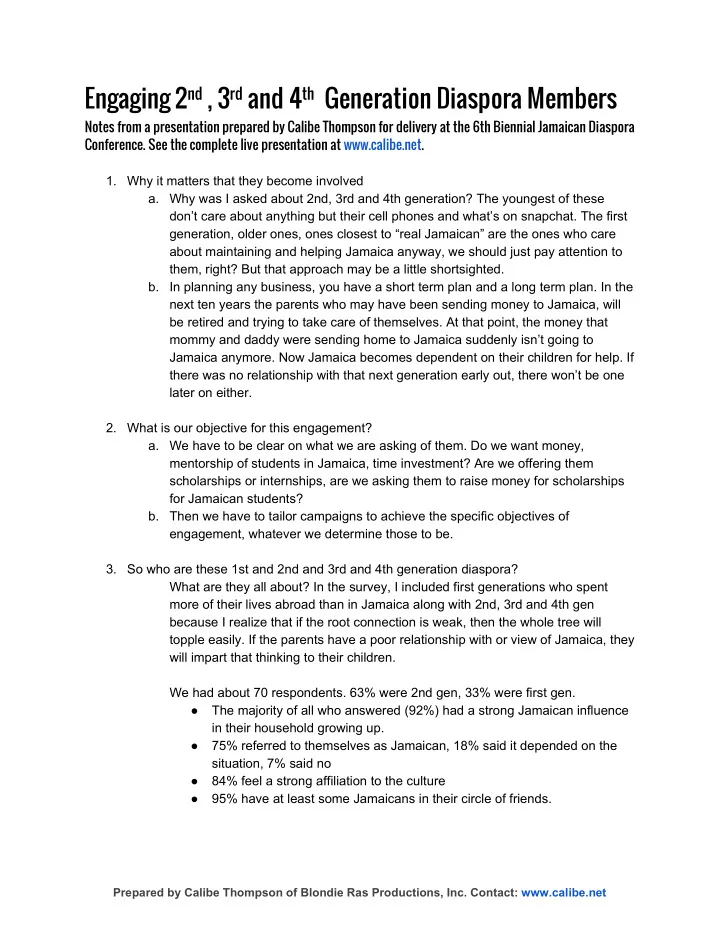
Engaging 2 nd , 3 rd and 4 th Generation Diaspora Members Notes from a presentation prepared by Calibe Thompson for delivery at the 6th Biennial Jamaican Diaspora Conference. See the complete live presentation at


slide-1
SLIDE 1

Engaging 2​nd​ , 3​rd​ and 4​th​ Generation Diaspora Members

Notes from a presentation prepared by Calibe Thompson for delivery at the 6th Biennial Jamaican Diaspora

  • Conference. See the complete live presentation at ​www.calibe.net​.

1. Why it matters that they become involved a. Why was I asked about 2nd, 3rd and 4th generation? The youngest of these don’t care about anything but their cell phones and what’s on snapchat. The first generation, older ones, ones closest to “real Jamaican” are the ones who care about maintaining and helping Jamaica anyway, we should just pay attention to them, right? But that approach may be a little shortsighted. b. In planning any business, you have a short term plan and a long term plan. In the next ten years the parents who may have been sending money to Jamaica, will be retired and trying to take care of themselves. At that point, the money that mommy and daddy were sending home to Jamaica suddenly isn’t going to Jamaica anymore. Now Jamaica becomes dependent on their children for help. If there was no relationship with that next generation early out, there won’t be one later on either. 2. What is our objective for this engagement? a. We have to be clear on what we are asking of them. Do we want money, mentorship of students in Jamaica, time investment? Are we offering them scholarships or internships, are we asking them to raise money for scholarships for Jamaican students? b. Then we have to tailor campaigns to achieve the specific objectives of engagement, whatever we determine those to be. 3. So who are these 1st and 2nd and 3rd and 4th generation diaspora? What are they all about? In the survey, I included first generations who spent more of their lives abroad than in Jamaica along with 2nd, 3rd and 4th gen because I realize that if the root connection is weak, then the whole tree will topple easily. If the parents have a poor relationship with or view of Jamaica, they will impart that thinking to their children. We had about 70 respondents. 63% were 2nd gen, 33% were first gen.

  • The majority of all who answered (92%) had a strong Jamaican influence

in their household growing up.

  • 75% referred to themselves as Jamaican, 18% said it depended on the

situation, 7% said no

  • 84% feel a strong affiliation to the culture
  • 95% have at least some Jamaicans in their circle of friends.

Prepared by Calibe Thompson of Blondie Ras Productions, Inc. Contact: ​www.calibe.net

slide-2
SLIDE 2

According to research conducted by Garth Rose in the South Florida community, next gens are:

  • Strong users of social media
  • Weak supporters of Caribbean media
  • Not interested in Jamaican politics (Turned off by (old) age of Jamaican

politicians)

  • Visitors to Jamaica regularly for fun and recreation

4. Their current thoughts toward the home island

  • 56% relate to Jamaica but don’t want to live there, 32% think of it as

home, 12% are pretty much removed

  • Over 93% would want to visit occasionally or frequently. Only 3% wanted

to live there.

  • Only 25% would certainly consider moving there.
  • 41% would buy a home there even if they weren’t living there, 34% would

consider it. 5. I was asked to zero in on media, and how to engage them with media. So my first question to them is, what engages them now?

  • Bearing in mind that most were in the 25 ­ 44 year old range, 90% used

FB regularly, 48% were often on instagram, youtube was only 29%. The really young ones use Snapchat.

  • 69% like to read but they read blogs and magazines, NOT newspapers
  • 85% read news and current events, 40 / 47% read Caribbean news and

business

  • 76% like to watch video. Most popular is youtube and online viewing

(69%). Cable and Netflix type platforms are equally popular (49 ­ 53%)

  • Over 70% watched News, Movies, documentaries and comedies
  • 70% like to listen to radio.
  • Over 55% liked online radio, Only 38% liked terrestrial radio, Satellite

radio was the least favorite

  • Urban and Caribbean music were most popular at 74%, adult

contemporary 56%, Caribbean talk radio 12.5% 6. How we have traditionally approached outreach and how might we change our thinking to facilitate this audience (new media, community outreach where they are, “cooler” ambassadors) In South Florida where I am from, to engage the Caribbean audience, most advertisers go to the print media and Caribbean talk radio. But they aren’t getting listenership or readership from 2nd generation, or even long staying 1st generation.

Prepared by Calibe Thompson of Blondie Ras Productions, Inc. Contact: ​www.calibe.net

slide-3
SLIDE 3

Again, we cannot take the attitude that if they want the information they should go and look for it. If you want to sell chicken, you don’t open a store, cook it and then say if people are hungry, they should come and look for you. You will lose all your business to Island Grill and KFC. Roll your jerk pan into the biggest dance and set up right in front! Go where your clients are. Perhaps we should try reaching next gens through Facebook and instagram where most daily interaction happens, blogs and online news magazines, ENGAGING youtube videos (they won’t watch it just because you recorded it), urban and caribbean radio, which might mean underground or pirate stations, but if you want the audience, that’s where they are. That is how Best of the Best got

  • ver 10 thousand patrons inside of Bayfront Park.

Naisha from Urban Relations Marketing who is the main South Florida promoter

  • f that event, which in fact also pulls patrons from North Florida, Georgia and the

NY markets, suggests the following:

  • Engage the parents ­ they have tremendous influence over their kids
  • Face to face is the best forum to reach them, but it can’t be BORING
  • Have younger celebrities or community leaders ­ their stars and

influencers ­ address them in their own language. They don’t care about politicians and dignitaries.

  • Reach out through the colleges. The Florida Caribbean Students’

Association is very strong.

  • The streets make an impact. Promote diaspora initiatives with street

teams at parties and events just like you would any other event. (Banners at events, posters and fliers at restaurants etc) Directly from participants, feedback on engagement reflected:

  • Over 90% were excited or open to learning more about diaspora

engagement

  • 27% said they couldn’t think of anything that would engage them more

with Jamaica

  • They want quality representation on major overseas media
  • They want to see more tolerance for the LGBT community.
  • Less discrimination by older diaspora and Jamaicans­by­birth against

expats or those who weren’t born there

  • Better use of intellectual capital of Jamaicans and expats, not just looking

at them as an ATM that should spit out money and not be concerned about how it is used. They feel their professional and technical skillsets are underutilized.

  • Less galas, expensive events and church focused events, and more

events that engage youth where they are

  • Appeal to people by age group and or area of interest rather than taking a
  • ne size fits all approach.

Prepared by Calibe Thompson of Blondie Ras Productions, Inc. Contact: ​www.calibe.net

slide-4
SLIDE 4
  • Internships and job opportunities ­ Ex. Grace and their Birthright Program
  • Only 2 participants said they already felt engaged

What do they think about current diaspora engagement activities?:

  • 74% had never even heard of any. The others thought they were okay, or

they were disillusioned. Only 8% had a favorable response. 7. How media can help to facilitate engagement (online, video based, engagement through personalities in entertainment)

  • There is NO authentic media outlet for the Caribbean in South Florida. No

real TV station or TV block of time, and no real FM radio station.

  • Many respondents also suggested increased media reach. Podcasts,

youtube and iTunes videos, various content to let people know why they should come back and what there is about Jamaica to be proud of. We see so many videos telling tourists why they should come to Jamaica, selling Jamaica to them. Think of the next generation the same way. We have to create content that sells Jamaica to them, or else they too will become tourists only.

  • Specifically ­ Tap into what they watch, listen to or attend
  • To get the viral element, look at the sites younger people watch and

share, Buzzfeed and Vice News are two examples. Model your messages in that way. Short and entertaining. Gleaner minute news format will not cut it for this audience.

  • Create message videos that get to the heart of your issue ­ like the

UNICEF video showed at the South Florida Town Hall.

  • Engage Majah Hype and Bella Blair, Machel Montano, Etana and

Chronixx and such to deliver your messages. Did you see President Obama with the selfie stick and Between two Ferns, and on all the nightly comedy shows promoting healthcare? Go where the young people are and stop worrying about how dignified you won’t look. 8. Answering the question “what does Jamaica have to offer me?”

  • Stop asking for investment without thinking that people should want a
  • return. That is called charity. Jamaica should not be a charity cause, it

should be an investment. And investments yield returns.

  • Some people will want a financial return if they are investing hard dollars.

Others are happy to know that they sent a pencil, and a deserving child received it. But they need to trust and know that their investment did not line an unscrupulous person’s pocket or rot on the wharf because it couldn’t be cleared.

  • Make it easier and safer to do business there. One person suggested ­

Create demands outside of tourism. Is there any other business to invest in? What is that?

Prepared by Calibe Thompson of Blondie Ras Productions, Inc. Contact: ​www.calibe.net

slide-5
SLIDE 5
  • Overall safety is an issue. If crime, health care and emergency services

are lacking, people will not want to make an investment in the country.

  • They want to be shown that the country is investing in the youth so that

their investment might possibly have a future

  • They want Jamaica to stop putting short term gain (a road or a bridge)

ahead of the long term benefit (enforcing employment minimums for qualified Jamaicans) Now, perhaps some of the impressions we have overseas are not true, but if they are wrong, I challenge you to tell us that. Don’t ask us to go searching for the information. Deliver it to us where we are. One person said SPOON FEED it to us. That is how you’re going to reach the next generation

Prepared by Calibe Thompson of Blondie Ras Productions, Inc. Contact: ​www.calibe.net