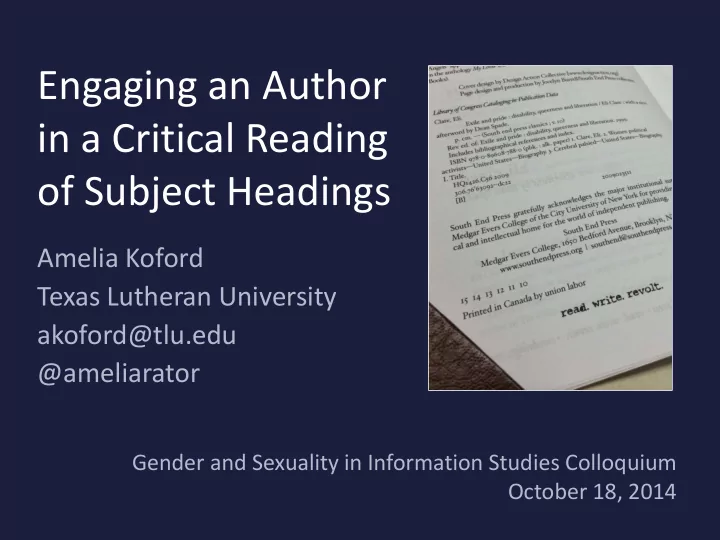
SLIDE 1 Engaging an Author in a Critical Reading
Amelia Koford Texas Lutheran University akoford@tlu.edu @ameliarator
Gender and Sexuality in Information Studies Colloquium October 18, 2014
SLIDE 2
SLIDE 3
Critiques of Subject Access Standards
SLIDE 4 Davis and Davis, Mainstreaming Library Service for Disabled People, 1980
SLIDE 5
- Inherent limitations of subject
access
- What to do?
- Campaign for change
- Tagging and other technologies to
supplement headings
- Acknowledge bias
- Use as teaching tool
SLIDE 6
SLIDE 7 http://eliclare.com/
SLIDE 8 1. Clare, Eli 2. Women political activists – United States – Biography 3. Cerebral palsied – United States – Biography
SLIDE 9
“What I...remember is opening the book…and noticing the subject headings and thinking, ‘What in the world is this? Have they really read the book?’ And moving on from there.”
SLIDE 10
- Inviting authors to engage
- Inadequacies in headings
- Genderqueer analysis
SLIDE 11
- Inviting authors to engage
- Inadequacies in headings
- Genderqueer analysis
SLIDE 12
“Rather than being like, ‘Oh yeah, I saw them, they don't make sense, whatever’...your asking the questions made me think...and be like, ‘Oh, I can have an opinion about this.’”
SLIDE 13 “I either wasn't paying attention during copy editing, or I did pay attention but felt that this was a realm that I had no authority
- ver. And I clearly remember
that initial sense of dismay and then just moving on.”
SLIDE 14
Talking with authors?
SLIDE 15 “…she discusses the subject headings assigned to the book Exile and Pride: Disability, Queerness, and Liberation with the author, Eli Clare. That is unique, so far as I know, and makes me want to consider doing the same with some authors I know”
- James Weinheimer, originally posted on Autocat
listerv April 2013, available at First Thurs blog
SLIDE 16
- Inviting authors to engage
- Inadequacies in headings
- Genderqueer analysis
SLIDE 17
- 1. Clare, Eli
- 2. Women political activists –
United States – Biography
- 3. Cerebral palsied – United
States – Biography
SLIDE 18
“There's a way in which Women political activists as a heading in 1999 made some sense, although in 2011, because I now live in the world as a white guy, that heading makes much less sense. I'm not upset by having that piece of history connected to my work.”
SLIDE 19
“Have you read the book about what I'm saying about the gender binary?”
SLIDE 20
- 1. Clare, Eli
- 2. Women political activists –
United States – Biography
- 3. Cerebral palsied – United
States – Biography
SLIDE 21
“The book is such a mix of memoir with political theory and thinking, and analysis with some history, with some political diatribe or polemic”
SLIDE 22
- 1. Clare, Eli
- 2. Women political activists –
United States – Biography
- 3. Cerebral palsied – United
States – Biography
SLIDE 23
“The book about disability being reduced or compressed into what is a medical diagnosis, something the doctors have said about my body … To have all that politics and culture and history reduced to cerebral palsy was like a big, ‘What have you done and why have you done it?’”
SLIDE 24
- 1. Clare, Eli
- 2. Women political activists –
United States – Biography
- 3. Cerebral palsied – United
States – Biography
SLIDE 25
“In terms of the subject headings as a way of searching, who is going to search under, not cerebral palsy, but cerebral palsied?”
SLIDE 26
- 1. Clare, Eli
- 2. Women political activists –
United States – Biography
- 3. Cerebral palsied – United
States – Biography
Queerness?
SLIDE 27 “I cannot believe that in your record, it is a[n]
- versight but a conscious omission. The question
is: why? I can imagine three possible reasons:
- the cataloger did not have enough time to add
another subject heading
- the cataloger did not want to add the subject
heading
- as a cataloger suggested to me (off-line): fear.”
- James Weinheimer, originally posted on Autocat listerv
April 2013, available at First Thurs blog
SLIDE 28
- Inviting authors to engage
- Inadequacies in headings
- Genderqueer analysis
SLIDE 29
“One of the things that I often say when I do transgender awareness work is that...there's so much evidence to suggest that humans are such creatures of categorization”
SLIDE 30 “No system is going to reflect the whole range of ways of existing, being, and naming. Just to have that knowledge go into…that particular system is going to help - figuring out what category systems reflect more
- f the whole range rather than less
- f the whole range.”
SLIDE 31
“How can we create a category system that acknowledges that it won't encompass everything easily or well, and how do you build into the system what falls outside, what falls on the lines? … Do we punish them, do we embrace them, do we let the category system flex for them, do we gatekeep, do we silence, do we celebrate?”
SLIDE 32
- Inviting authors to engage
- Formally, informally, in research
- During editing process through
publishers?
- Inadequacies in headings
- One of many examples
- Genderqueer analysis
- Useful framework
SLIDE 33 Thank you!
Contact: Amelia Koford akoford@tlu.edu @ameliarator
SLIDE 34 Selected critiques of subject access standards Arranged chronologically
Berman, S. (1971). Prejudices and antipathies: A tract on the LC Subject Heads concerning people. Metuchen, N.J.: Scarecrow Press. Davis, E. A., & Davis, C. M. (1980). Mainstreaming library service for disabled
- people. Metuchen, N.J.: Scarecrow Press.
Bowker, G. C., & Star, S. L. (1999). Sorting things out: Classification and its
- consequences. Cambridge, MA: MIT Press.
Olson, H. A. (2002). The power to name: Locating the limits of subject representation in libraries. Dordrecht, The Netherlands: Kluwer Academic. Fischer, K. S. (2005). Critical views of LCSH, 1990–2001: The third bibliographic
- essay. Cataloging & Classification Quarterly, 41(1), 63–109. [First and second
bibliographic essays were published in 1982 and 1992]
SLIDE 35 Feinberg, M. (2007). Hidden bias to responsible bias: An approach to information systems based on Haraway’s situated knowledges. Information Research, 12(4), paper colis07. Retrieved from http://InformationR.net/ir/12- 4/colis/colis07.html Roberto, K. R. (Ed.). (2008). Radical cataloging: Essays at the front. Jefferson, N.C.: McFarland & Co. Johnson, M. (2010). Transgender subject access: History and current practice. Cataloging & Classification Quarterly, 48(8), 661–683. Drabinski, E. (2013). Queering the catalog: Queer theory and the politics of
- correction. Library Quarterly, 83(2), 94–111.
Billey, A., Drabinski, E., & Roberto, K. R. (2014). What’s gender got to do with it? A critique of RDA 9.7. Cataloging & Classification Quarterly, 52(4), 412– 421.