Engineering Education for IT Professional in Hong Kong Speaker: - - PDF document

engineering education for it professional in hong kong
SMART_READER_LITE
LIVE PREVIEW

Engineering Education for IT Professional in Hong Kong Speaker: - - PDF document

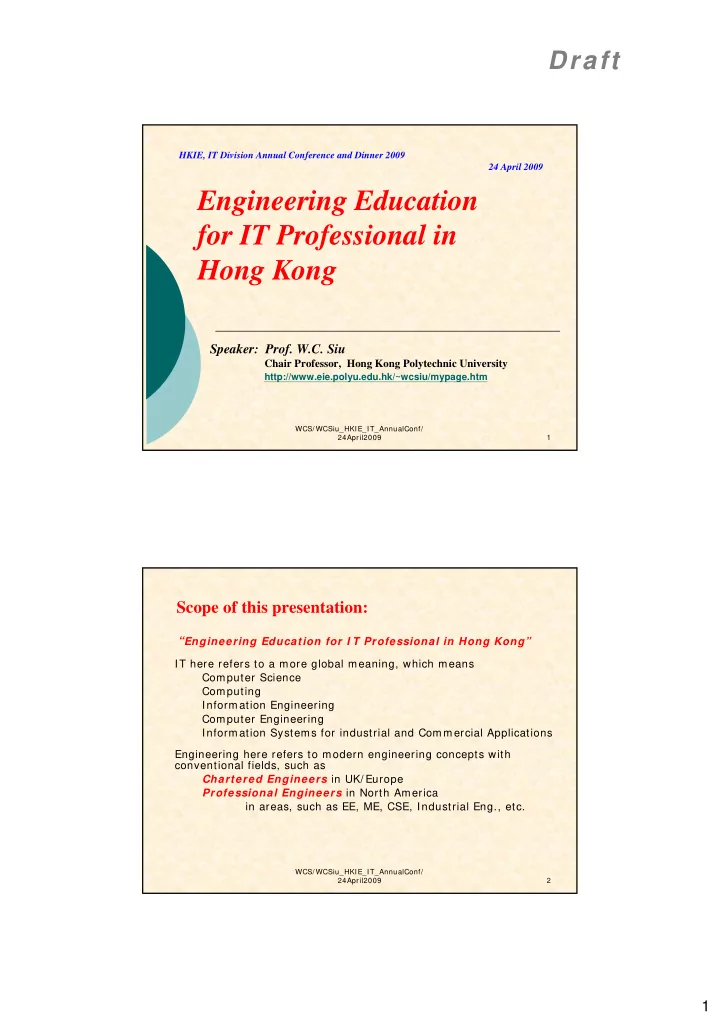
Draft HKIE, IT Division Annual Conference and Dinner 2009 24 April 2009 Engineering Education for IT Professional in Hong Kong Speaker: Prof. W.C. Siu Chair Professor, Hong Kong Polytechnic University


slide-1
SLIDE 1

1

Draft

WCS/ WCSiu_HKIE_IT_AnnualConf/ 24April2009 1

Engineering Education for IT Professional in Hong Kong

Speaker: Prof. W.C. Siu

Chair Professor, Hong Kong Polytechnic University

http://www.eie.polyu.edu.hk/~wcsiu/mypage.htm HKIE, IT Division Annual Conference and Dinner 2009 24 April 2009

WCS/ WCSiu_HKIE_IT_AnnualConf/ 24April2009 2

Scope of this presentation:

“Engineering Education for I T Professional in Hong Kong”

IT here refers to a more global meaning, which means Computer Science Computing Information Engineering Computer Engineering Information Systems for industrial and Commercial Applications Engineering here refers to modern engineering concepts with conventional fields, such as Chartered Engineers in UK/ Europe Professional Engineers in North America in areas, such as EE, ME, CSE, Industrial Eng., etc.

slide-2
SLIDE 2

2

Draft

WCS/ WCSiu_HKIE_IT_AnnualConf/ 24April2009 3

Scope of discussion:

“Engineering Education for I T Professional in Hong Kong”

Objectives of this talk include: i) to give a discussion on how would the education of an IT professional (such as those from computer science courses) be considered as engineering oriented, or be recognized to satisfy the educational requirement to become a professional/ chartered engineer ii) to arouse the interest of the audience on its requirements, to have feedbacks and further discussions, since the “standard and requirements” are owned by the academic/ professional peers. Output- Based Teaching and Learning: This topic is purposely left out, since this is a big topic which has to be discussed separately.

WCS/ WCSiu_HKIE_IT_AnnualConf/ 24April2009 4

  • 1. Basic Tools:

A computer/software engineer must be able to make use of basic tools for their daily work, such as computer graphics tools, database, mathematical tools and word processing. There is no fixed boundary of the scope of the training, but these must be a consistent set of tools and the topics must be acceptable by professional peers forming the basis for him/her to practise as an engineer. After going through this very basic training the student should be able to perform computer system installation, simple networking connection , information retrieval, information exchange via internet, presentation using computer tools, simple web page design, search engines, …etc.

slide-3
SLIDE 3

3

Draft

WCS/ WCSiu_HKIE_IT_AnnualConf/ 24April2009 5

  • 2. Design

Sufficient design elements should be defined clearly in most subjects at senior levels, and examples should be available upon request (to be reflected in examination papers, etc.) Furthermore, subjects/topics related to modeling and design of computer-based systems are recommended since they can be used to demonstrate comprehension of the tradeoff involved in design choices.

WCS/ WCSiu_HKIE_IT_AnnualConf/ 24April2009 6

  • 2. Design (con’t)

For example, the outcome of such a training is to equip the student to be able i) to design a database system to be able to input data, retrieve information, plot graphs, vet papers … for conference organization management /or shop purchasing… ii) to design and implement a fast search algorithm to look for a matched string of structure within a database… iii) to design a software iii) to design a simple microcontroller system, with appropriate ROM, RAM, bus structure and connection … EPLD simulation iv) to design a fast motion estimation algorithm for video coding with the minimum amount of bits or with the best quality under a certain constraint.

slide-4
SLIDE 4

4

Draft

WCS/ WCSiu_HKIE_IT_AnnualConf/ 24April2009 7

This element is indispensable in a computer science programme. The stress is not so much on the theoretical side of software engineering, but more on the understanding and application

  • f good practices and tools, in areas including the

. design and integration of large software, . software modeling and analysis, . verification and validation, . quality assurance, . software maintenance, . documentation and safety, . software and project management, etc.

  • 3. Software Engineering and Project Management

WCS/ WCSiu_HKIE_IT_AnnualConf/ 24April2009 8

A subject should be offered related to “Society and Engineers”, contents of which include

professionalism, work as a registered engineer or chartered engineer role of responsibilities, ethics, security, including computer security safety environmental protection, and it related issues legal aspects, etc.

*It should be a Compulsory subject, or the university should ensure each student to acquire such knowledge/ideas before his/her graduation. *It can be learnt from various parts of some General studies.

  • 4. Society and Engineers
slide-5
SLIDE 5

5

Draft

WCS/ WCSiu_HKIE_IT_AnnualConf/ 24April2009 9

Sufficient mathematics contents should be included in a computer science programme. The actual contents and percentage of mathematics are left to course designers. It is recommended that 16% be used as a reference, and significant deviation is not expected.

  • 5. Mathematics

WCS/ WCSiu_HKIE_IT_AnnualConf/ 24April2009 10

Computer science programmes should be sufficiently modern;contemporary subjects/topics such as web programming, UML (unified modeling language), object-

  • riented design and programming, information security,

search engine, information retrieval, modern networking, bioinformatics, etc. should be included whenever they are appropriate.

  • 6. Modernization
slide-6
SLIDE 6

6

Draft

WCS/ WCSiu_HKIE_IT_AnnualConf/ 24April2009 11

Computer science/information programmes should emphasize oral and written communication skills training as graduates from these courses normally need to spend much time to make presentations and read/write manuals, reports

  • r instructions for the purpose of communication with other

people or in a teamwork environment. (It is good if this kind of training could be absorbed, as far as possible, as part of their training in CS subjects.)

  • 7. Language/Communication Skills

WCS/ WCSiu_HKIE_IT_AnnualConf/ 24April2009 12

A Final year projects or capstone projects are indispensable in a computer science/information programme to be recognized by the HKIE -honours project. Further points: (i) Both individual or group projects are recommended. (ii) Each student must be independently assessed. (iii) This is an integration of knowledge, showing that the student be able to become an engineer in the future,.., etc. (iii) Each project must have a certain depth of understanding /extrapolation of knowledge, in terms of design, realization, analysis,.. or evaluation.

  • 8. Project Work
slide-7
SLIDE 7

7

Draft

WCS/ WCSiu_HKIE_IT_AnnualConf/ 24April2009 13

The HKIE should not be overly prescriptive in curriculum design, but courses must be designed with a consistent, systematic and comprehensive philosophy. Course leaders must prepare to defend their course structures and design methodology during accreditation exercises. (During the accreditation, we would expect to see most, if not all, staff members teaching the programme. This is (i) to facilitate information exchange among peers and (ii) to understand the implementation of the policies, etc.)

  • 9. Consistency in Course Design

WCS/ WCSiu_HKIE_IT_AnnualConf/ 24April2009 14

Computer Science covers a broad discipline. The actual contents of a programme are left to course designers. A list of possible core contents is available for the sake of reference. It is expected that many of these items be included in a computer science programme seeking for accreditation.

  • 10. Examples of “Core Contents” in a Computer

Science Programme

slide-8
SLIDE 8

8

Draft

WCS/ WCSiu_HKIE_IT_AnnualConf/ 24April2009 15

  • 1. The exercise should be formally done, because we are
  • professionals. Furthermore, it is governed by various

international agreements signed, or to be signed, for international recognition, and mutual recognition.

  • 2. Ownership: The Accreditation exercise is belong to

professional and academic peers in Hong Kong (with some

  • verseas colleagues) . Your opinions form and control the

quality.

  • 3. Indirectly, this exercise should be able to help you, in the

department, to push colleagues in your unit to review, to rectify, to modernize and to improve your work/programms, and to have inputs from industrialists or international experts, etc.

Further Points:

Return

WCS/ WCSiu_HKIE_IT_AnnualConf/ 24April2009 16

END

slide-9
SLIDE 9

9

Draft

WCS/ WCSiu_HKIE_IT_AnnualConf/ 24April2009 17

DS. Discrete Structures DS1 . Functions, relations and sets DS2 . Basic logic DS3 . Proof techniques DS4 . Basics of counting DS5 . Graphs and trees DS6 . Discrete probability PF. Program m ing Fundam entals PF1 . Fundam ental program m ing constructs PF2 . Algorithm s and problem -solving PF3 . Fundam ental data structures PF4 . Recursion PF5 . Event-driven program m ing

Appendix: Possible CS subject contents

WCS/ WCSiu_HKIE_IT_AnnualConf/ 24April2009 18

AL

Algorithm s and Com plexity AL1 . Basic algorithm ic analysis AL2 . Algorithm ic strategies AL3 . Fundam ental com puting algorithm s AL4 . Distributed algorithm s AL5 . Basic com putability AR. Architecture and Organization AR1 . Digital logic and digital system s AR2 . Machine level representation of data AR3 . Assem bly level m achine organization AR4 . Mem ory system organization and architecture AR5 . I nterfacing and com m unication AR6 . Functional organization DS. Discrete Structures

Appendix: Possible CS subject contents

slide-10
SLIDE 10

10

Draft

WCS/ WCSiu_HKIE_IT_AnnualConf/ 24April2009 19

AR7 . Multiprocessing and alternative architectures OS. Operating System s OS1 . Overview of operating system s OS2 . Operating system principles OS3 . Concurrency OS4 . Scheduling and dispatch OS5 . Mem ory m anagem ent NC. Net-Centric Com puting NC1 . I ntroduction to net- centric com puting NC2 . Com m unication and netw orking NC3 . Netw ork security NC4 . The w eb as an exam ple of client-server com puting

Appendix: Possible CS subject contents

WCS/ WCSiu_HKIE_IT_AnnualConf/ 24April2009 20

Program m ing Languages PL1 . Overview of program m ing languages PL2 . Virtual m achines PL3 . I ntroduction to language translation PL4 . Declarations and types PL5 . Abstraction m echanism s PL6 . Object-oriented program m ing HC. Hum an-Com puter I nteraction HC1 . Foundations of hum an-com puter interaction HC2 . Building a sim ple graphical user interface GV. Graphics and Visual Com puting GV1 . Fundam ental techniques in graphics GV2 . Graphic system s

Appendix: Possible CS subject contents

slide-11
SLIDE 11

11

Draft

WCS/ WCSiu_HKIE_IT_AnnualConf/ 24April2009 21

I S. I ntelligent System s I S1 . Fundam ental issues in intelligent system s I S2 . Search and constraint satisfaction I S3 . Know ledge representation and reasoning I M. I nform ation Managem ent I M1 . I nform ation m odels and system s I M2 . Database system s I M3 . Data m odeling

Appendix: Possible CS subject contents

WCS/ WCSiu_HKIE_IT_AnnualConf/ 24April2009 22

SP. Social and Professional I ssues SP1 . History of com puting SP2 . Social context of com puting SP3 . Methods and tools of analysis SP4 . Professional and ethical responsibilities SP5 . Risks and liabilities of com puter-based system s SP6 . I ntellectual property SP7 . Privacy and civil liberties SE. Softw are Engineering SE1 . Softw are design SE2 . Using API s SE3 . Softw are tools and environm ents SE4 . Softw are processes SE5 . Softw are requirem ents and specifications SE6 . Softw are validation SE7 . Softw are evolution SE8 . Softw are project m anagem ent

Appendix: Possible CS subject contents

slide-12
SLIDE 12

12

Draft

WCS/ WCSiu_HKIE_IT_AnnualConf/ 24April2009 23

END

WCS/ WCSiu_HKIE_IT_AnnualConf/ 24April2009 24

  • 1. Outcome based Education
  • 2. Conventional concepts: Design, Tools, Project Management (Software

Engineering), …

  • 3. In a university, we are also talking about knowledge, originality,

novelty and creativity. What is the relationship between these two?

  • 4. Are items 2 and 3 conflicting? (No, they are complementary.)

Points from HKIE doc, Seoul Accord, US practices …

To be enhanced: