Environment and Natural Resources Trust Fund 2012-2013 Request for - - PDF document

environment and natural resources trust fund 2012 2013
SMART_READER_LITE
LIVE PREVIEW

Environment and Natural Resources Trust Fund 2012-2013 Request for - - PDF document

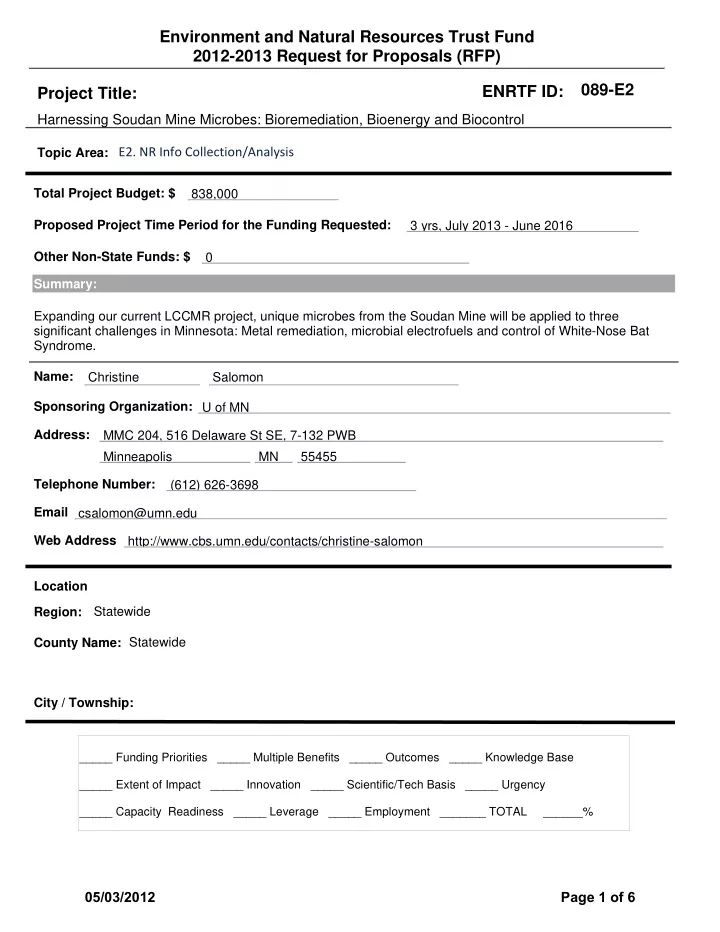
Environment and Natural Resources Trust Fund 2012-2013 Request for Proposals (RFP) 089-E2 ENRTF ID: Project Title: Harnessing Soudan Mine Microbes: Bioremediation, Bioenergy and Biocontrol E2. NR Info Collection/Analysis Topic Area: Total


slide-1
SLIDE 1

Environment and Natural Resources Trust Fund 2012-2013 Request for Proposals (RFP) Project Title:

Total Project Budget: $ Proposed Project Time Period for the Funding Requested: Other Non-State Funds: $ Name: Sponsoring Organization: Address: Telephone Number: Email Web Address County Name: City / Township: Region: Summary: Location

Harnessing Soudan Mine Microbes: Bioremediation, Bioenergy and Biocontrol

838,000 3 yrs, July 2013 - June 2016 Expanding our current LCCMR project, unique microbes from the Soudan Mine will be applied to three significant challenges in Minnesota: Metal remediation, microbial electrofuels and control of White-Nose Bat Syndrome. Christine U of MN MMC 204, 516 Delaware St SE, 7-132 PWB Minneapolis MN 55455 (612) 626-3698 csalomon@umn.edu http://www.cbs.umn.edu/contacts/christine-salomon Statewide Statewide Salomon

_____ Funding Priorities _____ Multiple Benefits _____ Outcomes _____ Knowledge Base _____ Extent of Impact _____ Innovation _____ Scientific/Tech Basis _____ Urgency _____ Capacity Readiness _____ Leverage _____ Employment _______ TOTAL ______%

  • E2. NR Info Collection/Analysis

ENRTF ID: 089-E2

Topic Area:

05/03/2012 Page 1 of 6

slide-2
SLIDE 2

Environment and Natural Resources Trust Fund (ENRTF) 2012‐2013 Main Proposal

PROJECT TITLE: Harnessing Soudan Mine Microbes: Bioremediation, Bioenergy and Biocontrol. PROJECT STATEMENT: The Soudan Iron Mine in northern Minnesota is the state’s oldest and deep- est iron mine. The mine was active from 1882 until 1962 when it was closed and developed into Soudan Mine Underground State Park. Although iron is no longer being extracted, the mine continues to provide valuable resources to the state of Minnesota, including access to fascinating microbial communities that may not exist anywhere else on the planet. The water seeping into the mine from exploratory holes drilled by the miners is highly unusual: It is extremely salty (2-3 times saltier than seawater), high in dissolved iron and other metals, and completely anoxic (without dissolved oxygen gas) until it mixes with the air in the tunnels. The Soudan Iron Mine provides a window into this unique subterranean world and direct access to microbes with special adaptations that can be harnessed for biotechnology. This proposal builds on the success and findings of our current research program (funded by LCCMR 2010-2013) focused on characterizing microbes that live in this extreme environment and their unique metabolic capabilities. We propose to apply knowledge gained from our initial research project and harness these microbes to approach some of the most critical environmental challenges in Minnesota:

  • 1. Removing metals from mine waters with microbes. The park currently spends upwards of $200k/year

to remove metals from mine effluent. Bacteria and fungi are found thriving in areas of the mine that are heavily contaminated with copper, cobalt and other metals. These microbes are adapted to Soudan conditions, and could be developed for removal of metals from mine waters to meet water quality

  • requirements. We propose to identify efficient metal binding bacteria and fungi with the goal of

incorporating them into a bio-filter to treat the contaminated mine water on-site (bioremediation). This technology could be utilized by Soudan Park as well as other mines and contaminated environments.

  • 2. Microbes and electrofuels. Bacteria have the ability to eat and breathe iron. The iron-breathing bacteria

can be used to generate electricity, an aspect that both Gralnick and Bond have studied for over 10 years. Using electrodes, we can grow both kinds of bacteria, depending on how we poise the electrode (negative for iron breathers and positive for iron eaters). The Soudan Iron Mine is a unique environment that has novel populations of both kinds of bacteria. Iron breathing bacteria can be harnessed to generate electricity, while iron-eating bacteria will help create biofuels in a process called ‘electrosynthesis.’ We are enriching and culturing novel bacteria from the mine with our current LCCMR project. In this new proposal we will test the best bacteria for our desired applications in electricity and electrofuels.

  • 3. Inhibition of the White Nose Bat Syndrome fungus (Latin name: Geomyces destructans). Since

2006, white nose syndrome (WNS) has decimated bat populations in the Northeastern US, incurring devastating economic and biodiversity losses. Although WNS has not yet reached Minnesota, the Soudan Mine serves as the largest hibernaculum in the upper Midwest and is threatened by the rapid westward spread of this deadly fungal disease (confirmed in Missouri and Ontario, Canada). We have tested microbial strains from the Soudan Mine against a panel of 10 different pathogenic bacteria and fungi, and found that 40% of isolates inhibit the growth of fungi. Because these anti-fungal isolates are already adapted to living in the extreme environment of the mine, they may be good candidates for potentially controlling or preventing WNS (“Biocontrol”). We propose to survey the microbial population (existing strain library and new isolates) for strains that could potentially inhibit the WNS fungus.

  • II. DESCRIPTION OF PROJECT ACTIVITIES

Activity 1: Removing metals from mine waters with microbes Budget: $329,771 This project will be focused on isolating and characterizing microbes from the most contaminated areas

  • f the mine and testing the best candidates for further development into a biofilter.

Outcomes: Completion Date

  • 1. Isolation of microbes from high copper and cobalt areas of the mine

June 30, 2014

  • 2. Determination of the metal binding capacity of each isolate

June 30, 2015

  • 3. Evaluation/testing of the most efficient metal-removing bacterial and fungal strains June 30, 2016

05/03/2012 Page 2 of 6

slide-3
SLIDE 3

Harnessing Soudan Mine Microbes: Bioremediation, Bioenergy and Biocontrol Activity 2: Microbes and electrofuels Budget: $322,646 Using cultured bacteria and enrichments from level 27 of the Soudan Iron Mine, we will elucidate electron transfer pathways of novel iron oxidizing and iron reducing bacteria. We will work with natural isolates, and also augment bacteria currently used by the Gralnick and Bond Labs. Outcomes: Completion Date

  • 1. Test and prove the use of isolated Soudan bacteria interfaced with electrodes

June 30, 2015

  • 2. Molecular characterization of electron transfer in novel mine bacteria

June 30, 2016

  • 3. Optimization of electron transfer by bacteria associated with electrodes

June 30, 2016 Activity 3: Biological control of the white nose bat fungus, Geomyces destructans Budget: $185,511 Bacteria and fungi will be cultivated from hibernaculum areas and bat surfaces to identify “native” species pre-adapted to the mine environment. Isolates will be tested for the ability to inhibit the growth of fungi and the most promising microbes will be evaluated against the WNS fungus Geomyces destructans. Outcomes: Completion Date

  • 1. Isolation of bacteria and fungi from bat hibernaculum areas.

June 30, 2015

  • 2. Testing of each isolate against nonpathogenic species of Geomyces

June 30, 2016

  • 3. Evaluation of most potent strains against Geomyces destructans

June 30, 2016

  • 4. Test promising strains for protection of bats against fungus

June 30, 2016

  • III. PROJECT STRATEGY
  • A. Project Team/Partners funded by ENRTF
  • Dr. Christine Salomon (UMN) Assistant Professor, BioTechnology Institute and Center for Drug Design

is an expert in microbial culturing, testing and characterization and will oversee the project and contribute to Activities 1 and 3.

  • Dr. Brandy Toner (UMN) Assistant Professor in the Soil, Water and Climate Department is an expert in

geomicrobiology and responsible for all mineralogical and metal analyses in Activity 1.

  • Dr. Jeff Gralnick (UMN) Associate Professor in the Department of Microbiology and the

BioTechnology Institute is an expert in bacterial genetics and will oversee Activity 2.

  • Dr. Daniel Bond (UMN) is an Associate Professor of Microbiology and the BioTechnology Institute. He

is an expert in microbial fuel cells and bacterial metal reduction for Activity 2.

  • Dr. Robert Blanchette (UMN) is a Professor in Plant Pathology and an expert in fungal biology. He will

lead the fungal collections for both the bioremediation and Geomyces Activities 1 and 3. Additional partners (not funded by ENRTF) include Jim Essig (DNR Park Manager of Soudan Mine State Park) who will help coordinate research activities and Dr. David Blehert (USGS, WI) who will provide advice and assistance with testing microbial isolates against the WNS fungus Geomyces destructans.

  • B. Timeline Requirements

Three years will be sufficient to accomplish the objectives of the three scientific areas (microbial bioremediation, fuel cell development and biological control of the white nose bat pathogen).

  • C. Long-Term Strategy and Future Funding Needs

The proposed work is a direct extension of our current program focused on the microbiology of the Soudan Mine (LCCMR 2010-2013). By the end of this next phase, we expect to obtain federal funding (National Science Foundation, Department of Energy, United States Department of Agriculture) to support development in each of these areas of biotechnology. We also anticipate partnering with companies on the Iron Range in Northern Minnesota to conduct feasibility, efficiency and implementation studies related to bioremediation. Any patents and/or royalties earned from the proposed research will be shared with invested partners (DNR, ENRTF) to the extent of their role and investment.

05/03/2012 Page 3 of 6

slide-4
SLIDE 4

Harnessing Soudan Mine Microbes: Bioremediation, Bioenergy and Biocontrol BUDGET ITEM AMOUNT %FTE Personnel: Brandy Toner (requesting 1 week of summer salary/yr for 3 years due to 9 month academic appointment)-Activity 1, (84% salary, 16% fringe + benefits) $7,916 2% 2 Graduate Research Students (Microbiology, PhD) Activity 2, (48% salary, 52% fringe + benefits) 3 years $257,646 50% 1 Graduate Research Student (Soil, Water, Climate, PhD) Activity 1, (48% salary, 52% fringe + benefits) 3 years $116,845 50% 1 Graduate Research Student (Plant Pathology, PhD) Activity 3, (48% salary, 52% fringe + benefits) 3 years $128,823 50% 1 Postdoctoral Research Associate (Center for Drug Design) Activities 1 and 3, (80% salary, 20% fringe + benefits) 3 years $151,200 100% Equipment/Tools/Supplies: Activity 1 (Microbial metal remediation) Supplies for microbial isolations (growth media, reagents, antibiotics, petri dishes, tubes), DNA isolation kits ($350 per kit x 3 kits per year) consumables (tubes, pipette tips, vials, gloves, etc.), pH and oxygen electrodes, purified water filters. For 2 scientists x 3 years each. Analytical chemistry analysis (Aqueous Geochemistry core facility): $50-$75 per sample for metal and/or ion analysis, 60 samples per year x 3 years. Molecular biology reagents (PCR reagents, DNA extraction and purification kits ($350 per kit x 3 kits per year), enzymes, chemicals, general lab supplies (gloves, tubes, pipette tips, flasks etc.), electrodes, fuel cells, microbiology cultivation supplies (growth media, reagents, antibiotics, petri dishes, tubes) For 2 scientists for 3 years each. Activity 3 (Microbial Biological Control) Supplies for microbial isolations (growth media, reagents, antibiotics, petri dishes, tubes), DNA isolation supplies (extraction kits $350 per kit x 2 per year) general lab supplies (gloves, tips, tubes, etc.), chemicals, solvents, glassware. For 1 scientist for 3 years. Sequencing for phylogenetic analysis of microbial isolates: (AGAC sequencing facilities, $3.50 per reaction x ~625 reactions per year, over 3 years) Microscopy (Scanning Electron, Light, Confocal microscopes-hourly instrument fees at CBS Biological Imaging Facility $25-$37 per hour plus specimen preparation fees, ~ 20hrs/year) publication fees (~3 total, $500 per publication-page/color fee charges to publish work in scientific manuscripts) Travel: In-state round trip travel between St. Paul and Soudan Mine Park: room/board for 4-8 researchers, mileage, plus mine hoist charges, est. 5-6 trips/yr (1-3 days each trip) for 3 yrs TOTAL ENVIRONMENT AND NATURAL RESOURCES TRUST FUND $ REQUEST = SOURCE OF FUNDS AMOUNT Status Other Non-State $ Being Applied to Project During Project Period: none Other State $ Being Applied to Project During Project Period: none In-kind Services During Project Period: 1 month salary+fringe contributed for each investigator (Salomon, Gralnick, Bond, Toner and Blanchette) annually x 3 years $161,691 Remaining $ from Current ENRTF Appropriation (if applicable): "Science and Innovation from the Soudan Mine", 0509-2-033 $351,420 (as

  • f December

2011) Obligated to be 100% spent by 06/13 Funding History: Currently funded by LCCMR for 2010-2013 to conduct research on the microbes in the mine ("Science and Innovation from the Soudan Mine", 0509-2-033) This investment has led directly to the applied work in the proposed application. $545,451

  • V. OTHER FUNDS

838,000 $ $2,500 $1,500

2012-2013 Detailed Project Budget

  • IV. TOTAL ENRTF REQUEST BUDGET (3 years)

$48,000 $6,300 $12,000 $60,000 Activity 2 (Microbes and electricity) $30,000 $15,270

05/03/2012 Page 4 of 6
slide-5
SLIDE 5

Bioremediation: Toxic Metal Removal Biocontrol: Invasive White Nose Bat fungus Bioenergy: Microbes and Electrofuels

copper mercury cobalt

Soudan Mine

Largest bat hibernaculum in the upper Midwest.

MN

Confirmed White Nose Bat Syndrome (WNS) Areas. WNS was first detected in upstate New York in 2006 and is rapidly spreading westward across North America.

STOP

Confirmed 2007 Confirmed 2010 Confirmed 2011 Confirmed 2008 Confirmed 2009

05/03/2012 Page 5 of 6

slide-6
SLIDE 6

Harnessing Soudan Mine Microbes: Bioremediation, Biocontrol and Bioenergy

  • VI. PROJECT MANAGER QUALIFICATIONS AND ORGANIZATION DESCRIPTION

Project Manager Qualifications

  • Dr. Christine E. Salomon, Project Manager and Principle Investigator
  • Dr. Salomon is an Assistant Professor and Assistant Director at the Center for Drug

Design and a faculty member in the Biotechnology Institute at the University of

  • Minnesota. Dr. Salomon earned her Ph.D. at the Scripps Institution of Oceanography,

UCSD, in the area of natural products chemistry from invertebrates and microbes. She continued her training in the Department of Microbiology at the University of Minnesota where she worked on understanding how soil microbes biosynthesize chemical compounds. Dr. Salomon’s current research program is focused on the discovery and utilization of novel microbes that can be used for biological control of agricultural pathogens and production of unique compounds for biomedical and biotechnological applications. She has successfully secured both internal (Academic Health Center, Masonic Cancer Center, Healthy Foods Healthy Lives Institute) and external (United States Department of Agriculture) support for her research program.

  • Dr. Salomon is one of the Co‐PIs on a currently funded ENRTF project "Science and

Innovation from the Soudan Mine", 0509‐2‐033. Her ongoing work on the isolation, characterization and testing of novel microbes in this unique environment led directly to key components in the proposed research on biological control and bioremediation. She has worked and collaborated extensively with all of the investigators and partners listed and will serve as the project manager for the proposed interdisciplinary work. As a member of the Biotechnology Institute, Dr. Salomon has access to industrial companies interested in partnering with academic researchers for future development

  • efforts. She is experienced in patent protection of intellectual property and has

worked closely with the Office of Technology Commercialization at the University of

  • Minnesota. These connections will be essential for the commercial development of any

biotechnologies discovered through the proposed research. Organizational Description The University of Minnesota Biotechnology Institute was initially established to catalyze the development of a biotechnology industry in Minnesota. It plays a central role in providing training and coordinating research in biological, chemical and engineering sciences at the University of Minnesota. It also serves as an important resource for industry by providing connections with academic research partners. The primary mission of the Center for Drug Design at the University of Minnesota is to promote scientific research to advance health. As an independently funded research center, the focus of the institute is applied research. Members of the CDD have an excellent track record of successfully developing technologies that have then been licensed by a variety of industrial partners for commercialization. 05/03/2012 Page 6 of 6