Environment and Natural Resources Trust Fund 2012-2013 Request for - - PDF document

environment and natural resources trust fund 2012 2013
SMART_READER_LITE
LIVE PREVIEW

Environment and Natural Resources Trust Fund 2012-2013 Request for - - PDF document

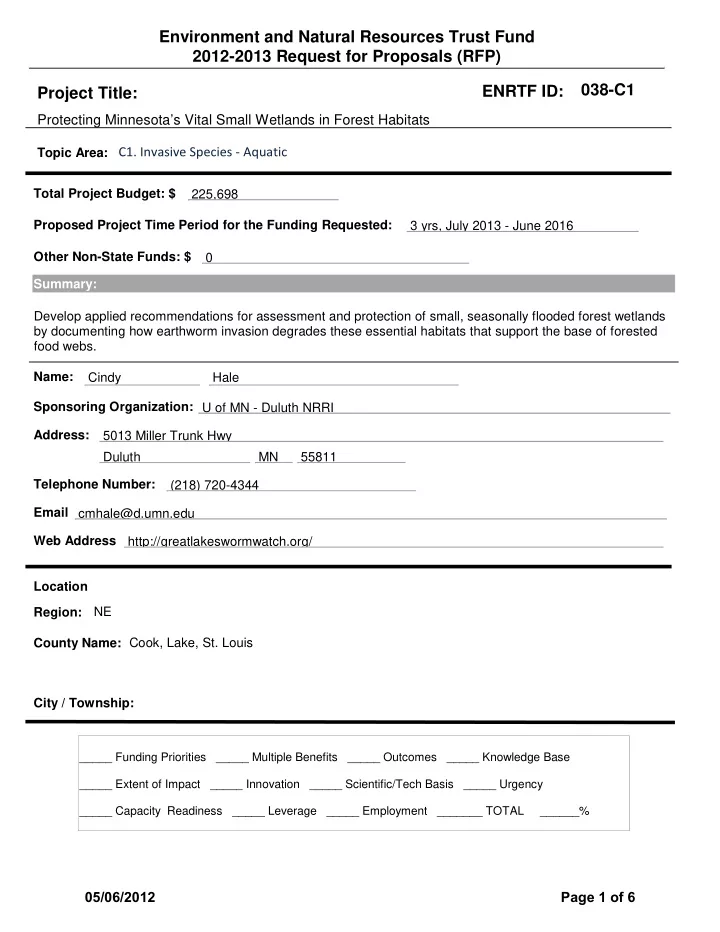
Environment and Natural Resources Trust Fund 2012-2013 Request for Proposals (RFP) 038-C1 ENRTF ID: Project Title: Protecting Minnesotas Vital Small Wetlands in Forest Habitats C1. Invasive Species Aquatic Topic Area: Total Project


slide-1
SLIDE 1

Environment and Natural Resources Trust Fund 2012-2013 Request for Proposals (RFP) Project Title:

Total Project Budget: $ Proposed Project Time Period for the Funding Requested: Other Non-State Funds: $ Name: Sponsoring Organization: Address: Telephone Number: Email Web Address County Name: City / Township: Region: Summary: Location

Protecting Minnesota’s Vital Small Wetlands in Forest Habitats

225,698 3 yrs, July 2013 - June 2016 Develop applied recommendations for assessment and protection of small, seasonally flooded forest wetlands by documenting how earthworm invasion degrades these essential habitats that support the base of forested food webs. Cindy U of MN - Duluth NRRI 5013 Miller Trunk Hwy Duluth MN 55811 (218) 720-4344 cmhale@d.umn.edu http://greatlakeswormwatch.org/ NE Cook, Lake, St. Louis Hale

_____ Funding Priorities _____ Multiple Benefits _____ Outcomes _____ Knowledge Base _____ Extent of Impact _____ Innovation _____ Scientific/Tech Basis _____ Urgency _____ Capacity Readiness _____ Leverage _____ Employment _______ TOTAL ______%

  • C1. Invasive Species ‐ Aquatic

ENRTF ID: 038-C1

Topic Area:

05/06/2012 Page 1 of 6

slide-2
SLIDE 2

Environment and Natural Resources Trust Fund (ENRTF) 2012‐2013 Main Proposal

1 PROJECT TITLE: Protecting Minnesota’s vital small wetlands in forest habitats

  • I. PROJECT STATEMENT

Small (i.e. 10ft to football field sized), seasonally flooded by snow melt and rain, fishless wetlands in forests are called vernal pools. Fishless vernal pools provide virtually predator‐free habitats required for successful development of eggs and larva for more than half of MN’s native amphibians ( frogs, toads, salamanders) and aquatic invertebrates (i.e. mayflies, dragonflies, damselflies, beetles, and many more). These are the primary food base for terrestrial wildlife in northern forests (e.g. snakes, turtle, water birds, song birds, raptors, and mammals ranging in size from mice and weasels to fox and bear). In the last 200 years, 53% of all wetlands in the continental US have been lost. Vernal pools have no legal protection and their loss is known to be associated with forest fragmentation and conversion of intact forests to intensive management, farming, or other land uses. Invasive earthworms (there are NO NATIVE EARTHWORMS in MN) are expected to further increase the loss of vernal pool habitat by increasing erosion which carries nutrients and sediments that decrease the habitat quality, often to the point of it no longer being a viable habitat for the dependent species. We propose to conduct the first study to document how earthworm invasion degrades the habitat quality and sustainability of vernal pools. Our primary project outcome is to create protocols for identifying, assessing and providing protection for vernal pools across MN and the region by: 1) identifying, verifying and mapping areas in the Superior National Forest using GIS‐analysis to locate areas likely to contain vernal pools and field surveys to verify their locations; 2) characterizing the habitat and water quality of vernal pools in earthworm invaded and earthworm‐free areas; 3) demonstrating how earthworms degrade vernal pool habitats using field‐based experiments to assess the ecosystem level changes in nutrient and sediment flows which are known to affect invertebrates and amphibian communities of vernal pools; 4) identifying and mapping vernal pool areas for protection from future impacts.

  • II. DESCRIPTION OF PROJECT ACTIVITIES

Activity 1: Use the Superior National Forest as a demonstration area for the development of protocols to locate vernal pools. Budget: $34,008 The Superior National Forest is 2.2 million acres (~14% of forested land in MN) and is estimated to contain as many as 100,000 vernal pools. We will geographically locate vernal pools in the Superior National Forest using a combination of local knowledge and GIS resources/maps. Outcome Completion Date

  • 1. Gather local knowledge and create GIS maps indicating probably vernal pool

locations across the Superior National Forest March 2014

  • 3. Develop sampling strategy for field identification of vernal pools

April 2014

  • 4. Conduct field surveys to geographically locate vernal pools

August 2014 Activity 2: Characterize the invasion status around vernal pools Budget: $33,157 During field surveys to locate vernal pools (Activity 1), preliminary ecological data will be collected including assessment of the earthworm invasion status using the Invasive Earthworm Rapid Assessment Tool developed to classify the level of earthworm impacts (earthworm‐free to heavily impacted). Outcome Completion Date

  • 1. Collect data to verify that a pool meets the criteria for VP designation

August 2014

  • 2. Characterize tree, shrub, and understory plants; soil type and topography

August 2014

  • 3. Conduct Invasive Earthworm Rapid Assessment Tool

August 2014

05/06/2012 Page 2 of 6

slide-3
SLIDE 3

Protecting Minnesota’s vital small wetlands in forest habitats 2 Activity 3: Conduct quantitative sampling at vernal pools Budget: $104,429 Impacts of earthworm invasions on the structure and function of vernal pool ecosystems, will be accessed through quantitative earthworm and water chemistry sampling at a subset of vernal pools spanning a gradient of sites from earthworm‐free to heavily impacted (as identified in Activity 2). Outcome Completion Date

  • 1. Identify 45 vernal pool sites for study, 15 in each of three earthworm invasion

classifications ( earthworm‐free, moderately invaded, and heavily invaded) September 2014

  • 2. Quantitatively sample earthworm populations along three randomly placed

transects radiating out 250 meters from the edges of each vernal pool. December 2014

  • 3. Conduct identification and biomass measurements of earthworms in the lab.

June 2015

  • 4. Collect a suite of water chemistry samples three times during spring‐summer

season (temperature, pH, conductivity, dissolved oxygen, turbidity, chlorophyll‐A, total suspended solids, total volatile solids, nutrients, dissolved organic carbon) September 2015 Activity 4: Analyze data to identify protection priorities Budget: $54,104 Analyze water chemistry and earthworm data (Activity 3) and interpret results to create maps of vernal pools habitat quality and recommended protection areas in Superior National Forest. A technical report will serve as a model for replication of vernal pool assessment and protection in other areas of MN,16.3 million acres of forested land, potentially contain over 800,000 (average five vernal pools per 100 acres).

  • III. PROJECT STRATEGY
  • A. Project Team/Partners
  • Drs. Hale (research associate) and Johnson (center director) at the Natural Resources Research Institute

(NRRI) will provide project oversight. Bruce Anderson, forest monitoring coordinator, Superior National Forest, will facilitate coordination with national forest staff and resources. He will receive no ENTRF funding for this work. Jennifer Olker (research fellow, NRRI) will coordinate data management and

  • analysis. Ryan Hueffmeier (junior scientist, NRRI) will coordinate and manage field surveys, earthworm

collections, and analysis.

  • B. Timeline Requirements

We request a three‐year project to take advantage of two full field seasons.

  • C. Long‐term Strategy and Future Funding Needs

We strive to provide scientifically validated information to inform research, policy, and management for northern forests that result in long‐term sustainability. Our considerable existing data on vernal pools and earthworm‐invaded ecosystems makes us well prepared to undertake this collaborative project. Understanding a major threat such as earthworm invasion on these sensitive systems, essential habitats for many native vertebrate and invertebrates, will be critical for development of conservation and management plans to protect these vital aquatic habitats in forested areas of MN. Outcome Completion Date

  • 1. Analyze all data to document how earthworm invasion degrades the habitat

quality, persistence, and sustainability of vernal pools. January 2016

  • 2. Create GIS data layers indicating habitat quality of vernal pools in Superior

National Forest and base maps indicating priority areas for protection. March 2016

  • 3. Final technical report for use by land managers and researchers

July 2016

05/06/2012 Page 3 of 6

slide-4
SLIDE 4

Protecting Minnesota’s vital small wetlands in forest habitats

BUDGET ITEM Personnel: all personel UMD Hale, manager, 36 months @ 10%=$23,481; $17,266 salary, $6,215 fringe (36%) Olker,Research Fellow, 36 months @ 30%=$58,296; $42,866 salary, $15,430 fringe (36%) Hueffmeier, Junior Scientist, 27 months @ 25%, 9 months @ 75%=$72,276; $51,152 salary, $21,124 fringe (41.3%) Two - undergradaute field technicians 24 mos @ 20% =$9,808; $8,958 salary, $850 fringe (9.5%) Two - udergraduate work study students, 25% of $10/hr for 333.3 hours=$833/year; all salary, no fringe Contracts: Conservation Corps Minnesota - Americorp fieldcrews for earthworm sampling, $750/day per crew x 2 crews for 10 days Equipment/Tools/Supplies: Water quality meter $1500 & supplies for $400 Worm sampling supplies-50 ml vials, 10% formalin, isopropyl alcohol, baggies for 675 sampling plots (45 wetlands x 3 transects/wetland x 5 plots/transect= 675) General lab supplies-sampling bottles, filters, water quality supplies except for analysis work (covered under Services) Field supplies-Handheld Garmin GPS unit $400; routine supplies $250 (boots, meter sticks, clip boards, data sheets, sampling tools (hydrogrometer, thermometer), coolers, ice) Travel: 2 people-12,000 miles @$0.555/mile +$10/day fee vehicle rental * 75 days in the field = $7410; $30 camping fee/day + $60/day food for 2 ppl * 55 days of overnight travel = $4950 Additional Budget Items: NRRI GIS Lab fee, for use of lab (photo analysis & mapping) $4.10/hr x 300 hours per year NRRI Analytical Lab-Water quality analysis; 45 sampling locations, sampled 3x =135 samples (Nutrients: total Nitrogen, Ammonia (NH3+), Nitrate/Nitrite (NO3/NO2+), total Phosphorus, dissolved Phosphorous - $56/sample x 135= $7560; Turbidity -$5.50/sample x 135= $743; Total Suspended Solids and Volatile Suspended Solids -$10/sample x 135 = $1350; Dissolved Organic Carbon - $19/sample x 135 = $2,565) TOTAL ENVIRONMENT AND NATURAL RESOURCES TRUST FUND $ REQUEST = SOURCE OF FUNDS AMOUNT Status Other Non-State $ Being Applied to Project During Project Period: n/a Other State $ Being Applied to Project During Project Period: Drs. Hale & Johnson receive 10% of their 12-month base appointment through state allocation as well as funding from grants such as this. $80,339 (Separate but complimentary, not match or cost-sharing for this proposal.) In-kind Services During Project Period: Superior National Forest staff time and relevant geographic data for locating vernal pools estimate ~ 10% full-time equivalency. (Separate but complimentary, not match or cost-sharing for this proposal). 40,000 $ Remaining $ from Current ENRTF Appropriation (if applicable): "Prevention and Early Detection of Asian Earthworms and Reducing the Spread of European Earthworms," lead investigator Cindy Hale (total award amount $150,000; 6/30/12, all funds will be spent by

  • Dec. 2012)

Unspent until Dec Funding History: Great Lakes Worm Watch program - "Reducing human-mediated spread

  • f non-native earthworms in vulnerable northern hardwood forests," USDA, lead investigator
  • Dr. David Andow (total award $491,000; end date 1/31/2013) - pilot study to locate vernal

pools and assess earthworm invasion status of selected areas of NE MN; "Exotic earthworm invasions: integrated research and education to achieve natural resource protection” Minnesota Coastal Program grant. Lead investigator Cindy Hale (total award $94,220; ended 12/31/10) - developed the Invasive Earthworm Rapid Assessment Tool to be used in this study. (Data to be used for this grant is valued at $50,750. Funding History: "Effects of Forest Fragmentation on Community Structure and Meta- population Dynamics of Amphibians," EPA STAR grant, Lead investigator Dr. Lucinda Johnson (total award $769,623; ended 11/30/2003) - documented the potenial density of vernal pools in the forested landscape of MN. (Data to be used for this grant is valued at $35,000)

2012-2013 Detailed Project Budget

  • IV. TOTAL ENRTF REQUEST BUDGET 3 years

AMOUNT 23,481 $ 15,000 $

  • V. OTHER FUNDS

72,276 $ 12,360 $ 3,000 $ 1,900 $ 58,296 $ 225,698 $

  • $

1,545 $ 650 $ 1,666 $ 3,690 $ 12,218 $ 19,616 $

I:\ML2013\RFP\proposals_recevied\hale-cindy_0412-2-151-Budget_revised

05/06/2012 Page 4 of 6

slide-5
SLIDE 5

05/06/2012 Page 5 of 6

slide-6
SLIDE 6

Protecting Minnesota’s vital small wetlands in forest habitats

  • 6. Project Manager Qualifications and Organization Description

Cindy Hale, Research Associate, Natural Resources Research Institute, University of Minnesota Duluth Director, Great Lakes Worm Watch <www.greatlakeswormwatch.org>

  • Dr. Hale excels in collaborative, interdisciplinary research that probes the interactions and consequences
  • f non-native earthworm invasions in hardwood forests of the cold-temperate regions of the western Great

Lakes region. Her dissertation research was the first to examine the patterns and mechanisms of change resulting from non-native earthworm invasions on native forest plant communities, soil structure, and nutrient dynamics. In subsequent and ongoing research collaboratives she is looking at how earthworms invasions affect small mammal communities, ground nesting song bird populations, and biogeochemical processes such as carbon dynamics and mineral weathering; how changes in soil hydrology affect dendro- chronological patterns and how those patterns might be used to date past invasions events. She is leading a regional effort to develop and implement an Invasive Earthworm Rapid Assessment Tool which will allow researchers and land managers to quickly evaluate the extent and intensity of earthworm invasions across the landscape. The tool is already proving useful in identifying potential areas for protection and to identify potential study areas for a range of research projects. Education University of Minnesota St. Paul Ecology-individually designed program BS 1988 University of Minnesota Duluth Environmental Sciences MS 1997 University of Minnesota St. Paul Forest Ecology and Science Education PhD 2004 Publications Hale, C. M., L.E. Frelich, P.B. Reich and J Pastor. 2008. Exotic earthworm effects on hardwood forest floor, nutrient availability and native plants: a mesocosm study. Oecologia 155: 509-518. Hale, C. M., L. E. Frelich, P. B. Reich. 2006. Changes in cold-temperate hardwood forest understory plant communities in response to invasion by European earthworms. Ecology 87(7): 1637-1649. Hale, C. M., L. E. Frelich, P. B. Reich and J. Pastor. 2005. Effects of European earthworm invasion on soil characteristics in northern hardwood forests of Minnesota, U.S.A. Ecosystems 8(8): 911-927. Hale, C. M. and G.E. Host. 2005. Assessing the impacts of European earthworm invasions in beech- maple hardwood and aspen-fir boreal forests of the western Great Lakes region. National Park Service Great Lakes Inventory and Monitoring Network Report GLKN/2005/11. Hale, C. M., L. E. Frelich, P. B. Reich. 2005. Exotic European earthworm invasion dynamics in northern hardwood forests of Minnesota, USA. Ecological Applications 15(3): 848-860. Selected Grants  Reducing human-mediated spread of non-native earthworms in vulnerable northern hardwood forests, CSREES USDA-AFRI Weedy and Invasive Species. Andow, D., T. Hurley, G. Host, C. Hale, N. Meyers and R. Knowles. 2010 –2013, $491,000.  Prevention and early detection of Asian earthworms and reducing the spread of European

  • earthworms. Legislative Citizen Commission on MN Resources. 2009-2012, $150,000.

 Exotic earthworm invasions: integrated research and education to achieve natural resource protection. Minnesota Lake Superior’s Coastal Program. 2008-2010, $46,935.  Graduate Fellows In K-12 Education – biology, geology, and mathematics graduate fellows in the K- 12 environment. C. Latterell, C. Hale, B. Munson, P. Morton, and J. Pastor. National Science Foundation (DGE 637027), 2007-2012, $2,931,797. The Natural Resources Research Institute is a part of the University of Minnesota Duluth. NRRI’s mission is to promote private sector employment based on natural resources in an environmentally sensitive manner. NRRI scientists have extensive experience in applied ecological research on terrestrial and aquatic systems.

05/06/2012 Page 6 of 6