ENVIRONMENTAL FOOTPRINT WORK GROUP Agenda for May 28, 2008 1. - - PowerPoint PPT Presentation

environmental footprint work group agenda for may 28 2008
SMART_READER_LITE
LIVE PREVIEW

ENVIRONMENTAL FOOTPRINT WORK GROUP Agenda for May 28, 2008 1. - - PowerPoint PPT Presentation

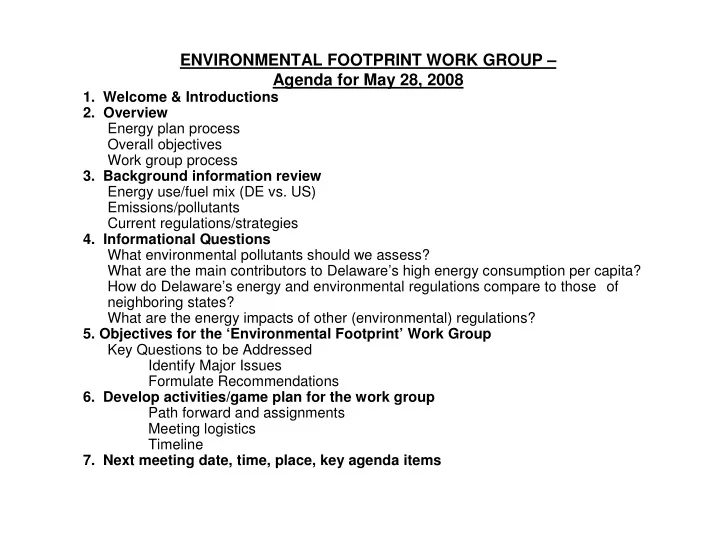
ENVIRONMENTAL FOOTPRINT WORK GROUP Agenda for May 28, 2008 1. Welcome & Introductions 2. Overview Energy plan process Overall objectives Work group process 3. Background information review Energy use/fuel mix (DE vs. US)


slide-1
SLIDE 1

ENVIRONMENTAL FOOTPRINT WORK GROUP – Agenda for May 28, 2008

  • 1. Welcome & Introductions
  • 2. Overview

Energy plan process Overall objectives Work group process

  • 3. Background information review

Energy use/fuel mix (DE vs. US) Emissions/pollutants Current regulations/strategies

  • 4. Informational Questions

What environmental pollutants should we assess? What are the main contributors to Delaware’s high energy consumption per capita? How do Delaware’s energy and environmental regulations compare to those of neighboring states? What are the energy impacts of other (environmental) regulations?

  • 5. Objectives for the ‘Environmental Footprint’ Work Group

Key Questions to be Addressed Identify Major Issues Formulate Recommendations

  • 6. Develop activities/game plan for the work group

Path forward and assignments Meeting logistics Timeline

  • 7. Next meeting date, time, place, key agenda items
slide-2
SLIDE 2

A Few Energy Facts

World Energy Consumption ≈ 400 Quads/yr US Energy Consumption ≈ 100 Quads/yr Delaware Energy Consumption ≈ 0.3 Quads/yr (Quad = Quadrillion BTU)

US daily consumption: 20 million barrels of oil 60 billion cubic feet of natural gas 3 million tons of coal

slide-3
SLIDE 3

Total US Energy Consumption (2004)

slide-4
SLIDE 4

US Energy Sources and Uses

U.S. Primary Energy Consumption by Source and Sector, 2004 (quadrillion Btu) Source: http://www.eia.doe.gov/basics/energybasics101.html

slide-5
SLIDE 5

Energy Sources for US Electricity

slide-6
SLIDE 6

US Energy Mix

Electricity Generation (~40% of total):

50% Coal, 20% Nuclear, 18% Natural gas, 3% Petroleum

Transportation Fuels (~30 % of total):

96% Petroleum Very little overlap between energy sources for these two dominant sectors!

slide-7
SLIDE 7
slide-8
SLIDE 8

Needed GHG Emissions Reductions to Needed GHG Emissions Reductions to Stabilize Atmospheric Concentrations at Stabilize Atmospheric Concentrations at Current Levels Current Levels

Carbon dioxide > 60% Methane 8 - 20% Nitrous oxide 70 - 80% CFC 11 70 - 75% CFC 12 75 - 85% HCFC 22 40 - 50%

Source: IPCC Second & Third Assessment Reports

Carbon dioxide > 60% Methane 8 - 20% Nitrous oxide 70 - 80% CFC 11 70 - 75% CFC 12 75 - 85% HCFC 22 40 - 50%

Source: IPCC Second & Third Assessment Reports

Center for Energy and Environmental Policy Center for Energy and Environmental Policy Center for Energy and Environmental Policy

slide-9
SLIDE 9

Sir David King, 2007 presentation to AAAS

slide-10
SLIDE 10
slide-11
SLIDE 11

Next Energy Plan

  • Reducing Delaware’s Energy Usage
  • Reducing Environmental Footprint of the

Energy Delawareans Use

  • Having Effective and Efficient Energy

Transmission and Distribution Systems (for any type of energy or fuel)

  • Reducing the Energy Impact of Transportation

in Delaware

  • Maximizing Delaware’s Clean Energy

Economic Development Opportunities

slide-12
SLIDE 12

Reduced energy use Reduce footprint of existing sources/uses + Increasing fraction of smaller footprint sources/uses Clean Energy Developments

X =

REDUCED ENERGY IMPACT WG1 WG2 WG5

slide-13
SLIDE 13

Per capita energy use was ~357 million BTUs in 1999, and 372 million BTUs in 2005, a growth of 4.2% over the 6 year period. US average 2005 per capita energy use was 339 million BTUs; Delaware ranked as the 19th largest per capita user of energy. States with the lowest and highest 2005 per capita energy use were: Rhode Island 213 million BTU New York 217 million BTU California 232 million BTU Wyoming 912 million BTU Alaska 1,192 million BTU 2005 per capita use was lower than Delaware in all neighboring states: Delaware 372 million BTU Maryland 279 million BTU New Jersey 315 million BTU Pennsylvania 327 million BTU A note that should be made, Delaware’s per capita figures are affected by refineries and power plants vs. the relatively small population.

Delaware’s Energy Footprint

slide-14
SLIDE 14

US Energy Use by Sector, 2006

residential, 21% commercial, 18% industrial, 32% transportation, 28%

Delaware Energy Use by Sector, 2005

residential 23% commercial 1 9% industrial 35% transportation 23%

Phil Cherry, LWV presentation, 4/23/08

slide-15
SLIDE 15

CO2 Emissions by Sector (million metric tons)

0.7 4.27 1.21 5.24 6.32

commercial Industrial Residential Transportation Utilities

2005

slide-16
SLIDE 16

Year 2000 Generation and Emissions

Phil Cherry, LWV presentation, 4/23/08

slide-17
SLIDE 17

CO2 Output Emission Rate

Phil Cherry, LWV presentation, 4/23/08

slide-18
SLIDE 18

Electricity Generation by Fuel Type, PJM 2006

56.80% 0.30% 5.50% 34.60% 0.70% 2.00% 0.10% Coal Oil Gas Nuclear Solid Waste Hydroelectric Wind

Where Does Our Electricity Come From?

Electricity Generation by Fuel Type, US 2006

50.00% 1.66% 17.11% 19.86% 0.64% 6.99% 0.62% 2.11% 0.58% Coal Oil Gas Nuclear Solid Waste Hydroelectric Wind Other Renewable Other & Imports

Generation and Consumption in Delaware (2006)

Delaware electricity consumption: 11,555 million kWh Delaware electricity generation: 7,182 million kWh

slide-19
SLIDE 19

10 20 30 40 50 60 70 1995 2003 2005 2006 Coal Oil Nat.Gas Other

Year

In-State Electricity Generation by Source Type (%)

slide-20
SLIDE 20

CO2 Emissions from Electricity Generation in Delaware (thousand metric tons)

1000 2000 3000 4000 5000 6000 1995 2003 2005 2006 Coal Oil Nat.Gas

Year

slide-21
SLIDE 21

SO2 from Delaware Electric Power Plant Emissions (Thousand Metric Tons)

5 10 15 20 25 30 35 40 1995 2003 2005 2006 Coal Oil

slide-22
SLIDE 22

2 4 6 8 10 12 14 16 1995 2003 2005 2006 Coal Oil Nat.Gas Other

NOx from Delaware Electric Power Plant Emissions (Thousand Metric Tons)

slide-23
SLIDE 23

45 Distillate Oil Natural Gas Warren F. Sam Beasley Station 180 Distillate Oil, Natural Gas Syngas Refinery 63 Syngas Refinery Gas Refinery 119 Refinery Gas Refinery Premcor 17 Distillate Oil Indian River 782.4 Distillate Oil Coal Indian River 100 Distillate Oil Natural Gas Energy Center Dover 18 Natural Gas Coal Energy Center Dover NRG 30 Residual Oil, Natural Gas Coal Invista 14 Distillate Oil West Substation 237 Waste Heat Hay Road 705 Distillate Oil Natural Gas Hay Road 12.5 Distillate Oil Edge Moor 446 Natural Gas, Distillate Oil Residual Oil Edge Moor 251.8 LFG, WWTP Gas, Natural Gas, Distillate Oil Coal Edge Moor 14 Distillate Oil Delaware City 45 Distillate Oil Christiana Conectiv 45.1 Distillate Oil Natural Gas Van Sant 151.2 Natural Gas Residual Oil McKee Run City of Dover Nameplate Capacity (MW) Other Fuels Main Fuel Plant Name

slide-24
SLIDE 24

1 2 9,360 Warren F. Sam Beasley Station 4 21 779 496 1,665,563 Premcor Refinery 33 2,346 6,373 20,706 3,573,125 NRG Indian River 2 95 382 1,531 127,498 NRG Energy Center Dover 3 249 1053 4,143 270,946 Invista 1 474 Conectiv West Substation 9 30 269 3 564,024 Conectiv Hay Road 24 416 1,665 7,982 1,657,418 Conectiv Edge Moor 2 1 724 Conectiv Delaware City 5 2 1,257 Conectiv Christiana 2 2,538 City of Dover Van Sant 1 3 47 55 19,959 City of Dover McKee Run VOC (TPY) PM2.5 (TPY) NOx (TPY) SO2 (TPY) CO2 (TPY) Plant Name

slide-25
SLIDE 25

Environmental Impacts from Energy - NOx

  • Over 47,000 tons

per year emitted in Delaware

  • Mobile sources

account for 66%

  • f states NOx
  • Delaware’s power

plants accounted for about 16% of Delaware’s

  • verall NOX

inventory for 2002.

NOX - tons per year

7293, 13% 2622, 5% 21341, 37% 16299, 29% 9052, 16%

Point (less EGUs) Area On-road Off-road EGU's

Phil Cherry, LWV presentation, 4/23/08

slide-26
SLIDE 26

Environmental Impacts from Energy - SO2

  • Approximately 50,000

tons per year emitted in Delaware

  • Delaware’s power

plants (EGU’s) account for 65% of the SO2 emitted in the state (after the DCR project).

  • 75% of the off-road

SO2 emissions are from commercial marine vessels.

SO2 - tons per year

11281, 23% 1590, 3% 584, 1% 4004, 8% 32463, 65% Point (less EGUs) Area On-road Off-road EGU's

Phil Cherry, LWV presentation, 4/23/08

slide-27
SLIDE 27

Other Power Plant Issues

  • Water use from DE coal plants estimated at 1.5 BGD – 2%

consumptive

  • Fisheries impact significant

– Hundreds of millions of fish eggs and Larvae – Hundreds of thousands of fish

  • Health implications

– Asthma/respiratory ailments – Mercury impacts – Cancers

  • Acid rain/deposition
  • Aerial nitrogen deposition
  • Ash disposal/landfills
  • Particulates
  • Smog/visibility issues
  • Carbon

Phil Cherry, LWV presentation, 4/23/08

slide-28
SLIDE 28

New Regulations/Strategies

  • Renewable Portfolio Standards (RPS)
  • Sustainable Energy Utility (SEU)
  • Regional Greenhouse Gas Initiative (RGGI)
slide-29
SLIDE 29

ENVIRONMENTAL FOOTPRINT WORK GROUP – Agenda for May 28, 2008

  • 1. Welcome & Introductions
  • 2. Overview

Energy plan process Overall objectives Work group process

  • 3. Background information review

Energy use/fuel mix (DE vs. US) Emissions/pollutants Current regulations/strategies

  • 4. Informational Questions

What environmental pollutants should we assess? What are the main contributors to Delaware’s high energy consumption per capita? How do Delaware’s energy and environmental regulations compare to those of neighboring states? What are the energy impacts of other (environmental) regulations?

  • 5. Objectives for the ‘Environmental Footprint’ Work Group

Key Questions to be Addressed Identify Major Issues Formulate Recommendations

  • 6. Develop activities/game plan for the work group

Path forward and assignments Meeting logistics Timeline

  • 7. Next meeting date, time, place, key agenda items
slide-30
SLIDE 30

Key Questions to be Addressed by the Work Group:

  • 1. What policies and programs can be put into place that will reduce the

environmental footprint of Delaware’s energy use?

  • 2. How should Delaware meet its current and future electricity

requirements?

  • 3. What will the impact be on Delaware’s electricity generation system

as the price of coal rises? The price of natural gas? The price of carbon?

  • 4. What can be done to moderate price shocks or create price stability
  • ver time? What is the likelihood of price stability or instability?
  • 5. What is the likelihood of future regulations impacting the energy type

used to generate electricity in Delaware?

  • 6. What should be the appropriate balance between regionally

generated electricity and transmission from distant generation facilities?