Enzyme Inhibitors Petr Kuzmi , Ph.D. BioKin, Ltd. TOPICS: 1. - - PDF document

enzyme inhibitors
SMART_READER_LITE
LIVE PREVIEW

Enzyme Inhibitors Petr Kuzmi , Ph.D. BioKin, Ltd. TOPICS: 1. - - PDF document

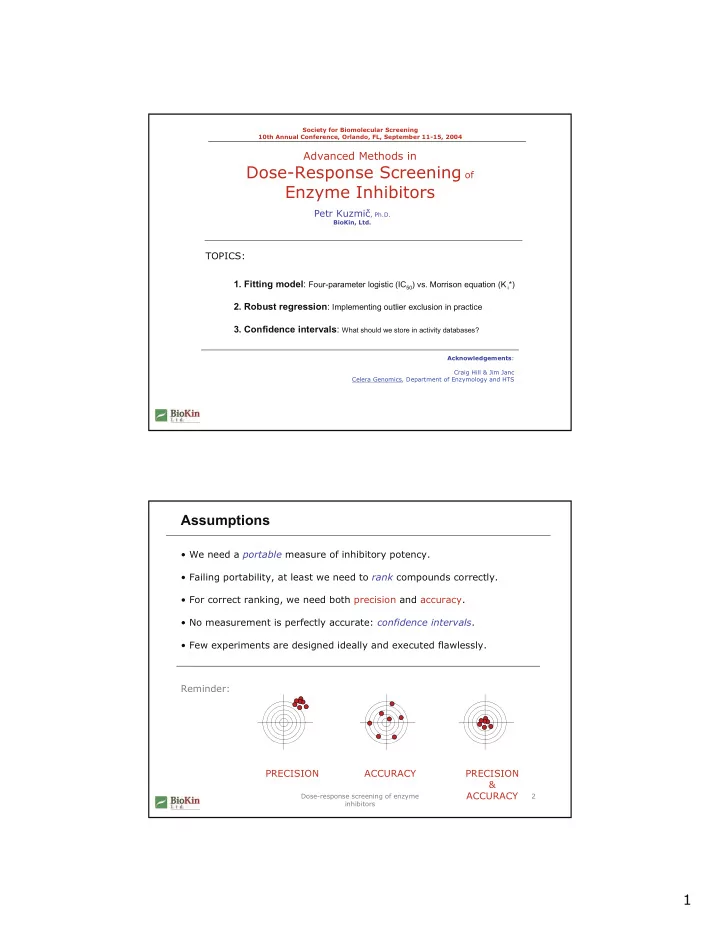
Society for Biomolecular Screening 10th Annual Conference, Orlando, FL, September 11-15, 2004 Advanced Methods in Dose-Response Screening of Enzyme Inhibitors Petr Kuzmi , Ph.D. BioKin, Ltd. TOPICS: 1. Fitting model : Four-parameter logistic


slide-1
SLIDE 1

1

Advanced Methods in

Dose-Response Screening of Enzyme Inhibitors

  • 1. Fitting model: Four-parameter logistic (IC50) vs. Morrison equation (K i*)
  • 2. Robust regression: Implementing outlier exclusion in practice
  • 3. Confidence intervals: What should we store in activity databases?

TOPICS:

Acknowledgements: Craig Hill & Jim Janc Celera Genomics, Department of Enzymology and HTS

Petr Kuzmič, Ph.D.

BioKin, Ltd. Society for Biomolecular Screening 10th Annual Conference, Orlando, FL, September 11-15, 2004

Dose-response screening of enzyme inhibitors 2

Assumptions

  • We need a portable measure of inhibitory potency.
  • Failing portability, at least we need to rank compounds correctly.
  • For correct ranking, we need both precision and accuracy.
  • No measurement is perfectly accurate: confidence intervals.
  • Few experiments are designed ideally and executed flawlessly.

Reminder: PRECISION ACCURACY PRECISION & ACCURACY

slide-2
SLIDE 2

2

Dose-response screening of enzyme inhibitors 3

Measures of inhibitory potency

  • 1. Inhibition constant
  • 2. Apparent K i
  • 3. IC50

Depends on [S] [E] NO YES YES NO NO YES K i K i

* = K i (1 + [S]/KM)

IC50 = K i (1 + [S]/KM) + [E]/2 Example: Competitive inhibitor

INTRINSIC MEASURE OF POTENCY: DEPENDENCE ON EXPERIMENTAL CONDITIONS

[E] « K i: IC50 ≈ K i

*

ΔG = -RT log K i [E] ≈ K i: IC50 ≠ K i

* "CLASSICAL" INHIBITORS: "TIGHT BINDING" INHIBITORS: Dose-response screening of enzyme inhibitors 4

Tight binding inhibitors : [E] ≈ K i

HOW PREVALENT IS "TIGHT BINDING"?

... NOT SHOWN

log K i *

  • 12
  • 9
  • 6
  • 3

N 500 1000 1500 2000

A typical data set: Completely inactive: Tight binding: ~ 10,000 compounds ~ 1,100 ~ 400

Data courtesy of Celera Genomics

slide-3
SLIDE 3

3

Dose-response screening of enzyme inhibitors 5

Problem: Negative Ki from IC50

log [I]

  • 11
  • 10
  • 9
  • 8
  • 7
  • 6

rate 0.0 0.2 0.4 0.6 0.8 1.0 1.2 1.4

  • inf

nHill IC50 1.4 2.9 nM [E] = 7.0 nM K i* = 2.9 - 7.0 / 2 = - 0.6 nM

FIT TO FOUR-PARAMETER LOGISTIC:

K i

* = IC50 - [E] / 2

Data courtesy of Celera Genomics

Dose-response screening of enzyme inhibitors 6

Solution: Do not use four-parameter logistic

log [I]

  • 11
  • 10
  • 9
  • 8
  • 7
  • 6

rate 0.0 0.2 0.4 0.6 0.8 1.0 1.2 1.4

  • inf

[E]nominal = 7.0 nM [E]fitted = 4.5 nM K i* = 0.9 nM

FIT TO MODIFIED MORRISON EQUATION:

  • P. Kuzmic et al. (2000) Anal. Biochem. 281, 62-67.
  • P. Kuzmic et al. (2000) Anal. Biochem. 286, 45-50.

Data courtesy of Celera Genomics

slide-4
SLIDE 4

4

Dose-response screening of enzyme inhibitors 7

Fitting model for enzyme inhibition: Summary

  • Apparent inhibition constant K i

* is preferred over IC50

  • Modified Morrison equation is preferred over

four-parameter logistic

  • Optionally, adjust the enzyme concentration in fitting K i

*

MEASURE OF INHIBITORY POTENCY MATHEMATICAL MODEL METHODOLOGY

( )

] [ 2 ] [ 4 ] [ ] [ ] [ ] [

* 2 * *

E K E K I E K I E V V v

i i i b

+ − − + − − + =

  • 1. Fitting model: Four-parameter logistic (IC50) vs. Morrison equation (K i*)
  • 2. Robust regression: Implementing outlier exclusion in practice
  • 3. Confidence intervals: What should we store in activity databases?

TOPICS:

slide-5
SLIDE 5

5

Dose-response screening of enzyme inhibitors 9

Problem: Occasional "outlier" points

log [I]

  • 9
  • 8
  • 7
  • 6
  • 5
  • 4

rate 20 40 60 80 100 120 140 160

  • inf

K i* = 43 μM

LEAST-SQUARES FIT

  • P. Kuzmic et al. (2004) Meth. Enzymol. 383, 66-81.

Dose-response screening of enzyme inhibitors 10

Solution: Robust regression ("IRLS")

log [I]

  • 9
  • 8
  • 7
  • 6
  • 5
  • 4

rate 20 40 60 80 100 120 140 160

  • inf

K i* = 130 μM

HUBER'S "MINIMAX" METHOD

  • P. Kuzmic et al. (2004) Meth. Enzymol. 383, 66-81.
slide-6
SLIDE 6

6

Dose-response screening of enzyme inhibitors 11

Robust fit: Practical considerations

"The devil is in the details."

  • Treat negative controls in a special way (unit weight).
  • Allow only a certain maximum number of "outliers".

Dose-response screening of enzyme inhibitors 12

Robust fit: Constant weighting of negative controls

log [I]

  • 9
  • 8
  • 7
  • 6
  • 5
  • 4

rate 0.0 0.2 0.4 0.6 0.8 1.0 1.2 1.4

  • inf

Huber's method Unit weight @ [I] = 0

NEGATIVE CONTROL WELLS ([I] = 0) ARE EXCLUDED FROM ROBUST WEIGHTING SCHEME

Data courtesy of Celera Genomics

slide-7
SLIDE 7

7

Dose-response screening of enzyme inhibitors 13

Robust fit: Limiting the number of "outliers"

log [I]

  • 9
  • 8
  • 7
  • 6
  • 5
  • 4

rate 0.0 0.5 1.0 1.5 2.0 2.5

  • inf

Max 50% points with weight < 1.0 Huber's method 100 2 100 88 58 50 91 79 100 IRLS weights

I.R.L.S.: AT MOST ONE HALF OF DATA POINTS WITH NON-UNIT WEIGHTS

Data courtesy of Celera Genomics

Dose-response screening of enzyme inhibitors 14

Robust fit: Productivity and objectivity gains

A CASE STUDY "BEFORE AND AFTER" IMPLEMENTING ROBUST REGRESSION

10 20 30 40 50 60 70 80 90

before after robust fit % repeat deletions

Data courtesy of Celera Genomics

slide-8
SLIDE 8

8

Dose-response screening of enzyme inhibitors 15

Robust fit: Summary

  • Tested on 10,000+ dose response curves
  • Huber's "Minimax method" proved most effective
  • Modifications for inhibitor screening:
  • a. Handling of negative controls
  • b. Prevent too many outliers
  • Increase in scientific objectivity & productivity
  • 1. Fitting model: Four-parameter logistic (IC50) vs. Morrison equation (K i*)
  • 2. Robust regression: Implementing outlier exclusion in practice
  • 3. Confidence intervals: What should we store in activity databases?

TOPICS:

slide-9
SLIDE 9

9

Dose-response screening of enzyme inhibitors 17

What is the "true" value of an inhibition constant?

experiment no.

50 60 70 80 90

K i* , μM

10 15 20 AVERAGE & STANDARD DEVIATION FROM 43 REPLICATES

Average:

  • Std. Dev.: 0.9 μM

13.7 μM

#76 : Ki = 11.5 μM

Data courtesy of Celera Genomics

Dose-response screening of enzyme inhibitors 18

Formal standard errors are too narrow

EXPERIMENT #76

K i* = (11.5 ± 1.2) μM Formal standard error

INTERVAL DOES NOT INCLUDE "TRUE" VALUE 13.7 μM

Data courtesy of Celera Genomics

slide-10
SLIDE 10

10

Dose-response screening of enzyme inhibitors 19

Symmetrical confidence intervals are better

K i* = (8.6 ... 14.4) μM Symmetrical 95% confidence interval

INTERVAL DOES INCLUDE "TRUE" VALUE 13.7 μM

Data courtesy of Celera Genomics

EXPERIMENT #76 Dose-response screening of enzyme inhibitors 20

Nonsymmetrical confidence intervals are the best

experiment no.

50 60 70 80 90

K i* , μM

10 15 20

NONSYMMETRICAL 99% C.I.

Watts, D.G. (1994) Meth. Enzymol. 240, 23-36. Bates & Watts (1988) Nonlinear Regression, p. 207

Data courtesy of Celera Genomics

slide-11
SLIDE 11

11

Dose-response screening of enzyme inhibitors 21

Confidence intervals (C.I.): Summary

  • Report two numbers for each compound: high and low end of the C.I.
  • If two C.I.'s overlap, the two inhibitory activities are indistinguishable.
  • Thus, many compounds can end up with identical rank!
  • 1. Fitting model: Four-parameter logistic (IC50) vs. Morrison equation (K i*)
  • 2. Robust regression: Implementing outlier exclusion in practice
  • 3. Confidence intervals: What should we store in activity databases?

Conclusions: Toward a "best-practice" standard in secondary screening TOPICS:

slide-12
SLIDE 12

12

Dose-response screening of enzyme inhibitors 23

Toward "best-practice" in secondary screening

  • Measure Ki

*, not IC50 (dependence on experimental conditions).

  • Use a mechanism-based model (Morrison equation),

not the four-parameter logistic equation (no physical meaning).

  • Employ robust regression techniques, but very carefully.
  • Report a high/low range (confidence interval) for every Ki

*. DOSE-RESPONSE STUDIES OF ENZYME INHIBITORS