EPA REGION I X UNITED STATES ENVIRONMENTAL PROTECTION AGENCY - - PDF document

epa region i x
SMART_READER_LITE
LIVE PREVIEW

EPA REGION I X UNITED STATES ENVIRONMENTAL PROTECTION AGENCY - - PDF document

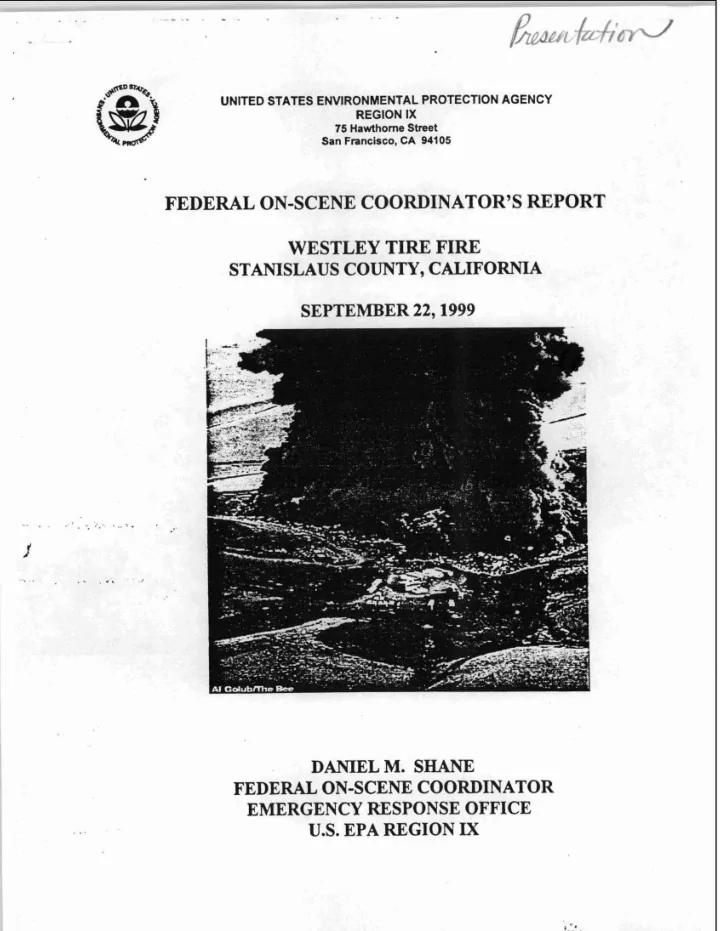
UNITED STATES ENVIRONMENTAL PROTECTION AGENCY REGION IX 75 Hawthorne Street San Francisco, CA 94105 FEDERAL ON-SCENE COORDINATOR'S REPORT WESTLEY TIRE FIRE STANISLAUS COUNTY, CALIFORNIA SEPTEMBER 22,1999 DANIEL M. SHANE FEDERAL ON-SCENE

slide-1
SLIDE 1

UNITED STATES ENVIRONMENTAL PROTECTION AGENCY REGION IX 75 Hawthorne

Street San Francisco, CA 94105

FEDERAL ON-SCENE COORDINATOR'S REPORT WESTLEY TIRE FIRE

STANISLAUS COUNTY, CALIFORNIA SEPTEMBER 22,1999 DANIEL M. SHANE FEDERAL ON-SCENE COORDINATOR EMERGENCY RESPONSE OFFICE

U . S .

EPA REGION I

X

slide-2
SLIDE 2

UNITED STATES ENVIRONMENTAL PROTECTION AGENCY REGION IX

75 Hawthorne Street San Francisco, CA 94105

TABLE OF CONTENTS

I. Executive Summary .............................................................................................. 3

................................................................................

A. Chronology of Events 4

I1

Summary

  • f Events

..................................................................................................

A. Situation 6 1. Background 2. Tire Fire Dynamics ..................................................................... 9 3. Potential Threats 4. Initial Notification and Response

................................................ I0

5. EPA Response Actions B. Organization of the Response

...........................................................................

C. Fire Suppression Tactics 15 D. Managing Runoff

...................................................................................... 16

D. Disposal of Pyrolytic Oil E. Air Monitoring and Surveillance

.............................................................. 1

8

. .

. . . .

.: .............. F, ,

: Site Winterization

.......................

1

G. Assessment of Contamination in Ash, Debris and Runoff 19

', .,. .. , .

. . . .

g...: .............. H.

. . . &

  • Resources Committed

............................................................................... 20

1. Estimated Costs 2. Personnel Resources

..................................................................

.2 1

3.

Equipment Resources.. ..............................................................

  • 22

1 1 1 .

Lessons Learned

......................................................................................................

23 A. Key Lessons Learned B. Problems Associated with Multi-Agency Response and Coordination

.....

27

................................................................

N

Information on State Emergency Permits 3 1

....................................................................................

V.

Reference List for Tire Fires 32

Page 2 of 42

slide-3
SLIDE 3

UNITED STATES ENVIRONMENTAL PROTECTION AGENCY REGION IX

75 Hawthorne Street San Francisco, CA 94105

August 30, 2000

WESTLEY TIRE FIRE WESTLEY, STANISLAUS COUNTY, CALIFORNIA VI. Executive Summary In the past couple of years there has been a rash of tire fires in the United States. EPA Region 9 has experienced a number of tire fires. Date

  • Site NameLocation

Size of Pile 1996 - Panoche Hills Tire Fire, Fresno County - 3 million tires 1 997 - Gila River Tire Fire, Arizona

  • 3 million tires

1998 - Tracy Tire Fire, San Joaquin County - 5 million tires 1998 - Ordot Landfill Tire Fire, Guam

  • 1 million tires

1999 - Westley Tire Fire, Stanislaus County - 7 million tires Large tire fires are a major hazardous material event where large populations are affected and they can cause severe environmental damage. The cost of fighting these fires are staggering. For a

.

. . .

,...response to be successll, responders must recognize that tire fires are a unique multi-category event

.

containing the elements of a major fire, hazardous materials release and oil spill discharge combined into

  • ne event. Each tire fire incident is a unique situation that may require innovative fire suppression

strqtegies.. . The primary tactics that have been used include, let it bum, bury and smother with sand or

,

  • :

.

.I

A'.,

,

dirt, and extinguish with water and foam. Past experience with foam suppression methods at tire fires have indicated very limited success on mostly small burning tire piles. The use of other suppression methods such as injection of liquid carbon dioxide, cryogenic gases or use of accelerants have been much less successful and can be very hazardous to work with. These methods are not normally

  • recommended. The choice of tactics depends on many factors including the size of the tire pile,

configuration of the tires, surrounding terrain, public health exposures, risk to natural resources, feasibility, cost, and the acceptance of trade-offs such as increasing air pollution as in the "let it bum" scenario in exchange for reducing the potential to contaminate ground water supplies as in the "water suppression" scenario. Tactical decisions can be influenced by the degree of community and political involvement in the area. This was the first successll extinguishment of a large tire fire using water and foam as the sole suppression method. However, the initial decision was not to use water and foam to extingu:sh the fire due to containment and environmental concerns. Governmental agencies were concerned about the containment of massive volumes of contaminated runoff and impacts to surface and ground water. It was interesting to see how the fire-fighting strategies evolved at this incident.

Page 3 of 4 2

slide-4
SLIDE 4

On September 22, 1999, a lightning strike ignited a fire in the Filbin tire pile located in a canyon

  • n the east slope of the coastal mountain range. The tire dump contained an estimated seven million

scrap tires piled on steep slopes of the canyon. The fire spread quickly and engulfed most of the main tire pile. The tremendous smoke plume fiom the tire fire impacted nearby farming communities and caused widespread concern of potential health affects fiom exposure to the smoke emissions. The tire fire produced large volumes of pyrolytic oil that flowed off the slope and into the drainage of an intermittent stream. The oil runoff was initially contained behind an existing stock watering pond consisting of a small earthen dam and impoundment structure. A reduction in smoke emissions was evident as the tire fire entered into the smoldering stage. The burning tires in the drainage ignited the oil flowing in the stream. The large oil fire significantly increased the smoke emissions and a local climatic inversion caused the smoke to remain close to ground level. The response to the oil and tire fires quickly overwhelmed the resources of the local and State agencies The U.S. EPA Federal On-Scene Coordinator (FOSC) immediately responded using Oil Pollution Act of 1990 (OPA) authority. The FOSC quickly mobilized EPA's contractors and the U.S. Coast Guard Pacific Strike Team. On the recommendations

  • f the U.S. Coast Guard, the

FOSC directed EPA's cleanup contractor, IT Corporation, to procure the services of Williams Fire and Hazard Control to fight the oil fire. Due to the geographic setting, the oil flowed away from the tire piles resulting in a slower burning fire. It was discovered that only the top ten feet of tires were

  • burning. A tactical plan was developed to implement a safe and effective suppression of the fire. Largr

excavators and special foam delivery apparatus were used to extinguish fires one slope at a time while moving up the canyon. It took 27 days to extinguish the fire. Over 250,000 gallons of pyrolytic oil were recovered from the containment pond. An estimated 4 million gallons of contaminated fire fighting water were impounded on site in a series of constructed

.

. .

. .

.

..

' basiiis 'within:the drainage channel. Total EPA emergency response costs were estimated to be $3.5

t

  • million. Future work will involve site winterization, characterization and remediation.
  • .a*.. - "

y s .'

, .

4 -

. ,

.

,. . - t s

  • . - The response action was highly successful. Some of the most difficult problems that were

'

encountered included working in extremely hot and unstable fire conditions, maneuvering heavy equipment on steep slopes, deep and spongy tire piles, controlling massive volumes of oil and water runoff, coordinating with local and State governmental agencies, forming a hlly integrated and effective Unified Command, and the recycling of pyrolytic oil under current California hazardous waste regulations. A. Chronologv of Events 09/22/99 - Tire pile was ignited by a lighting strike at 0400 EPA received initial notification from CIWMB at 0900 Hundreds of local and State responders mobilized to contain the blaze Multi-agency meeting held in Modesto Decision made to "let it burn", fire was contained in the canyon 09/23/99 - Oil slick observed on surface of pond at 0430 Page 4 of 42

slide-5
SLIDE 5

09124199 -

9

09/25/99 - 09/26/99 - 09/27/99 -

9

. .

09/28/99 -

. .

9

09130199 - 10101/99 -

  • 9

10/02199 - 10104199 - 10/07199 - 10108199 - 10/10/99 -

  • 10/14199 -

.. ..

.

Y . . .

.

* :...

. -

I

10115199 -

.*.;.'..,.h 2 . '.'

' - - ' *10!16/99 -

10119199 - 10124/99 - 10/25/99 -

. .

10126199 - 10127199 - 10/29199 11/03/99 - CDF transferred lead to County and demobilized Thick pyrolytic oil flowing into pond observed at 1200 DTSC ERU contractor began oil recovery operations at pond Smoke emissions significantly reduced due to crust formation EPA issued verbal Notice of Federal Interest to Filbin Large oil fire in drainage ignited by burning tires Oil fire significantly increased smoke emissions Oil fire ignited a large pile of unburned tires across drainage Fire jumped breaks and ignited a 1,500 acre grassland fire at 0200 Multi-agency meeting held to form a Unified Command Recovered a total of 45,000 gallons of oil to date Volunteer fire department mobilized to extinguish the oil fire The immensity of the fire quickly overwhelmed local resources EPA FOSC initiated federal response action using OPA authority EPA FOSC activated federal response team (ERRS, START, USCG PST) Williams Fire & Hazard Control arrived on scene Williams fire-fighters extinguished oil fire Recovered a total of 1 15,000 gallons of oil to date Estimated 200,000 gallons of oil contained in on-site pond and tanks Commenced overhauling burning tire debris in lower canyon areas Town Hall Community Meeting held a Patterson High School Began shipments of oil to Evergreen Oil Company for recycling Filbin's proposal to use soil to smother the fire was rejected Excavation along steep ridge revealed only top 10 feet of tires burning Recovered a total of 135,000 gallons of oil to date Began excavation of large silt basin for control of storm runoff CRWQCB issued a Cleanup & Abatement Order to PRPs Completed overhauling burning tire debris in lower canyon areas Recovered a total of 173,000 gallons of oil to date Commenced overhauling burning tire debris in middle canyon areas Representatives from ofices of Feintein, Boxer and Condit tour site Williams completed overhauling burning tire debris in middle canyon CI WMB contractor's began construction of check dams for winterization Commenced overhauling burning tire debris in upper canyon areas Began shipments of oil to Romic Environmental Technologies

  • A. Johnson, CIWMB, designated SOSC by Cal-EPA

Conducted infrared survey to locate remaining hot spots Fire officially declared out by EPA FOSC at 1235 Fire burned for a total of 36 days California legislative committee on tire disposal held meeting in Patterson Last shipment of oil to Romic Environmental Total volume of oil sent to recyclers was 250,950 gallons Federal response team demobilizd all personnel and equipment Cal-EPA assumed lead agency role and continued winterization work

Page 5 of 4 2

slide-6
SLIDE 6

11.

Summary of Events

  • A. Situation

1. Background Back in the 1950's, Edward Joseph Filbin opened a dump for scrap tires on his ranch. The dump was in a canyon where the rolling hills of the Diablo Coastal Range meets the Great Central Valley of California. The site was about 35 miles southeast of San Francisco Bay and 114 miles fiom Interstate highway 5. This was a rural farming area and the surrounding land was being used for agricultural production and g

r a z i n g . As you travel up the canyon fiom the valley into the hills the

canyon gradually became deeper, the walls became higher and steeper. Filbin dumped the tires on the very steep eastern slopes of the main canyon. The site was approximately 40 acres of which 22 acres were covered by the main tire pile that was impacted by the fire. At the time of the fire there were an estimated 5 million tires in the main tire pile. An estimated 2 million tires in separate piles were located south and southwest of the bum site and were unaffected by the fire. A n unnamed intermittent stream flowed north in the drainage and under the tire pile. This stream was fed by springs and runoff from tributary drainages. Shallow ground water was encountered in the upper canyon area. There were four tributary canyons that drained approximately 800 acres of watershed. A stock watering pond and earthen dam were located in the lower part of the canyon. By 1987 it was estimated that Filbin had accumulated 40 million tires stacked 80 feet high on the

  • slopes. This would have made the Filbin pile the largest tire pile in the country. In 1988,

Modesto Energy Limited Partnership (MELP) started-up the first tire burning co-generation power plant. The

' ..

MELP, power plant was built on a tall hill overlooking the tire pile. The source of tire-derived fuel was a combination of old tires fiom the scrap pile and new tires that were brought to the facility by

1

contracted haulers. The heat generated by burning tires converted water into high pressure steam which drove a turbine and generator and produced electricity that was sold to a private utility company, Pacific

,

.'..'..

.,' .\

.

,

' * ~ k

& Electric. The tire incinerator burned 18,000 tires per day, 6 million tires per year or 60% of northern California scrap tires. This provided electricity for 18,000 homes. But the reduction in the size of the pile was slow because the older scrap tires had less BTU value than the newer tires. The daily consumption of tires included only 20% old tires. The energy plant eventually reduced the pile to 7 million tires. Filbin had constructed a road that transected the hillside above the canyon of tires. Haulers would drive to the top of the pile and dump their load on top of the pile. A steel-plated ramp was placed

  • ver the pile at the top of the canyon and was extended out over the precipice. The ramp was actually

part of the runway of an aircraft carrier. The trucks would back up onto the ramp and dump over the side building up piles that were 60 feet deep. Additionally, Filbin may have buried thousands of tires in the drainage. It has been alleged that during the construction of the energy plant the hilltop was leveled and the soil was bulldozed to the bottom of the canyon to create a level surface for stockpiling the tires. The tires piled in this area were not moved and were covered by the soils removed from the top of the

. hill. Evidence of this was uncovered while backhoes were overhauling burning tire debris in the

Page 6 of 42

slide-7
SLIDE 7

drainage area. Attempts by State regulators to compel Filbin to provide adequate fire protection, fire breaks and further reduction in the size of the tire pile were unsuccessful. The tire pile did not comply with NFPA guidelines which called for a minimum 60-foot wide separation between piles, not greater than 20 feet high and 250 feet in length and width. Page 7 of 42

slide-8
SLIDE 8

Page 8 of 42

slide-9
SLIDE 9

2. Tire Fire Dynamics On January 22, 1999, a rare lightning storm moved into the San Francisco Bay Area. Hundreds of lightning strikes were recorded. One lightning bolt struck the metal ramp and ignited the tires in the Filbin tire pile. The fire roared down the canyon with a 200 foot high fireball leading the conflagration. Temperatures were over 2,000 degrees F. The smoke plume formed a tomado-like vortex lifting the smoke upwards in a spiraling chimney reaching 6,000 feet in altitude. The ash and soot fallout was reported as far

as 60 miles away. Rains

mixed with ash and soot fell as black rain over the San Francisco Bay Area. The Westley Tire Fire progressed through several stages that were typical of most tire fires. These were identified as the ignitiodpropagation phase, compression stage, and the pyrolysis/smoldering stage. The propagation phase was characterized by high open flames, high temperatures and flammable vapors. At this stage there was an incredible amount of energy released which manifested itself as a cyclonic tomado- type vortex that generated tremendous heat and winds. The smoke was lifted in a column thousands of feet into the air. During the compression stage the tires lost their rigidity, settled and began to collapse in on

  • themselves. Both heat and smoke increased at this stage. As the tires melted down, the ash, bead wire and

steel belts formed a crust layer over the pile. At this stage it was a deep seated fire, slower buming with less smoke emissions. Tires deep in the pile began to pyrolyze and oil began to flow fiom the bottom of the pile. 3. Potential Threats The smoke plume contained toxic air contaminants that affected the residents and migrant workers in the area. During the early stages of the fire a climatic inversion caused the smoke plume to hang low over the valley and decreased visibility on the Interstate. The day turned into darkness as the black smoke blocked out the sun. A number of people complained of symptoms related to exposure to the smoke

.

. .

"... including headaches, vomiting, nose bleeds, breathing difficulties, seizures and coughing up blood. People

with'kfhma and allergies suffered the most fiom exposure to the smoke. It was estimated that if the fire was allowed to bum it would release 141,000 pounds of benzene, a carcinogen, 70,000 pounds of polycyclic aromatic hydrocarbons (many are carcinogenic), 10,000 pounds of butadiene, a chemical linked to leukemia,

  • *-'.*- '.*tho~simds
  • f pounds of carbon monoxide and particulates and trace amounts of arsenic, chromium, lead ind
  • zinc. Located nearby was the Pacific Intertie that was the central electrical grid for the Westem U.S.

and carried 500,000 volts. Smoke particulates that settled on the lines could cause arching and shorting out of the system putting millions of homes in the dark. The pathway for the pyrolytic oil runoff was into the stream which flowed under Interstate Highway 5 and across a field. Downstream was the California Aqueduct and the Delta Mendota Canal. The canal flowed to a local reservoir that was a municipal water supply for the Bay Area. Infiltration of contaminants into the soil threatened the regional ground water supply. Oil was produced in the tire fire by pyrolysis - the low temperature distillation of a tire in the absence of air. The average passenger tire contained an equivalent of two gallons of oil. The Filbin tire pile contained 7 million tires or 14 million gallons of oil. For comparison, the largest U

. S .

  • il spill was the Exxon Valdez which spilled 1

1 million gallons into Prince William Sound. Although vast quantities of oil were consumed in the fire there was a serious threat of oil discharge from the large tire fire.

Page 9 of 4 2

slide-10
SLIDE 10

4. Initial Notification and Response This was a major hazardous materials incident event and most local and State emergency and environmental agencies responded to the incident. EPA received an initial report of the incident on 9/22/99 at 0900 fiom the California Integrated Waste Management Board (IWMB). Hundreds of State and local volunteer fire fighters responded and battled to contain the blaze. Stanislaus County set up an Emergency Operations Center (EOC), media and medical hotlines. The first responders made the decision to let it bum. The fire was too hot and dangerous to battle and the enormous volume of water needed to fight the fire would cause severe environmental damage and overwhelm the containment. The California Department of Forestry (CDF) set up an incident command system (ICS) and formed a Unified Command (UC) with the West Stanislaus County Fire Protection District (WSCFPD). On 9/23/99, the CDF declared the fire contained in the canyon and demobilize and transferred the Incident Command to the WSCFPD, the local volunteer fire department. The primary objective at this point was to maintain fire breaks around the piles and monitor. Water would be sprayed on the unburned tire piles to cool and prevent the spread of the fire into these areas. Other unaffected piles would be moved, if possible, to increase their distance fiom the

  • fire. Oil runoff was contained in the existing stock watering pond located about 100 yards downstream

fiom the fire. The Cal-EPA Emergency Response Unit hired a contractor, PARC Environmental, to begin the removal of oil fiom the pond. The contractor used a vacuum truck to recover the oil. The oil was transferred to 20,000 gallon Baker Tanks for temporary storage.

5.

EPA Response Action Four days into the fire the oil flowing into the creek ignited. The huge oil fire sent a tremendous amount of oily smoke into the valley. The valley was basically a great big bowl that effectively trapped the

  • smoke. The air quality became extremely poor. The air pollution became exceedingly worse due to a

climatic inversion and ground level impacts were observed. The volunteer fire department responded but did not have the capability to deal with the oil fire. The EPA FOSC deemed the situation ~nacceptable~due

.

:.c'

to the substhtial threat to public health. The FOSC initiated a federal response using delegated authorities

I

in accordance with the National Contingency Plan (NCP) and Oil Pollution Act of 1990 (OPA). The FOSC

#

mobilized the federal response team consisting of the U.S. Coast Guard Pacific Strike Team, Superfund

,* ....

...--

  • :%

Tzchical Assistance and Response Team (START) contractor and the Emergency Response and Remedial'. Services (ERRS) cleanup contractor. The FOSC began assisting in the formation of a Unified Command (UC) under the ICS. Each participating agency accepted a role in the response effort. For example, the California Air Resources Board (ARB) would conduct off-site air monitoring, Stanislaus County would handle public relations, and the IWMB would develop a winterization plan. EPA would contain and recover the oil and provide resources needed to extinguish the oil fire. To put out the oil fire, the U.S. Coast Guard recommended Williams Fire and Hazard Control out of Mauriceville, Texas. Williams was formerly part of the famed Red Adair's Boots and Coots "hellfighters". Williams had over 50 years of experience in putting out large oil fires all over the world and extinguished the oil well fires during the Gulf War. The Williams fire fighters extinguished the oil fire in two days.

  • B. Or~anization
  • f the Res~onse

The National Interagency Incident Management System (NIIMS) Incident Command System (ICS) is the system used by the fire service and other emergency response organizations to manage crisis response

  • perations. NIIMS is organizationally flexible

and capable of expanding and contracting to accommodate responses of varying size and complexity. It involves four functional sections which report to the incident

slide-11
SLIDE 11

commander - planning, operations, logistics and finance. Additionally, other functional support, such as media and public information officer (PIO) and health & safety are part of the command staff.

A n ICS led

by a Unified Command (UC) is used to manage a complex, multi-jurisdictional response. The ICS led by a UC is recognized as the most effective method to involve local, State and Federal parties and the Responsible Party (RP) and to bring their respective expertise to the response. The UC maintains a cooperative environment, promoting overall efficiency in the emergency response. All agencies retain their authorities and responsibilities and work together to develop a common set of incident objectives and strategies, share information, maximize the utilization of available resources, and enhance the efficiency of the individual response organizations. At the Westley Tire Fire, there w

a s

an attempt to organize the agencies into a unified command. A standard NIIMS ICS w

a s

not used primarily because the State and County governmental agencies did not follow the ICS doctrine and most were not familar with the system. However, some of the components of the NIIMS ICS were implemented. The following is a list of primary agency representatives that participated in the response. Additionally, an organizational chart provides a conceptual structure used at the Westley Tire Fire. The individual roles and functions may have changed, overlapped or elapsed over the course of the response.

+

AGENCY CONTACT RESPONSE ROLE

I

U.S. EPA, Emergency Response Daniel M. Shane, Responsible for managing the deployment of Office Federal On-Scene Coordinator resources and personnel, coordinating response 75 Hawthorne Street (4 15) 744-2286 actions with other federal, state and local agencies San Francisco, CA 94 105 U.S. Coast Guard, Pacific Strike Team CDR Paul Jewel1 Health & Safety Officer Hangar 2, Hamilton Field (415) 883-331 1 Responsible for ensuring compliance with Health Novato, CA 94949 & Safety Plan, communications, cost

.

* .

. .

documentation, ICS support U.S. Coast Guard, National Pollution LCDR Greg Buie Administers the OPA Oil Spill Liability Trust Fund Center (202) 493-6846 Fund, dispenses funds for federal oil spill 4200 Wilson Blvd, Suite 1000, response actions, manages claims and cost ,bIington, VA-22203 recovery Commanding Officer CWO Daniel Waldschmidt Directed by the FOSC to assist in media and National Strike Force (252) 33 1-6000 public relations, town hall meetings, press Public Information and Assistance conferences and photo and video documentation Team 1461 N. Road Street Elizabeth, NC 27909 NOAA Heather Parker Hall Scientific Support Coordinator (SSC) Ofiice of Response & Restoration (510) 437-5344 Directed by FOSC to provide daily weather 1 1'" Coast Guard District forecasting and meteorological information Coast Guard Island, B50-5 Alameda, CA 94501 Ecology & Environment, Inc. Robin Clemens EPA START Contractor 350 Sansome Street #300 (415) 981-281 1 Technical and scientific support multi-media San Francisco, CA 94 1 04 monitoring and sampling. polreps and documentation

Page 11 of 4 2

slide-12
SLIDE 12

Page 12 of 4 2

RESPONSE ROLE EPA ERRS Contractor Prime contractor with overall responsibility for mobilization of equipment and supplies, fire suppression activities, cleanup and disposal

  • perations

ERRS Subcontractor Lead Fire-fighter, responsible for extinguishing the tire fire ERRS Subcontractor Responsible for oil containment, recovery, storage, transportation, disposal and recycling Initial First Responder State Incident Commander Responsible for set up of ICS, fire control & containment State Representative to the Unified Command. Primary regulatory authority over the tire pile, developed and implemented site winterization and tire remediation projects, provided on-site technical expertise in tire fire suppression and site remediation techniques Responsible for surface and groundwater protection, treatment and disposal of fire-fighting water, initiated enforcement action against PRPs Mobilized initial response to oil spill. Hired contractor to pump and store oil runoff. Responsible for waste classification and assisting in the recycling of oil Responsible for off-site air surveillance program and evaluation of air impacts to surrounding communities Provided on-site technical assistance. State Resource Trustee, characterized impacts of runoff

  • n fish and wildlife.

Responsible for overall coordination of State

  • agencies. Monitored response and reported to the

Governor's Office.

"

AGENCY IT Corporation 2130 William Pitt Way Pittsburg, PA 15238 Williams Fire & Hazard Control, Inc. P.O. Box 1359 Mauriceville, Texas 77626 Ecology Control Industries 255 Parr Blvd Richmond, CA 9480 1 California Department of Forestry and Fire Prevention 15670 Montercy Street Morgan Hill, CA 95037 Cal-EPA, Integrated Waste Management Board 8800 Cal Center Drive Sacramento, CA 95826 California1 Regional Water Quality Control Board 3443 Routier Road, Suite A Sacramento, CA 95827 Cal-EPA, Department of Toxic Substances Control, Emergency Response Unit P.O. Box 806 Sscramento, CA 95812 Cal-EPA, Air Resources Board P.O. Box 28 15 Sacramento, CA 958 12 California Department of Fish & Game, Office of Spill Prevention and Response P.O. Box 944209 Sacramento, CA 94244 California

  • f

l i c e

  • f Emergency

Services P.O. Box 4 19047 Rancho Cordova, CA 95670 CONTACT Richard Fisher, Response Manager (4 12) 826-33 19 Dwight Williams (800) 23 1-461 3 Karen Bluitt-Ruffin (5 10) 970-7463 Carl Burton (408) 779-2 12

1

Ralph Chandler, State IC (9 16) 255-2 182 Albert Johnson, SOSC (9

3 6) 255-3840

Todd Thalharner (916) 255-1 194 Robert Fujii (916) 255-1300 Wendy Arano (916) 255-3137 Karl Palmer (916) 323-3658

Sam

Martinez (9 16) 323-35 16 Jim Morgester (9 16) 322-6022 Kim McCleneghan (916) 322-921 Tracey Vardas (9 16) 464-3287

slide-13
SLIDE 13

Page 13 of 4 2

RESPONSE ROLE Responsible for directing EOC operations and coordinating local fire department resources in support of the response Local representative to the Unified Command. Responsible for public relations, medialpublic hotlines and wtbsitc. Provided general response support Provided office trailer for use as a command post, office equipment and utility hook-ups. Coordinated overall local response efforts, facilitated multi-agency and town hall meetings, served as a primary spokesperson for the media Initial first responder Local lncident Commander Responsible for control and containment of fire during night time hours Responsible Party representative to the Unified Command. Responsible for site security, water supply, and general support to the UC

k

AGENCY Stanislaus County Ofice of Emergency Services

1 100 H. Street

Modesto, CA 95354 Stanislaus County Department of Environmental Resources

3800 Cornucopia Way, Suite C,

Modesto, CA 95358 Stanislaus County Department of Public Works

1

100 H Street Modesto, CA 95354 Stanislaus County Executive Oftice West Stanislaus County Fire Protection District P.O. Box 565 Patterson, CA 95363 Modesto Energy Limited PartnershipIUAE Energy Operations Corp.

CONTACT Chief Russell Richards (209) 558-6453 Jim Simpson, Local IC (209) 525-6753 George Stillman (209) 525-7547

Reagan Wilson, CEO

(209) 525-6333

Chief Richard Gaiser

(209) 892-562

1

John Brown, RP 1C

(209) 894-3 1 6

1

slide-14
SLIDE 14

UNIFIED COMMAND

(Federal, State, Local, RP)

I

Public Affair.

I

(County)

1

  • Safety Officer

I

(DSCG)

I

1

  • Technical Support

I

rWMB

I

DFG/OSPR

I

# O M SSC

I

Operationm/ Planning (EPA) Logimticm (EPA) Finance (EPA) I

I

Ba

ZM t Group (EPA/ERRS

I-

I

contain and recover pyrolytic oil (ECI)

I

ucavate and overhaul burning tira debrim (IT Corp)

I

manage f ire-f ighting runoff water (ECI)

I

wamte clammification & oil recycling (DTSC)

I

procure, rapair

& maintain heavy mquipment (IT

Corp)

I

transportation and bimpomal (ECI)

I

equipment decontamination (IT Corp)

I

mite mecurity (#ELP, IT Corp)

I

1

  • Fire Suppreamion

Group (Willilms/WSCPPD/CoOBS)

I

I

extinguish

  • il fire (Williams)

I

axtinguiah tire fire (Willim)

..%.

+ ; . .

I

. . amtablimh adequata mupply of watar & form (IT Corp)

  • - . .

"'I'

' ' 'operate

delivery qmtem to extinguimh fire8 (Williams)

? I

provide ramcue & radical capability (IT Corp)

I

provide 'night watcha (WSCFPD)

I

coordinate local fire remourcee (CoOES)

,I . .*

, . .

..*I -.... .

I

Environmental Monitoring & A88em.nrant Group (EPA/START)

I

I

  • n-mite air monitoring (START)

I

  • ff-aita air monitoring (ARB)

I

wamte mampla collection . a d laboratory analyaim (START)

1

ammemm impactm to murface water & groundwatar (RUQCB)

I

infrared murvay (

  • 1

I

)---- Winterization Group (IUMB)

I I

conmtruct d m and water divermion (IUKB/kZORCAL)

I

conmtruct large milt bamin (EPA/IT Corp)

I

develop eromion control plan (START/Ninyo

& Moore) I

rmcontour

& hydromaed mlopaa (IWKB)

I

treat .nd dimpome of wamtawater (RWQCB)

I

I

Remediation Group (DTSC/f#MB)

I

I

remediata unburned tira pile6 (IWB)

I

conduct uite characterization (DTSC)

I

romsdiata burn rite (DTSC) .

I

review work plan6 (DTSC,

I W l 5 , RWQCB, EPA)

Page 14 of

4 2

slide-15
SLIDE 15

C. Fire Su~~ression Tactics The initial fire suppression strategy was to extinguish the oil fire, prevent re-ignition of the oil fire and reduce smoke emissions as much as possible without endangering the responders. Williams quickly extinguished the oil fire in two days. For the flammable liquid fire fighting Williams used a Daspit Tool, a new monitor on legs developed by Williams that was capable of flowing up to 500 gpm

  • f water and foam solution. A 3M Light Water AFFF/ATC proportioned at 3 percent was used for the

attack on the hydrocarbon fire. The oil in the drainage continued to boil and AFFF was re-applied to place a foam blanket and control vapor emissions to reduce the possibility of re-flash. A buffer or cooling zone was created by removing burning tires fiom the stream in the lower canyon up to the first steep slope. The burning tires were moved by excavators to work areas that were leveled on both sides

  • f the stream. The smoldering debris was spread out over the area in thin lifts by the dozers and doused

with water and foam. Thousands of buried tires below the streambed were encountered and had to be

  • excavated. Buried tires were encountered to a depth of more than 25 feet below grade. A pit was

deepened above the road culvert to catch oil flowing fiom the tire pile. A 30 foot length of ten inch pipeline was installed below the culvert in the streambed to convey oil to the retention pond. Should the oil flowing fiom the pile re-ignite, the flow of oil through the pipe would encounter an oxygen deficient atmosphere and be snuffed out and cooled before entering the pond. Burning tires on relatively level areas in the lower part of the canyon were extinguished up to the first steep slope further reducing smoke emissions. During this phase there was constant re-assessment of tactics that could be used to attack the fire in the deepest portion of the tire pile located on the slopes. The slopes were very steep and unstable, tires were collapsing under extreme temperatures. The large quantities of water that would have to be applied to extinguish the fire could overwhelm the containment structures and produce millions of gallons of contaminated water runoff that would have to be removed. Additionally, EPA's past

. . . ..

... experiences with using water and foam extinguishment methods on large tire fires proved unsuccessful. - The public w& very critical of any decision that called for letting the tire fire bum itself out and emit toxic smoke for years. The FOSC had the ultimate responsibility for the safety of the response

. workers. .No

decision would be made to send in personnel and equipment into the high danger areas

I a ..

until the FOSC was convinced that it could be done safely and effectively. The fire-fighters continued to extinguish burning tire debris in relatively safe areas below the steep slopes of the hillside. As Williams approached the fnst slope the excavator operatior dug along the outer fringe of the burning pile to explore how far the fire had progressed into the pile. It was discovered that the fire had penetrated only 7-1 0 feet into the pile. The FOSC surmised that the reason why only the top of the pile was burning was because the tires were piled on steep slopes allowing the oil to flow away from the seat

  • f the fire. This resulted in a much slower burning pile because the fire was being robbed of fbel.

Under these circumstances it would be reasonable to predict that the tires would continue to bum for ,many years at this rate since there were millions of unburned tires remaining in the pile. Armed with this information, a fire-fighting strategy was developed for separating and extinguishing the top layer of burning tires. Fighting the fire on the slopes required the largest heavy equipment that could be found. This included giant excavators, long-stick backhoes with 70-foot reach, tracked dozers, fiont-end loaders and end dump trucks. Williams brought in larger pumps and Daspit tools that were portable and mounted

  • n trucks. Several 2000 gpm monitor guns were used to attack the fire fiom the bottom and top of the

Page 15 of 4 2

slide-16
SLIDE 16
  • canyon. Williams used a new foam on the market, 3M SFFF, to penetrate and extinguish the 3-

dimensional deep seated fires. This foam had the ability to greatly reduce the surface tension of water which allowed it to penetrate quickly to the seat of the fire for effective extinguishment. The ridge team used large volume high pressure monitors to "hydro-mine" the buming debris and wash it down the steep slopes to the excavators. The excavators would pick-up and toss the burning debris in the air while the ground team doused the debris with foam. The Komatsu 1 100 "Big Girl" would move the smoldering debris to the bottom of the hill. The Komatsu literally moved mountains of buming tires and debris in a safe and effective manner. A ground team using long-stick trackhoes reached across the stream and loaded debris into their buckets. The hot debris was quenched in slurry pits that had been dug into the streambed. It was very important to submerse the debris in water because the wire and steel in the melted tires were still very hot. In fact, a small fire was re-ignited in a large debris stockpile by hot steel that was not quenched prior to removal. The quenched debris was loaded into end dumps and hauled to several stockpiling areas. The local volunteer fire department was subcontracted to provide a night watch to contain the fire so that it did not spread back into areas previously extinguished during the day. The fire was totally extinguished in 27 days. A total of 38,000 gallons of foam were used at a cost of $607,000. D. Managing Runoff All oil and water runoff was successfblly contained behind the earthem dam. Only once did the runoff threaten to overwhelm the containment. Upon returning to the site the next morning it was

  • bserved that excessive amount of water had flowed into the pond and the floating oil layer was only 2-3

inches fiom the overflow and in danger of overtopping and discharging to the down stream side of the

  • dam. To deal with the problem, a waste water recycling system was improvised. A large pump was

installed at the pond and water was pumped below the floating oil layer uphill through 3,000 feet of 5 inch fire hose to the power plant's one million gallon capacity cooling water lagoon Another pump was

.

..- . locatd at thefagoon and water was pumped downhill to the monitors. Fire-fighting water runoff

.. -

I

flowed down the slopes and downstream to the oil retention pond. This recycled waste water was continuously re-circulated in this manner. Later testing of the waste water revealed that this system

.

.- ... ..

.,. .

.:.. . , :. accelerated the vaporization of dissolved volatile organic compounds (VOCs) in the re-used water.

. ,. .

. , .

Vacuum truck operators worked all day to skim oil off the surface of the pond. The oil was transferred to 20,000 storage tanks. Approximately 80 percent of the oil generated by the fire occurred within the first 10 days. Once the optimum conditions for pyrolysis were reached oil flowed at a high rate in a short period of time. On-site air monitoring detected the highest total VOCs at the pond. The use of Level C personal protective equipment was mandatory when working in this area.

  • E. Disposal of Pyrolytic Oil

Faly in the response the FOSC directed ERRS to research disposal options for the pyrolytic oil.

.

START collected oil samples fiom the tanks. The oil samples were submitted to an analytical laboratory to determine the composition and physical properties of the oil. Additionally, Cal-EPNDTSC collected samples for the purpose of waste classification. The EPA analyses indicated the pyrolytic oil was similar in composition to used crankcase oil. The volatile organic compound (VOC) concentrations were higher in the pyrolytic oil but comparable to the VOC concentrations in many fbel oils. The metal concentrations in the oil were below regulatory threshold levels. Additionally, the heating value of the pyrolytic oil was 17,000 BTU's per pound which was between the heating values of coal and #6 Fuel

  • Oil. The following table shows the oil composition of pyrolytic oil in comparison to used oil:

Page 16 of 4 2

slide-17
SLIDE 17

Based on these results, EPA directed ERRS to focus their effort on recycling the oil. Some of the recycling options considered included sending the oil to: a petroleum refinery for re-processing into a fuel oil product; an authorized oil recycler for blending into a supplemental fuel; a tire manufacturer for use in making new tire products and; an asphalt plant to use as an oil supplement in making asphalt

  • products. The FOSC's preference was to send the oil to a local refinery for re-processing into a

petroleum product. This was how other EPA regions had dealt with the pyrolytic oil from tire fires. A small local refinery, Huntway Refinery in Benecia, CA, indicated an interest in taking the oil at no cost.

r

PYROLYTIC OIL Benzene 880 pprn Toluene 2600 pprn Xylene 2 1 00 ppm Napthalene 7 10 pprn Lead 3.4 ppm Zinc 830 ppm Flashpoint 120 F Cal-EPA notified the FOSC that their analyses indicated that the oil would have to be classified as a "hazardous waste" under California hazardous waste regulations. The classification was based on the oil exceeding the State regulatory threshold levels for benzene, ignitability and aquatic toxicity. The

' .. . * . .oil failed'the 96-hour fish bioassay test. These levels were not unusual for many recycled petroleum

8

  • products. The FOSC requested Cal-EPA to grant a one-time emergency permit to the refinery. Cal-

EPA would not grant the permit. The basis for not issuing the permit remains unclear. Under Gal-

.

: ; 'EPX iegdations, DTSC may issue emergency permits to a non-permitted facility when there is an

'

imminent and substantial endangerment to human health or the environment (CCR, Title 22, 5 66270.61). The situation at the site became critical due to lack of storage tank capacity. Using emergency authority under the NCP, the FOSC transported 60,000 gallons of oil to Evergreen Oil Company in Newark, CA. Prior to the oil shipment, a sample was provided to Evergreen. Evergreen tested the oil and found it to be acceptable under the conditions of their permit. The oil was manifested

as

"Used Oil, Non-RCRA Hazardous Waste". Further shipments of oil to Evergreen were halted after Cal-EPA began enforcement action against Evergreen for violation of their permit for accepting the pyrolytic oil. Cal-EPA recommended three oil recyclers in California who were authorized to take the oil - Safety'Kleen, San Jose, CA, Demrneno Kardoon, Comptom, CA and Romic Environmental Technologies, East Palo Alto. Safety Kleen was not interested, Demenno Kardoon was facing major enforcement action. Romic became the selected oil recycler by default. Romic charged $0.96 per gallon for recycling the oil. The total cost was $1.08 per gallon including transportation. EPA

'

ma.tiifested the oil to Romic as "RQ Waste Flammable Liquid N.O.S. (RQ benzene)". Romic re- manifested the oil at their East Palo Alto facility and transported the oil to the Port of Redwood City. The oil was then transferred to rail cars and shipped to Fedonia, Kansas. There, the oil was transported USED CRANKCASE OIL Benzene 20 pprn Toluene 380 pprn Xylene 550 ppm Napthalene 330 pprn Lead 240 ppm Zinc 480 ppm Flashpoint > 140 F

Page 17 of 4 2

slide-18
SLIDE 18

to the Systech Cement Kiln and used as a supplemental fuel source in the manufacturing of cement. EPA removed over 250,000 gallons of pyrolytic oil. The total cost for recycling the oil as a blended fuel source was over $250,000. By comparison, there would have been no cost for recycling the oil as a feedstock material (product) for petroleum refining, excluding transportation.

  • F. Air Monitoring and Surveillance

The California Air Resources Board (ARB) deployed significant resources to assist the UC by

  • conducting off-site ambient air monitoring of pollutants in the smoke plume and better understand the

impacts to nearby residents. The ARB conducted 24-hr surveillance and air monitoring from September 22 to October 27. The ARB deployed the "Rover" air monitoring station which has extensive monitoring capabilities, including criteria and toxic air pollutants. Additionally, ARB set-up fixed air monitoring stations at six sites in several communities as requested by the UC. The National Atmospheric Release Advisory Center at the Lawrence Livemore National Lab was requested to perform plume modeling and predict the winds, the dispersion and deposition of smoke from the fire. Air monitoring station results indicated downwind ambient concentrations of carbon monoxide and total hydrocarbons were essentially zero during the fire. A comparison of total carbon and average PMlO particulate concentrations during the height of the fire indicated that the fire smoke had little impact on the particulate levels at the sampling sites. However, there were concentration spikes where exposure to ground-level smoke caused short-term impacts. Many local residents reported adverse health effects fiom periodic ground-level impacts by the smoke. In addition to off-site air monitoring, EPA and ARB conducted on-site air monitoring and and collected air samples. On September 23, the EPA START contractor collected two SUMMA cannister samples of the smoke in the fire plume. The ARB analyzed the samples and found 570 ppb and 338 ppb butadiene, and 930 ppb and 557 ppb of benzene, respectively. For comparison, the OSHA

. ..Permissable

Exposure Levels (8-hr average) for butadiene and benzene are 1000 ppm and 1 ppm,

I

  • respectively. On September 29, the FOSC directed START to analyze the vapor emissions from the oil

containment pond to determine the appropriate level of protection for workers. There were very strong

.

. -.-

.

a

  • % .*

.noxious

  • dors eminating fiom the pyrolytic oil collection area. START subcontracted Air Toxics, Inc.

to provide a mobile lab for volatile organics (mass specKO-14). The maximum concentrations detected were toluene (520 ppb), ethylbenzene (395 ppb), benzene (270 ppb) and m,p-xylene (260 ppb). The ARB also performed a pyrolytic oil headspace analyses on October 25. The analytical results indicated three hydrocarbon compounds represented 55 percent by volume of total hydrocarbons detected. The hydrocarbons were 2-methylpropene (isobutylene), benzene and toluene. During the time period of October 6-1 0, START collected samples with personal pumps to characterize airborne concentrations in the hot zone and determine the adequate level of personal respiratory protection. The samples were analyzed for polycyclic aromatic hydrocarbons (PAHs), volatile organic compounds (VOCs) and metals. Results for all samples were below the OSHA permissable exposure limits.

  • G. Site Winterization

After the fue was nearly extinguished, there was a transition period where U.S. EPA transferred the lead agency role to Cal-EPA. Cal-EPA designated Albert Johnson, IWMB, as the State On-Scene

a

Coordinator (SOSC). The IWMB immediately mobilized their contractor, NORCAL, to begin site winterization activities. The governmental agencies were concerned that California could experience an El Nino season involving heavy winter storms that could generate significant runoff problems. Runoff

Page 18 of 42

slide-19
SLIDE 19

fiom the 800 acres of watershed could deluge the site, overwhelm the existing containment structure and mix with the contaminated soil and ash. High volumes of essentially a contaminated slurry would create disposal problems. The IWMB geotechnical engineers developed a plan to impound runoff water in several tributary canyons and build pipelines that would convey the water through the site and discharge downstream. The contractors constructed small coffer dams in two of the largest tributaries and two nearly mile long above-ground pipelines to transport clean water impounded behind the dams to a discharge point below the contamination zone. EPA provided assistance to IWMB by completing two major projects prior to demobilization. IT Corp was directed to construct a large silt basin upstream of the final retention pond. The silt basin would act as a sediment and debris trap and prevent oil and other contaminants fiom flowing into the final pond. The narrow drainage way was filled with soil. The soil plug served as a dam structure for the silt basin. A pipe was laid through the plug and a gate valve was installed on the basin side of the

  • pipe. In this way the water level in the silt basin could be controlled. Additionally, Ninyo & Moore, a

geotechnical & environmental science consultant for START, developed an erosion control plan which was implemented by the IWMB. The slopes were re-contoured and hydro-seeded to reduce erosion. Additionally, the surrounding hills that were impacted by the grassland fire were hydro-seeded. It was estimated that 4 million gallons of fire-fighting water were impounded on site. This water needed to be removed to provide sufficient capacity to hold back winter storm water runoff. The cost for hauling, treating and disposing of such a large volume of contaminated water at an off-site facility would have been significant. The FOSC recommended that the water be tested and, if acceptable, used as make-up cooling water at the MELP power plant. The RWQCB collected and analyzed samples of the waste water. The RWQCB analytical results indicated that the waste water was not hazardous and acceptable for use at the plant. The MELP plant was re-started and millions of

.-.

I .

gallons of waste water were pumped to the plant's cooling water storage lagoon. Sand and carbon . . filtration uiits were used to treat the water to reduce the suspended solids and VOC's to acceptable 1 ' levels for use in the cooling towers and to comply with their air permit. In this process, the energy plant

, .

mitigated a significant fire hazard by burning an estimated 800,000 scrap tires that were not involved in

A .. the fire.

  • H. Assessment of Contamination in Ash, Debris and Runoff

On October 13 and 26, START members collected ash samples to characterize waste b

u m

materials in order to evaluate disposal plans and is case of a release. The ash samples were analyzed for volatile organics, semi-volatile organics, total and soluble metals, pH and total recoverable petroleum hydrocarbons (TRPH). One ash sample was a mixture of ash and debris and the other sample was mainly composed of ash. Generally, lower concentrations of contaminants were found in the ashldebris sample as compared with the pure ash sample. Low concentrations of volatile and semi-volatile compounds were detected in the samples. The highest concentrations were benzoic acid (1 6 mg/kg), 2- methylnapthalene (2.3 mgkg) and para-isopropyl toluene (2 mglkg). Low concentrations of metals were detected in the samples with the exception of zinc. The zinc (total) concentrations ranged from 880 to 1 1,000 mgkg. The Total Threshold Limit Concentration (TTLC) for hazardous waste containing zinc was 5,000. The EPA's Preliminary Remediation Goal (PRG) for zinc in residential areas was 22,000 mgkg. The zinc (soluble) concentrations ranged from 40 to 8 1 mgll. The Soluble Threshold Limit Concentration (STLC) for hazardous waste containing zinc was 250 mgll. The ash pH ranged from 8.2 to 8.4. The ash residues contained high concentrations of TRPH which ranged fiom Page 19 of

4 2

slide-20
SLIDE 20

On September 22, START members collected a fire-fighting water sample from the ditch downstream of the burning tire piles. The samples were collected to establish a baseline for future sampling and at the time the samples were taken there was no oil sheen on the water. The samples were analyzed for volatile organics, semi-volatile organics, priority pollutant metals and total extractable hydrocarbons (diesel range). Low concentrations of volatiles, semi-volatiles and metals were detected in the sample. The highest concentrations of volatiles were 4-methyl-2-pentanone (1 200 ug/l), acetone (460 ugn) and 2-butanone (250 ugll). The highest concentrations of semi-volatiles were benzoic acid (7,100 ugkg), phenol (2,600 ugn) and 2-methylphenol (800 uglkg). The highest concentration for metals was zinc (8,300 ugfl), . The concentration for diesel C 10-C24 was 28,000 ug/l. On October 13, START members collected a sample of the fire suppression water being recycled back to the general water supply. The samples were analyzed as before. There was a substantial increase in the concentrations of contaminants detected during the first sampling event. Additionally, new contaminants were detected. The highest concentrations of volatiles were acetone (9,800 ugh), 2- butanone (1,800 ugfl) and benzene (1,000 ugll). The highest concentrations of semi-volatiles were benzoic acid (380,000 ugn), phenol (1 9,000 ugn) and 2-methylphenol (6,900 ugn). The highest concentration for metals was zinc (55,000 ugll). The pH was 6.8. The TRPH concentration was 20,000

  • ugn. As the the fire-fighting water retirculated through the system there was a significant reduction in

the concentrations of organics and metals. On December 6, the DTSC conducted sampling of the waste water stored in unlined retention ponds for the purpose of waste classification. The water was determined to exhibit non-hazardous characteristics. Upon this determination, MELP commenced pumping waste water from three ponds to MELP's cooling water lagoon, a permitted Class I1 lined

  • impoundment. MELP proceeded to utilitize the water in the cooling tower, thereby speeding the

reduction of volume in their pond via evaporation. On 3 1 January, 2000, MELP closed the plant and no

. -'..: longer could utilize the waste water in the tire burning operations. MELP contracted for the removal

and off-site disposal of remaining contaminated storm water that was pumped to the lined impoundment. The RWQCB approved the disposal of waste water at Anadime's Oxnard Class I1 Fluids Disposal

,. ;

: .

  • Facility. The Anadime plant is licensed for commercial Class I1 N.O.W. (Non-hazardous oilfield waste)
  • disposal. Anadime utilizes Slurry Injection Technology for deep well disposal of Class I1 fluids.

Approximately 1.2 million gallons of waste water were removed during February through 17 March, 2000. I. Resources Committed 1. Estimated Cost This is the estimated cost of the emergency response action and may not include all costs to +date. EPA's total project cost ceiling was $5 million. The cost of the response action is summarized below:

Page 20 of 4 2

slide-21
SLIDE 21

Estimated Costs: Cost Ceilings:

  • ERRS

Contractor:

$ 3,500,000

$3,868,000 Government Costs: 200,000 U.S. EPA U.S. Coast Guard START Federal Total:

$ 3,700,000

State Costs: 827,000 MELP Costs: 1,000,000 Grand Total:

$ 5,527,000

{Estimated Remediation Cost: $10 to $22 million). 2. Personnel Resources Federal (6) 1 EPA On-Scene Coordinator 4 - U.S. Coast Guard Pacific Strike Team Members

1 -

U.S. Coast Guard Public Information Assistance Team Member

.

  • .

. &

Federal Contractors (28)

f

4 -

Superfbd Technical Assistance & Response Team Members (E&E)

a,. .

...

. - j t - ........ * t ..*...

  • .-*-..

. . . ,

24-

Emergency Response & Remediation Services (IT Corp.) 1

  • Response Manager

1- Foreman 1 - Health & Safey Techician

1

1

  • Equipment OperatorIClean-Up Technician

3- Truck Driver

1 - Pump Operator

4- Oil Recovery (ECI) 2- Field Clerk Williams Fire & Hazard Control (14)

1

  • Lead Fire Fighter

'

  • . 1- Operations

Manager 8- Fire-Fighters 1 - Pump Operator

Page 21 of 42

slide-22
SLIDE 22

2 - Equipment Operator 1 - Breathing Air Tech/Safety West Stanislaus County Fire Protection District (6) - 6- Fire-Fighters TOTAL PERSONNEL: 54

3.

Eaui~ment Resources 1- 4000 GPM Pump 2- 2000 GPM Pump 1

  • Rain-For-Rent Pump

1

  • 2000 GPM Hired Gun

1- 2000 GPM Daspit Skid Mounted 1

  • 5600 feet of 5" Hose

1

  • 2950 feet of 3" Hose

1- 3000 feet of 1 %" Hose 1

  • Lot Breathing Air Equipment

6- 3800+ Gallon Vacuum Trucks 1

  • Komatsu Excavator P C - 2 2 0 ~ ~

1

  • Komatsu Excavator PC-220LC EX

1

  • Komatsu Excavator PC-

1 100CL

1

  • Kamatsu Excavator PC-600

1 - Catepillar 245 Excavator

. .

. *

1

  • .

Catepillar 330 Excavator

a

" . I .

4- datip';1lar 375 Excavator

I

1

  • Karnatsu Crawler Dozer DZR525

**

:p:

..ht,'.,

5 .

. ' . .

: 1-

Catepillar Dozer D6R I-' ' ' ."'Citepillar Dozer D9R Catepillar Dozer D 1 O R Catepillar Dozer D 1 55 Catepillar Dozer D3 75A Catepillar Dozer D65PX- 12 Catepillar D 1 O N Track Type Tractor Komatsu Wheel Loader WLA430 Catepillar Loader 988 Catepillar Loader WA600 Catepillar D400E Articuated Dump Truck Catepillar D3 50E Articulated Dump Truck atep pillar 8 1 SF Compactor Catepillar Compactor 54" Catepillar TH-83 Telescopic Forklift Baker Storage Tanks 20000 Gallon water Truck 4000 Gallon Towable Light Tower

Page 22 of 42

slide-23
SLIDE 23

Decon Trailer 8x20 Air Compressor Office Trailers 10x40 Williams' Equipment Storage Trailer Williams' Emergency Response Trailer 50000 Gallons Fire-Fighting Foam 1 1 1 . Lessons Learned A. Kev Lessons Learned Incident Command SvstemNnified Command Environmental and pollution response personnel from federal, state and local agencies need training in ICS NC. 2. State needs to designate a lead agency and identify the IC for off-highway oil and hazardous material incidents.

3.

State and local Incident Commanders should be persons that are empowered to make decisions and commit resources on behalf of their agency.

4.

The incident should be managed by the UC in the field.

5.

Joint decisions made by the UC should not be changed or circumvented by agencies not participating with the UC in the management of the emergency.

. .

'6. State &d local agency personnel with ICS responsibilities must be able to disengage fiom normal

,

duties, and be present on a daily basis to expedite issues critical to the UC.

..

.'.

,

,

' .

. a , . .,. '.\

.

, '7.'

" '?he ICS should not disband following the transition fiom the emergency to the remediation

phase unless there is consensus by the UC that it is no longer needed. Federal, State and Local Coordination

1.

Local agencies stressed the importance of having a full blown multi-agency meeting very early in the response to provide an overview of the incident and discuss coordination issues. 2. Local agencies would benefit fiom a knowledgeable Liaison Officer who can explain the relationship between local, state and federal resources and authorities. Local agency representatives stated that they never did figure out how the Federal EPA got requested or dispatched to the scene. 3. Local agencies stated a need for more key meetings or conference calls with state and federal representatives at the policy level, periodically through the response.

4.

A State regulatory specialist should be on-scene to resolve waste classification, waste management, emergency permits and other regulatory issues and ensure they are given high Page 23 of 42

slide-24
SLIDE 24

priority by their management.

5.

EPA needs to provide better training to State and local agencies on the requirements for

  • btaining reimbursement of response costs through the Claims or Pollution Removal Funding

Authorization process after an oil spill incident. 6 . Need to use existing emergency response coordinating committees to improve response and coordination between federal, state and local agencies during major inland oil and hazardous material incidents.

7.

Need to establish operational guidelines for all agencies that will likely participate on a large response or be called upon for assistance.

8.

All agencies with statutory or jurisdictional authority for environmental emergencies should work together to pre-plan the early stages of the response by pre-scripting the initial actions to some degree.

9.

The early pre-planning process should involve the development of an ICSNC for oil and hazardous material spills and a short-list of generalized objectives that will guide a large

  • rganization and drive the response in the right direction.

10.

The pre-planning process should consider preassigned responsibilities and other ways to speed up the response and ensure the response organization will be cohesive, effective and sustained. Fire Su~pression Tactics

.

1.

The use of portable high pressure, high volume monitors working in tandem with large

.

. . * . . . . .

. . excavators to overhaul burning tire debris can be effective, but costly.

d

2. Bringing in a technical specialist such as Williams Fire and Hazard Control was the best thing

I .

,

....

4..

that could have happened on this response. An excellent working relationship developed between the OSC, Williams and the contractors.

3.

The Fire Suppression Group should consider the pros and cons of different fire suppression

  • strategies. The evaluation process should be documented to enable the command to

communicate the basis for implementing a specific strategy.

4.

Each fire-fighting strategy should take into account safety, effectiveness, resources, cost, duration, health and environmental impacts.

5.

Fire suppression using water and foam will generate a large volume of oil and water runoff that has to be contained and managed. Large tire fires may require the construction of a large diking system, dams and retention basins. 6 . The waste water re-circulation system worked well in recycling and conserving fire-fighting

a .

water for reuse and preventing overflow to the containment pond. Also VOCs were reduced to non-hazardous levels by volatilization.

Page 24 of 4 2

slide-25
SLIDE 25

7.

The William's patented portable monitors rated at 2000 gpm were crucial to the successful suppression of the tire fire and provided a safety cushion for personnel working in the fire zone.

8.

A new foam product fiom 3M Company, SFFF (Class A Foam), proportioned at 1% was notably

superior to other products. 9. The use of a 30 foot section of 10 inch diameter steel pipe to convey burning pyrolytic oil to the containment pond was effective in snuffing out the flames and cooling the oil before it entered the pond.

10.

The quantity of foam required to extinguish a large tire fire may not be available locally. The logistics of sustaining a continuous supply of foam could turn into a monumental task. 11. The use of quenching ponds to cool debris containing hot wire and steel was crucial for preventing secondary fires in the debris stockpiles.

12.

Heavy equipment will sustain significant heat damage and maintenancelrepair costs will be high. 13. Resist public pressure to use or demonstrate vendor products. An emergency response action is not the time to test a new product. Hold a foam demonstration work shop to test and evaluate new foams on the market. Public Relations

1.

Establish a Joint Information Center (

J I C )

  • n-scene to control the flow of information. This will

enable the Unified Command to provide accurate information fiom a single source.

9 .

; .

  • *

, . . . . .

l

2.

Press conferences should be a joint effort of the Unified Command. This sends a message of unity and governmental agencies working together to mitigate the effects of the incident.

.,..

..

,

.

. .

3.

?'he media needs to be controlled, and their needs addressed. Press conferences and photo

  • pportunities should be scheduled at a set time, place and duration.

4.

Trained community relations specialists are needed to address serious concerns of the community during and after the event.

5.

Fact sheets should be prepared by experienced community relations specialists and distributed to the public as often as necessary. 6. Professionally trained facilitators would be an invaluable asset in arranging and moderating community meetings.

7 . An incident-specific Web-site would greatly enhance the Unified Command's ability to keep the

public and the media informed on the response actions being taken to abate, mitigate and cleanup

.

the spill.

.

.

Page 25 of 42

slide-26
SLIDE 26

8.

There are risk communication specialists that can be called upon to assist the Unified Command in preparing statements that address public health concerns in non-technical terms. This would help in the building of trust between the community and the government. Health & Safety 1. Fire-Fighters need to be equipped with Air-Purifying Respirators (APRs) and use them when there is a potential for exposure through inhalation of hazardous air pollutants. Tire fires emit toxic smoke.

2.

Personal air sampling pumps should be used during an entire work shift to evaluate actual exposures to workers in the fire zone. The pumps should be placed on the worker and positioned near the breathing zone to collect the data necessary to evaluate the adequacy of personal protective equipment. 3. Development of a unified Site Safety Plan provided uniform and consistent safety policies and procedures for the response.

4.

Daily tailgate safety meetings attended by all personnel helped identify potential safety concerns fiom all operational areas. The usefulness of full-blown daily safety meetings to stress proper safety procedures cannot be overstated. I am convinced that these meetings were taken very seriously and as a result there were no injuries during the response which involved very dangerous operations over of span of 27 continuous days.

5.

The utilization of Coast Guard Strike Team members as safety monitors inside the exclusion zone contributed to a safe operation.

.

  • < .'. , .

. . . .. :

j :

..

. . . . . ~eeulations. Policv and Research Needs

1. The State of California Hazardous Materials Incident Management and Oil Spill Contingency

.

. . , a ,

. * . ...

...

. I L r - ( ,

'

Pians need to revised to make them more consistent with SEMS and ICS. 2. The State of California needs to develop an official policy that requires supporting departments such as those involved with regulatory and permitting issues to suspend normal duties and provide immediate assistance and resources when requested by the Unified Command during a major oil or hazardous materials incident. 3. Need to develop regulations for a fue plan for sites over 100,000

  • tires. Create a national

inventory of sites and evaluate public health and environmental risks. For the plan to be of value it must distinguish tire fires as a unique multi-category event containing the elements of a major fire, hazardous materials release and oil spill discharge combined into one event.

4.

Need to develop and publish guidance on tire fires and post on a Web-site. General information needs to be accessible to local governments and fire departments within minutes. Information

  • n chemical exposure, chemical constituents of ash, pyrolytic oil and smoke, types of foam,

suppression techniques, qualified contractors, etc. need to be accessible from a central source of information.

Page 26 of 42

slide-27
SLIDE 27

5.

Need to conduct more research to define the actual constituents of tire fire smoke during the free burning and fie suppression phases to better predict chemical exposures. 6. The Uniform Fire Code needs to be revised to prevent spread of fire from one pile to another. Currently, it recommends maximum pile separation distance of 60 feet and maximum height of 20 feet for piles that are 250 feet in length and width. Experience at recent tire fires indicated that pile separation for this size of a tire pile should be at least 200 feet. 7 . A tire fire conference should be held to examine the numerous issues and problems at a tire fire. Bring in local, state, private and federal representatives from around the country and islands and discuss protocols, review literature and look at pros and cons.

8.

Federal and State government should co-sponsor a Foam Technology Workshop and test other foams/suppressants. There are numerous vendors with potentially good products and others (snake oil salesman) that claim they have the magical sauce that will suppress a tire fire. An approved foam product schedule list (similar to EPA's dispersant product schedule list) should be established for quick decision making.

9.

Lamar University in Texas holds an annual Foam Conference. If tire test bums could be evaluated for emissions and new suppression technology, we might be able to provide some key information to local governments and fire departments B. Problems Associated With Multi-Aaencv Response and Coordination in California This is a discussion on the problems with response and coordination in the State of California using for an example the Westley Tire Fire. The problems experienced at the Westley Tire Fire are not

.

  • ..

. . new and similar type problems occurred at previous large scale oil and hazardous material incidents such

t

as the Cantara Loop Train Derailment, Santa Clara River Oil Spill, Cajon Junction Train Wreck and

i

  • thers.

.,. ..

' I < ,.

.-.A:.

.

(

  • .. '

' .

. ,

* ' -,.

There is a response management system in place in the State of California that uses the principles

  • f ICS and Unified Command. This system is the State Emergency Management System or SEMS.

The basic problem is that federal, state and local environmental agencies have not conferred on how to implement the oil and hazardous material incident response plans developed under SEMS. There is not a clear and complete understanding of how all parties will work together in an efficient and effective manner during a response to a large scale oil or hazardous materials incident involving multiple agencies, multiple jurisdictions and authorities. Additionally, there is a lack of understanding and training in the principles and procedures of ICSNC among many of the participating federal, state and local agencies. The California Hazardous Materials Incident Contingency Plan (HMICP) describes in some detail the response management structure, the predesignated Incident Commanders and agency roles and responsibilities, capabilities and limitations. According to the HMICP, the predesignated IC for On- Highway spills (incorporated, excluding freeways) is the Law Enforcement Agency with primary traffic

  • investigative authority. For On-Highway spills (Unincorporated

roadways, including all freeways) it is the California Highway Patrol. For Off-Highway spills it is the Responsible Local Official in whose Page 27 of 4 2

slide-28
SLIDE 28

jurisdiction an incident requiring mutual aid has occurred. However, the HMICP does not describe how the transition works from the initial "crises response' phase involving the preservation and protection of life and property to the "pollution response" phase involving the cleanup of the spill. In the first phase the responders typically include local fire, police and health officials. In the second phase the response group can get much larger as environmental agencies from Federal and State government arrive at the scene. In these situations, the command structure usually goes through a transition fiom an ICS that uses a direct incident command to an ICS that uses a unified command. Additionally, there usually is a complete transfer of command from law enforcement or fire agencies to the .environmental agencies. It is at this point that the HMICP is not clear as to which State or local agency will be represented in the unified command and be empowered as the local or State Incident Commander. Most local police, fire and health officials are not qualified to direct and manage a large pollution response effort. At the Westley Tire Fire, a true ICS response management structure was never established at the field level. Most of the State and local agencies were unfamiliar with ICS and, consequently did not play by the ICS rules. The State and local agencies had representation within the Unified Command. However, these individuals were not empowered to make decisions on behalf of the State and local agencies they represented and were unfamiliar with their roles as IC's within the Unified Command. The State and local IC's were not on-scene and worked fiom their offices. As a result, the EPA OSC made most field decisions without consultation with the other unified commanders. In accordance with the rules of Unified Command, no actions that might affect the response should be taken without approval of the Unified Command. Several State agencies operated independently of the Unified Command in variance of the principles of ICS. The RWQCB issued Clean-Up and Abatement Orders to the responsible parties without prior notice to the UC. This caused

. ..

problems because the responsible parties were ordered to perform work which could interfere with

  • ngoing emergency response actions. The DTSC initiated enforcement action against the oil recycler

J used by EPA, Evergreen Oil, for accepting the pyrolytic oil. This again w

a s

conducted without prior

. *

.

.

  • < .
. I

.-,$a,

..- .

: consultation-with

the UC. This action resulted in the return of 4500 gallons of oil and discontinued use

.

  • f Evergreen services. The enforcement action was later rescinded by the State. The following sections

were taken fiom SEMS: "Any process used by the unified command must permit the command team to develop a consolidated action plan that adequately reflects the jurisdictional needs of the agencies with responsibility for the incident. Unified command is based on the oresumotion that all res~onsible agencies will coo~erate in a collective effort to mitipate an incident."

  • "It is impossible to implement unified command unless the responsible agencies have agreed to

participate in the process. Once this has been achieved, incident management goals, objectives and strategies are established through a consensus process" (SEMS). The California State Emergency Management System (SEMS) and Hazardous Materials Incident Contingency Plan (HMICP) specifically state that State agencies will use the ICSNC response

.. .management

  • structure. All local government must use SEMS to be eligible for state reimbursement for

their response-related costs in multi-agency or multi-jurisdictional emergencies. These plans provide

Page 28 of

4 2

slide-29
SLIDE 29

some information on agency responsibilities in support of a spill response, but these plans and procedures are not either read, understood or followed. Few State agencies appear to be trained in ICS. Additionally, EPA is unaware which State agencies have jurisdiction and responsibilities at a hazardous material incident and whether they conduct exercises or drills to practice the use of ICS as required by SEMS and HMICP plans. Two State agencies, DFG/OSPR and CDF, are trained in the use of ICS. Both CDF and OSPR have implemented ICS numerous times at wild land fires and oil spills,

  • respectively. DFG/OSPR and USCG provided on-scene assistance at the Westley Tire Fire but most

agencies were just too unfamiliar with the principles of ICS to make it work. The State does not have predesignated individuals that are qualified, trained and empowered to act as the State Incident Commander during hazardous material incidents. DFG and CDF have qualified individuals for response to marine/inland oil spills and fires on State lands, respectively. The California Vehicle Code states that the CHP is the IC for hazardous material incidents on State highways and County roads. . The State IC for off-highway incidents is still unclear. The California Fish and Game Code designates DFG as the trustee of fish, wildlife, and natural resources, but does not explicitly designate DFG as the IC at off-highway incidents, as is often assumed. The California Government Code does, however, designate the Administer of OSPR as the IC at oil spill incidents in marine waters

  • f the state. Other agencies that will participate or support the response effort, but not actually take the

role of an IC, must also be trained in the use of the ICS and evaluate how their organization will fit into the ICS. The following section is taken fiom SEMS: "Agencies that will be partners in a unified command situation should, whenever possible, establish agreements in advance of emergencv incidents that identifv iurisdictional and functional res~onsibilities and delineate the elements of the unified command structure. In addition, agencies should take every opportunity to exercise the provisions of these agreements through periodic training

.'

  • ' and simulation drills."

I

The State has very limited resources to abate, mitigate and manage a major spill event.

.. .a

  • %

. Currently, the State depends on EPA OSCs and federal resources to conduct emergency response and removal actions (especially if there are no viable responsible parties to conduct the response) under their CERCLA and OPA authorities. Because EPA has such a major role in oil and hazardous material response actions in California, it is imperative that preparedness and planning efforts are a joint effort by state and federal responders. Currently, State emergency response plans are developed without input from EPA OSCs. Unlike the USCG for marine response, the EPA for inland response has not developed broad area contingency plans (ACPs) or area committees consisting of stakeholders to develop these

  • plans. EPA has several ACPs for specific environmentally sensitive geographic areas (Tahoe Basin,

Feather River Area, Colorado River, Upper Sacramento Area, and Border Area). However, these do not hlly address the statewide problems of coordination between Federal, State and local agencies during a major hazardous material incident. The following sections were taken fiom SEMS: "A basic precept of unified command is that jurisdictional authorities responsible for the incident are never excluded fiom the command structure. The legal requirements for federal, state, and local agencies must be taken into account when developing a consolidated action plan. Exactly bow those jurisdictional authorities function in the unified command is a matter to be determined according to the details of the incident and the ~arties involved."

Page 29 of 4 2

slide-30
SLIDE 30

"It is essential to the success of efficient emergency management that jurisdictions and functional agencies preestablish the unified command structure and conduct freauent drills to exercise the svstem." Recommendations: 1 . Establish a readiness work group involving key responders from federal and state agencies to work on making changes to improve response and coordination in the State of California. 2. Provide a forum that will create an opportunity to improve the working relationships among responders from federal, state and local agencies who will likely participate in the ICS during a major oil or hazardous materials incident.

3.

Develop a conceptual ICSNC organizational chart that can be used for large scale oil and hazardous material responses. However, responders should have flexibility to use the concepts of ICSNC without the resource requirements of a full-blown 1CS

  • rganization.

The size, complexity and duration of an incident should dictate whether the ICSNC be applied in a formal or informal manner. Informal response systems can be effectively implemented and successfully executed without the formality of standard forms, charts and multiple ICS positions.

4.

Establish generic response functions that are common to most oil and hazardous material response operations.

5.

Identify each agency or group that may participate in a response and their functional role

. . , . . .. . in the ICS command and general staffing positions.

..

1 .

I

.it

6.

Establish operational guidelines for all agencies that will likely participate on the response

I

.

i ..

. . I

, .

  • r be called upon for assistance (e.g., commitment to work in the field, share resources,

, a

chain-of command, responsiveness, etc.). Regulatory programs need to be more responsive when assistance is requested by the Unified Command (e.g., requests for emergency variances or permits).

7.

Prescript or preplan initial actions to some degree by developing a short-list of generalized

  • bjectives that will guide a large response organization and drive the response in the right

direction during the early stages of the response. Consider preassigned responsibilities and

  • ther ways to speed up the response and ensure the response organization will be cohesive,

effective and sustained. 8. Develop boilerplate plans that consolidate various agencies' requirements for health & safety, air monitoring, communications, public relations, waste disposal, sampling and cleanup, etc. Existing plans may be used or refmed.

. . . 9.

Establish a procedure for making the transition from the crisis response (panic) phase to the pollution response (project) phase. It must ensure that environmental agencies are

Page 30 of 42

slide-31
SLIDE 31

smoothly integrated into the existing ICS structure. 10. Use existing training programs (e.g., EPA ERT, U.S. Coast Guard, CAOES CSTI) to develop and deliver specialized training in the use of ICSAJC during a major oil spill or hazardous material incident. The training should take into account the uniqueness and complexity of inland area response. 11. Develop fact sheets or newsletters that would update federal, state and local agencies and industry on new developments in multi-agency, multi-jurisdictional response and coordination and continue an open dialogue on the subject. Develop methods for making the lessons learned system work better (i.e., facilitating a positive learning experience without placing blame, neutralizing liability concerns, building tmst, etc.). 12. Obtain buy-in and commitment from management.

I

I V .

Information on Emergency Permits For Emergency Permit requests that don't involve open burning or open detonation (OBIOD), the requestor should follow the regulatory requirements provided below and depending on the regional location of the subject site, contact the following Branch Chiefs directly: Sacramento: Jim Pappas (916) 255-3553 Berkeley: Mohinder Sandhu (5 10) 540-3974

lenda ale :

Jose Kou (818) 551-2920 Cypress: Karen Baker (714) 484-5423

q . . a n ;

s .

  • . . .

. .

I

For Ekergency Permit requests that involve OB/OD, DTSC is developing a guidance that describes specific steps DTSC personnel should follow to process such requests in a timely and

.I ...

. .appropriate

  • manner. Jan Smith at DTSC (91

6-324-0705) is facilitating this effort, which still needs additional changes before becoming final. One unique procedural step proposed in this guidance is to have OB/OD emergency permit requestors contact one particular Point-of-Contact at DTSC. This centralized coordination should help ensure consistency and standardization in how such OBIOD requests are processed. This guidance was developed with the input and coordination of DTSC's Permitting, Site Mitigation, and Ofice of Military Facilities Offices, and with assistance from EPA Region 9's RCRA

Permits Office.

In the meantime California's hazardous waste regulations address Emergency Permits as follows:

California Code of Regulations Title 22, Division 4.5 $66270.61. Emergency Permits. (a) Notwithstanding any other provision of this chapter or chapter 21 of this division, in the event the Department fmds an imminent and substantial endangerment to human health or the environment the Department may issue a temporary emergency permit:

(I) to an otherwise non-permitted facility, including but not limited to, a facility operating pursuant to interim status or a

Page 31 of 42

slide-32
SLIDE 32

variance, etc., to allow transfer, treatment, storage, or disposal of hazardous waste; or (2) to a permitted facility to allow transfer, treatment, storage, or disposal of a hazardous waste not covered by an effective permit. (b) This emergency permit: (1) may be oral or written. if oral, it shall be followed in five days by a written emergency permit; (2) shall not exceed 90 days in duration;

(3) shall clearly specify

the hazardous wastes to be received, and the manner and location of their transfer, treatment, storage, or disposal; (4) may be terminated by the Department at any time without process if it is determined that termination is appropriate to protect human health or the environment; (5) shall be accompanied by a public notice published under section 66271.9 including:

(A) name and address of the office granting the emergency authorization;

(B) name and location of the permitted HWM facility; (C) a brief description of the wastes involved;

@) a brief description of the action authorized and reasons for authorizing it; and (E) duration of the emergency permit; and (6) shall incorporate, to the extent possible and not inconsistent with the emergency situation, all applicable requirements of this chapter and chapters 14 and 16 of this division. Authority cited: Sections 208,25 150 and 25 159, Health and Safety Code Reference: Sections 25 159 and 25 1 59.5, Health and Safety Code; 40 CFR Section 270.6 1.

.
  • L
.

.

<

..

. . . . . . .

.

.

. . . . . . . . . . . .

: .

: :

.

V.

' Reference List for Tire Fires

  • 1. Adolfson Associates, Inc. in Association with Coble, Kim; "Tire Fire Contingency Plan-Toxicology.

.,.>.........

. . . . . .

. . . . . . . . . . . . .

;.

...................

Aspects," Prepared for Tacoma-Pierce County Health Department, Tacoma, WA, September 1994.

  • 2. California Office of State Fire Marshal; "Rings of Fire - Fire Prevention and Fire Suppression of

Scrap Tire Piles", California State Fire Marshal, Sacramento, CA, ($1 8 plus S&H, can be ordered fiom the California Dept. of Forestry, Sacramento, CA, phone # 9 16-445-8 1 58).

  • 3. California Office of State Fire Marshal; "Rings of Fire9'(video),

California State Fire Marshal, Sacramento, CA, ($25 plus S&H, can be ordered fiom the California Dept. of Forestry, Sacramento,

CA,

phone # 91 6-445-81 58). 4. Ecology & Environment, Inc.; "Conceptual Air Surveillance Program for Tire and Landfill Fires", Report f ~ r

U . S .

EPA Region 9 On-Scene Coordinator, Dan Shane, San Francisco, CA..

5.

Environmental Sciences International, Inc.; "Technical Bulletin Number Two: Tire Fire Management.", ESE, Inc. Office of Technical Services Fire Protection Engineering, Glouchester, MA. Environmental Sciences International, Inc.; "Technical Bulletin Number Seven: The Science of Tire

Page 32 of 42

slide-33
SLIDE 33

Fires Prevention and Recovery Measures.", ESE, Inc. Ofice of Technical Services Fire Protection Engineering, Glouchester, MA. Horrigan, Liz; 'Tire Fires: Toxic Exposure (Big Wheels keep on burning)", U.S. Dept. of Health and Human Services, Center for Disease Control, Agency for Toxic Substances and Disease Registry (ATSDR), Washington, DC, April 1999. McPhee, John; "Duty of Care", The New Yorker Magazine, June 28,1993, pp.72-80. Office of the Fire Marshal; "One Bite at a Time: A Summary of the Report on the February 12,1990 Tire Fire" (a.k.a. Hagersville Tire Fire), City of Nanticoke, Ontario, 1990. Scrap Tire Management Council; "Scrap Tire Characteristics", Washington, DC, 1 999 (available fiee via internet at http://www.rma.org). Scrap Tire Management Council; "Scrap Tire Facts and Figures", Washington, DC, 1999 (available fiee via internet at htt~://www.rma.or& Scrap Tire Management Council; "Guidelines for the Prevention and Management of Scrap Tire Fires.", Scrap Tire Management Council, Washington, DC ($1 5 plus S&H, order form available via internet at http:/lwww.rma.org). U.S. EPA; "About Portable Document Format Files", U.S. EPA, Washington, DC (available free via internet at ~~ID://www.~D~. eov/e~ahome/~df. html). U.

  • S. EPA; "Air Emissions From Scrap Tire Combustion", EPAl600/R-971115, U.S. EPA Office of

,

.

. *

  • ..- . . Research arid.Development, Washington, DC, October 1997, (available fiee via internet at

. . .

.

1

htt~://www .e~a. eov/ttn/catc/cica/cicaen~l, 655 kb, pdf format).

. ,

,-

  • ,,

. -

bc .

.

. . , .

  • - .

. :

. ..

U.S.. ErA; "Gram, MI Tire Fire" (video), U.S. EPA ERT, Edison, NJ, (can be ordered, no charge, via . .. ..- internet at htt~:l/204.46.140.12lmedia resrcslmedia resrcs.as~). U.S. EPA; "OSC Report: Panoche Tire Dump Fire, Fresno County, CA", U.S. EPA Region 9, San Francisco, CA, March 1997, (1 03kb, bac, word processor, format).

  • U. S. EPA; "Project Summary: Air Emissions fiom Scrap Tire Combustion", EPA/600/SR-971115, U.S.

EPA Office of Research and Development, National Risk Management Research Laboratory, Cincinnati, OH, November, 1997 (available fiee via internet at htt~://www.e~a.govlordntrnt~ORD/WebPubs/~rosum/600sr~711 5.~df, 18kb, pdf format).

'u.s.

EPA; "Tire Fires, A Burning Issue" (video), U.S. EPA ERT, Edison, NJ, (can be ordered, no charge, via internet at htt~:l/204.46.140.12/media resrcslmedia resrcs.as~).

  • U. S. Fire Administration; Report to Congress, Federal Emergency Management Agency, US Fire
  • Administration, Washington, DC, August 1998 (available fiee via internet at

htt~://www.usfa.fema.~ov/usfa~ubs/tirefi. 93kb, pdf format). Page 33 of 42

slide-34
SLIDE 34
  • U. S. Fire Administration; "Scrap and Shredded Tire Fires, Special Report 93", Federal Emergency

Management Agency, U.S. Fire Administration, Washington, DC, December 1998, (available free via internet at http://www.usfa.fema.~ov/techrepsItrO93

.htm, 1.08Mb, pdf format).

California Integrated Waste Management Board; "Construction Completion Report at Panoche Bum Site Remediation, Fresno County, California," Todd Thalharner, CIWMB, December 1997. (available free via the intemet at

http://www.ciwmb.ca.gov/TireDisposaVFires/Pan~~he)

California Integrated Waste Management Board's Tire Fire web page can be accessed at htt~://www.ciwmb.ca.~ov/TireDis~osal/Fires/

  • U.S. EPA; "OSC Report: Westley Tire Fire, Stanislaus County, CAY',

U.S. EPA Region 9, San Francisco, CA, Draft August 2000 U.S. EPA ERT, Weston Consultants' Report on Tire Fire Air Data Collected from Eight Tire Fires, WA#1286, August 21,1989. Bibliographies From The NFPA Web Site

http:llwww,nfpa.orglResearch/Library/BibliographiesKireFires/tirefires. html

Tire Fires Bibliography--May 1 996

... .

.. . ,1.

Baumgart, Don. Tire Energy. Cornstock's [California ca$t&l ~eii&]. 1993 Oct; Vol. 5(no. 10): pp. 41-45.

1 '

.'

** -p~4,.-~,L

$ ' +-* 2. Bierwiler, Dave and Lea Ekman. Fire at Tire

~ountain. Fiie Command. 1987 Oct; Vol. 54(no. 10):

  • pp. 18-1

9,48-49.

  • 3. Bullis, Tim. Tire Fire is Under Control: Units From

Four States Remain at W. Virginia Site. Gaurd [Inwood, W. Virginia]. 1993 Sep 15.

  • 4. Bullis, Tim and Nelson, Jeff. Tires Ablaze at

Inwood: Arson Suspected. Gaurd [Inwood, W.

  • Virginia]. 1993 Sep 15.
  • 5. Calvan, Bobby. Mountain of Tires Still Not Moved.

Record Searchlight Bedding, California]. ; 1993

Jun

29; Vol. 142, no. 109: pp. A1 & A8.

'6.

Came, Bany. The Fire Mountain: Battling the Blaze at Quebec Tire Dump. Maclean's. 1990 Jun 29; Vol. Page 34 of 42

slide-35
SLIDE 35
  • 7. Coles, Clayton. Shasta College Tire Fire: Analyses.

,

:

Lawrence & Associates, Engineering Geologist; 1993 Jan 25.

  • 8. Cowan, Richard. Rubber Tire Fire Gives Fireman a
  • Workout. Pacific Coast Fire Journal. 1961 Dec: pp.

8-9.

  • 9. Culkowski, W. M. ,
  • C. Nappo, B. Templeman, J.

W ~ M . A Photographic Study of a Massive Tire Fire. Atmospheric Enviromnent. 1984; Vole- l8(no. 4): p. 893.

  • 10. DtArcy,

Je~ings. A Balancing Act: Fighting the Tire Fire is Trial and Error: Hagersville, Ontario, Fourteen Million Tires on Fire, Arson Suspected. Maclean's. 1990 Mar 5; Vol. 103(no. 10): pp. 50(2). 1

  • 1. Dilwali, Kumkwn M. Environmental Contamination

from Fires and Firefighting Activities. Cambridge, MA: Arthur D. Little; 1994.

3

6p.

  • 12. Emergency Response Remedial Program Lessens

. . .

Impact of Canadian Tire Blaze. Emergency Preparedness'News. 1990 Mar 14: pp.77-78.

I

  • 13. Experts Learning on the Job Fighting Fire in Pile of

( . ...

,. .*. ... .

' I "Tifes.'New York Times. ;

1983 Dec 4: p. 91 (L).

  • 14. Firefighters Battle Tire Blaze. Associated Press.

1995 Apr 23.

  • 15. Fischer, Jim. Air Quality Impacts of Burning Tires

in Cement K i l n s .

:

California Environmental Protection Agency, Air Resources Board; 1993 Jul.

  • 16. Fumes from Dump Fire Worry Wisconsin Town.

New York Times. ; 1986 Oct 22; N: p. 11.

  • 17. Grady, Julie C. Tire Disposal Problem May Be

Short-lived. Waste Age. 1 987 Jan; Vol. 1 8(no. 1): pp. 34-44. 1

  • 8. Green, Jay. The Science of Tire Fires. :

Page 35 of 4 2

slide-36
SLIDE 36

Environmental Sciences Intemational Inc. (Technical Bulletin #7).

  • 19. Guidlines for the Prevention & Management of

'.

Scrap Tire Fires. : Cooperative Publication between The Scrap Tire Management Council and The Intemational Association of Fire Chiefs; 1993 Oct.

  • 20. Harris, Hugh. Fire Companies from Four States

Fight Tire Fire in West Virginia. Central Maryland News. 2

  • 1. Hasegawa, H. K. and Staggs, K. L. Large Scale

Test to Evaluate the Effectiveness of Various Fire Suppression Agents on Burning Stacked Tires. : Lawrence Livermore National Laboratory; 199 1 Oct 5.

  • 22. Hill, Waddell F. Demonstration Tire Burn
  • Pierce

County, State of Washington [unpublished]. . 1989 May. Note: Paper presented at Speaker Session #3, NFPA Annual Meeting, 1989.

  • 23. Hill, Waddell F. Tire Fire Management

Workbook/Guide. : Pierce County Fire Protection District.

.. . .

' ' ' ' '24. Hodgkins, Joe E. Holding Pond Water & Site

1 ,

# ,

Sludge Analysis Re: Round-To-It Tire Recycle Fire. ; 1992 Sep 29.

..

* . .

..

I I

  • 25. Hodgkins, Joe E. Holding Pond Water EPA 624

Analysis Re: Round-To-It Tire Recycle Fire. ; 1992

Oct 26.

  • 26. Hodgkins, Joe E. Metals in Holding Pond Re:

Round-To-It Tire Recycle Fire. : Alpha Chemical & Biomedical Laboratories hc.; 1992 Sep 30.

  • 27. Howard, Hank
  • A. National Tire Fire Disposal

Problems Affecting the Fire Service. ; 1987. Note: draft - 1987.

  • 28. Howard, Hank
  • A. Tires Burning by the Acre. Fire
  • Engineering. 1988 Jun;
  • Vol. 14

1

(no. 6): pp. 22-26,30,

. *

33.

Page 36 of 4 2

slide-37
SLIDE 37
  • 29. Huber, Marian. Evaluating

the Risk to Human Health, Environment, and the Economy from Tire Fires [Draft]. : U.S. Army Corps of Engineers, Norfolk District.

I

  • 30. A Huge Supply of Tires Bums for 5th Day in a
  • Row. New York Times. ;

198 1 Apr 27: p. 15. 3 1

.

Legzdins, Arnold. Analytical Chemistry in Hell: The 1990 Hagersville Tire Fire. Canadian Chemical

  • News. 1991 Sep: pp. 33-34.
  • 32. Loeb, Donald L. (Chief). Don't Pan the plan. Fire
  • Chief. 1996

Mar; Vol. 40(no. 3): pp. 60-63.

  • 33. Loeb, Donald L. (Chief). Tires and Fires. Fire
  • Chief. 1996 Mar; Vol. 40(no. 3): pp. 5

1-52,5446.

  • 34. MacLeod, Robert. Gravel, Cement Dust Used to

Douse U.S. Tire Blazes. The Globe and Mail. ; 1990.

  • 35. Mawhinney

,

  • H. R. Different Strategies Used to

Combat Canadian Tyre Fires. Fire International. 1990 Aug(no. 124): p. 1 1.

  • 36. Mawhinney, H. R. The Hagersville Tire Fire

.

[draft]. : Ottawa: National Research Council of

  • . . .

.. . ;

s .

Canada; 1990.

J

  • 37. Mawhinney, H. R. The Tire Fire at Saint Amable,

.., .

, ,

. Quebec, May 16

to 19, 1990. : Ottawa: National Research Council of Canada; 1990. (Internal Report

  • no. 595).
  • 38. Mawhinney, H. R. Tire Fire Pollutes Environment.

NFPA Journal. 1991 Jan; Vol. 55(no. 1): pp. 50-56 .

  • 39. McInnes, Craig. Top Forest Fire Fighters Take

Over From Volunteers Battling Tire Blaze. The Globe and Mail. ; 1990.

  • 40. McKeon, Michael. Catskill Tire Conflagration

Requires Implementation Of State Mutual-Aid Plan.

  • Firehouse. 1989 Jun;
  • Vol. 14(no. 6): pp. 88-93.

4

  • 1. McTear, Ian. Tyre Dumps 'A Red Disaster Just

Waiting to Happen'. Brigham Post [England]. ; 1990 Page 37 of 4 2

slide-38
SLIDE 38

Oct 25.

  • 42. Millions of Tires Burn

South of Dallas. The United Press International. 1995 Dec 1.

  • 43. Month-old Fire in a Pile of Tires Has Experts

Learning on the Job. New York Times. ; 1983 Dec 4; N,L: pp. 40,9 1.

  • 44. A Mound of Burning Tires Scars an Ontario Town.

New York Times. ; 1990 Feb 26; N, A: p. 9.

  • 45. Nappo, C. J. et al. Photo and Video Analyses of the

Winchester, Virginia, Tire-Fire Smoke Plume. Fourth Joint Conference on Applications of Air Pollution Meteorology, Portland, OR, October 1 6- 1 9,1984. Boston: American Meteorological Society; 1984. pp. 30-32.

  • pp. 30-32.
  • 46. Neill, Mike. Catskill Tire Fire: Sampling Results. ;

1993 NOV

  • 17. (; V. TAT-02-F-05605).
  • 47. Nelson, Jeff. Local Fire Fighters Aid in West

Virginia Tire Fire. Gaurd [Inwood, W. Virginia]. ;

.

, ....--

. .

. : . . : 1993 Sep !?.

..

  • 48. Nuital, Nick. Tyre Piles Become a Burning

" .

.

. .. ,I .,

  • .

. ,

6 . Political Issue. The Time Home News [England]. ;

1 990 0ct '23:

'p. 5.

  • 49. Oil From Burning

Tires Perils Aquatic Life at a Park in Ohio. New York Times. ; 198 1 Aug 1 1

;

N, LC:

  • p. 8, A

1 0 respectively.

  • 50. Papp, Leslie. Flames Out But Crews Still Fight

Tire Fire Damage. Toronto Star. ; 1990. 5

  • 1. Papp, Leslie. Huge Tire Fire Blaze Doused -

At

  • Last. Toronto Star. ;

1990.

  • 52. Peterson, J. C. et al. "Tire Fire Oil - Monitoring a

New Environmental Pollutant". Analytical Chemistry. 1986 Jan; Vol. 58(no. 1): pp. 70A-72A, 74A.

  • 53. Planck, Georgeanne. Westley Tire Pile Fire Could

Page 38 of 42

slide-39
SLIDE 39

Spark "Doomsday" Scenario. The Signal, 77th year. 1987 Nov 1 1 (no. 18).

  • 54. Pollution Alert Follows Canadian Tyre Fire. Fire

[Overseas Supplement]. 1990 Jun; Vol. 83(no. 1020):

  • pp. 1-2,8.
  • 55. Powis, Tim. Toxic Flames (Tyre King Recycling
  • Ltd. Fire Near Hagersville, Ontario). Macleans. 1990

Feb 26; Vol. 103(no. 9): p. 47(1).

  • 56. Rule, Charles. Declaration Regarding Tire Pile
  • Fires. :

Superior Court of California, for the County of Stanislaus; 1983 Jan 8.

  • 57. Ryan, Jeffery V. Characterization of Emissions

from the Simulated Burning of Scrap Tires. Research Triangle Park, NC: U.S. Environmental Protection Agency; 1989. (EPA-600/2-89-054).

  • 58. Saint Amable, Quebec, Canada. Fire Prevention.

1991 Jul(no. 241): pp. 24-26.

  • 59. Schmitt, Eric. Town's Rights, Others' Fears Vie

Over Tire-burning Plant (Sterling, Connecticut; Struggle to assert local control over development that

...

has-regional impact). New York Times. ; 1 989 Oct 1 5;

.

. *

. - .

, .-.

.

N: p.'l. '

1

'

...,...

  • Y :

,

  • 60. Schneider, Keith. Fire Illuminates Massive Waste

. :. . - b e

.

Dis$bsal Problem: Buring Tires Spew Poisons Into Air, Water. Phoenix Gazette, Final. ; 1990 Mar 2; Front: p. A6.

  • 61. Schneider, Keith. Worst Fire Inferno Has Put Focus
  • n Disposal Probelm. (Tire Fire at Dump in

Hagersville, Ontario.) The New York Times. ; 1990 Mar 2; N, L, A: pp. 8,10 respectively.

  • 62. Scrap Tire Fires Are Costly [from Nation's Cities

Weekly]. Minnesota Fire Chief. 1992 Nov; Vol. 29(no. 2): p. 21.

a

  • 63. Sherman,

David W. Buffalo Firefighters Battle Inferno; Third to Strike Nursery Company in Eight

  • Years. Firehouse. 1'989

Jun; Vol. 14(no. 6): pp. 88-91.

slide-40
SLIDE 40
  • 64. Slaughter, Rodney. Pointers for a Tire-Some
  • Problem. Fire Chief. 1996

Mar; Vol. 40(no. 3): pp. 57-59.

  • 65. Slaughter, Rodney A. Rings of Fire; Fire

prevention & fire suppression of scrap tire piles. Sacramento, CA: California Office of the State Fire

  • Marshal; 1

993.

  • 66. Slaughter, Rodney. Rings of Fire: What You Should

Know About Tire Pile Hazards. American Fire

  • Joumal. 1994 Aug; Vol. 46(no. 8): pp. 20-22,24,26,

28-30.

  • 67. Smith, E. D. Inwood Tire Fire Task Force Report.

The Maryland Fire Dispatch. 1994 Feb 1 5; Vol. 1 O(no. 3): pp. 5 1-52.

  • 68. Socha, Adam C. Report Background Information

and Review of Health Risks, Tyre King Fire.

  • Memorandum. :

Ontario Ministry of the Environment; 1989 Oct 22.

  • 69. Stanley, Pat. Tire Fire Extinguished in AmCan:

Health Officials Investigating Potential Hazards. Register papa]. 1993 Sep 29: p. 1 A.

' .

: .

*, ,

. . " , . .

. . . . . . '.

  • 70. Stofferah, Jeffey A. and Vemeta Simon.

I?

...(

Emergency ~ e s ~ o n s e to a Large Tire Fire: Reducing impacts to public health and the environment. Haztech

. , * , ? ,

  • ,

. F , v B

,. . : .

  • -, International '(Pudvan)

Conference, St. Louis, August 26-28, 1987. Illinois: Dames & Moore; EPA; 1987:

  • pp. 483-496.
  • 71. Sweeny, James. Dumped Tires Growing Into a

Mountain of Woe. The Press Democrat, [Santa Rosa]. ; 1993 Mar 7; no. 135.

  • 72. Thornson, Dave. Hagersville, Ontario, Tire Fire
  • Bums for 17
  • Days. Firehouse. 1990 Jun; Vol. 15(6):
  • pp. 86-87.
  • 73. Tire Fire: Hagersville Nightmare. Fire Fighting in
  • Canada. 1990 Mar; Vol. 34(no. 2): pp. 6-7.

"

  • 74. Tire Fire: Hagersville Wrap Up. Fire Fighting in
  • Canada. 1990 Jun; Vol. 34(no. 4): pp. 6-7.

Page 4 0 of 42

slide-41
SLIDE 41
  • 75. Tire Fire Foam on Sale. Toronto Sun. ;

1990 Mar

  • 76. Tire Fire to Bum Itself Out. Fire Control Digest.

1990 Nov; Vol. 16(no. 1 1): pp. 5-6.

  • 77. Tire Fire Will Be Allowed To Burn
  • Out. St. Paul

Pioneer Press Dispatch, AM Metro Final. ; 1990 Apr 2

1

;

Metro: 10A.

  • 78. Tire Fires Can Be Prevented Through Recycling

Waste-to-Energy Use. PR Newswire. 1990 Mar 13(03 13NYFNS 1).

  • 79. T

y r e

Fires - a Pile of Pollution. Fire Prevention. 1991 Jul(no. 241): pp. 22-23.

  • 80. U.S. Environmental Protection Agency, Emergency

and Remedial Response. S u p e h d Record of Decision: Rhinehart Tire Fire Dump, VA. Washington, D.C. :

U . S .

Environmental Protection Agency; 1 988. (EPA/ROD/FO3-88-050). 8

  • 1. U.S. Environmental Protection Agency, Technical

Assistance Team for Region X. Tire Fire Investigation, Everett, Washington, 25 September to October 1984. Seattle: Environmental Protection Agency; 1984.

. .. -82. U.S. National Institute for Occupational Safety and

.j

Health, centers for Disease Control. Health Hazard Evaluation Report: Rhinehart Tire Fire, Winchester,

. Virginia. Cincinnati, Ohio: U.S. NIOSH; 1984. (HETA

, ,

. .,.

, a -*. 4

. .

, .

: . .

84-044- 144 1).

  • 83. Verhovek, Sam Howe. Fiery "Mountains of Tires"

Defy Firefighters at New York Dump. New York

  • Times. ;

1989 Mar 1; N, L, A, B: pp. 17,l respectively.

  • 84. Walsh, Mary Williams. Fire Threatens Disaster in

Canada.. .(Burning Tires Near Hagerville). Los Angeles Times. ; 1990 Feb 21 ;

A: p. 5.

  • 85. Webber, Maura. Struggling to Apply Brakes to a

Mounting Tire Problem: The Mounds Are an Eyesore. When They Catch Fire, They Become Real Environmental Hazard. Philadelphia Inquirer. ; 1992 Aug 6.

Page 41 of 42

slide-42
SLIDE 42
  • 86. Wong, Tony and Bill Taylor. Dikes Hold Back Oil

Flowing From Blazing Tires. Toronto Star. ; 1990 Feb 15; A: p. 12.

  • 87. Wong, Tony. Tire Blaze Not A Disaster, Scientists
  • Say. Toronto Star. ;

1990 Apr 12.

  • 88. Youth Admits Tossing Gas on Hagersville Tires.

Fire Fighting in Canada. 1991 Jun; Vol. 35(no. 4): p.

  • 89. Zarpas, Stephanie. Tires on Fire. The
  • Conservationist. 1990 Feb; Vol. 44(no. 5): pp. 14-17.

Page 42 of 42