Equity & Sustainability Field Hearings bringing voices of - - PowerPoint PPT Presentation

equity sustainability field hearings
SMART_READER_LITE
LIVE PREVIEW

Equity & Sustainability Field Hearings bringing voices of - - PowerPoint PPT Presentation

Equity & Sustainability Field Hearings bringing voices of socially and economically insecure, excluded or marginalized communities into the global dialogue on sustainable development Priscilla M Achakpa National Coordinator Water Supply and


slide-1
SLIDE 1

Equity & Sustainability Field Hearings

bringing voices of socially and economically insecure, excluded or marginalized communities into the global dialogue on sustainable development

Priscilla M Achakpa

National Coordinator Water Supply and Sanitation Collaborative Council(WSSCC) Executive Director Women Environmental Programme(WEP), Nigeria

Member, Project Steering Committee

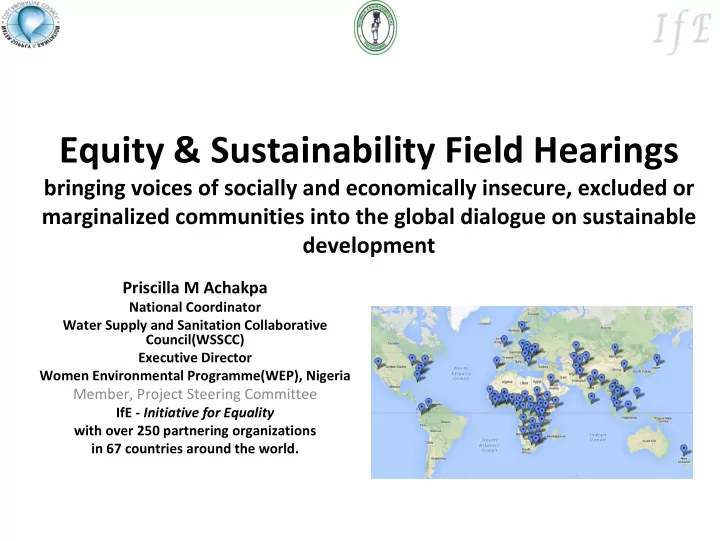
IfE ‐ Initiative for Equality with over 250 partnering organizations in 67 countries around the world.

slide-2
SLIDE 2

Outline of Presentation

  • Who We Are
  • Equity & Sustainability Field Hearings
  • Goals
  • The 2012 Field Hearings

‐ Questionnaire / Reporting Template ‐ Preliminary Results ‐ Report: June 2012 ‐ Co‐authors 2012

  • 2013: Structure of Project

‐ Project Steering Committee ‐ Steps & Follow‐through for Partners ‐ Solving Challenges ‐ Countries with Field Hearings Partners as of 15 September 2013.

slide-3
SLIDE 3

Who We are

Initiative for Equality (IFE)

  • IFE is a global network of activists and academics working on

issues related to the three pillars

  • f

sustainable development; environmental, social and economic/ political equality. Along with partners and communities around the word. We develop information, goals, and strategies needed to bring about greater equality: We collaborate and coordinate efforts on issues, test and implement. Water Supply and Sanitation Collaborative Council(WSSCC)

  • WSSCC

work in

  • pen

collaboration with its Members and partners to contribute to the broader goals

  • f

improved health, social and economic development and promote good governance, equity and sustainability Women Environmental Programme (WEP)

  • WEP

is a Nigerian‐based NGO that inspires actions through working for change. The

  • rganization

envisions a society where environmental, socio‐ economic and political rights

  • f

women, children and youths are protected through collaboration and partnership, networking, lobbying and advocacy for policy and decision inclusivity, community engagement, capacity building, climate change, water and sanitation, research and documentation
slide-4
SLIDE 4

Equity & Sustainability Field Hearings

  • collate

input from highly vulnerable (economically insecure, socially excluded or marginalized) communities

  • present

these collective voices in the global dialogue

  • n

Sustainable Development Goals

slide-5
SLIDE 5

We need your participation!

We need Field Hearings in every country.

slide-6
SLIDE 6

Goals

1. Influence the Sustainable Development Goals outcomes through these grassroots voices

IfE is partnering with Stakeholder Forum, WEP and

  • thers, bringing this input into the UN‘s SDG dialogue.

http://www.sdgseinventory.org/

slide-7
SLIDE 7

Goals

  • 2. Build a strong global network of organizations working for more

equitable development

slide-8
SLIDE 8

Goals

  • 3. Interested groups and communities will be able to take part in a

follow‐up project, developing local plans to create fairer, more participatory economic opportunities

slide-9
SLIDE 9

2012 Field Hearings

  • 18 academic and civil

society organizations

  • 34 communities in Asia,

Africa, and Europe

  • 2700+ individuals
  • 60 co‐authors
slide-10
SLIDE 10

Questionnaire / Reporting Template

  • assess trends: health, education, the economy, politics,

conflict, families, happiness, circumstances for women

  • speculate about the causes
  • propose changes needed
  • describe perceptions of privilege

and deprivation

  • articulate wishes for the future
slide-11
SLIDE 11
slide-12
SLIDE 12

Preliminary Results 2012.

Worsening income insecurity, social breakdown, and environmental degradation – causes seen as:

  • corruption, lack of accountability and transparency
  • social and economic inequality
  • competition for scarce resources, growing populations,

changing weather

  • lack of appropriate training and planning
  • lack of sufficient trust and unity among community

members

slide-13
SLIDE 13
slide-14
SLIDE 14

Preliminary Results 2012 cont..

  • Inequality perceived as increasing greatly almost

everywhere

  • Wealth and poverty seen as directly associated with

access to political decision‐making and economic

  • pportunities
  • Modest and sustainable aspirations: a future in

which basic food, housing, health care, education, and job security needs could be met

slide-15
SLIDE 15

The Future We Want for WATER???

slide-16
SLIDE 16
slide-17
SLIDE 17

Report: June 2012

slide-18
SLIDE 18

Co‐authors 2012

Nazmul Huq Syed Iqbal Ali Sarder Alam Saqib Huq

  • Md. Mahmudul Alam

Mohammad Mashnun Hossain Lei Zhang Yiwen Hu Duoyi Peng Zhuangyue Luo Zhengyi Feng György Málovics Barbara Mihók István Szentistványi György Pataki Elizabeth Lakatos László Jakab Manish Vyas Shailaish Majumdar Ashu Saxena Ajit Kumar Saxena Aizhamal Bakashova Olga Djanaeva Asel Dunganaeva Nazira Dzhapakova January Watchman Mvula Daniel Phiri Eliya Jumbe Mc Donald Mvula Brian Damison Grace Haundi Nawsheen Hosenally Dashini Allagapen Priscilla M. Achakpa Frank T. Yawon Samuel Tough

  • Mr. Amama Sunday

Ahmed Chinade Abdullahi Tina S. Clemente Sonia G. Masaoay Karl Leonid R. Silva‐netto Charles De Guzman Darlene Miller Pamela Harris Diana Sanchez Betancourt Gray Maguire Charles Nhemachena Richard Osaliya Rose Nandudu Leonard Otika Robert J. Macheri

slide-19
SLIDE 19

2013: Structure of Project

Global Convenor & Coordinator: Initiative for Equality (IfE) Regional Coordinators: 2 to 4 per continent Field Hearings Partners: local civil society groups, NGOs, academic and research institutions (1 to 10 per country) Local communities: 1 to 5 per Field Hearing Partner Steering Committee: 17 members

slide-20
SLIDE 20

Project Steering Committee

Ai Zhamal Bakashova* Akhteruzzaman Sano* Amewu Attah Anthony Akpan* Bálint Balázs Christina Straub* Deborah Rogers George Chaima* Mouna Eusman*

  • Md. Mahmudul Alam

Nazmul Huq Russell Priscilla Achakpa Roberto Guimaraes Richard Osaliya* Samuel Eyambe A. Clifford* Tina Clemente Zhiyuan Song

* Regional coordinators

slide-21
SLIDE 21

Steps & Follow‐through for Partners

  • Select communities and arrange Field Hearings
  • Translate and modify Questionnaire for local use
  • Conduct Field Hearings –

public meeting, focus group, or individual interviews

  • Expense money for partners (subject to availability)
  • Submit report to global convenor (in English)
  • Together we will use report to inform decision‐makers and

Sustainable Development Goals process

  • Follow‐up with communities to plan future pro‐equality

economic development alternatives –

  • ptional
slide-22
SLIDE 22

Solving Challenges

  • Accessing remote

communities

  • Language and cultural

barriers

  • Taking the message to

decision‐makers

slide-23
SLIDE 23

Solving Challenges

How do we get from here... ...

slide-24
SLIDE 24

Water, the future we want for all.

slide-25
SLIDE 25

Countries with Field Hearings Partners as of 15 September 2013

slide-26
SLIDE 26

From residents of war‐torn Bukavu City, DR Congo, to indigenous hunters in Burundi’s forests; from displaced farmers

  • n the outskirts of Kunming

to fruit vendors in Rawalpindi’s markets: this is an unprecedented phenomenon. Never before have so many marginalized communities around the world come together to speak out – collectively – to influence policy.

slide-27
SLIDE 27

We need you to fill in the blanks!

slide-28
SLIDE 28

Co‐authors 2013?

We invite you to join us!

slide-29
SLIDE 29

Thank you!

Initiative for Equality A US‐based charitable organization fiscal sponsor: FJC https://www.initiativeforequality.org/ Email: info@initiativeforequality.org WSSCC A UN focused organization on water and sanitation www.wsscc.org Email: pmachakpa@gmail.com Women Environmental Programme (WEP) A Nigerian‐based NGO inspiring action, working for change www.wepnigeria.net Email: info@wepnigeria.net, wep2002@hotmail.com