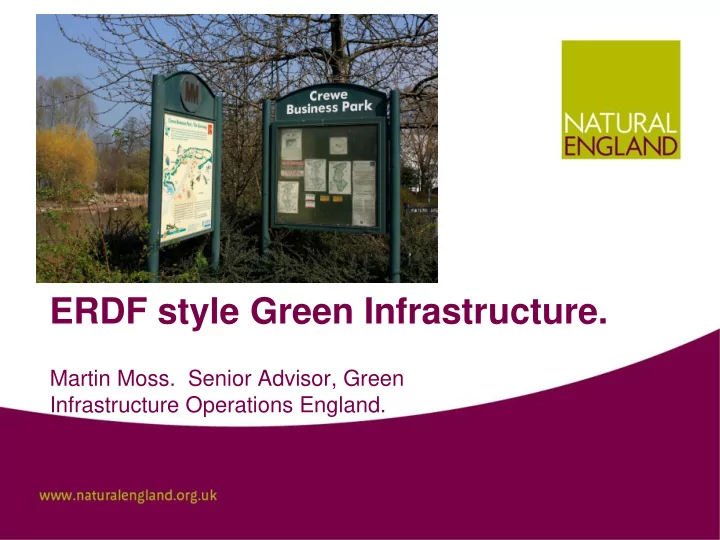
SLIDE 1
ERDF style Green Infrastructure.
Martin Moss. Senior Advisor, Green Infrastructure Operations England.
SLIDE 2 What is ERDF looking for?
- Specific Objective 6.1 sets the
scene.
- “Investments in Green and
Blue Infrastructure and actions to support the provision of ecosystem services on which businesses and communities depend to increase local natural capital and support economic growth”.
- But there is a context;
- “Outside of the farmed
landscape”;
- “Targeted improvements in the
urban environment through an increase in the area of Green Infrastructure”.
- ERDF intended to compliment
EAFRD (Countryside Stewardship) but spatially to be mutually exclusive – The Demarcation Issue..
SLIDE 3 So ERDF is looking for;
- Green AND Blue infrastructure
(Land and water) in the “non- farmed landscape”.
Services.
- That benefit Businesses and
communities
- Builds Natural Capital.
- And Supports economic
- bjectives.
SLIDE 4 So what are Green Infrastructure, Ecosystem Services and Natural Capital?
- Need to understand;
- What GI is about.
- What Ecosystem Services are
about.
- What Natural Capital is about.
- A complex cloud of competing
conceptuality?
- How do these things relate to
each other?
- ERDF uses the GI definition
from the National Planning Policy Framework.
- “A network of multi-functional
green space, urban and rural, which is capable of delivering a wide range of environmental and quality of life benefits for local communities”.
- But is that very helpful?
SLIDE 5 Green Infrastructure is about working with nature to provide services and benefits for people and the economy. GI is a critical infrastructure just like
- transport. It consists of series of individual
components that together deliver multiple services and benefits for humans, and homes for wildlife.
Need people to see GI as an infrastructure in its own right.
SLIDE 6 Key elements of GI – Nature doing a job.
- Green = something to do with
nature - GI is about working with nature.
- Infrastructure – provides a
service - There to do a job.
- Therefore need to know;
- What GI is needed.
- What job it is needed for.
- Where it needs to be to deliver
the benefits.
SLIDE 7
Not The National Grid …………The Natural Grid This is not Grey …………… It’s Green (and blue!).
SLIDE 8 Relating GI, Ecosystem Services and Natural Capital Type.
EVAPO- TRANSPIRATION CARBON SEQUESTRATION PARTICULATE FILTERING
GI TYPE / Feature GI FUNCTION GI BENEFIT GI VALUE (£)
CLIMATE CHANGE ADAPTATION - URBAN COOLING CLIMATE CHANGE MITIGATION IMPROVED AIR QUALITY £ REDUCED AIRCONDITIONING COSTS/HEALTH £ MARKET VALUE OF CO2 STORED £ REDUCED HEALTH COSTS
From biodiversity to value. Biodiversity The thing Ecosystem Services The “So what factor”. Natural Capital The bottom line.
SLIDE 9 Focus of investment for PA6d.
- All PA6 GI projects need to
contribute towards biodiversity priorities with a particular focus
woodland habitats.
- In addition projects need to
deliver at least one socio- economic benefit from a list.
- This list is effectively a high
level options list for required GI Ecosystem Services / Benefits.
- Flood and water management.
- Water and air pollution
management.
investment.
(Recreation if linked to growth benefit).
- Provision of products from the
land.
- Climate Change adaptation
and mitigation.
- In other words – Biodiversity
doing a job.
SLIDE 10 GI contribution to economic objectives - The evidence base – Micro Economic Benefits of Investing in the Environment.
- Extensive, increasing, multi-
disciplinary – but still early days.
- Many research questions are
being identified as gaps in understanding become apparent.
- BUT …
- Natural England have
compiled a broad literature review.
- First published in 2012 –
MEBIE 2 published 2014.
- Thorough review of literature
- n the benefits of investment in
the natural environment.
- http://publications.naturalengland.org.u
k/publication/32031
- PA6 does not oblige you to prove the
economic outputs of a project.
- Output indicator relates to Ha of land
brought into “higher conservation status”.
- However, PA6 calls may ask for
projects to demonstrate their relationship with local growth
SLIDE 11 GI supporting Growth.
- Defra / Natural England report
by Eftec – 2013
contribution to economic growth – a review.
- Found that GI can support
economic growth in range of ways, including;
- http://sciencesearch.defra.gov.uk/Defa
ult.aspx?Menu=Menu&Module=More& Location=None&Completed=0&Project ID=19056
- Attracting inward investment.
- Increasing visitor spending
(increased footfall).
- Providing environmental cost
savings (pollution filtration, flood risk management etc).
- Health improvements leading
to increased productivity.
- Market sales (products from
the land).
(Green Space sector accounts for 5% of jobs in England).
SLIDE 12 GI as an employment sector - A recent study in Greater Manchester.
- A study in Greater Manchester
is 2013 estimated that the GI sector involved;
- 15,000 jobs linked to, or
dependant upon Green Infrastructure.
million GVA for the local economy.
- Averaging £31,000 GVA/Full
time equivalent jobs.
Opportunity.
- Greater Manchester Briefing.
- Natural Economy Northwest
Investment Forum.
- August 2013.
- http://www.greeninfrastructurenw.co.uk/reso
urces/The_new_EU_green_growth_opportu nity_Greater_Manchester.pdf
SLIDE 13 Challenges with accessing PA6d.
- Minimum grant threshold of
£500 K.
- ERDF is new to many
- rganisations and PA6 is new
to ERDF / DCLG.
you need to be looking at the right sort of land.
- Short 6 week call durations.
- Probable need for partnership
“warm up period” – being ready for the call before its issued.
- “Oven ready” projects – no
project development grant.
SLIDE 14 So what might be involved in an ERDF GI Proposal? Experience so far …
- Partnership – probably need
to work as a consortium.
provide clarity on outcomes sought – What GI and where – but also WHY.
- A spatial proposition – how
will the proposed investment relate to local strategic
economic).
interventions – a collection of interventions linked to the spatial proposition.
SLIDE 15 Don’t forget to use your local GI strategy ! It’s there to help you.
- GI Strategy can;
- Provide evidence.
- Show strategic fit – policy and
spatial plans.
- Enable partner support – GI
strategies have wide stakeholder buy in.
developed on the basis of local GI Strategy – set out what the investment would do to contribute toward its delivery.
SLIDE 16
Some other examples of strategic approaches being taken elsewhere:
SLIDE 17 Example project 1 – PA6 within Sustainable Urban Development Strategies.
- Liverpool City Region.
- The Liverpool City Region GI
Framework (Nature at Work) was used to provide the backing evidence for developing ERDF related GI proposals (Prospectus of investable projects) in the context of priorities set out in the Strategic Economic Plan (SEP).
Strategic projects programme.
SLIDE 18
Defined the key benefits sought from ERDF GI investment in Liverpool City Region. Core ecosystem services / GI Benefits sought. Nature + job
SLIDE 19
Reviewed the spatial strategic economic investment interests in the SEP.
SLIDE 20 Developed a GI projects Prospectus for ESIF delivery – assessment process.
- A long list of 90 sites and their issues – investment risk such as
poor image, flood risk, contamination and climate change impacts.
- Can GI help? What GI interventions could help address the issues?
- What GI benefits might be delivered (economic growth, health and
climate change adaptation and mitigation).
- Criteria used to create a ‘short list’ of Strategic Investment Areas
(SIA) where GI projects might help secure investment.
- The delivery costs identified.
- Estimated economic value of GI interventions in terms of new jobs
and Gross Value Added (GVA) was then calculated.
SLIDE 21 Developed the short list – most promising places.
- Criteria based assessment –
- There are issues in the SIA that green infrastructure
can help resolve.
- Partners are willing to engage in a Strategic Alliance to
implement GI.
- Partners are willing to use their investment as match
funding.
- The sites are ready to progress and they can deliver
significant outputs for ESIF.
SLIDE 22 Proposed outputs.
- Total number of jobs attributable to GI – 227.
- Total investment made by investors in buildings and infrastructures -
£163 million.
- Total cost of GI interventions - £10.8 million.
- Area of GI created – 91 Ha.
- GVA from GI interventions - £17.9 million.
- Impact of local property value - £207.7 million uplift.
- Wider economic (non-GVA) benefits £176 million.
- Cost per job - £47,651
- Cost per Ha - £118,894
SLIDE 23 Example project 2 – Strategic programme proposal in current programme.
- Black Country Blue Network.
- Seeking to;
- “Improve habitat quality and
ecological networks by investment in GI along the area’s waterways and linked green space”.
involving.
Authorities.
- Environment Agency.
- Canal and Rivers Trust.
- Birmingham and Black Country
Wildlife Trust.
SLIDE 24 Strategic context leading to strategic programme
- f delivery.
- Based on previous strategic
initiatives including;
- Black Country Urban Park.
- Black Country Nature
Improvement Area.
- These provided the strategic
context.
programme of specific proposals within the strategic context.
- 13 specific projects.
- Total programme value - £3.88
million.
- Total ERDF requested - £1.73
million.
SLIDE 25 Key outcomes – A multi-functional product – nature doing a job.
- Nature - Improved habitats
and connectivity.
- Doing a job – broad benefits;
- Encouraging healthy
lifestyles.
- Access to nature.
- Attracting investment
improved quality of urban landscape and area image.
- Improved quality of life.
- Climate change – flood and
water management, urban heat island.
- Outputs –
- 11 Ha rehabilitated land.
- 191 Ha of land in “better
conservation status”.
- Due to deliver by 31st Dec
2018
SLIDE 26
GI as Natural Capital – Beam Parklands example
SLIDE 27 Here’s one we made earlier – GI as Natural Capital.
- Beam Parklands.
- Owned by The Land Trust.
- Located in East London.
- A previous ERDF investment.
- A 53 Ha site.
- Previous flood protection asset
protecting local businesses, homes and power station.
SLIDE 28 Something had to be done … Investment mix.
- Inputs –
- ERDF - £1.5 million.
- Environment Agency - £1
million
- DCLG funds (Parklands) - £1.9
million.
- Landfill tax credits - £0.25
million
Council £50,000
- Outputs –
- A brownfield site transformed
by taking a Green Infrastructure approach.
- 12 Ha of Priority Habitat
created.
- 2 km River Beam restoration.
- 30,000 cubic metres of
additional flood storage capacity.
SLIDE 29 Key Functions delivered by the site.
enhancing biodiversity habitats.
- Doing a job;
- Creating opportunity for access
to nature.
- Promoting opportunity for
recreation and play.
- Remediating previous land fill
sites.
management.
- Adaptation to climate change.
SLIDE 30 The balance Sheet – Beam Parklands Natural Capital Account (Eftec for GLA Nov 2015)
- Net Present Values over 99
years.
- Flood damage costs avoided -
£19 million.
- Local community benefits - £26
million.
- Total £42 million (adjusted for
costs) and lots of biodiversity too.
- Change due to investment –
- Net Natural Capital Asset
value 2009 - £21 m
£10 m
- Gain due to local population
growth - £12 m
- Gross NCAV - £43 m
- Liabilities - £1 m
- Net NCAV - £42 m
SLIDE 31 ERDF investment can;
- Increase and improve local Green Infrastructure.
- Boost its ability to deliver local ecosystem services.
- Help build local Natural Capital.
- Benefit local communities and businesses.
- Improve the local Natural Capital Balance sheet – its worth it !
- Its also worth working together to make it happen - good luck !
SLIDE 32
Where to start? We don’t have to start from scratch – D2N2 previous work.
SLIDE 33
Strategy Coverage in D2N2 Area:
SLIDE 34
6Cs strategic network and funded schemes:
SLIDE 35
Erewash Valley:
A 30 mile circular walking and cycling route that is: Helping promote regeneration of former industrial landscapes Creating a brand identity which local communities and businesses recognise and value Working with NHS partners to engage local communities and deliver health and wellbeing benefits Delivering on Lawton Principles of bigger, better and more joined up
SLIDE 36
Thank you and questions.