Erosion and Deposition From Washes to Canyons at Parashant - - PowerPoint PPT Presentation

erosion and deposition from washes to canyons at parashant
SMART_READER_LITE
LIVE PREVIEW

Erosion and Deposition From Washes to Canyons at Parashant - - PowerPoint PPT Presentation

Erosion and Deposition From Washes to Canyons at Parashant Geological Adventures at Parashant Lesson 7 Objectives Running water orients clasts in streams in ways that enable us to reconstruct the directions of ancient stream flow;


slide-1
SLIDE 1

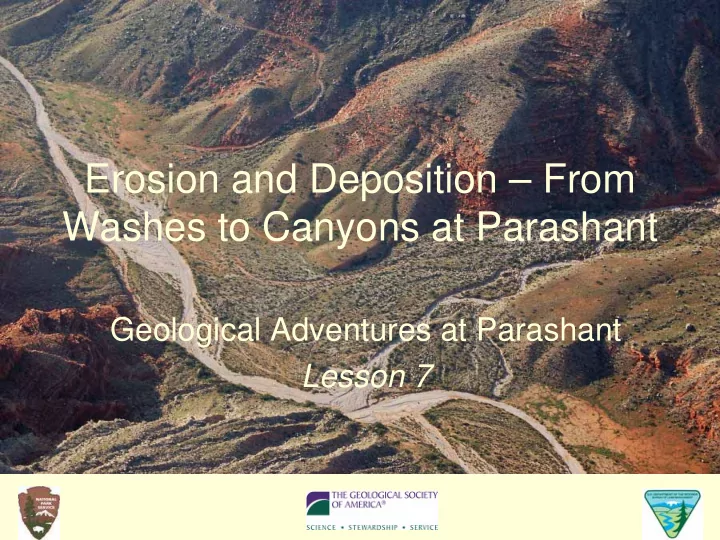
Erosion and Deposition – From Washes to Canyons at Parashant

Geological Adventures at Parashant Lesson 7

slide-2
SLIDE 2

Objectives

  • Running water orients clasts in streams in ways that

enable us to reconstruct the directions of ancient stream flow;

  • Erosion is the transport of sediment by wind, water,

gravity, and ice, and wears down the land;

  • Deposition is the settling of eroded sediment at a lower

elevation and builds up the land;

  • Running water is the most important agent of erosion in

the desert;

  • Rocks are broken into smaller pieces over time through

chemical and mechanical weathering;

  • The composition of rocks in ancient stream deposits

provides clues about the existence and nature of ancient mountains.

slide-3
SLIDE 3

WORKSHEET 7.1 – OLDER WASH DEPOSITS EXPOSED AT WHITMORE WASH

slide-4
SLIDE 4

FIGURE 1 Sample interpretation of clast orientation for 20 clasts in a wash deposit exposed at Whitmore Wash. All 20 clasts are oriented with the high end pointing to the left.

slide-5
SLIDE 5

WORKSHEET 7.2 – OLDER WASH DEPOSITS EXPOSED AT WHITMORE WASH

slide-6
SLIDE 6

WORKSHEET 7.3 – WASH ROCKS UPPER LEFT

slide-7
SLIDE 7

WORKSHEET 7.4 – WASH ROCKS UPPER RIGHT

slide-8
SLIDE 8

WORKSHEET 7.5 – WASH ROCKS LOWER LEFT

slide-9
SLIDE 9

WORKSHEET 7.6 – WASH ROCKS LOWER RIGHT

slide-10
SLIDE 10

FIGURE 2 Sample interpretation of Worksheet 7.3 - Wash Rocks Upper Left.

slide-11
SLIDE 11

Figures in the Student Text

slide-12
SLIDE 12

FIGURE 7.1 Diagram of two rocks on the bottom of a wash. The dashed line is level of water during a thunderstorm.

Water flow direction A Sediment B

slide-13
SLIDE 13

FIGURE 7.2 Rocks exposed in Whitmore Wash at

  • Parashant. The box outlines the area shown in

Worksheet 7.1.

slide-14
SLIDE 14

FIGURE 7.3 This large block of limestone has paused temporarily on its trip downhill under the force of gravity.

slide-15
SLIDE 15

FIGURE 7.4 Wind erosion removes finer particles of sediment, leaving a coarse-grained desert pavement behind.

slide-16
SLIDE 16

FIGURE 7.5 Canyon forming north of Parashant. Down slope is to the lower right. Note how the canyon becomes wider and deeper

  • ver its course, and how smaller channels feed into the larger main

channel.

slide-17
SLIDE 17

FIGURE 7.6 Alluvium covers the slopes along the Grand Wash Cliffs at Parashant to the point where little of the sedimentary rock layers are visible.

slide-18
SLIDE 18

FIGURE 7.8 Chemical weathering gives the Navajo Sandstone at Parashant its red color. Mechanical weathering disintegrates it into sand, seen at the base of the outcrop.

slide-19
SLIDE 19

FIGURE 7.9 The person who photographed this flash flood in the Grand Wash at Parashant noted hearing sounds made by boulders tumbling in the water.

slide-20
SLIDE 20

FIGURE 7.10 Clasts in an ancient conglomerate. Penny for scale.