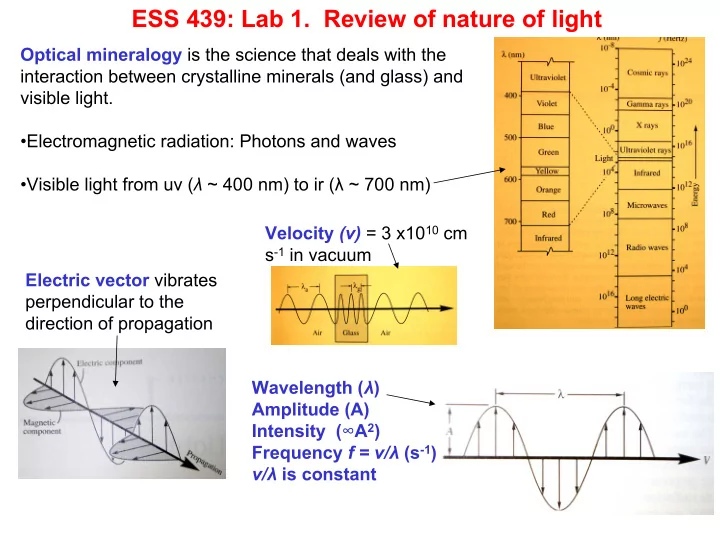
SLIDE 1 ESS 439: Lab 1. Review of nature of light
Optical mineralogy is the science that deals with the interaction between crystalline minerals (and glass) and visible light.
- Electromagnetic radiation: Photons and waves
- Visible light from uv (λ ~ 400 nm) to ir (λ ~ 700 nm)
Electric vector vibrates perpendicular to the direction of propagation Velocity (v) = 3 x1010 cm s-1 in vacuum Wavelength (λ) Amplitude (A) Intensity (∞A2) Frequency f = v/λ (s-1) v/λ is constant
SLIDE 2
Wave front: surface that connects similar points on adjacent waves Wave normal: Line ┴ wave front Ray: direction of propagation Isotropic medium: velocity of light is same in all directions (wave normal = ray direction), e.g., glass and isometric crystals) Anisotropic medium: Velocity is different in different directions (wave normal and ray direction are not parallel), e.g., all non- isometric crystals)
SLIDE 3
(1) Interference of waves
Retardation (∆) ∆ = iλ In phase when i is an integer and Out of phase when i is a fraction When i = ½ complete cancellation
Light waves (cont.)
(2) Resolution of waves
R A B
(3) Color: Monochromatic light (single wavelength), e.g., Na vapor λ = 589 nm
Polychromatic (aka. “white”) light: multiple wavelengths
SLIDE 4 Light waves (cont.)
Reflection
θ1 θ2
Refraction: “bending”
- f light as it passes from
- ne medium to another—
function of differences in refractive index (n)
n = vvac/vmed n ≥ 1.0 In air, n = 1.0003 Minerals: n ranges from ~1.4 to ~2.0 Snell’s law:
Sin θ1/sinθ2 = n2/n1
SLIDE 5
Light waves (cont)
Critical angle and internal reflection
sin r = (ni /nr) sin i when r = 90º sin r = 1
Critical angle: when (ni/nr) sin i = 1
i i i r air med
Dispersion
Recall: v ∞ λ n ∞ 1/λ n ∞ 1/v nD is the value reported in tables I0/IT Lambert’s law: I0/IT = e-kt where IT = int. of transmitted light I0 = int. of incident light t = thickness k = absorption coefficient Absorption and color λ (nm)
400 800 Clear glass Red glass Dark glass 1
SLIDE 6 Light Waves (cont.)
Polarization of light
In routine optical mineralogy we use polychromatic (white) light provided by a tungsten lamp with a blue filter. On occasion, for precise determination of refractive index (n) we use monochromatic light provided by a sodium vapor lamp (λ = 589 nm). Light is polarized, i.e., it is constrained to vibrate in a single direction, in our case an East-West direction. Referred to as “plane polarized light” and the direction
- f vibration of the polarized light is called the PRIVILEGED DIRECTION
Polarization may be produced by: 1) selective absorption using polaroid film 2) Double refraction using a Nicol prism made from calcite
SLIDE 7
Polarizing microscope