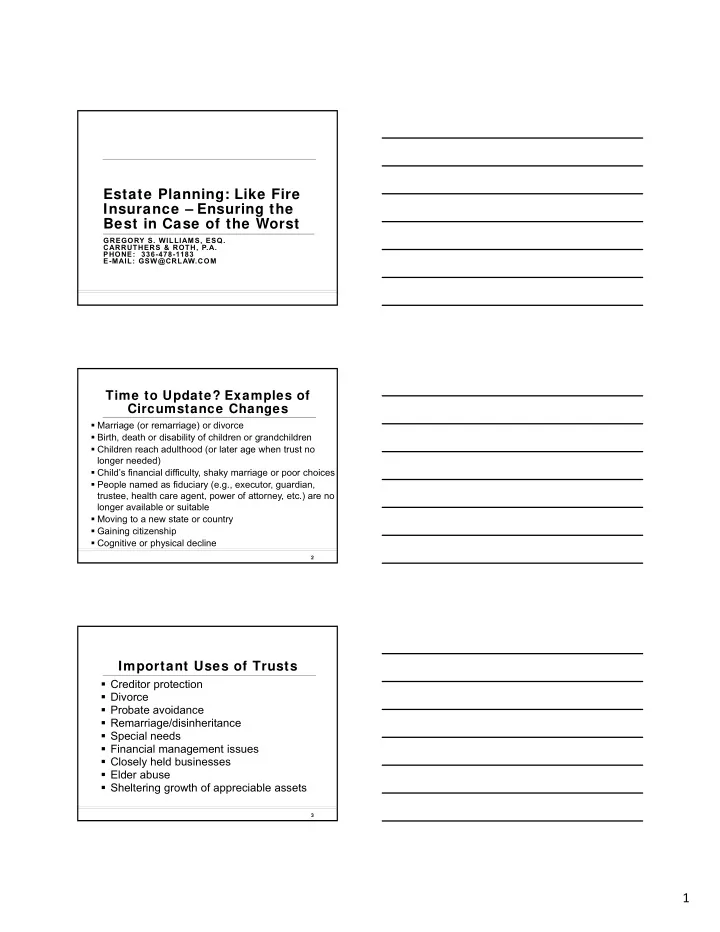
Estate Planning: Like Fire Insurance Ensuring the Best in Case of - - PDF document

estate planning like fire insurance ensuring the best in
SMART_READER_LITE
LIVE PREVIEW

Estate Planning: Like Fire Insurance Ensuring the Best in Case of - - PDF document

Estate Planning: Like Fire Insurance Ensuring the Best in Case of the Worst GREGORY S. WILLIAMS, ESQ. CARRUTHERS & ROTH, P.A. PHONE: 336-478-1183 E-MAIL: GSW@CRLAW.COM Time to Update? Examples of Circumstance Changes Marriage


slide-1
SLIDE 1

1 Estate Planning: Like Fire Insurance – Ensuring the Best in Case of the Worst

GREGORY S. WILLIAMS, ESQ. CARRUTHERS & ROTH, P.A. PHONE: 336-478-1183 E-MAIL: GSW@CRLAW.COM

Time to Update? Examples of Circumstance Changes

  • Marriage (or remarriage) or divorce
  • Birth, death or disability of children or grandchildren
  • Children reach adulthood (or later age when trust no

longer needed)

  • Child’s financial difficulty, shaky marriage or poor choices
  • People named as fiduciary (e.g., executor, guardian,

trustee, health care agent, power of attorney, etc.) are no longer available or suitable

  • Moving to a new state or country
  • Gaining citizenship
  • Cognitive or physical decline

2

Important Uses of Trusts

  • Creditor protection
  • Divorce
  • Probate avoidance
  • Remarriage/disinheritance
  • Special needs
  • Financial management issues
  • Closely held businesses
  • Elder abuse
  • Sheltering growth of appreciable assets

3

slide-2
SLIDE 2

2

Second or Subsequent Marriages

  • Failure to Remove Prior Spouse

from Beneficiary Designations.

  • Potential Disinheritance of Children

from a Prior Marriage.

4

Second or Subsequent Marriages (cont’d)

  • Subsequent Spouse's Right to Claim

Statutory Share.

  • Premarital Agreements Ineffective for

Medicaid Purposes (and for Doctrine of Medical Necessaries).

5

Probate – What is it and w hy avoid it?

  • Probate – proving the validity of a will;

typically used to refer to the entire process

  • f estate administration under jurisdiction of

the court

  • Probate is (or can be):
  • Time consuming or slow
  • Unnecessarily complicated
  • Expensive (probate fees and legal fees)
  • Public

6

slide-3
SLIDE 3

3

Probate – How Do you Avoid It?

  • Joint Tenants with Right of Survivorship

(JTWROS) (or tenancy by entirety)

  • Payable on Death or Transfer on Death

(POD or TOD)

  • Beneficiary Designation
  • Assets Owned by Revocable Trust

7

Probate Avoidance – Revocable Trusts

  • Established during life (hence “living” or “inter vivos”)
  • Contains dispositive provisions typically put in the will
  • Invisible for income tax purposes during life
  • Remains revocable and amendable during life
  • Assets owned by trust at death are not subject to

probate

  • Efficient strategy to transfer control in the event of

incapacity or death

8

Documents that Affect Rights During Life

9

  • General power of attorney.
  • Health care power of attorney.
  • Living will (declaration of desire for

natural death).

  • HIPAA
  • Cremation
slide-4
SLIDE 4

4

RMD Tax Deferral Planning

  • Increasingly large part of estate
  • Inadequate attention paid
  • Subject to income taxes (except for

Roth plans) and potentially estate tax

  • Creditor protections
  • Tax law and personal changes require

periodic review

10

Assets Protected Under North Carolina Law

  • Exemptions
  • Life Insurance
  • Tenants by the Entireties
  • Retirement accounts
  • 529 Plans

11

Life Insurance Policies Ow ned by an Individual

  • Constitutional protection
  • Unlimited amount
  • Protects insurance and proceeds for sole

benefit of spouse and/or children

  • Don’t let proceeds get paid to the estate!
  • Failure to designate usually means it goes to

estate

  • ILIT

12

slide-5
SLIDE 5

5

Tenancy by the Entirety Real Property

  • Owned by husband and wife
  • Applies to any real property, not just

personal residence

  • No protection from IRS liens or joint

creditors (vicarious car accident liability?)

  • Note: creditor protection lost upon death
  • f one spouse, divorce or sale
  • Does not apply to joint personal property

13

Retirement Plans (including IRAs)

  • Creditor protection for both IRA and

ERISA-qualified plans

  • No protection for commercial annuities?
  • Inherited IRAs

14

529 College Savings Plans

  • Limited protection
  • Protection designed for funds likely to be used

for college expenses ((i) limited to $25K, excluding contributions within the past 12 months, except those made pursuant to an established pattern, (ii) only for child of the debtor, and (iii) “will actually be used for the child’s college or university expenses.”)

  • Consider putting in spouse’s name
  • Consider a 529 plan trust

15

slide-6
SLIDE 6

6

Asset Protection Strategies – Transfer of Assets to Spouse (or to Trust for Spouse)

  • Transfer from “at risk” spouse to other

spouse (can you tell who is who?)

  • Unlimited marital deduction
  • Fraudulent transfer limitation
  • Equitable distribution issue

16

Asset Protection Strategies – Transfer of Assets to Children (or Trusts for Children)

  • Traditional estate planning purpose
  • Outright v. in trust
  • Gift tax considerations
  • Pattern of gifting
  • Cessation of use and control

17

Asset Protection Strategies - Estate Planning

  • Revocable living trust – good asset management

and probate avoidance tool; but useless for asset protection (or Medicaid planning)

  • Insurance trust
  • Gift trust for issue or other beneficiaries (e.g.,

GRAT, IDGT)

  • Charitable trust
  • Special Needs Trust

18

slide-7
SLIDE 7

7

Planning Steps That Can Be Taken By Other Family Members

  • The North Carolina "Spendthrift" Trust

Statute

  • Trust that is not subject to

attachment by creditors

  • Spendthrift provision
  • Discretionary or support trust
  • Protective trust

19

Planning Steps That Can Be Taken By Other Family Members

  • "Skipping" the Potential Bankrupt in

Favor of Children or Other Beneficiaries

  • Restructuring the Will and Trust of

Parents to Prevent the Potential Bankrupt from Having Direct Ownership of Assets

20

Need for SNTs

  • Disabled individuals often can’t support

themselves

  • Government has programs to pay for support

and healthcare

  • Government wants people to use their own

assets first

  • Means testing
  • Government programs only address basic food,

clothing, shelter and healthcare

  • We want our loved ones to enjoy more than just

the basics

21

slide-8
SLIDE 8

8

Options for Estate Plan

  • Direct bequest – “I leave my estate to Billy.”
  • Disinheritance – “I leave my estate to Tom.”
  • Support trust -- “ I leave my estate to Tom, to

use for Billy’s health, support and maintenance.”

  • Discretionary trust -- “ I leave my estate to Tom,

to use for Billy as Tom decides in Tom’s sole and absolute discretion.”

  • SNT – “I leave my estate to Tom, to use for Billy,

but only to pay for things not covered by the government.”

22

Types of SNTs

  • Supplemental Needs Trust – 3rd party

(i.e., parents, grandparents, etc.) discretionary trust

  • Special Needs Trust – Created with

funds of disabled individual under age 65; payback

  • Pooled Trusts – nonprofit serves as

trustee and pools funds from many disabled persons

23

Major Document Decisions to Make

  • Type of trust (SNT; discretionary)
  • Timing of establishing trust (lifetime or at

death)

  • Funding of trust (source, amount,

assets)

  • Trustee
  • Other beneficiaries
  • Final beneficiaries

24

slide-9
SLIDE 9

9

Non-tax Family Business Issues

  • Sale v. gift
  • Lifetime or at death
  • Include all children or only active

participants

  • Equalization with other assets
  • Equity v. control
  • Use of life insurance to address shortfall

25

Estate Planning: Like Fire Insurance – Ensuring the Best in Case of the Worst

GREGORY S. WILLIAMS, ESQ. CARRUTHERS & ROTH, P.A. PHONE: 336-478-1183 E-MAIL: GSW@CRLAW.COM

26

slide-10
SLIDE 10

1 Overview of Required Minimum Distributions (RMD) Resulting from Various Beneficiary Designations Gregory S. Williams Carruthers & Roth, P.A. Phone: 336-478-1183 E-mail: gsw@crlaw.com

  • 1. Death Before Required Beginning Date ("RBD")
  • a. RMD for year of death. – None required.
  • b. No designated beneficiary/Naming estate as beneficiary. Entire IRA must be

distributed by 12/31 of the 5th year following the year of death (the "5 Year Rule").

  • c. Corporation or charity named as beneficiary. Five Year Rule.
  • d. Spouse as beneficiary. Three options:
  • i. Roll over and treat as spouse's own account (i.e., no requirement to take

RMD's until spouse's RBD)

  • ii. 5 Year Rule
  • iii. RMD's over spouse's life expectancy (using recalculation (or attained age)

method – check table each year; starting with birthday on year after death), but RMD's do not have to begin until owner would have turned 70 1/2

  • e. Other individual as beneficiary. Beneficiary's life expectancy (using fixed term

(or reduction) method – check table once, then reduce by one each year).

  • f. Multiple individuals as beneficiary. Oldest beneficiary's life expectancy (using

fixed term (or reduction) method – check table once, then reduce by one each year); unless "separate accounts" rule applies and separate accounts established by 12/31 of year after year of death (then treat as one designated beneficiary per account and follow rule in e. above).

  • g. See-through trust as beneficiary. Generally, if all beneficiaries are individuals,

then the oldest trust beneficiary's life expectancy.

  • i. Requirements to qualify as a "designated beneficiary" ("look through" or

"see through") trust:

  • 1. Trust must be valid under state law.
  • 2. Trust is either irrevocable or will become irrevocable at death.
  • 3. Beneficiaries must be "identifiable" from the trust instrument.
  • 4. Trust document must be provided to the plan administrator.
  • 5. All trust beneficiaries must be individuals.
  • ii. Determining oldest beneficiary/"mere potential successors"
  • 1. Primary trust versus sub-trust
  • 2. Contingent beneficiaries (sometimes referred to as ultimate or final

beneficiaries)

  • 3. Impact of powers of appointment
  • iii. "Removing" beneficiaries by deadline (9/30) of year after death
  • 1. Distribute the beneficiary's share of benefits
  • 2. Qualified disclaimer
slide-11
SLIDE 11

2

  • 3. Decanting or judicial modification?
  • iv. Conduit Trusts – a type of see-through trust under which the trustee has no

power to accumulate plan distributions in the trust; IRS regards the conduit beneficiary as the sole beneficiary of the trust (all other beneficiaries are considered mere successors and are disregarded).

  • 2. Death After RBD
  • a. RMD for year of death. – If the owner had not taken the year's RMD before

death, then the beneficiary must take by the end of the year whatever the owner would have had to take.

  • b. No designated beneficiary/Naming estate as beneficiary. RMDs based on what

would have been deceased owner's remaining life expectancy.

  • c. Corporation or charity named as beneficiary. Same as no designated

beneficiary.

  • d. Spouse as beneficiary. Three options:
  • i. Roll over and treat as spouse's own account (i.e., no requirement to take

RMD's until spouse's RBD).

  • ii. RMD's over spouse's life expectancy (using recalculation (or attained age)

method – check table each year; starting with birthday on year after death).

  • iii. RMD's over the deceased owner's life expectancy (using fixed term (or

reduction) method – check table once, then reduce by one each year).

  • e. Other individual as beneficiary. Longer of deceased owner's life expectancy or

beneficiary's life expectancy (using fixed term (or reduction) method – check table once, then reduce by one each year).

  • f. Multiple individuals as beneficiary. Deceased owner's remaining life

expectancy (using fixed term (or reduction) method – check table once, then reduce by one each year); unless "separate accounts" rule applies and separate accounts established by 12/31 of year after year of death (then treat as one designated beneficiary per account and follow rule in e. above)

  • g. See-through trust as beneficiary. Generally, if all beneficiaries are individuals,

then the longer of deceased owner's life expectancy or oldest trust beneficiary's life expectancy. Reference: Natalie B. Choate, Life and Death Planning for Retirement Benefits https://www.irs.gov/retirement-plans/required-minimum-distributions-for-ira- beneficiaries

slide-12
SLIDE 12

1 North Carolina Life Insurance Has Long Received Solid Protection From Creditors

  • - But Only if You Follow the Rules!

By Gregory S. Williams North Carolina has long provided its residents with special protection for life insurance policies against the claims of creditors. Recent cases, however, have made clear that the protection is

  • nly afforded if the rules are followed explicitly.

Creditors and sources of liability are everywhere these days. The most obvious targets for liability are physicians and celebrities, but anyone could be at risk for a terrible car accident ruled to be their fault. In the legal process, when someone is pursued by creditors, there are some assets that can be cordoned off from creditors. These assets are protected by statutory "exemptions", but most exemptions are severely limited to small amounts. Life insurance policies, on the other hand, are protected in unlimited amounts, both as to cash value and death

  • benefit. This article will explain the exemption for life insurance and then review some recent

cases explaining when and if the creditor protection is available and when it fails. North Carolina's constitution (Article X, Section 5) provides as follows: A person may insure his or her own life for the sole use and benefit of his

  • r her spouse or children or both, and upon his or her death the proceeds

from the insurance shall be paid to or for the benefit of the spouse or children or both, or to a guardian, free from all claims of the representatives or creditors of the insured or his or her estate. Any insurance policy which insures the life of a person for the sole use and benefit of that person's spouse or children or both shall not be subject to the claims of creditors of the insured during his or her lifetime, whether

  • r not the policy reserves to the insured during his or her lifetime any
  • r all rights provided for by the policy and whether or not the policy

proceeds are payable to the estate of the insured in the event the beneficiary or beneficiaries predecease the insured. (Emphasis added.) North Carolina also has a separate statute (N.C.G.S. 58-58-115) that generally protects, except in cases of fraud, life insurance against the claims of creditors regardless of who is named as beneficiary of the policy. The federal bankruptcy rules provide certain exemptions from the claims of creditors, but give each state the right to choose the federal exemptions or to use their own. North Carolina, as a so- called "opt out" state, uses its own exemptions, and the relevant exemption here, N.C.G.S. 1C- 1601(a)(6), exempts from the claims of creditors "Life insurance as provided in Article X, Section 5 of the Constitution of North Carolina." So, life insurance is generally protected from the claims of creditors in North Carolina, but if a North Carolina resident files for or is forced into bankruptcy then the protection is limited to what is provided by the state's constitution.

slide-13
SLIDE 13

2 Until recently, there were a number of unanswered questions about the extent of the constitutional protection of life insurance. Does it matter who the owner of the policy is? What is the "sole use and benefit" of the spouse, children or both? What if the policy is payable to a trust that benefits the spouse and children? What if grandchildren are also beneficiaries of the trust? The following Foster, Eshelman and Forgione decisions, all stemming from bankruptcy cases in North Carolina bankruptcy court districts, address some of these questions. In In Re Foster, 2011 WL 5903393 (Bankr. E.D.N.C.), two cash value insurance policies were at

  • issue. A husband and wife had filed personal bankruptcy and claimed that the policies were

exempt from the claims of creditors. The first policy insured the husband, was owned by the husband, and named the husband's revocable trust as the beneficiary. The second policy insured the husband, was owned by the wife, and named the husband's revocable trust as the beneficiary. The court concluded that neither policy was exempt since the policies were not for "the sole use and benefit" of the insured's wife and children. The stated basis for this conclusion was that the husband's revocable trust authorized the use of trust property to pay burial expenses, taxes and unsecured creditors of the trust. Because the insurance proceeds could have been used to pay debts of the trust, reasoned the court, the claim for exemption was improper. Note that the court suggested that it would likely not have permitted the exemption for the second policy in any event since it was not owned by the insured (and the constitution suggests that the exemption is

  • nly for policies owned by the insured).

In In Re Eshelman, 2012 WL 1945709 (Bankr. E.D.N.C.), a cash value policy owned by a bankrupt debtor was claimed as exempt in the bankruptcy proceeding. The debtor's bankruptcy application initially incorrectly listed his spouse as the beneficiary (when the named beneficiary was actually his revocable trust). The revocable trust included language requiring the trustee to use trust property to pay debts, expenses, and taxes. However, the trust included the following proviso: "my Trustee may in its sole discretion decline to pay to or otherwise make available for the benefit of my estate or my Executor life insurance proceeds, or any other assets, which would

  • therwise be exempt from the claims of creditors." The court concluded that the language

regarding the use of trust property to pay creditors doomed the exemption. The court specifically stated that the trustee's discretion not to use insurance proceeds to pay creditors did not change the result. Note that the court acknowledged that after the beneficiary designation error was discovered the debtor changed the designation to his wife. The court completely ignored this change, presumably because it concluded that the determining factor was the designated beneficiary at the moment the debtor filed his bankruptcy petition. In In Re Forgione, 2014 WL 4549004 (Bankr. M.D.N.C.), four cash value policies were at issue. One policy included the debtor's ex-wife as a beneficiary along with his children. The court quickly concluded that this policy was not exempt because it was not for the sole use and benefit

  • f spouse and children. The other three policies named one or more of the debtor's children.

The court allowed the exemption with respect to those policies. Significantly, the bankruptcy trustee also objected to the exemption claim on at least one of the other policies because it was alleged that the debtor's brother had been removed as a beneficiary within the four-year period prior to the petition date, and that in the event that a change of beneficiary was voidable under the bankruptcy statutes then the policies would not be exempt. The court did not address this further as the trustee apparently did not pursue that claim at the hearing. Moreover, the debtor

slide-14
SLIDE 14

3 did not try to claim that his ex-wife fit within the constitutional provisions, but instead that only ¼ of the cash value was exposed (which the court found unpersuasive). The court did note that the debtor did not assert that his ex-wife was a guardian of the children. That statement hints that the argument might have merit in the right circumstances. From a review of the exemptions and case law, we can glean the following principles or guidelines:

  • 1. Never, under any circumstances, should a life insurance policy lack a valid primary or

contingent beneficiary. If there is no designation, the constitutional creditor protections will not be available and most insurance companies will pay the policy to the estate upon the insured's death, subjecting the proceeds to creditors and probate fees.

  • 2. The insured should be the owner of the policy in order to qualify for the exemption.

There may be tax or estate planning reasons for the insured's spouse or a trust to be the

  • wner, but the insured should be the owner where creditors could be an issue down the

road.

  • 3. Where appropriate, name the spouse and/or children as the direct beneficiaries of the
  • policy. Unless a revocable trust is drafted very carefully for this purpose it will be

unlikely to meet the "sole use and benefit" standard required by the exemption from creditor claims. Most revocable trusts direct the trustee to satisfy the grantor's debts (and a stated exemption of life insurance from such direction was not significant to the bankruptcy courts who considered the issue).

  • 4. The identity of the contingent beneficiary should not matter unless something happens to

the primary beneficiary. In other words, the fact that the insured names his revocable trust as contingent beneficiary should not be problematic as long as the primary beneficiary is living.

  • 5. Policyholders should periodically review and update beneficiary designations. If you

find yourself in financial difficulty that might end up in bankruptcy, consider whether the beneficiary designations meet the standard of the exemption (i.e., for the "sole use and benefit" of spouse and/or children). Although changing the ownership of a policy within a certain period prior to filing bankruptcy could be invalidated by creditors (under fraudulent transfer laws), changing the beneficiary is arguably not the transfer of an asset (which is what subjects a transaction to the fraudulent transfer laws). The Forgione court mentioned that as a potential issue, but it wasn't argued at the hearing stage.

  • 6. Consider changing the ownership and beneficiary designation to an irrevocable life

insurance trust ("ILIT"). Not only would this shield the proceeds from estate taxes, an ILIT should provide creditor protection (unless it is established too close in time to a bankruptcy or if the change in ownership to the ILIT constitutes a fraudulent transfer).

  • 7. Don't overlook other important asset protection strategies such as obtaining a substantial

umbrella liability policy, maximizing funding of retirement accounts, and using limited liability entities for business and real estate ventures.

  • 8. The constitutional protection is aimed for creditors of the insured, not of the potential

beneficiaries of the policy. If the potential beneficiaries are at risk of financial or legal trouble, then consider having their benefits pass into a protective trust rather than passing

  • utright to them.
slide-15
SLIDE 15

4 In conclusion, North Carolina has provided a powerful protection in its constitution for life insurance policies structured to benefit the insured's immediate family. However, recent bankruptcy cases show that unless the specific terms of the constitutional provision are followed exactly, then no protection is afforded and creditors of the insured can reach both the policy values and death benefit. Reference: Gregory S. Williams, North Carolina Life Insurance Has Long Received Solid Protection From Creditors -- But Only if You Follow the Rules! http://crlaw.com/news/2015/06/north-carolina-life-insurance-has-long-received- solid-protection-from-creditors-but-only-if-you-follow-the-rules/