Estuary Restoration Project Need for Data Analysis & - - PowerPoint PPT Presentation

estuary restoration project
SMART_READER_LITE
LIVE PREVIEW

Estuary Restoration Project Need for Data Analysis & - - PowerPoint PPT Presentation

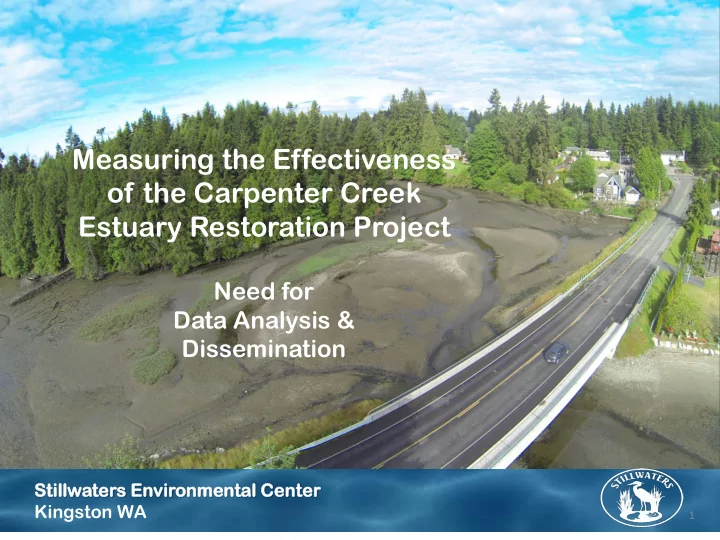
Measuring the Effectiveness of the Carpenter Creek Estuary Restoration Project Need for Data Analysis & Dissemination Stil illwater ters Envir ironme nmenta ntal l Center er Kingston WA 1 Importance of this Puget Sound Lowland

slide-1
SLIDE 1

1

Measuring the Effectiveness

  • f the Carpenter Creek

Estuary Restoration Project

Need for Data Analysis & Dissemination

Stil illwater ters Envir ironme nmenta ntal l Center er Kingston WA

slide-2
SLIDE 2

Importance of this Puget Sound Lowland Stream & Watershed

2

Carpenter Creek /Appletree Cove System 2312 acre System includes: 1886 ac Carpenter Creek drainage 39 ac pocket estuary-high marsh complex 102 ac peat/sphagnum bog 426 ac Kingfisher/Crabapple creek drainages

Figure from Puget Sound Salmon Recovery Plan

slide-3
SLIDE 3

Stillwaters-Initiated Watershed Restoration & Monitoring

  • Stream Water Quality

Monitoring since 2000

  • Phase 1 Estuary

Restoration – culvert replacement in 2012

  • Phase 2 Estuary

Restoration – culvert replacement in 2017

  • Monitoring of Estuary

began in 2005

  • Salt Marsh Monitoring

added in 2014

  • Monitoring continues until

2022 (Ph 1) & 2027 (Ph 2)

3

Stillwaters

slide-4
SLIDE 4

Protocols for Sample Collection and Analysis

Carefully Assembled Protocols, Strictly Followed, Generating Years of QUALITY DATA

“A primary goal of our protocol is to promote both scientific sufficiency and adequacy in the assessment of fish and wildlife support in restored estuarine habitats.

slide-5
SLIDE 5

Protocols for Sample Collection and Analysis

“By sufficiency, we mean that enough information about the habitat must be gathered to adequately characterize the various support functions. “Adequacy addresses the requirement for data of high quality, which relates to the way it is collected and analyzed.”

From “Estuarine Habitat Assessment Protocol” by Puget Sound Estuary Program.

slide-6
SLIDE 6

Protocols for Sample Collection and Analysis

By creating excellent, achievable protocols for every parameter measured, and maintaining strict adherence to those protocols, the Stillwaters monitoring program produces high quality data to tell the story

  • f this estuarine restoration.
slide-7
SLIDE 7

Creating a Watershed Characterization

  • Monitoring began in 2000 & grew to include:

– Monthly water quality (8 sites, 7 parameters) – Monthly bird survey (estuary & lake) – Yearly Freshwater Benthic Invertebrate survey (2 sites) – Habitat survey – Photo Log – Fish survey in estuary

7

slide-8
SLIDE 8

Monitoring Program Expands

In 2011, we continued our pre-bridge construction efforts and added: – Vegetation Survey (terrestrial, aquatic, marsh) – Tidal Height Monitoring (2 sites) – Terrestrial Insect Collection (8 locations) – Topography

8

slide-9
SLIDE 9

Monitoring Program Expands

– Fish Presence (seining plus in-water photos ) – Plankton Sampling (quarterly) – Photo Log (annual) – Sediment Characterization Study (33 samples biennially)

9

slide-10
SLIDE 10

Salt Marsh Monitoring

10

– Large Woody Debris (i.d. & location) – Vegetation Surveys – including intertidal moss – Elevation Mapping – Macroinvertebrate Study – Drainage Channel Soil & Water Column Analysis

slide-11
SLIDE 11

Data Analysis and Publication – Telling the Restoration Story

OBJECTIVES

  • Organize, analyze, and interpret the data we have collected.
  • Publish data for the professional science community around

Puget Sound.

  • Use data to demonstrate need for protection and restoration
  • f the many pocket estuaries and few remaining estuarine

marshes around the Sound.

11

5 10 15 1/6/2008 5/18/2008 9/14/2008 2/8/2009 6/14/2009 10/4/2009 . 3/7/2010 7/11/2010 11/14/2010 (mm/dd/yy) 4/10/2011 8/14/2011 12/11/2011 1/8/2012 5/6/2012 9/9/2012 2/3/2013 6/2/2013

Dissolved Oxygen (ppm)

slide-12
SLIDE 12

Data Analysis and Publication – Telling the Restoration Story

OBJECTIVES

  • Publish our successful protocol &

methodology, especially for marsh monitoring.

  • Communicate the model of an

effective citizen-driven monitoring project for other pocket estuaries.

  • Share the data and the story of the

estuary with the general public to inspire them to protect marshes and estuaries.

12

slide-13
SLIDE 13

Support for our monitoring program is provided by

  • the Puget Sound Stewardship and

Mitigation Fund, a grantmaking fund created by the Puget Soundkeeper Alliance and administered by the Rose Foundation for Communities and the Environment

  • Kingston-North Kitsap Rotary
  • Norcross Wildlife Foundation
  • Suquamish Tribe
  • Pt. Gamble S’Klallam Tribe
  • Kitsap Community Foundation

Stillwaters Environmental Center 26059 Barber Cut Off Road NE Kingston WA 98346 360-297-1226 www.stillwatersenvironmentalcenter.org