EU Cohesion Policy: what works and where? Riccardo Crescenzi London - - PDF document

eu cohesion policy what works and where
SMART_READER_LITE
LIVE PREVIEW

EU Cohesion Policy: what works and where? Riccardo Crescenzi London - - PDF document

02/03/2018 1st ERSA-REGIO Academic Lecture 2018 European Commission - DG REGIO Brussels, 19 February 2018 EU Cohesion Policy: what works and where? Riccardo Crescenzi London School of Economics Team Guido De Blasio Fabrizio De


slide-1
SLIDE 1

02/03/2018 1

Riccardo Crescenzi London School of Economics

EU Cohesion Policy: what works and where?

1st ERSA-REGIO Academic Lecture 2018 European Commission - DG REGIO Brussels, 19 February 2018
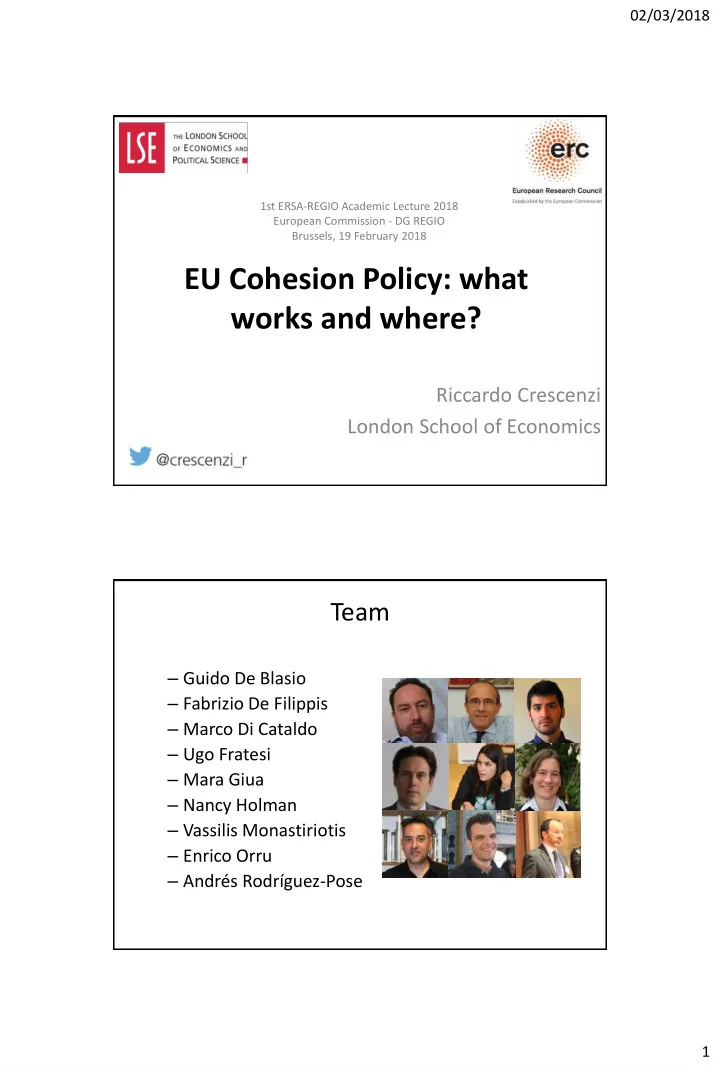
Team

– Guido De Blasio – Fabrizio De Filippis – Marco Di Cataldo – Ugo Fratesi – Mara Giua – Nancy Holman – Vassilis Monastiriotis – Enrico Orru – Andrés Rodríguez-Pose

slide-2
SLIDE 2

02/03/2018 2

Towards 2020: Special Sessions and Roundtables

  • 2016-08 - ERSA Wien:

Special Session: “The cohesion policy of the European Union and the factors influencing its impacts on growth, jobs and investment” (Organisers: R.Crescenzi, U.Fratesi, V. Monastiriotis)

  • 2017-06 - RSA Dublin:

Special Session: “The Cohesion Policy of the European Union after the Economic Crisis & Brexit” (Organisers R.Crescenzi, U.Fratesi, V. Monastiriotis)

  • 2017-08 - ERSA Groningen:

Special Session: “The EU Cohesion Policy after the Crisis and Brexit” (Organisers R.Crescenzi, U.Fratesi, V. Monastiriotis)

  • 2017-09 - AISRe Cagliari:

Special Session «Il futuro delle politiche di coesione nell'Europa post Brexit» (Organisers R.Crescenzi, U.Fratesi, M. Giua)

  • 2017-11 - RSA London:

Plenary Roundtable “The Cohesion Policy of the European Union after the Economic Crisis & Brexit: Back to National Regional Policies?” (Chair R.Crescenzi; Panelists: U.Fratesi, V. Monastiriotis, L. Polverari, P. Wostner)

  • Forthcoming 2018-08 ERSA Cork:

Special Session “The EU Cohesion Policy after the Crisis and Brexit” (Organisers: R.Crescenzi, U.Fratesi, V. Monastiriotis)

  • Proposal 2018-10 European Week of Regions Brussels:

Interactive University Session “Thirty years of EU Cohesion Policy: What works? Where? for Whom?” (Organisers R.Crescenzi, U.Fratesi, V. Monastiriotis)

Special Issue: “EU Cohesion Policy: Back to National Regional Policies?”

Editors: R. Crescenzi, U.Fratesi, V. Monastiriotis

  • Ten papers now at advanced stage
  • Forthcoming in 2018
  • Explores the features of EU Cohesion

Policy, its impacts on regional

  • utcomes, and the socio-economic,

political and institutional factors conditioning these processes

slide-3
SLIDE 3

02/03/2018 3

This talk

  • Towards 2020: A decade of ‘crises’
  • European regions and the ‘double-challenge’ for EU Cohesion

Policy

  • EU Cohesion Policy after 2020

– The ‘political’ rationale – ‘EU value added’ and ‘impact’

  • Pathway to impact

– How regions work – How POLICIES work in practice

  • What works? Where? Under what conditions?

– Identification – Contextualisation

  • General conclusions

A decade of ‘crises’ (1)

2008 – Great Recession – Severe contraction of economic activity and employment in virtually all regions

  • Shift of EU Cohesion expenditure in order to:

– Address new and emerging local ‘needs’ – Compensate for cuts in ‘national’ public expenditure in key areas

– Asymmetric spatial patterns of recovery

  • New demands for Cohesion Policy in order to facilitate recovery
slide-4
SLIDE 4

02/03/2018 4

Geography of the Crisis (1)

Average Annual Growth Rates of Regional GDP pc, 2008-2010 (Eurostat)

Source: Crescenzi, Luca, Milio 2016

Changes in FDI towards the regions of Europe after the crisis (Differences in capital expenditure between 2003–08 and 2009–14).

Geography of the Crisis (2)

Source: Crescenzi & Iammarino 2017 - fDi Markets data

slide-5
SLIDE 5

02/03/2018 5

A decade of ‘crises’(2)

2016 – Brexit – Political crisis with financial and economic implications

  • The debate on Brexit called into question the ‘value’ of the Union
  • The UK played a relevant role in shaping EU policies including the

progressive shift of resources from CAP towards Cohesion

  • Pressures on EU Budget following the departure of a net

contributor with complex re-distributive effects

Net contribution to EU Budget Pre/Post Brexit

  • 20,000
  • 15,000
  • 10,000
  • 5,000
  • 5,000

10,000

Germany France Netherlands Italy Sweden Belgium Austria Denmark Finlandia Luxembourg Cyprus Malta Croatia Estonia Ireland Lituania Slovenia Latvia Portugal Bulgaria Slovakia Spain Hungary Greece Romania Czech Republic Poland

Authors’ calculations based on European Commission data on expenditure and revenues by Member

  • States. 2015 Operating budgetary balances – Before Brexit (Grey) – After Brexit (Yellow)
slide-6
SLIDE 6

02/03/2018 6

A decade of ‘crises’(2)

2016 – Brexit – Political crisis with financial and economic implications

  • The debate on Brexit called into question the ‘value’ of the Union
  • The UK played a relevant role in shaping EU policies including the

progressive shift of resources from CAP towards Cohesion

  • Pressures on EU Budget following the departure of a net

contributor with complex re-distributive effects

– Asymmetric spatial impacts

  • New demands for Cohesion Policy in order to deal with new

asymmetric shocks via trade and FDI

Geography of the impacts of Brexit

Source: Chen, W., Los, B., McCann, P., Ortega-Argiles, R., Thissen, M., van Oort, F (2018)

Regional shares of local labour income exposed to Brexit (excluding the UK)

slide-7
SLIDE 7

02/03/2018 7

EU Crises and the regions

Doing more - Asymmetric economic impacts with complex geographies With (even) less (?) – Increasing pressures on available resources for less developed regions: – Uncertainty over resources available in the post-2020 EU Budget – Communication of the Commission regarding the priorities

  • f the post-2020 EU budget (14th February 2018) contains

some critical elements for less developed regions “Sometimes less is more. The EU27 could focus on areas where we make a real difference” “EU states could regain control over matters ranging from regional development to consumer protection”

slide-8
SLIDE 8

02/03/2018 8

Cohesion Policy in post-2020 Europe (1)

Existential challenge for Cohesion Policy Potential discontinuity in public policies for less developed regions throughout Europe

– Cohesion Policy is often the only development tool available (‘natural experiment’ in the UK shows the difficulty faced by ‘less developed’ regions to attract national resources)

In order to (re)assert its role, EU Cohesion Policy cannot rely on purely political arguments such as:

– Cohesion Policy needed for redistributive purposes – Less developed regions ‘voting against European integration’

Regional GDP and Trust in the EU

50 100 150 200 250 300 0.1 0.2 0.3 0.4 0.5 0.6 0.7 GDP per head (EU28 = 100) Tend to Trust Own elaboration: Flash Eurobarometer (Public opinion in the EU NUTS 1/2 regions); GDP per head (PPS), 2015 EUROSTAT

slide-9
SLIDE 9

02/03/2018 9

Source: Eurostat, BBC

UKC1 UKC2 UKD1 UKD2 UKD3 UKD4 UKD5 UKE1 UKE2 UKE3 UKE4 UKF1 UKF2 UKF3 UKG1 UKG2 UKG3 UKH1 UKH2 UKH3 UKI1 UKI2 UKJ1 UKJ2 UKJ3 UKJ4 UKK1 UKK2 UKK3 UKK4 UKL1 UKL2 UKM2 UKM3 UKM5 UKM6 UKN0

30 40 50 60 70 9.5 10 10.5 11 11.5 Log GDP per capita

Brexit: leave votes and regional GDP pc (1)

UKC1 UKC2 UKD1 UKD2 UKD3 UKD4 UKD5 UKE1 UKE2 UKE3 UKE4 UKF1 UKF2 UKF3 UKG1 UKG2 UKG3 UKH1 UKH2 UKH3 UKI2 UKJ1 UKJ2 UKJ3 UKJ4 UKK1 UKK2 UKK3 UKK4 UKL1 UKL2 UKM2 UKM3 UKM5 UKM6 UKN0

30 40 50 60 70 9.8 10 10.2 10.4 10.6 Log GDP per capita

Brexit: leave votes and regional GDP pc (2)

(Excluding London)

Source: Eurostat, BBC

slide-10
SLIDE 10

02/03/2018 10

UKC1 UKC2 UKD1 UKD2 UKD3 UKD4 UKD5 UKE1 UKE2 UKE3 UKE4 UKF1 UKF2 UKF3 UKG1 UKG2 UKG3 UKH1 UKH2 UKH3 UKI2 UKJ1 UKJ2 UKJ3 UKJ4 UKK1 UKK2 UKK3 UKK4 UKL1 UKL2 UKM2 UKM3 UKM5 UKM6 UKN0

30 40 50 60 70 9.8 10 10.2 10.4 10.6 Log GDP per capita

Brexit: leave votes and regional GDP pc (2)

(Excluding London)

Source: Eurostat, BBC

Cambridgeshire (UKH12)

Leave votes by ward

Source: Crescenzi, Di Cataldo and Giua (2018) - elaboration based on BBC data

slide-11
SLIDE 11

02/03/2018 11

Cohesion Policy in post-2020 Europe (2)

Cohesion Policy is economically justified if it can show that: – It is an EU economic priority (EU rationale)

  • Equity Argument (asymmetric impacts of EU integration and

EU policies)

  • Efficiency Argument (removal of developmental bottlenecks

and global challenges) – It works (Impact  not only ‘economic impacts’ matter but all impacts should be testable against a credible benchmark) – Best use of public resources vs. other alternative options (Effectiveness)

The diagnosis

Existent scholarly and policy debates have focused on ‘how regions work’ – Very dynamic field of research in Economic Geography, Regional Economics, Urban Planning etc. – Remarkable attention by policy makers taking on board state-

  • f-the-art academic work (e.g. Barca Report or Smart

Specialisation) – Data quality constantly improving – Very accurate diagnoses (e.g. Cohesion Report)

slide-12
SLIDE 12

02/03/2018 12

The cure: What works? Where? (1)

More limited attention to ‘how Regional Policies work and where’ in terms of economic outcomes – More recent (but rapidly developing) field of research – Still difficult to draw general conclusions to inform policies – Significant data barriers (with some best practices, e.g. OpenCoesione in Italy) Sophisticated diagnoses not matched by ‘well-tested medications’: – Regions have been told (and very rightly so) to ‘invest more in innovation’, ‘increase and improve human capital’, ‘reinforce institutions’ etc. – If all regions were good at this kind of thing, these problems wouldn't exist today! – Generic recipes are good cover-ups for rent-seeking by local elites – How to achieve these goals in practice given local conditions? What works? Where?

The cure: What works? Where? (2)

slide-13
SLIDE 13

02/03/2018 13 Theory-driven empirical work (quantitative, qualitative, mixed method, experimental) – Leveraging ‘real’ policy data and information – Meeting ‘quality’ requirements in terms of falsifiability and reproducibility Leverage complementarities between different streams of research

The cure: What works? Where? (3)

Contextualisation Identification

What works? Does it work? Where? Under what conditions?

Analyses of territorial contextual conditions and factors conditioning success and failure (contextualisation approaches) Analyses of ‘net’ policy impact by means of counterfactual methods (identification approaches) Analyses of heterogeneous effects of policies and programmes in different contexts

slide-14
SLIDE 14

02/03/2018 14

Does it work?

E.g. Mohl & Hagen, 2010; Becker et al., 2010; Accetturo & De Blasio, 2011; Bondonio & Greenbaum, 2012; Pellegrini et al., 2013.

Identification

Emerging literature on counterfactual assessment of Cohesion Policy impacts Separation between EU-wide studies (Becker et al., 2010 and 2013; Pellegrini et al., 2013; Percoco, 2017) vs. one- country studies (e.g. Di Cataldo, 2017 for the UK or Giua, 2017 for Italy)

Does it work? The impact of Cohesion Policy (1)

slide-15
SLIDE 15

02/03/2018 15

Does it work? The impact of Cohesion Policy (2)

Key questions – Does Cohesion Policy boost regional growth and employment? – Do regions in ALL Member States benefit from Cohesion Policy? Crescenzi & Giua (2018): – Spatial Regression Discontinuity Design (RDD) estimates distinct but fully comparable regional impacts for each individual Member State before the Crisis and during Recovery – Eligible and non-eligible areas are compared by means of a spatial forcing variable

Treated NUTS-3 regions (belonging to Objective 1 regions according to the 2000-2006 EU Cohesion Policy eligibility criteria) in red. Counterfactual NUTS-3 regions in green

Does it work? The impact of Cohesion Policy (3)

Source: Crescenzi and Giua (2018)

slide-16
SLIDE 16

02/03/2018 16

Table 4. Effects of EU Cohesion Policy on economic growth and employment (2000- 2010) Europe Germany Italy Spain UK Panel A - Y: economic growth Objective 1 0.0036** (0.0011) 0.0354** (0.0118) 0.0295 (0.0411) 0.5078 (0.5907) 0.0074 (0.0451) R squared 0.183 0.094 0.195 0.360 0.138 Polynomial degree 3-2 3-1 2-1 2-1 1-1 Observations 779 428 87 44 125 Panel B- Y: employment Objective 1 0.0045* (0.0017) 9.7737 (4.9094) 40.8626** (12.8633)

  • 78.82296

(43.9912) 50.3325** (16.6211) R squared 0.300 0.154 0.218 0.510 0.177 Polynomial degree 3-1 3-3 2-3 3-3 3-2 Observations 770 421 87 42 125

  • Positive EU-wide impact on both regional economic growth and

employment

  • The positive impact on regional employment has survived the

Crisis and supported less developed regions in the recovery period

  • Positive effects are unevenly distributed across member states:

– ‘Regional growth bonus’ concentrated in Germany – Impacts on regional employment are largely confined to UK regions – Italian beneficiary regions experienced better employment performance but this effect ended with the Crisis – Spanish beneficiary regions have benefited in terms of better growth during Recovery with no impacts on employment

Does it work? The impact of Cohesion Policy (4)

slide-17
SLIDE 17

02/03/2018 17 In post-Brexit Europe, EU Cohesion Policy remains an EU-wide public good Better adaptation of the policy to the needs and overarching

  • bjectives of each individual Member State might be the best

complement to the current place-based approach

Does it work? The impact of Cohesion Policy (4)

Contextualisation

Does it work? Where? Under what conditions?

E.g. Cappellen et al., 2003; Rodríguez-Pose & Fratesi, 2004; Ederveen et al., 2006; Dall’Erba et al., 2007; Esposti & Bussoletti, 2008; Bondonio & Greenbaum, 2012.

Where? Under what conditions?

slide-18
SLIDE 18

02/03/2018 18

A bottom-up approach in all regions?

  • Crescenzi & Giua (2016) compare the territorial implications of a

fully ‘top-down’ policy (CAP) with an increasingly ‘bottom-up’ policy (Cohesion Policy)

  • Link ‘models of intervention’ to heterogeneous territorial

conditions

  • Test the association between growth and regional-level

expenditure for EU Cohesion Policy, Rural Development Policy and CAP over the 1994-2013 period

  • The results suggest that:

– The positive influence of EU Cohesion Policy on regional growth is stronger in regions with the most favourable socio-economic initial conditions; – CAP has a positive link with regional economic performance only in the most deprived regions of the EU; – Coordination between EU policies maximises impacts

Concentration and alignment with needs

  • Crescenzi, Fratesi and Monastiriotis (2017) bridge a case-

study approach with econometric analysis

  • Quantitative assessment of 15 selected regions with both

quantitative and qualitative information on expenditure and local achievements

  • Explore the link between the structure of expenditure, its

alignment with local needs and a variety of objective and subjective local achievements

  • The results suggest that:

– Structure of expenditure is a key factor conditioning impacts; – Consistency, in terms of planned interventions and alignment between objectives and on-the-ground needs, is a key conditioning factor for all types of achievements (not only economic returns)

slide-19
SLIDE 19

02/03/2018 19 Contextualisation Identification

What works?

What Works? (1)

A Smart Specialisation Forerunner Programme

Too early for rigorous evaluation of actual 2014-2020 Smart Specialisation Programmes But we can analyse ‘S-3 forerunner programmes’ from the past and learn from them Crescenzi, De Blasio & Giua (2018) evaluate the impact of a scheme (Collaborative Industrial Research - CIR) supporting innovative activities of firms located in less developed regions in Italy (1 billion euros) Co-financed by the EU Cohesion Policy in 2007-2013 and it anticipates some key features of Smart Specialisation Strategy Programmes

slide-20
SLIDE 20

02/03/2018 20 Makes it possible to draw insights on the potential impacts of S-3: – What features of S-3 Programmes work best in the most disadvantaged areas of the EU? – What is the impact and 'value added' of some of the new features introduced into regional innovation strategies by S-3?

What Works? (2)

A Smart Specialisation Forerunner Programme

Unique collection of detailed programme-level and firm- level data Information on applicants, selection scores and beneficiaries with actual payments and firm characteristics and performance (5 different datasets) RDD approach using the evaluation score of the applications as the forcing variable (some projects are eligible but not funded due to limited resources) Focus on project-level heterogeneity (i.e. anticipation of some S-3 features)

What Works? (3)

A Smart Specialisation Forerunner Programme

slide-21
SLIDE 21

02/03/2018 21

Investments Value Added Employment

Z1: Public research (presence of a University in the project partnership) Treatment*Z1

  • 1.1480

(0.8926) 0.4142 (0.7503) 1.0767* (0.4205) Z2: Collaboration (project partnership involving large number of firms) Treatment*Z2

  • 0.5514

(0.5438)

  • 1.9874***

(0.5263)

  • 1.9942***

(0.4992) Z3: Advanced Activities (activity of the project classified as advanced) Treatment*Z3

  • 0.4083

(0.4439)

  • 0.2672

(0.4907)

  • 1.4622*

(0.5910) Z4: Low tech (firms operating in low tech sectors) Treatment*Z4 1.2951** (0.4333) 0.1203 (0.4162) 1.3514** (0.4749) Z5: Patenting (firms with a high capacity of patenting) Treatment*Z5

  • 0.1697***

(0.0477) 0.2223*** (0.0596) 0.1248 (0.0876) Z6: Internationalisation (multinational corporations) Treatment*Z6

  • 0.7148

(0.6535)

  • 0.9529*

(0.3698)

  • 1.7699*

(0.7928)

Heterogeneous Impact (H-ATE ) Results

Source: Crescenzi, De Blasio & Giua (2018)

Z1- Collaboration with public research centres or Universities does not increase impact Z2 - Large partnerships have a negative impact on value added and employment Z3 - Most innovative activities (e.g. ICT or Health and bio- technologies) do not show any additional benefits vs. more 'traditional' activities (e.g. Agro-industrial system, Cultural heritage) Z4 - Firms operating in low tech economic sectors benefit the most Z5 - Firms with more consolidated innovative capabilities reduce investments (crowding-out) and focus on value added Z6 - No benefit for large internationalised firms

What Works? (4)

A Smart Specialisation Forerunner Programme

slide-22
SLIDE 22

02/03/2018 22

Conclusions (1)

EU Regions are facing a ‘double-challenge’ – Multiple shocks (Recovery from Great Recession & Brexit) with asymmetric territorial impacts – Changing budget constraints for development policies EU Cohesion Policy can and should remain central after 2020 ‘EU value added’ and ‘Impact’ are key to success in a changing Europe Good understanding of how regions work (Diagnosis) More work is needed on how regional policies work in practice (Well-tested medications) – What works? – Under what conditions? Where? Exciting field of research combining identification and contextualisation Gradual transparent evidence-based policy learning based on:

– Ex-ante, in-itinere and ex-post evaluation of policies, programmes and projects beyond formal requirements – (Open) Data availability at the firm/individual beneficiary level in ALL Member States – Combination of qualitative, quantitative and mixed methods (including Machine Learning) – Stringent requirements in terms of valid methods, external validity and transferability of results – Eclectic evidence-based selection of policy tools – Top-down and bottom-up integrated approach – Coordination between policies – Small-scale experimentation with continuous feedback mechanisms

Conclusions (2)

slide-23
SLIDE 23

02/03/2018 23

http://blogs.lse.ac.uk/gild/ Riccardo Crescenzi London School of Economics r.crescenzi@lse.ac.uk

slide-24
SLIDE 24

02/03/2018 24

Acknowledgements

The research leading to these results has received funding from the European Research Council under the European Union’s Horizon 2020 Programme H2020/2014-2020 (Grant Agreement n 639633-MASSIVE-ERC- 2014-STG). All errors and omissions are our own

Key References

  • Crescenzi R., De Blasio G. and Giua M. “Cohesion Policy Incentives for Collaborative

Industrial Research. The Evaluation of a Smart Specialisation Forerunner Programme” LSE/SERC Discussion Paper #231/2018, 2018

  • Crescenzi R. and Giua M. “One or many Cohesion Policies of the European Union?

On the diverging impacts of Cohesion Policy across Member States” LSE/SERC Discussion Paper #230/2018, 2018

  • Crescenzi, R. and Fratesi, U. and Monastiriotis, V., The EU cohesion policy and the

factors conditioning success and failure: evidence from 15 regions Regions Magazine, 305(1), 4-7, 2017. ISSN 1367-3882

  • Crescenzi R. and Giua M., "The EU Cohesion policy in context: Does a bottom-up

approach work in all regions?", Environment and Planning A, 48(11), 2340–2357, 2016, DOI: 10.1177/0308518X16658291

  • Crescenzi R. and Giua M. “Different approaches to the analysis of the EU Cohesion

Policy: leveraging complementarities for evidence-based policy learning” in Berkowitz P., Bachtler J., Muravska T. and Hardy S. (Eds) EU Cohesion Policy Reassessing Performance and Direction, Routledge, Regions and Cities, 2016

  • Crescenzi R., De Filippis F. & Pierangeli F. “In tandem for cohesion? Synergies and

conflicts between regional and agricultural policies of the European Union”, Regional Studies, 49(4), 2015 also available http://eprints.lse.ac.uk/59953/

  • Crescenzi R. and De Filippis F. “Cohesion policy and rural development” in Piattoni
  • S. and Polverari L. (editors) Handbook of Cohesion Policy in the EU, Edward Elgar,

2016