EUCONSULT SUMMER CONGRESS STRASBOURG, 18-20 JUNE 2015 COLLABORATION - - PowerPoint PPT Presentation

euconsult summer congress strasbourg 18 20 june 2015
SMART_READER_LITE
LIVE PREVIEW

EUCONSULT SUMMER CONGRESS STRASBOURG, 18-20 JUNE 2015 COLLABORATION - - PowerPoint PPT Presentation

F. Zagni F. Zagni EUCONSULT SUMMER CONGRESS STRASBOURG, 18-20 JUNE 2015 COLLABORATION IN THE CURRENT SOCIAL ECONOMIC CLIMATE 1 F. Zagni F. Zagni THE SOCIAL ENTERPRISE IN EUROPE 2 F. Zagni F. Zagni INNOVATIVE SOCIAL INVESTMENT:


slide-1
SLIDE 1

1

  • F. Zagni

EUCONSULT SUMMER CONGRESS STRASBOURG, 18-20 JUNE 2015

  • F. Zagni

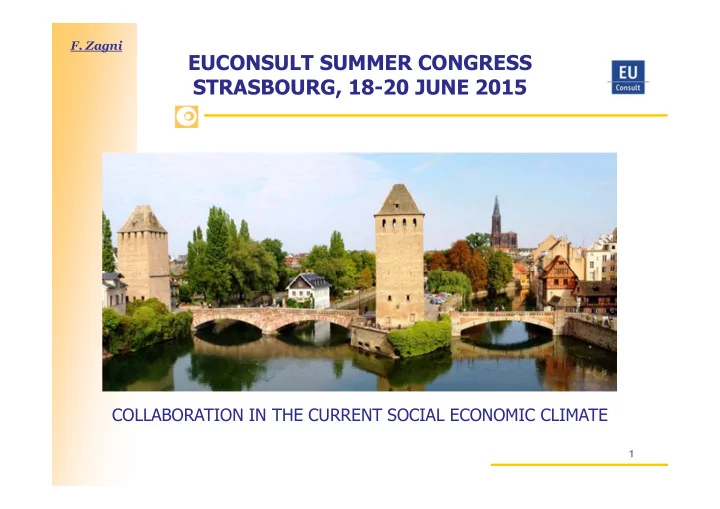
COLLABORATION IN THE CURRENT SOCIAL ECONOMIC CLIMATE

slide-2
SLIDE 2

2

  • F. Zagni

THE SOCIAL ENTERPRISE IN EUROPE

  • F. Zagni
slide-3
SLIDE 3

3

  • F. Zagni

INNOVATIVE SOCIAL INVESTMENT: Strenghtening Communities in Europe - 1

  • The case for Social investment European welfare states were designed to
  • ffer support against Twentieth Century social and economic risk. But

european societies are changing in a number of interlinked areas including demography, globalisation, ecological sustainability, family structure, employment, poverty and social inclusion.

  • The implication of this changes are profound!!!
  • The economic crisis of 2008 has emphasized that EU Member States will

have adopted distinctive social welfare reforms to improve their resilience and prepare for future economic and social risk.

InnoSi Study

  • F. Zagni
slide-4
SLIDE 4

4

  • F. Zagni

INNOVATIVE SOCIAL INVESTMENT: Strenghtening Communities in Europe - 2

  • In 2013 the European Commission adopted its ‘Social Investment

Package’. It stresses that welfare systems fulfil three functions: social investment, social protection and economic stabilisation.

  • Social investment involves strengthening people’s current and future

capacities…… and it helps to ‘prepare’ people to confront life’s risk, rather than simply ‘repairing’ consequences.

InnoSi Study

  • F. Zagni
slide-5
SLIDE 5

5

  • F. Zagni

Social Enterprise

  • Twelve years ago, the concept of social enterprise was rarely discussed in

Europe, however it is now making significant breakthroughs in European Union countries and several evolutions have been experienced across Europe and the key challenges they are facing. BUT, SO FAR ………

  • There is no absolute consensus concerning the definition of social enterprise
  • r social investment.
  • F. Zagni
slide-6
SLIDE 6

6

  • F. Zagni

THE SOCIAL BUSINESS

  • F. Zagni
slide-7
SLIDE 7

7

  • F. Zagni
  • “Social business can be indeed a very powerful agenda for change. To deliver

better outcomes for the common good. To show that it is possible to do things more responsibly and more fairly, whilst still being a success on the market. And to become a real engine of growth in the EU. Europe must not only be part

  • f these changes. Europe should be in the lead.” (J.M.Barroso)
  • “The Social Business Initiative is an invitation to national and regional

governments and stakeholders to develop eco-systems for social enterprise, to strengthen efforts at national and regional levels, and to make best use of the structural funds and other available sources of support.” (L. Andor)

  • F. Zagni
slide-8
SLIDE 8

8

  • F. Zagni
  • Social economy in the European Union:

⁻ 10% of the European economy (GDP). • More than 11 millions of workers, 4.5 % of the active EU population.

  • Social Entrepreneurship in the European Union:

⁻ 7.5% of the active population in Finland, 5.7% in the United Kingdom, 5.4% in Slovenia, 4.1% in Belgium, 3.3% in Italy, 3.1% in France, etc. • 1 out of 4 new enterprise set-up every year in the European Union, and up to 1 out of 3 in Finland, France and Belgium

  • F. Zagni
slide-9
SLIDE 9

9

  • F. Zagni

Social enterprises: first comparative overview

  • Social enterprises are an important driver for inclusive growth and play a key role in

tackling current economic and environmental challenges, according to a report published by the European Commission.

  • Yet, only eight countries (Bulgaria, Greece, France, Italy, Luxembourg, Slovenia,

Sweden, and United Kingdom) have a policy framework in place to encourage and support the development of social enterprises.

  • For the first time, this in-depth study outlines the main features of social enterprises in

28 EU Member States and Switzerland using a common definition and approach.

  • It also gives an overview of social enterprise eco-systems across countries,

including factors constraining their development.

  • F. Zagni

EU.Com. Study - nov. 2014

slide-10
SLIDE 10

10

  • F. Zagni

BARRIERS

  • poor visibility and recognition of the sector,
  • the constraints of current legal and regulatory frameworks,
  • limited financial resources,
  • difficult access to markets,
  • and the lack of business support and development structures,

training, and workforce development.

  • F. Zagni

EU.Com. Study - nov. 2014

slide-11
SLIDE 11

11

  • F. Zagni

GROWING CONVERGENCE

  • Definition of social enterprise as "an autonomous organization that combines a

social purpose with entrepreneural activity". It highlights that support structures are under-developed and fragmented, with the exception of Italy, France, and the UK. However, social enterprise policy is currently under development in seven countries (Ireland, Croatia, Latvia, Lithuania, Malta, Poland, and Romania).

  • F. Zagni
slide-12
SLIDE 12

12

  • F. Zagni

SOCIAL ENTERPRISE IN THE UK - 1

  • DEFINITION AND MODELS
  • Social enterprise is an activity as opposed to an organisational type. It is one of the

form of activities that social enterpreneurs engage in, but the term continues to be discusssed at lenght.

  • In the simple terms, a social enterprise is a business with more than one bottom line

mesurements: financial, social or community or cultural; or environmental.

  • From a social impact perspective, three moldels are proposed:
  • Enterprise activity which focuses on maximising profit going to support social ends (profit

generation model)

  • Enterprise activity with social impact, with a balancing of commercial activity with social

mission (trade off model)

  • Enterpprise activity that has a social impact generating financial returns that grow as the

social grows (lockstep model)

Magazine Art – oct. 2014

  • F. Zagni
slide-13
SLIDE 13

13

  • F. Zagni

SOCIAL ENTERPRISE IN THE UK - 2

  • Sociale Enterprise in the UK

70.000

  • People employed

1.000.000

  • Sector’s contribution to the economy

£ 24 billion

Magazine Art – oct. 2014

  • F. Zagni
slide-14
SLIDE 14

14

  • F. Zagni

SOCIAL ENTERPRISE IN ITALY (1)

  • The concept of ‘Social Enterprise’ , seems to have first appeared in Italy with the

definition of «Impresa Sociale» (1990) As the existing legislation at that time did not allow association to develop the Italian Parliament passed a low creating a new legal form namely «social cooperative» which proved to be very well adapted to those pionering social enterprise The development

  • f the idea inspired various other

countries during the following two decades both across and beyond Europe.

  • Several other European countries introduced new legal forms of Enterpreneural

approach adapted by not-for-profit organisations, but the term «Social Enterprise» was not always mentioned.

Defounry-Nyssens

  • F. Zagni
slide-15
SLIDE 15

15

  • F. Zagni

SOCIAL ENTERPRISE IN ITALY (2)

Models Number Employees Volunteers Beneficiaries Sector’s contributio n to the economy

Ex lege 118/05 (enterprise Official Register) 774 29,000 2,700 229,000 € 314 millions Social Enterprise by statute 574

  • Ex lege 381/91 (Social

cooperatives) 12,570 513,052 42,368 5,000,000 € 10,1 billions

Social Enterprise at the crossroad of Markets, Public Policies and Civil Society

  • F. Zagni
slide-16
SLIDE 16

16

  • F. Zagni

The reform of the third sector – Italy 3

  • On April 9, 2015 the italian Chamber of Deputies approved, the draft law on

Delegation to the Government for the reform of the Third Sector, Social Enterprise and for the discipline of the civil service (Act n. 2617).

  • The measure now goes to the Senate for approval.
  • F. Zagni
slide-17
SLIDE 17

17

  • F. Zagni

THREE CRUCIAL QUESTIONS AND …THREE FAST ANSWERS – ITALY 4

  • Would the Modification of the Law 155 on social Enterprise open the doors of the

Non-Profit to the Profit?.......... No

  • Would the reform of the third sector promote the privatization of welfare? .....No
  • Would the new concept of social enterprise be able to involve the italian citizens?

……………The situation very much depend on the capacity to accept the challenge.

  • F. Zagni
slide-18
SLIDE 18

18

  • F. Zagni

SOCIAL ENTERPRISE IN SWITZERLAND (1)

Fondazione San Gottardo Switzerland (Ticino) Integration of people with disabilities www.fsangottardo.ch Swiss Leg Globally Leg prothesis for poor people www.swissleg.com SOTELL Switzerland (Lugano) Youth unemployment & requalification through event logistic management www.sotell.ch Fondazione Diamante Switzerland (Ticino) Integration of people with disabilities www.f-diamante.ch Seed Switzerland, Italy, Developing countries Non profit organizational development www.seedlearn.org/ Social Business Earth Switzerland (Ticino) Social business promotion and incubator www.socialbusinessearth.org Sehende Hände Switzerland (Winterthur) Blind people integration through massage services www.sehendehaende.ch Blinde Kuh Switzerland (Zurich, Basel) Blind people integration through a “dark restaurant” www.blindekuh.ch/ Gump- & Drahtesel Switzerland (Bern region), Africa Integration of people with disabilities through recycling www.gumpesel.com NoPro Switzerland (Zurich region) Integration of people with disabilities through protected lab www.nopro.ch Job Factory Switzerland (Basel region) Youth unemployment www.jobfactory.ch PRO Switzerland (Geneva region) Professional integration of people with disabilities /invalidity www.pro-geneve.ch

Social entrepreneurship is more than a concept for European societies: it is a long-standing tradition that generated many important experiences locally and internationally. Here is a list of active social enterprises in SEE (Social Enterprising Europe) partner countries.

  • F. Zagni
slide-19
SLIDE 19

19

  • F. Zagni

Type of resource mobilization and self-financing Swiss SEs mobilize a mix of financial resources, a phenomenon referred to in the literature as “resource hybridization” (cf. Gardin, 2006). The

  • rganizations

examined are characterized by a funding model that mixes redistribution-based resources (public subsidies, 57%) and the market (income from sales mostly to the private sector, 41%). Reciprocity-based resources (donations and voluntary work) are, however, limited (2%).

SOCIAL ENTERPRISE IN SWITZERLAND (2)

  • F. Zagni
slide-20
SLIDE 20

20

  • F. Zagni
  • F. Zagni
slide-21
SLIDE 21

21

  • F. Zagni

Francesca Zagni Università S. Tommaso d’Aquino “ANGELICUM” – Membro Consiglio Direttivo di EU Consult e di Professione Etica - Presidente di ASSIF nel triennio 2008 – 2011

Diritti riservati - I partecipanti al corso possono utilizzare il materiale nel loro lavoro solo all’interno delle rispettive organizzazioni di appartenenza

francesca.zagni@fastwebnet.it

.

emmaprintsrls@gmail.com

  • F. Zagni