Eukaryotes and Gene and is intended for the non-commercial use of - - PDF document

eukaryotes and gene
SMART_READER_LITE
LIVE PREVIEW

Eukaryotes and Gene and is intended for the non-commercial use of - - PDF document

Slide 1 / 50 Slide 2 / 50 New Jersey Center for Teaching and Learning Progressive Science Initiative This material is made freely available at www.njctl.org Eukaryotes and Gene and is intended for the non-commercial use of students and


slide-1
SLIDE 1

Slide 1 / 50

This material is made freely available at www.njctl.org and is intended for the non-commercial use of students and teachers. These materials may not be used for any commercial purpose without the written permission of the owners. NJCTL maintains its website for the convenience of teachers who wish to make their work available to other teachers, participate in a virtual professional learning community, and/or provide access to course materials to parents, students and others.

Click to go to website: www.njctl.org New Jersey Center for Teaching and Learning Progressive Science Initiative

Slide 2 / 50

www.njctl.org

Eukaryotes and Gene Expression Multiple Choice Review

Slide 3 / 50

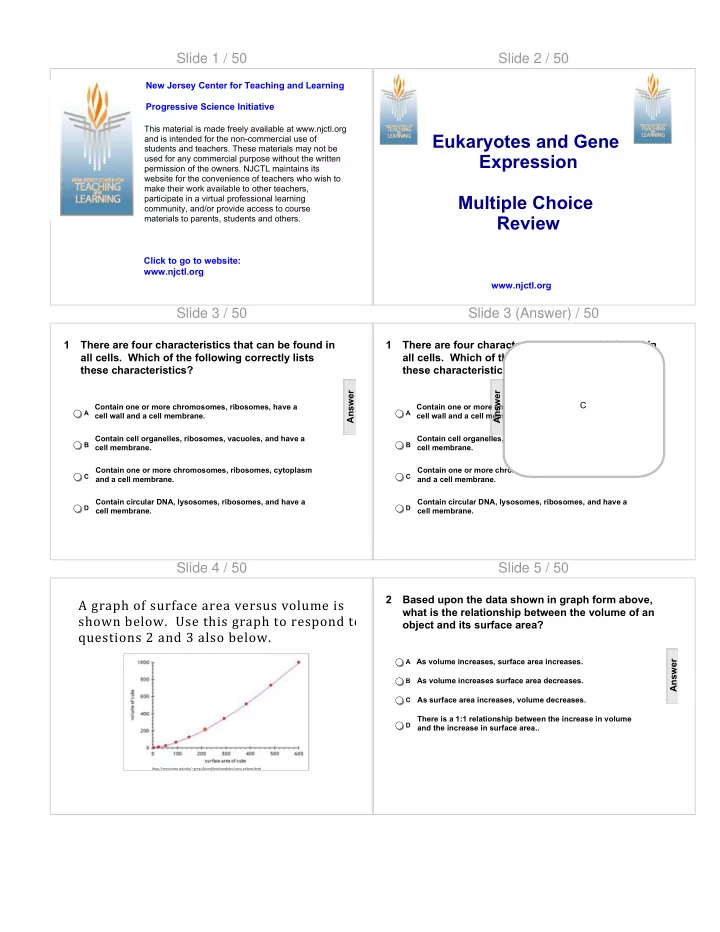
1 There are four characteristics that can be found in all cells. Which of the following correctly lists these characteristics?

A Contain one or more chromosomes, ribosomes, have a

cell wall and a cell membrane.

B Contain cell organelles, ribosomes, vacuoles, and have a

cell membrane.

C

Contain one or more chromosomes, ribosomes, cytoplasm and a cell membrane.

D

Contain circular DNA, lysosomes, ribosomes, and have a cell membrane.

Answer

Slide 3 (Answer) / 50

1 There are four characteristics that can be found in all cells. Which of the following correctly lists these characteristics?

A Contain one or more chromosomes, ribosomes, have a

cell wall and a cell membrane.

B Contain cell organelles, ribosomes, vacuoles, and have a

cell membrane.

C

Contain one or more chromosomes, ribosomes, cytoplasm and a cell membrane.

D

Contain circular DNA, lysosomes, ribosomes, and have a cell membrane.

[This object is a pull tab]

Answer C

Slide 4 / 50 A graph of surface area versus volume is shown below. Use this graph to respond to questions 2 and 3 also below.

http://www.tiem.utk.edu/~gross/bioed/bealsmodules/area_volume.html

Slide 5 / 50

2 Based upon the data shown in graph form above, what is the relationship between the volume of an

  • bject and its surface area?

A As volume increases, surface area increases. B

As volume increases surface area decreases.

C

As surface area increases, volume decreases.

D

There is a 1:1 relationship between the increase in volume and the increase in surface area..

Answer

slide-2
SLIDE 2

Slide 5 (Answer) / 50

2 Based upon the data shown in graph form above, what is the relationship between the volume of an

  • bject and its surface area?

A As volume increases, surface area increases. B

As volume increases surface area decreases.

C

As surface area increases, volume decreases.

D

There is a 1:1 relationship between the increase in volume and the increase in surface area..

[This object is a pull tab]

Answer A

Slide 6 / 50

3 Referring to the data points from the graph above, which characteristic of cubes increases most rapidly?

A Surface area increases more rapidly than volume. B Volume increases more rapidly than surface area. C

Surface area and volume increase at the same rate.

D

Surface area increases at twice the rate of volume. Answer

Slide 6 (Answer) / 50

3 Referring to the data points from the graph above, which characteristic of cubes increases most rapidly?

A Surface area increases more rapidly than volume. B Volume increases more rapidly than surface area. C

Surface area and volume increase at the same rate.

D

Surface area increases at twice the rate of volume.

[This object is a pull tab]

Answer B

Slide 7 / 50

4 Eukaryotic and prokaryotic cells have similarities as well as differences. Which of the following describe eukaryotic cells but not prokaryotic cells?

A Are smaller in size. B

Have DNA as genetic storage molecule.

C

Contain cell organelles.

D

Are unicellular organisms only.

Answer

Slide 7 (Answer) / 50

4 Eukaryotic and prokaryotic cells have similarities as well as differences. Which of the following describe eukaryotic cells but not prokaryotic cells?

A Are smaller in size. B

Have DNA as genetic storage molecule.

C

Contain cell organelles.

D

Are unicellular organisms only.

[This object is a pull tab]

Answer C

Slide 8 / 50

5 The nucleus is enclosed by a double membrane structure with pores. Which of these best describes the function of these pores?

A To allow small segments of DNA to leave the nucleus. B To allow RNA molecules to leave the nucleus after

transcription.

C

To allow transcription factors, RNA, and other molecules involved in gene expression access to genetic information stored in the DNA.

D

To allow the diffusion of proteins out of the nucleus and into the rough endoplasmic reticulum.

Answer

slide-3
SLIDE 3

Slide 8 (Answer) / 50

5 The nucleus is enclosed by a double membrane structure with pores. Which of these best describes the function of these pores?

A To allow small segments of DNA to leave the nucleus. B To allow RNA molecules to leave the nucleus after

transcription.

C

To allow transcription factors, RNA, and other molecules involved in gene expression access to genetic information stored in the DNA.

D

To allow the diffusion of proteins out of the nucleus and into the rough endoplasmic reticulum.

[This object is a pull tab]

Answer C

Slide 9 / 50

6 Which of the following is not a function of the nucleus?

A to produce rRNA B

to safely store DNA

C

to ensure transcription into RNA

D

to ensure translation into proteins

Answer

Slide 9 (Answer) / 50

6 Which of the following is not a function of the nucleus?

A to produce rRNA B

to safely store DNA

C

to ensure transcription into RNA

D

to ensure translation into proteins

[This object is a pull tab]

Answer D

Slide 10 / 50

7 Which of the following accurately reflects the DNA material found in eukaryotic cells?

A A eukaryotic cell contains only the portions of the DNA

material needed to perform its function.

B A eukaryotic cell contains half the number of

chromosomes of the eukaryotic organism.

C

A eukaryotic cell contains all of the genes required for the entire organism, but only certain genes are expressed in each cell.

D

A eukaryotic cell contains all of the genes required for the entire organism and therefore can change from one type

  • f cell to another quickly.

Answer

Slide 10 (Answer) / 50

7 Which of the following accurately reflects the DNA material found in eukaryotic cells?

A A eukaryotic cell contains only the portions of the DNA

material needed to perform its function.

B A eukaryotic cell contains half the number of

chromosomes of the eukaryotic organism.

C

A eukaryotic cell contains all of the genes required for the entire organism, but only certain genes are expressed in each cell.

D

A eukaryotic cell contains all of the genes required for the entire organism and therefore can change from one type

  • f cell to another quickly.

[This object is a pull tab]

Answer C

Slide 11 / 50

The image below represents the structure of DNA as seen in various magnifications. Use this illustration to respond to questions 8 and 9 below.

http://janetsplace.charbonniers.org/image5/chromatin.jpg

slide-4
SLIDE 4

Slide 12 / 50

8 During which of the following phases, as seen in the image above, is DNA accessible for transcription and by which enzyme?

A In #1 DNA polymerase can access the DNA B

In #5 DNA polymerase can access the DNA

C

in #2 RNA polymerase can access the DNA

D

in #1 RNA polymerase can access the DNA

Answer

Slide 12 (Answer) / 50

8 During which of the following phases, as seen in the image above, is DNA accessible for transcription and by which enzyme?

A In #1 DNA polymerase can access the DNA B

In #5 DNA polymerase can access the DNA

C

in #2 RNA polymerase can access the DNA

D

in #1 RNA polymerase can access the DNA

[This object is a pull tab]

Answer D

Slide 13 / 50

9 What are the structures seen in phases #2 and #3.

A #2 shows DNA wrapped around histones while #3 shows

nucleosomes

B #2 shows nucleosomes while #3 shows DNA wrapped

around histones

C

#2 shows DNA wrapped around RNA polymerase while #3 shows transcription

D

#2 shows DNA polymerase while #3 shows DNA replication

Answer

Slide 13 (Answer) / 50

9 What are the structures seen in phases #2 and #3.

A #2 shows DNA wrapped around histones while #3 shows

nucleosomes

B #2 shows nucleosomes while #3 shows DNA wrapped

around histones

C

#2 shows DNA wrapped around RNA polymerase while #3 shows transcription

D

#2 shows DNA polymerase while #3 shows DNA replication

[This object is a pull tab]

Answer A

Slide 14 / 50

10 When and where does mRNA processing occur?

A It occurs in the nucleus when transcription begins. B It occurs in the cytoplasm after transcription is complete. C

It occurs in the nucleus after transcription is complete.

D

It occurs in the nucleus during transcription.

Answer

Slide 14 (Answer) / 50

10 When and where does mRNA processing occur?

A It occurs in the nucleus when transcription begins. B It occurs in the cytoplasm after transcription is complete. C

It occurs in the nucleus after transcription is complete.

D

It occurs in the nucleus during transcription.

[This object is a pull tab]

Answer C

slide-5
SLIDE 5

Slide 15 / 50

11 What are the two primary steps of mRNA processing?

A alteration of the mRNA ends and removal of introns B Splicing of mRNA, removing exons and leaving introns. C

alteration of the mRNA ends and attachment of RNA polymerase

D

methylation of the RNA and degradation of RNA.

Answer

Slide 15 (Answer) / 50

11 What are the two primary steps of mRNA processing?

A alteration of the mRNA ends and removal of introns B Splicing of mRNA, removing exons and leaving introns. C

alteration of the mRNA ends and attachment of RNA polymerase

D

methylation of the RNA and degradation of RNA.

[This object is a pull tab]

Answer A

Slide 16 / 50

The image below is of a chart that can be used to determine the amino acid sequence of a protein, based upon an mRNA sequence. Use this chart to respond to questions 12, 13 and 14 below.

Slide 17 / 50

12 A section of DNA has the following base sequence: A G G T T C G C G A A T What would be the resulting sequence of amino acids in the protein produced?

A Arginine – Phenylalanine – Alanine - Asparagine B

Valine – Valine – Arginine – Aspartic acid

C

Serine – Lysine – Arginine - Leucine

D

Serine – Asparagine – Alanine – Tyrosine Answer

Slide 17 (Answer) / 50

12 A section of DNA has the following base sequence: A G G T T C G C G A A T What would be the resulting sequence of amino acids in the protein produced?

A Arginine – Phenylalanine – Alanine - Asparagine B

Valine – Valine – Arginine – Aspartic acid

C

Serine – Lysine – Arginine - Leucine

D

Serine – Asparagine – Alanine – Tyrosine

[This object is a pull tab]

Answer C

Slide 18 / 50

13 If we were to title the chart shown above, which of the following would represent an accurate title?

A mRNA codon chart B

DNA codon chart

C

mRNA anticodon chart

D

tRNA anticodon chart

Answer

slide-6
SLIDE 6

Slide 18 (Answer) / 50

13 If we were to title the chart shown above, which of the following would represent an accurate title?

A mRNA codon chart B

DNA codon chart

C

mRNA anticodon chart

D

tRNA anticodon chart

[This object is a pull tab]

Answer A

Slide 19 / 50

14 A protein has the following amino acid sequence Leucine – Isoleucine – Glycine – Histidine Which of the following accurately identifies a possible mRNA sequence for this protein?

A GAG – UAU – CCC – GUG B

CTC – TAT – CCC- GUG

C

CUC – AUA – GGG – CAC

D

UAU – AUA – GGG - GUG

Answer

Slide 19 (Answer) / 50

14 A protein has the following amino acid sequence Leucine – Isoleucine – Glycine – Histidine Which of the following accurately identifies a possible mRNA sequence for this protein?

A GAG – UAU – CCC – GUG B

CTC – TAT – CCC- GUG

C

CUC – AUA – GGG – CAC

D

UAU – AUA – GGG - GUG

[This object is a pull tab]

Answer C

Slide 20 / 50

The illustration below represents a system found within eukaryotic cells. Use this illustration to respond to questions 15 and 16 below.

http://www.yellowtang.org/images/how_endomembrane_sy_c_la_784.jpg

Slide 21 / 50

15 In the illustration above, substances are leaving area 1 and moving to area 2. This is labeled in the image as transport vesicle from ER. As this vesicle is leaving the rough ER, what is contained within this transport vesicle?

A glycolipids B

glycoproteins

C

sugars

D

RNA

Answer

Slide 21 (Answer) / 50

15 In the illustration above, substances are leaving area 1 and moving to area 2. This is labeled in the image as transport vesicle from ER. As this vesicle is leaving the rough ER, what is contained within this transport vesicle?

A glycolipids B

glycoproteins

C

sugars

D

RNA

[This object is a pull tab]

Answer B

slide-7
SLIDE 7

Slide 22 / 50

16 Once the Golgi apparatus has received substances from the endoplasmic reticulum, which of the following could happen to these substances?

A The proteins are folded into their tertiary structure. B

They are processed and transported outside of the cell.

C

They are returned to the nucleus.

D

They are reprocessed within the smooth ER.

Answer

Slide 22 (Answer) / 50

16 Once the Golgi apparatus has received substances from the endoplasmic reticulum, which of the following could happen to these substances?

A The proteins are folded into their tertiary structure. B

They are processed and transported outside of the cell.

C

They are returned to the nucleus.

D

They are reprocessed within the smooth ER.

[This object is a pull tab]

Answer B

Slide 23 / 50

17 Which of the following accurately describes one

  • f the roles of lysosomes within cells?

A They can carry sugars to help digest food materials within

a vacuole.

B They can lyse part of the cell membrane to allow

molecules to pass through.

C

They contain enzymes that can hydrolyze molecules.

D

They contain proteins that can be used to synthesize other molecules.

Answer

Slide 23 (Answer) / 50

17 Which of the following accurately describes one

  • f the roles of lysosomes within cells?

A They can carry sugars to help digest food materials within

a vacuole.

B They can lyse part of the cell membrane to allow

molecules to pass through.

C

They contain enzymes that can hydrolyze molecules.

D

They contain proteins that can be used to synthesize other molecules.

[This object is a pull tab]

Answer C

Slide 24 / 50

18 A peroxisome is a special type of lysosome that performs a critical function for cells. What do they contain and what is this critical function?

A They contain enzymes that synthesize hydrogen peroxide

needed by the cell.

B They contain enzymes that hydrolyze hydrogen peroxide,

which is toxic to cells.

C

They contain enzymes that changes peroxide to hydrogen peroxide.

D

They contain hydrogen and oxygen used to synthesize hydrogen peroxide.

Answer

Slide 24 (Answer) / 50

18 A peroxisome is a special type of lysosome that performs a critical function for cells. What do they contain and what is this critical function?

A They contain enzymes that synthesize hydrogen peroxide

needed by the cell.

B They contain enzymes that hydrolyze hydrogen peroxide,

which is toxic to cells.

C

They contain enzymes that changes peroxide to hydrogen peroxide.

D

They contain hydrogen and oxygen used to synthesize hydrogen peroxide.

[This object is a pull tab]

Answer B

slide-8
SLIDE 8

Slide 25 / 50

19 The Golgi body (apparatus) and the plasma membrane have a functional relationship. Which

  • f the following accurately describes this

relationship?

A

The proteins leaving the Golgi body (apparatus) must be transported through the plasma membrane by active transport due to their size.

B

The proteins leaving the Golgi body (apparatus) are packaged in a membrane unlike the plasma membrane to prevent fusion.

C

The proteins leaving the Golgi body (apparatus) must be able to pass through the plasma membrane by passive diffusion.

D

The proteins leaving the Golgi body (apparatus) may become embedded in, or will be transported through, the plasma membrane.

Answer

Slide 25 (Answer) / 50

19 The Golgi body (apparatus) and the plasma membrane have a functional relationship. Which

  • f the following accurately describes this

relationship?

A

The proteins leaving the Golgi body (apparatus) must be transported through the plasma membrane by active transport due to their size.

B

The proteins leaving the Golgi body (apparatus) are packaged in a membrane unlike the plasma membrane to prevent fusion.

C

The proteins leaving the Golgi body (apparatus) must be able to pass through the plasma membrane by passive diffusion.

D

The proteins leaving the Golgi body (apparatus) may become embedded in, or will be transported through, the plasma membrane.

[This object is a pull tab]

Answer D

Slide 26 / 50

20 Whether the process of endocytosis or exocytosis is to occur, what must be true regarding the membrane of the vesicle?

A It must be composed of a single layer of phospholipids. B

It must be composed of a phospholipid bilayer.

C

It must have transport proteins embedded into a phospholipid bilayer.

D

It must have hydrolytic enzymes enclosed in order to digest the plasma membrane.

Answer

Slide 26 (Answer) / 50

20 Whether the process of endocytosis or exocytosis is to occur, what must be true regarding the membrane of the vesicle?

A It must be composed of a single layer of phospholipids. B

It must be composed of a phospholipid bilayer.

C

It must have transport proteins embedded into a phospholipid bilayer.

D

It must have hydrolytic enzymes enclosed in order to digest the plasma membrane.

[This object is a pull tab]

Answer B

Slide 27 / 50

21 The image below highlights one of the cell

  • rganelles found in eukaryotic cells. What is the

name of this cell organelle and where are the structures labeled “1” assembled?

A Golgi apparatus; in the endoplasmic reticulum B

Smooth endoplasmic reticulum; in the Golgi apparatus.

C

Rough endoplasmic reticulum; in the cytoplasm.

D

Rough endoplasmic reticulum; in the nucleolus.

Answer

Slide 27 (Answer) / 50

21 The image below highlights one of the cell

  • rganelles found in eukaryotic cells. What is the

name of this cell organelle and where are the structures labeled “1” assembled?

A Golgi apparatus; in the endoplasmic reticulum B

Smooth endoplasmic reticulum; in the Golgi apparatus.

C

Rough endoplasmic reticulum; in the cytoplasm.

D

Rough endoplasmic reticulum; in the nucleolus.

[This object is a pull tab]

Answer D

slide-9
SLIDE 9

Slide 28 / 50

22 Within the endoplasmic reticulum, proteins are processed into glycoproteins. How are the proteins altered and why?

A Sugars are linked to the protein to indicate their

destination.

B Lipids are linked to the protein to indicate their

destination.

C

Sugars are linked to the protein to indicate whether passive, facilitated or active transport must take place.

D

Lipids are linked to direct any future processing of the protein.

Answer

Slide 28 (Answer) / 50

22 Within the endoplasmic reticulum, proteins are processed into glycoproteins. How are the proteins altered and why?

A Sugars are linked to the protein to indicate their

destination.

B Lipids are linked to the protein to indicate their

destination.

C

Sugars are linked to the protein to indicate whether passive, facilitated or active transport must take place.

D

Lipids are linked to direct any future processing of the protein.

[This object is a pull tab]

Answer A

Slide 29 / 50

The illustration below represents three possible transport mechanisms through the plasma membrane. Use this illustration to respond to questions 23 and 24.

Slide 30 / 50

23 Three examples of transport across the plasma membrane are shown in the illustration above. Which of these examples rely upon transmembrane proteins?

A Example 1 B

Example 2

C

Example 3

D

Examples 1, 2 and 3

Answer

Slide 30 (Answer) / 50

23 Three examples of transport across the plasma membrane are shown in the illustration above. Which of these examples rely upon transmembrane proteins?

A Example 1 B

Example 2

C

Example 3

D

Examples 1, 2 and 3

[This object is a pull tab]

Answer D

Slide 31 / 50

24 Example 3 in the illustration above appears to require energy. What type of transport is this and why is energy required?

A This is facilitated diffusion and energy is required for large

proteins to move across the plasma membrane.

B

This is passive diffusion and energy is required for molecules to move from higher concentration to lower concentration.

C

This is active transport and energy is required for molecules to move from lower concentration to higher concentration.

D

This is active transport and energy is required for molecules to move from higher concentration to lower concentration.

Answer

slide-10
SLIDE 10

Slide 31 (Answer) / 50

24 Example 3 in the illustration above appears to require energy. What type of transport is this and why is energy required?

A This is facilitated diffusion and energy is required for large

proteins to move across the plasma membrane.

B

This is passive diffusion and energy is required for molecules to move from higher concentration to lower concentration.

C

This is active transport and energy is required for molecules to move from lower concentration to higher concentration.

D

This is active transport and energy is required for molecules to move from higher concentration to lower concentration.

[This object is a pull tab]

Answer C

Slide 32 / 50

25 Some proteins, such as insulin, are produced by cells and must be secreted. What is the name of the process used and in which direction to the molecules travel?

A endocytosis; from inside to outside the cell B

exocytosis; from inside to outside the cell

C

endocytosis; from outside to inside the cell

D

exocytosis; from outside to inside the cell

Answer

Slide 32 (Answer) / 50

25 Some proteins, such as insulin, are produced by cells and must be secreted. What is the name of the process used and in which direction to the molecules travel?

A endocytosis; from inside to outside the cell B

exocytosis; from inside to outside the cell

C

endocytosis; from outside to inside the cell

D

exocytosis; from outside to inside the cell

[This object is a pull tab]

Answer B

Slide 33 / 50

26 What type of transportation is shown in the image above and why is this method utilized rather than passive, facilitated or active transport?

A Phagocytosis, because of the amount of liquid B Pinocytosis, because the solid molecule is too large for

the other methods

C

Phagocytosis, because the solid molecules is too large for the other methods

D

Exocytosis because the cell is taking in a liquid and a solid.

The illustration below represents one method of transportation into a cell.

Answer

Slide 33 (Answer) / 50

26 What type of transportation is shown in the image above and why is this method utilized rather than passive, facilitated or active transport?

A Phagocytosis, because of the amount of liquid B Pinocytosis, because the solid molecule is too large for

the other methods

C

Phagocytosis, because the solid molecules is too large for the other methods

D

Exocytosis because the cell is taking in a liquid and a solid.

The illustration below represents one method of transportation into a cell.

[This object is a pull tab]

Answer C

Slide 34 / 50

27 Both chloroplasts and mitochondria are considered to be energy-converting organelles. Which of the following best describes how each performs this role in a cell?

A Mitochondria convert solar energy into chemical energy

while chloroplasts convert chemical energy into ATP.

B Both convert chemical energy into ATP, but using different

methods.

C

Chloroplasts convert solar energy into chemical energy while mitochondria convert chemical energy into ATP.

D

Chloroplasts convert solar energy into ATP while mitochondria convert chemical energy into heat.

Answer

slide-11
SLIDE 11

Slide 34 (Answer) / 50

27 Both chloroplasts and mitochondria are considered to be energy-converting organelles. Which of the following best describes how each performs this role in a cell?

A Mitochondria convert solar energy into chemical energy

while chloroplasts convert chemical energy into ATP.

B Both convert chemical energy into ATP, but using different

methods.

C

Chloroplasts convert solar energy into chemical energy while mitochondria convert chemical energy into ATP.

D

Chloroplasts convert solar energy into ATP while mitochondria convert chemical energy into heat.

[This object is a pull tab]

Answer C

Slide 35 / 50

Image #1

Use the images below to respond to question 28.

Slide 36 / 50

28 Which of the images above represents a chloroplast and why?

A Image 2 because the light dependent reaction occurs

within the intermembrane space.

B Image 2 because cell respiration occurs within the

thylakoids

C

Image 1 because photosynthesis occurs within the intermembrane space.

D

Image 1 because the light dependent reaction occurs within the thylakoids

Answer

Slide 36 (Answer) / 50

28 Which of the images above represents a chloroplast and why?

A Image 2 because the light dependent reaction occurs

within the intermembrane space.

B Image 2 because cell respiration occurs within the

thylakoids

C

Image 1 because photosynthesis occurs within the intermembrane space.

D

Image 1 because the light dependent reaction occurs within the thylakoids

[This object is a pull tab]

Answer D

Slide 37 / 50

29 What causes an increase in turgor pressure?

A When a plant cell is in a hypotonic environment and the

central vacuole fills with water.

B When a plant cell is in a hypertonic environment and the

mitochondria fills with water.

C

When a plant cell is in a hypertonic environment and the stroma fills with water.

D

When a plant cell is in a hypotonic environment and the chloroplast fills with water.

Answer

Slide 37 (Answer) / 50

29 What causes an increase in turgor pressure?

A When a plant cell is in a hypotonic environment and the

central vacuole fills with water.

B When a plant cell is in a hypertonic environment and the

mitochondria fills with water.

C

When a plant cell is in a hypertonic environment and the stroma fills with water.

D

When a plant cell is in a hypotonic environment and the chloroplast fills with water.

[This object is a pull tab]

Answer A

slide-12
SLIDE 12

Slide 38 / 50

30 What is the role of a contractile vacuole?

A to maintain equilibrium when a prokaryotic cell is in a

hypertonic environment.

B to maintain equilibrium when a prokaryotic cell is in a

hypotonic environment

C

to maintain equilibrium when a eukaryotic cell is in a hypertonic environment

D

to maintain equilibrium when a eukaryotic cell is in a hypotonic environment

Answer

Slide 38 (Answer) / 50

30 What is the role of a contractile vacuole?

A to maintain equilibrium when a prokaryotic cell is in a

hypertonic environment.

B to maintain equilibrium when a prokaryotic cell is in a

hypotonic environment

C

to maintain equilibrium when a eukaryotic cell is in a hypertonic environment

D

to maintain equilibrium when a eukaryotic cell is in a hypotonic environment

[This object is a pull tab]

Answer B

Slide 39 / 50

31 Plant cells possess cell walls that provide support and protection for the cell. However, materials must still pass between cells. How is this communication and transfer of materials accomplished between plant cells?

A tight junctions bind the plant cells into leakproof sheets B

adhering junctions fasten plant cells into sheets

C

communicating gap junctions allow materials to pass

D

plasmodesmata are channels between plant cells

Answer

Slide 39 (Answer) / 50

31 Plant cells possess cell walls that provide support and protection for the cell. However, materials must still pass between cells. How is this communication and transfer of materials accomplished between plant cells?

A tight junctions bind the plant cells into leakproof sheets B

adhering junctions fasten plant cells into sheets

C

communicating gap junctions allow materials to pass

D

plasmodesmata are channels between plant cells

[This object is a pull tab]

Answer D

Slide 40 / 50

32 Animal cell junctions can bind or fasten cells together to provide for leakproof or strong sheets. Which of the following accurately describes a type of cell junction that allows for passage of materials between animal cells?

A plasmodesmata allow for transfer of materials between

animal cells

B gap junctions are totally leaky and allow substances to

flow between animal cells

C

tight junctions allow material to flow between animal cells

D

adhering junctions allow material to flow between animal cells

Answer

Slide 40 (Answer) / 50

32 Animal cell junctions can bind or fasten cells together to provide for leakproof or strong sheets. Which of the following accurately describes a type of cell junction that allows for passage of materials between animal cells?

A plasmodesmata allow for transfer of materials between

animal cells

B gap junctions are totally leaky and allow substances to

flow between animal cells

C

tight junctions allow material to flow between animal cells

D

adhering junctions allow material to flow between animal cells

[This object is a pull tab]

Answer B

slide-13
SLIDE 13

Slide 41 / 50

33 Plant and animals cells have similarities and also

  • differences. Which of the following are accurate

statements about either plant or animal cells?

A Plant cells are the smallest unit of life for plant species. B Chloroplasts are the smallest unit of life for plant species. C

Mitochondria are the smallest unit of life for animal species.

D

Both plant and animal cells are surrounded by cell walls.

Answer

Slide 41 (Answer) / 50

33 Plant and animals cells have similarities and also

  • differences. Which of the following are accurate

statements about either plant or animal cells?

A Plant cells are the smallest unit of life for plant species. B Chloroplasts are the smallest unit of life for plant species. C

Mitochondria are the smallest unit of life for animal species.

D

Both plant and animal cells are surrounded by cell walls.

[This object is a pull tab]

Answer A

Slide 42 / 50

# 3 # 2

Biologycorner.com

The two images below represent a plant cell and an animal cell. Respond to question 34, 35 and 36 based upon these images .

Slide 43 / 50

34 A structure found within both plant and animal cells is labeled #1 in both images. Which cell

  • rganelle is this and what is its function?

A Golgi apparatus; where packaging of molecules occurs for

transport within or out of the cell.

B lysosome; carries enzymes to be utilized to break down

molecules no longer needed.

C

plasma; the internal gel like material that contains cell

  • rganelles

D

vacuoles; they store water or food materials for the cell

Answer

Slide 43 (Answer) / 50

34 A structure found within both plant and animal cells is labeled #1 in both images. Which cell

  • rganelle is this and what is its function?

A Golgi apparatus; where packaging of molecules occurs for

transport within or out of the cell.

B lysosome; carries enzymes to be utilized to break down

molecules no longer needed.

C

plasma; the internal gel like material that contains cell

  • rganelles

D

vacuoles; they store water or food materials for the cell

[This object is a pull tab]

Answer D

Slide 44 / 50

35 One of the images above has a cell organelle labeled as “#2”. Which cell organelle is represented as #2

A mitochondria B

centriole

C

chloroplast

D

smooth endoplasmic reticulum

Answer

slide-14
SLIDE 14

Slide 44 (Answer) / 50

35 One of the images above has a cell organelle labeled as “#2”. Which cell organelle is represented as #2

A mitochondria B

centriole

C

chloroplast

D

smooth endoplasmic reticulum

[This object is a pull tab]

Answer C

Slide 45 / 50

36 Both images have a structure labeled as “#3”. Which cell organelle is represented as #3?

A chloroplast B

mitochondria

C

smooth endoplasmic reticulum

D

nucleus

Answer

Slide 45 (Answer) / 50

36 Both images have a structure labeled as “#3”. Which cell organelle is represented as #3?

A chloroplast B

mitochondria

C

smooth endoplasmic reticulum

D

nucleus

[This object is a pull tab]

Answer B

Slide 46 / 50

37 Based upon the animal cell vs plant cell lab, and the images provided below, which of the following statements correctly identifies one of the images and why it is identified as that type of cell?

A Cell 1 is the elodea cell because it has a central nucleus

and little else can be seen under the microscope.

B Cell 2 is the elodea cell because chloroplasts can be seen. C

Cell 1 is the cheek cell because the cell wall can be seen.

D

Cell 2 is the cheek cell because it is more complex than cell 1.

Answer

Slide 46 (Answer) / 50

37 Based upon the animal cell vs plant cell lab, and the images provided below, which of the following statements correctly identifies one of the images and why it is identified as that type of cell?

A Cell 1 is the elodea cell because it has a central nucleus

and little else can be seen under the microscope.

B Cell 2 is the elodea cell because chloroplasts can be seen. C

Cell 1 is the cheek cell because the cell wall can be seen.

D

Cell 2 is the cheek cell because it is more complex than cell 1.

Answer B

Slide 47 / 50

The surface area to volume ratio is critical for the life of a

  • cell. To visualize this we often determine the surface

area to volume ratio (SA:Vol) of cubes of various sizes. Utilize the following equations and images to respond to questions 38, 39 and 40 below.

Cube #1 Cube #2 Cube #3 One side of cube 10 cm x 10 cm 5cm x 5cm 1cm x 1cm # of sides to cube 6 6 6 Vol (length x width x height) 10cm x 10cm x 10cm 5cm x 5cm x 5cm 1cm x 1cm x 1cm

slide-15
SLIDE 15

Slide 48 / 50

38 Which of the responses below accurately represents the surface area of each cube, 1, 2, and 3?

A Cube 1 = 600cm2, cube 2 = 150cm2, cube 3 = 6cm2 B Cube 1 = 60cm2, cube 2 = 30cm2, cube 3 = 60cm2 C

Cube 1 = 100cm2, cube 2 = 25cm2, cube 3 = 1cm2

D

Cube 1 = 1000cm2, cube 2 = 125cm2, cube 3 = 1cm2

Answer

Slide 48 (Answer) / 50

38 Which of the responses below accurately represents the surface area of each cube, 1, 2, and 3?

A Cube 1 = 600cm2, cube 2 = 150cm2, cube 3 = 6cm2 B Cube 1 = 60cm2, cube 2 = 30cm2, cube 3 = 60cm2 C

Cube 1 = 100cm2, cube 2 = 25cm2, cube 3 = 1cm2

D

Cube 1 = 1000cm2, cube 2 = 125cm2, cube 3 = 1cm2

[This object is a pull tab]

Answer A

Slide 49 / 50

39 Which of the responses below accurately represents the volume of each cube 1, 2, and 3?

A Cube 1 = 600cm2, cube 2 = 300cm2, cube 3 = 1cm2 B Cube 1 = 100cm3, cube 2 = 25cm3, cube 3 = 1cm3 C

Cube 1 = 1000cm3, cube 2 = 125cm3, cube 3 = 1cm3

D

Cube 1 = 10cm3, cube 2 = 5cm3, cube 3 = 1cm3

Answer

Slide 49 (Answer) / 50

39 Which of the responses below accurately represents the volume of each cube 1, 2, and 3?

A Cube 1 = 600cm2, cube 2 = 300cm2, cube 3 = 1cm2 B Cube 1 = 100cm3, cube 2 = 25cm3, cube 3 = 1cm3 C

Cube 1 = 1000cm3, cube 2 = 125cm3, cube 3 = 1cm3

D

Cube 1 = 10cm3, cube 2 = 5cm3, cube 3 = 1cm3

[This object is a pull tab]

Answer C

Slide 50 / 50

40 Which of the following responses below accurately represents the SA:Vol ratio of each cube 1, 2, and 3?

A SA:Vol ratios: Cube 1 = 1.67, cube 2 = 0.42, cube 3 = .17 B SA:Vol ratios: Cube 1 = 0.6, cube 2 = 1.2, cube 3 = 6.0 C

SA:Vol ratios: Cube 1 = 6.0, cube 2 = 12.0, cube 3 = 60.0

D

SA:Vol ratios: Cube 1 = 0.06, cube 2 = 0.12, cube 3 = 0.60

Answer

Slide 50 (Answer) / 50

40 Which of the following responses below accurately represents the SA:Vol ratio of each cube 1, 2, and 3?

A SA:Vol ratios: Cube 1 = 1.67, cube 2 = 0.42, cube 3 = .17 B SA:Vol ratios: Cube 1 = 0.6, cube 2 = 1.2, cube 3 = 6.0 C

SA:Vol ratios: Cube 1 = 6.0, cube 2 = 12.0, cube 3 = 60.0

D

SA:Vol ratios: Cube 1 = 0.06, cube 2 = 0.12, cube 3 = 0.60

[This object is a pull tab]

Answer B