EUROPEAN & INTERNATIONAL STATUS ON THE MANAGEMENT AND DISPOSAL - - PowerPoint PPT Presentation

european international status on the management and
SMART_READER_LITE
LIVE PREVIEW

EUROPEAN & INTERNATIONAL STATUS ON THE MANAGEMENT AND DISPOSAL - - PowerPoint PPT Presentation

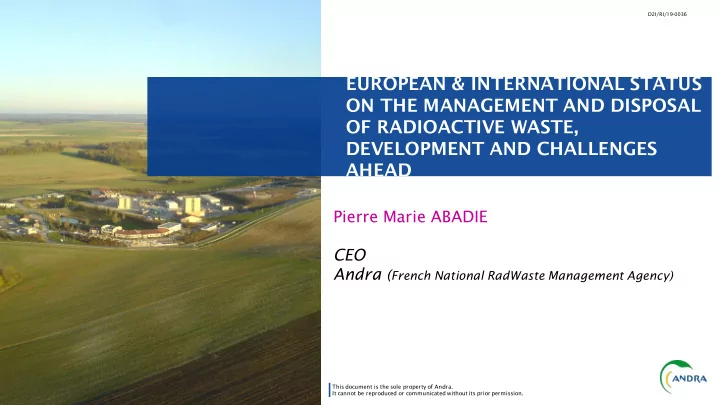
D2I/RI/19-0036 EUROPEAN & INTERNATIONAL STATUS ON THE MANAGEMENT AND DISPOSAL OF RADIOACTIVE WASTE, DEVELOPMENT AND CHALLENGES AHEAD Pierre Marie ABADIE CEO Andra ( French National RadWaste Management Agency) This document is the sole


slide-1
SLIDE 1

This document is the sole property of Andra. It cannot be reproduced or communicated without its prior permission.

EUROPEAN & INTERNATIONAL STATUS ON THE MANAGEMENT AND DISPOSAL OF RADIOACTIVE WASTE, DEVELOPMENT AND CHALLENGES AHEAD

Pierre Marie ABADIE CEO Andra (French National RadWaste Management Agency)

D2I/RI/19-0036

slide-2
SLIDE 2

This document is the sole property of Andra. It cannot be reproduced or communicated without its prior permission.

RADIOACTIVE WASTE ARISING FROM POWER PRODUCTION

  • Operations
  • Overall waste questions
  • High Level and Intermediate level radwaste and Spent Nuclear Fuel
  • Challenges
  • Dismantling
  • Challenges
  • Activities of International Organisations
  • Graphite waste

NORM & SOURCES

CONCLUSIONS

Summary

2 D2I/RI/19-0036

Euradwaste’2019

slide-3
SLIDE 3

This document is the sole property of Andra. It cannot be reproduced or communicated without its prior permission.

Radioactive waste arising from power production

Operations

3 D2I/RI/19-0036

Euradwaste’2019

slide-4
SLIDE 4

This document is the sole property of Andra. It cannot be reproduced or communicated without its prior permission.

Currently 446 reactors

  • perating

worldwide in 31 countries, and 4 new comers are in the process of joining that club (Turkey, United Arab Emirates, Bangladesh and Belarus) Radwaste arising from operations:

  • Operating waste, mainly low activity (LLW), and mainly

short lived

  • Spent Nuclear Fuel and/or waste from reprocessing mainly

high activity and including a significant amount of long lived elements Radwaste management routes and many disposal facilities exist for Majority

  • f

LLW (short lived), but different concepts:

  • Surface disposal, centre de l’Aube (France) (1)
  • Shallow disposal, silo (planned in Slovenia) (2)
  • Underground type, SFR (Sweden) (3)

The overall waste question (I)

4

(1) (2) (3)

Scheme of SFR in Sweden, courtesy of SKB Scheme of silo in Slovenia, courtesy of ARAO Scheme of CSA in France D2I/RI/19-0036

Euradwaste’2019

slide-5
SLIDE 5

This document is the sole property of Andra. It cannot be reproduced or communicated without its prior permission.

Long term management of spent nuclear fuel and/or radwaste from reprocessing: a challenge for the industry since the birth of nuclear power generation A main consensus for long term management: Deep Geological Repository as appropriate solution

  • This solution does not burden future generations. In this sense long term storage,

although technically sound, does not completely answer the question

  • Other possible envisaged solutions such as partitioning and transmutation do not

completely satisfy requirements either

  • Acceptance of such a DGR by local and national populations: a constant issue

A large set of knowledge available on DGR, resulting for more than 40 years of research

  • mainly focussed on long term safety of a DGR and construction (clay, granite…): host

rock, engineered barriers (buffer, backfill, seal, plugs), radwaste…

The overall waste question (II)

5 D2I/RI/19-0036

Euradwaste’2019

slide-6
SLIDE 6

This document is the sole property of Andra. It cannot be reproduced or communicated without its prior permission.

Significant variety of situations

  • For 3 countries, established projects for disposal exist:
  • Finland has a license for excavating a facility (SNF in

Crystalline host rock)

  • Sweden has applied for a license and the approval is

pending (SNF in Crystalline host rock)

  • France has a target date for submitting a license application

in 2020 (HLW and ILLW in clay host rock)

  • Other countries have started the sitting process/work:
  • UK: government (BEIS) kicked off the sitting in December

2018

  • Switzerland: sitting process ongoing
  • Japan: METI produced a map
  • f suitable

sites in the summer of 2016

  • China

and Russia: Underground Research Laboratories (URL) are being excavated in Crystalline rock

  • And URL’s exist in Belgium, Switzerland and Hungary.

With different schedules (can be very distant)

HLW, ILLW and Spent Nuclear Fuel: Situation regarding the DGR at 2019

Scheme of DGR in Finland (Courtesy of posiva) 6 Scheme of Cigéo project in France D2I/RI/19-0036

Euradwaste’2019

slide-7
SLIDE 7

This document is the sole property of Andra. It cannot be reproduced or communicated without its prior permission.

In all cases, the management of HLW/SNF lead up to R&D intensive projects:

  • A common development/realisation project duration: > 20-30 years
  • A common long operational duration: > 100 years
  • A significant oversight cost in the tens of billion Euro range, depending on inventory size

It also leads to managing an organisation that will have to adapt to the successive project phases:

  • Phase 0 : policy, framework and program establishment
  • Phase 1 : Site evaluation and site selection
  • Phase 2 : Site characterization and Design
  • Phase 3 : Facility construction
  • Phase 4 : Facility operation and closure
  • (Phase 5 : Post-closure)
  • The feedback from the Swedish, Finn and French projects all point to the transition from 2 to 3
  • There is a needed adaptation of the organisation to go from science to design to realisation
  • This in turn requires changes in both skills and organisation
  • But RD&D/innovation remains for optimization and adaptation of DGR, long term Knowledge

Management…

The challenges a waste manager faces

7 D2I/RI/19-0036

Euradwaste’2019

slide-8
SLIDE 8

This document is the sole property of Andra. It cannot be reproduced or communicated without its prior permission.

Radioactive waste arising from power production

Dismantling

8 D2I/RI/19-0036

Euradwaste’2019

slide-9
SLIDE 9

This document is the sole property of Andra. It cannot be reproduced or communicated without its prior permission.

D2I/RI/19-0036

slide-10
SLIDE 10

This document is the sole property of Andra. It cannot be reproduced or communicated without its prior permission.

The challenges differ between facilities

  • One of kind dismantling operations (ex. research facilities)
  • Repetitive dismantling of an homogeneous fleet of NPP’s

However in all cases, characterization is a key issue

  • for a better sorting and an identification of the most suited

management route

10

Dismantling - Challenges (I)

D2I/RI/19-0036

Euradwaste’2019

slide-11
SLIDE 11

This document is the sole property of Andra. It cannot be reproduced or communicated without its prior permission.

Strong need for optimization of waste stream

  • Optimization

based

  • n

safety, waste volume and cost criteria Requirement for a holistic approach of waste management chain and strong interaction between waste producer, operator and waste manager Options that lead to optimization cover:

  • Waste valorization (of scrap metal, of rubble)
  • Volume

reductions (metal fusion, incineration and compaction) including at the waste generation phase

  • Reorientation
  • f

waste streams to more appropriate solutions (ex. In situ disposal)

  • Options to be assessed as to their technical, economic,

environmental efficiency and to their social acceptability

  • Existence of clearance levels must also be taken into account
  • These options are supported by a significant R&D effort

Dismantling - Challenges (II)

11

George Besse facility (France) Disposal of a vapour generator at French surface disposal centre for VLLW (CIRES)

D2I/RI/19-0036

Euradwaste’2019

slide-12
SLIDE 12

This document is the sole property of Andra. It cannot be reproduced or communicated without its prior permission.

Low Level but Long Lived (LL-LL) waste

  • Originating from the dismantling of

first-generation graphite-gas cooled NPP’s

  • Ex. in France
  • (70,000m3)
  • Total activity ~ 21 200 TBq in

2013, the strongest activities being represented by C14, by H3 and by Co60

  • Significant Cl36 inventory

Many solutions still under studies for all

  • r

part

  • f

graphite Inventory

  • Treatment
  • DGR
  • Surface or shallow disposal

The specificities of graphite waste

Technical and economical

  • ptimization
  • f waste

disposal routes Moderate specific activity not requiring deep disposal Content in long lived RN compatible with CSA ?

Shallow disposa l

12

Safety Cost Characterization, Technical solutions and R&D in support

Example of french process

D2I/RI/19-0036

Euradwaste’2019

slide-13
SLIDE 13

This document is the sole property of Andra. It cannot be reproduced or communicated without its prior permission.

Other elements in the LL-LL inventory in France

Part of legacy bituminized waste (40,000m3)

  • Originating from the treatment of liquid effluents,

embedded in bitumen, in the process of being taken over by the CEA in Marcoule Uranium - bearing waste (50,000m3) resulting from natural uranium conversion NORM waste (2,000m3) Disused sealed sources

  • Smoke sensors: 241Am, 226Ra
  • Surge protectors: 3H, 226Ra…

13

Entrepôt EIP pour les fûts d’enrobés bitumineux de Marcoule (CEA)

D2I/RI/19-0036

Euradwaste’2019

slide-14
SLIDE 14

This document is the sole property of Andra. It cannot be reproduced or communicated without its prior permission.

A solution for disposal of LL-LL waste

Shallow disposal options in a geological layer with low permeability: 2 design options are under investigation Underground drifts Open pit + man-made clay cover

14 D2I/RI/19-0036

Euradwaste’2019

slide-15
SLIDE 15

This document is the sole property of Andra. It cannot be reproduced or communicated without its prior permission.

Norms and sources

15 D2I/RI/19-0036

slide-16
SLIDE 16

This document is the sole property of Andra. It cannot be reproduced or communicated without its prior permission.

NORM and sources are present in many countries

  • Sources:
  • Generally sources that have been used either for industrial or health linked applications

(Disused Sealed Sources)

  • Classified by IAEA on 1-5 scale (level 1 being the most active)
  • To be dealed in countries that are not nuclear countries
  • NORM waste
  • Waste arising from the processing of natural materials that are naturally rich in radionuclide

content but that are not used for their radioactive properties

  • extracting materials from the underground (water, oil, coal, rare earth…) or from the ground

(phosphate…),

  • Processing materials (coal, rare earth…)

Sources and NORM (I)

16 D2I/RI/19-0036

Euradwaste’2019

slide-17
SLIDE 17

This document is the sole property of Andra. It cannot be reproduced or communicated without its prior permission.

Difficulty to Handle these different categories of waste in countries were the nuclear and radioactive waste management culture is not present In addition the volumes can range from very small to significant Promising solutions are being investigated by the IAEA for Disused Sealed Sources, based on borehole technology.

  • Solution that also could be used for small volumes of other type of waste, and

this is being examined by the IAEA

Issues to identify solutions that are adapted to these waste streams:

  • Environmentally safe
  • Affordable for the country
  • Adequate proportionality from a waste management point of view (holistic view)

Sources and NORM (II)

17 D2I/RI/19-0036

Euradwaste’2019

slide-18
SLIDE 18

This document is the sole property of Andra. It cannot be reproduced or communicated without its prior permission.

CONCLUSIONS

18 D2I/RI/19-0036

Euradwaste’2019

slide-19
SLIDE 19

This document is the sole property of Andra. It cannot be reproduced or communicated without its prior permission.

LLW from NPP operations are disposed adequately in many existing facilities throughout the world HLW, ILLW and SNF from NPP operations can be disposed of via DGR’s, and the development of this type of solution is progressing with ongoing or planned license applications in 3 countries and siting projects in many countries

  • A strong knowledge base is available
  • The evolution of project from design and demonstration to construction and operation requires deep evolution of skills and organization
  • The long duration and the progressive development of projects allow optimization and innovation, supported by RD&D

Forecast Radioactive waste from decommissioning of NPP’s is a significant issue, for the next decades, according to large volume: characterization is a key point to optimize the waste routes in an holistic approach (recycling, disposal)

  • R&D on characterization, treatment and conditioning is required to support optimization

Low Level but Long Lived radwaste, such as graphite, (should) remain(s) an issue to address the appropriate route, depending of country policy (long term storage, DGR, shallow or surface disposal) Other types of waste (NORM, DSSS…) are to be considered: frequent in all countries and appropriate solutions are to be deployed in particular in countries without nuclear culture/NPP (borehole…) Whatever type of radwaste, but in particular HLW/ILLW and SNF, the long duration of projects (more than a century) highlights the need of a strong Knowledge Management process

Conclusions (I)

19 D2I/RI/19-0036

Euradwaste’2019
slide-20
SLIDE 20

This document is the sole property of Andra. It cannot be reproduced or communicated without its prior permission.

Conclusions (II)

20

In addition to efforts produced by each country, international organizations strongly contribute in a complementary and consistent way

  • to radioactive waste management:
  • IAEA: numerous initiatives (joint convention, production of safety standards and guides, supporting exchange

networks…)

  • NEA: Radioactive Waste Management Committee that in turn has organized many instances to share

information on waste management (The Integration group for the safety case (IGSC) ; Forum on Stakeholder Confidence (FSC)…

  • EC: Directive, Euratom R&D projects
  • in dismantling:
  • IAEA: recent Decommissioning & Environmental Remediation Section inside the department of nuclear energy
  • NEA: creation of an independent Committee on Decommissioning of Nuclear Installations and Legacy

Management (CDLM) since 2018

  • EC: Directive, Euratom R&D projects

In addition, international initiatives exist to address the complex subject of the disposal of HLW, ILLW or SNF for countries with a limited inventory (Netherlands, Slovenia…)

  • The previously mentioned significant financial needs associated to such projects naturally lead to

looking at the sharing of such facilities

D2I/RI/19-0036

Euradwaste’2019

slide-21
SLIDE 21

This document is the sole property of Andra. It cannot be reproduced or communicated without its prior permission.

Conclusions (III.1)

Courtesy of EC

21

Strong effort of EC to support R&D on radwaste since more than 40 years and an evolution to federate all the actors, in an holistic view and including all types of radwaste

Evolution of the R&D process Financial orientation

Joint programming EURAD IGD-TP 2009 ; SITEX 2012 EURADWASTE 2013 Large integrated projects Single partner or single discipline contracts Start multi partner & multi discipline projects and coordination actions

D2I/RI/19-0036 Euradwaste’2019

slide-22
SLIDE 22

This document is the sole property of Andra. It cannot be reproduced or communicated without its prior permission.

A positive evolution of EC support to RD&D:

  • To consider all Radwaste types
  • Including countries without NPPs
  • To consider all management solutions
  • To consider radwaste routes from cradle to grave
  • From predisposal to disposal
  • To federate all actors: Radwaste Producers, WMOs, TSOs, and REs, in close link with Civil Society
  • To promote sharing between all actors
  • Joint Strategic Research Agenda
  • Collaborative RD&D
  • Joint Knowledge Management and Training processes
  • Joint Strategic studies
  • To be complementary with IAEA and NEA and to promote common work on Knowledge

Management, Training and Strategic studies Toward an European community on Radwaste, whatever each national policy and level of progress

  • EURAD Joint Programming
  • (future) project on predisposal (characterization/treatment/conditioning) in close link with EURAD

Conclusions (III.2)

22 D2I/RI/19-0036

slide-23
SLIDE 23

This document is the sole property of Andra. It cannot be reproduced or communicated without its prior permission.

TITRE THANK YOU

D2I/RI/19-0036