European Network for the Advancement of Clinical Gene Transfer and - - PDF document

european network for the advancement of clinical gene
SMART_READER_LITE
LIVE PREVIEW

European Network for the Advancement of Clinical Gene Transfer and - - PDF document

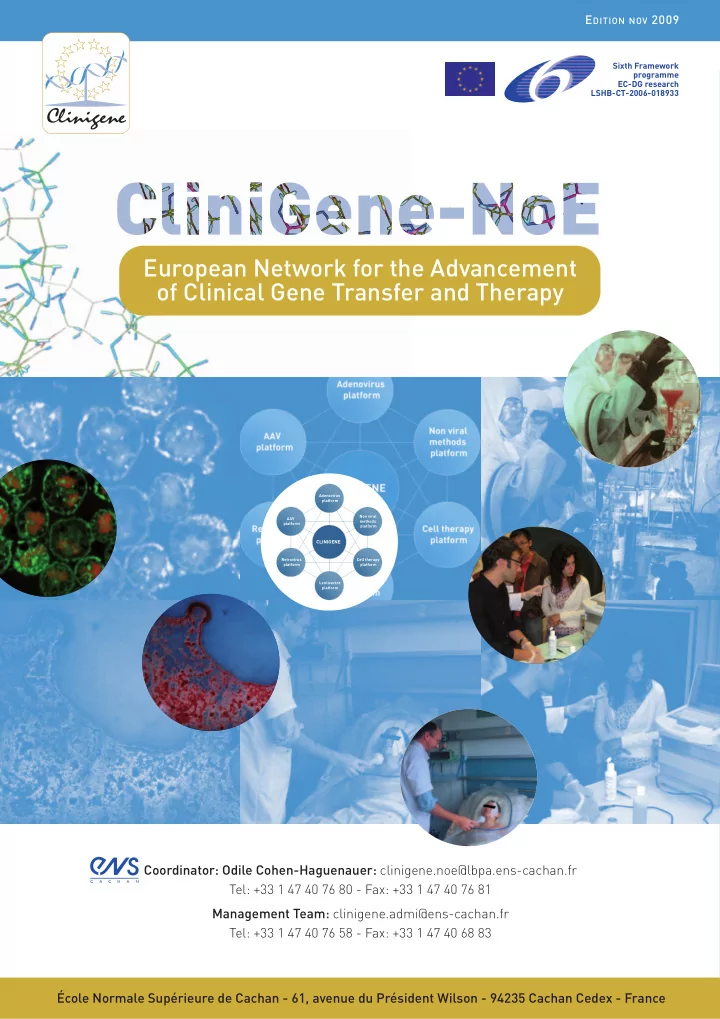
E DITION NOV 2009 Sixth Framework programme EC-DG research LSHB-CT-2006-018933 European Network for the Advancement of Clinical Gene Transfer and Therapy Adenovirus platform Non viral AAV methods platform platform CLINIGENE Retrovirus


slide-1
SLIDE 1

CLINIGENE

Adenovirus platform AAV platform Retrovirus platform Lentivector platform Cell therapy platform Non viral methods platform

Sixth Framework programme EC-DG research LSHB-CT-2006-018933

Coordinator: Odile Cohen-Haguenauer: clinigene.noe@lbpa.ens-cachan.fr Tel: +33 1 47 40 76 80 - Fax: +33 1 47 40 76 81 Management Team: clinigene.admi@ens-cachan.fr Tel: +33 1 47 40 76 58 - Fax: +33 1 47 40 68 83 École Normale Supérieure de Cachan - 61, avenue du Président Wilson - 94235 Cachan Cedex - France

EDITION NOV 2009

European Network for the Advancement

  • f Clinical Gene Transfer and Therapy
slide-2
SLIDE 2

General Organisation Emerging Technologies

Integration:“Hands-on” knowledge

◗ Sharing Facilities; Exchange & high level training ◗ General Biosafety & immunotoxicology ◗ Accelerate the transit phase from bench to bed-side: “critical path” ◗ Sustained action with Regulatory authority ◗ Integration knowledge within the Network

  • Public Web-site: www.clinigene.eu
  • Scientific & strategic software: Clinisoft
  • Clininews: bimonthly newsletter

◗ A new entity towards sustainability: translating into a new EU-Institute

ROTATE INDUSTRY PARTNERS ROTATION and POTENTIAL for R&D

Emerging Technologies

20% of funds to be assigned

(novel projects) (new partners)

SPREADING EXCELLENCE

R&D Potential impact on science policy & society

CLINIGENE INTEGRATION & ETHICS

STANDARDS

Clinical case studies

(not funded by NoE)

Core Academic

  • f

Partners

New Tools / Critical path Systems Task Forces Vector Club of Interest

Overcoming bottlenecks & limitations of current Gene Therapy technologies

Bottlenecks to be adressed, current limitations, solutions to be tested and if possible exemplified by the CliniGene-NoE.

For the technological platforms: AAV, Adenovirus, Retro- virus, Lentivirus, Genetically modified cells, Non viral technol-

  • gy (i) General, (ii) Naked DNA, (iii) Physical vectorisation-elec-

troporation, (iv) Chemical vectorisation, novel viral vectors…

Two main orientations for emerging tech- nologies:

◗ Direct in vivo gene transfer: can the gene transfer prod-

ucts be directly administered in vivo, whatever the route

  • f choice and reach its target without reaching unwant-

ed others? (“off-the-shelf” Gene therapy).

◗ It’s all about transgene integration: Is there a gene transfer vector

system capable of escaping its subsequent integration, even at background level, into the host cell genome? How can the risk of insertional mutagenesis be evaluated? Are there technologies and methods to prevent this major side-effect?

Flexibility funds

◗ The goal of these flexibility funds is to improve the integration and

the synergy within Clinigene. Calls for flexibility funds are unique

  • pportunities to promote (i) novelty, in identifying emerging

techologies and benefit from quick initial funding of related programmes, (ii) priviledged contacts between labs, (iii) dis- semination & outreach, including international contacts.

◗ Over 20% of the total budget is dedicated to these ”flexi

funds”. Specific internal call for tender are open twice a year. A strong and positive dynamics is generated: programmes must involve collaborative work between two CliniGene partners at least.

Confronting & evaluating orientations & output at the International level: the NoE-Governance

◗ Scientific Advisory Board:

Lucio Luzzato (chair)

◗ Scientific International Board: Inder Verma (chair) ◗ Ethical Review Board:

Alastair Kent (chair) Nancy King (vice chair)

* Name of the experts available on www.clinigene.eu

The general objectives of CLINIGENE are the following:

◗ Foster interaction between all stakeholders: regulators, pre-clinical & clin-

ical investigators, scientists, companies (otherwise competitors), patients’ groups, in order to streamline integration of multidisciplinary expertise.

◗ Establish quality, safety, efficacy and morally acceptable standards for clinical

gene transfer products.

◗ Identify the “critical path” to accelerate the transit phase from preclinical to

clinical phase by integrating expertise and generating new knowledge.

◗ Improve competitiveness by spreading of excellence and disseminating

knowledge.

◗ Obtain clinically significant improvement in the treatment of some human dis-

eases by gene therapy.

CLINIGENE

Adenovirus platform AAV platform Retrovirus platform Lentivector platform Cell therapy platform Non viral methods platform

slide-3
SLIDE 3

What is CliniGene?

The role of the European Network for the Advancement of Clinical Gene T rans- fer and Therapy (CLINIGENE) is to mobilise efficiently all interested parties, most- ly involving academic research and production centers together with companies, patients’ groups and regulatory bodies. Our goal is to integrate multidisciplinary research in order to decipher the key elements which can lead to improved safe- ty and clinical efficacy of gene transfer/therapy medicinal products, i.e. for clin- ical applications. Control and test methods will be established that may be ap- plied as platforms for particular gene transfer products. Besides quality control, safety is of germane concern since in the event where the treatment would be proven safe, it could be administered early enough in the course of the disease to achieve genuine cure, so that clinical gene transfer may be called therapy.

Preclinical models Manufacturing Pharmaco- toxicology Clinical trials

R E S E A R C H

Standardisation Feasibility of vector system standard profile Clinical development process European Network for the Advancement

  • f Clinical

Gene Transfer and Therapy (CLINIGENE) and Emerging Technologies AAV platform Adenovirus platform Retrovirus platform Lentivector platform Cell therapy platform Non viral methods platform Efficient and safe disease cure in a faster way and at lower costs if possible

devices for assessing safety for predicting benefit and effectiveness for accelerating advanced knowledge integration Tools

Integration of research activities

CliniGene academic partners: A. Aiuti (FCSR-TIGET, Milan),

  • R. Ali (University College

London), A. Auricchio (TIGEM, Napoli), S. Aymé (INSERM, Paris),

  • C. Baum (Hannover

Medical School), F. Bosch (Universitat Autonoma de Barcelona),

  • J. Bubenik (IMG-CAS,

Prague), M. Carrondo &

  • P. Cruz (IBET, Oeiras),
  • N. Cartier (INSERM,

Paris), K. Cichutek (Paul-Ehrlich-Institute, Langen), O. Cohen- Haguenauer (ENS-Cachan & APHP, Paris), N. Deglon (CEA, Saclay), G. Dickson (Royal Holloway, London),

  • M. Federspiel (Mayo

Clinic, Rochester),

  • G. Gahrton (Karolinska

Institutet, Stockholm),

  • B. Gänsbacher

(Technische Universitaet Muenchen), H. Hauser (Helmholtz center, Braunschweig), A. Jacobs (University of Cologne),

  • C. von Kalle (DKFZ,

Heidelberg),

  • D. Klatzmann (APHP,

Paris), S. Kochanek (University of Ulm),

  • N. Mermod (University of

Lausanne), L. Mir (CNRS, Villejuif), P. Moullier (CHU Nantes),

  • P. Moullier (GENETHON,

Evry)

  • A. Panet (Hebrew

University, Jerusalem),

  • M. Peschanski (INSERM,

Evry), D. Scherman (INSERM, Paris),

  • S. Yla-Herttuala

(University of Kuopio) CliniGene industry partners: BioAlliance Pharma, BioReliance, CellGenix, Clean Cells, Epixis, Genosafe, Oxford Biomedica, Plasmid Factory, Transgene.

Club of Interest (CoI)

The Club of Interest is the opportunity for external organisations to get involved with CliniGene; organisations such as industries, patients organisations, regulatory agencies, national ethics com-

  • mittees. The CoI main goal is to create a long-term framework

in which basic research and technology transfer are closely linked with the following objectives: to i) disseminate advanced fun- damental scientific information and standards, ii) create aca- demic/industry synergies, iii) establish new research partner- ships in emerging topics, iv) accelerate technology transfer, v)

  • rient the project towards market needs and finally vi) assess

technological and scientific options. The Club of Interest is made up of distinct groups of interest: INDUSTRY COL: EU: Ark Ther., AMT, GeneIBET, ECBio, Alan Boyd Consult., EUFETS, Cellectis, Austrianova, Artelis, Henogen, MolMed, Procure, Miltenyi, CEVEC, EuropaBio, EBE, Crucell, Crusade, Huntingdon, IGEA, Microsafe, Cobra, Poly+ Trans., Quintiles, Selexis, Schering AG, TexCell, Arthrogen, OZ Bio- sciences, Fovea, Genomining. USA: Florida Biologix, Ceregene, Lentigen, Vical, Cellgenesys, AGTC, Targeted Genetics. CLUB OF SOCIAL INTEREST including public authorities, regu- latory bodies: EU centralised, national and international, Learned Societies and patients associations such as: Genetic Interest Group: www.gig.org.uk (A. Kent), Europa Donna: www.europadonna.fr (N. Zernik), Eurordis: www.eurordis.org (F. Bignami & M Lipucci). EXPERT EXTERNAL SCIENTISTS besides the three governance bodies (SAB, IB & ERB – see p3): Academic scientists & doc- tors joining the CoI have the status of Associate partner: E. Al- ton (ICL, GB); Y. Bigot (CNRS, FR); P. Bosma (GI, NL); H. Bueler (Univ. Zurich, CH); B. Blits (AMT, NL); M. Collins (UCL, GB); F.L. Cosset (INSERM, FR); J.L. Darlix (INSERM, FR); J. Farrar (Uni.

  • Col. Cork, IE); S. Fruehauf (Univ. Heidelberg, DE); Z. Izsvak, (Del-

bruck, DE); Mauro Giacca (ICGEB, IT); J. Kleinschmidt (DKFZ, DE);

  • N. Maitland (UY, GB); B. Massie (Univ. Montreal, CA); A. Nathwani

(UCL, GB); T. O’Brien, (REMEDI, IRL); M. Sitbon (IGMM, FR); R. Sny- der (UFL, US); M. Themis (ICL, GB); T. Vandendriessche (VIB, BE): NB: FhG and Klinikum Braunschweig are partners linked to HZI.
slide-4
SLIDE 4

GMP Production

The currently available inventory of both academic and commercial GMP pro- duction facilities for the manufacture of gene therapy products among Clini- Gene partners’ institutions, companies or Club of Interest, involves 21 academ- ic and private centers. A dedicated interactive box is directly accessible from the CliniGene public front page: www.clinigene.eu in order to submit a request for the manufacture of a GMP- GT product. CliniGene plays an intermediary role in forwarding the request to the appro- priate GMP production centres involved and launching a competitive call for tender as requests are being filed.

Clinigene Academic Partners

◗ GenIBET now a spin-off

P

◗ Vecura, Karolinska Institut

SW

◗ Genethon

FR

◗ University of Kuopio

(also see Ark)* FI

◗ APHP - Assist Publique -

Hop Paris FR

◗ CHU Nantes & EFS Nantes

FR

◗ In the US: Mayo Clinic

USA

◗ HZI (FhG, Klinikum

Braunschweig) DE

CliniGene Board members

◗ ClinPharm now a spin-off

Oxford, UK

◗ CERHB Florida Biologics spin-off

USA

Clinigene Industry Partners

◗ BioReliance

UK

◗ Plasmid Factory

DE

◗ Oxford BioMedica (OBM)

UK

◗ Transgene

FR

◗ QC & Biodistrib: Genosafe;

CleanCell FR

◗ Cell therapy products only:

CellGenix DE

Industry Club of Interest

◗ EUFETS

DE

◗ AMT

NL

◗ *Ark Therapeutics: GMP Kuopio

FI, UK

◗ MOLMED

IT

◗ HENOGEN

BE

Placing a request reaching all GMP-facilities at once through www.clinigene.eu

First calls for tender have already been forward- ed by the Management Team to all platforms spe- cialising in the manufacture of retro- and lenti-virus

  • vectors. Each platform has the latitude to direct-

ly contact the client or not. In order to improve this support service, the CliniGene Management Team clinigene.admi@ens- cachan.fr requests to be informed of critical ex- changes and at least, kept posted on the outcome.

slide-5
SLIDE 5

Assessement Tools “Critical Path toward development” from Bench to Bed-side

◗ Imaging & Molecular imaging ◗ Platforms & facilities ◗ Collaboration with DiMi-NoE ◗ Satellite at ESGCT ◗ Ex vivo studies to replace animal models ◗ Tissue slices or micro-organs ◗ Vector tropism ◗ Vector safety ◗ High throughput genomics & proteomics

Quality/Manufacture

◗ Standardisation of preclinical quality & efficacy

  • Reference material
  • Test & control methods
  • Testing for efficacy will at best include in vitro

and in vivo models (i) for transducing activity, (ii) for transgene expression and functionality

  • Vector titers: physical and functional
  • Test material
  • Testing protocols: based on the results from

reference material and test/control methods, standard protocol will be established

◗ Manufacture-related virus safety testing ◗ Manufacturing processes SOPs

Safety (Pharmaco-toxicology)

◗ Safety = pharmaco-toxicology (including im-

muno)

  • Safety of vector constructs
  • In vivo testing: animal models, vector integra-

tion, biodistribution, duration of the expression, consequences including long-term

  • In vitro testing

◗ Administrative routes, doses, biodistribution &

pharmaco-tox profile, ex vivo & in vivo

◗ Applicability of algorithmic models to pre-

clinical safety

◗ Virus safety testing

Quality/Safety standards & SOPs

AAV - Adenovirus - Retrovirus - Lentivirus - Cell Therapy - Non-Viral Methods ◗ SOPs Define and/or upgrade Standard Oper- ating Procedures (SOPs). ◗ Reference materials Define reference material, relevant po- tency and safety assays of non-viral and viral delivery methods. ◗ Testing Test batteries developed, made avail- able to the network, the scientific com- munity and the public. ◗ Models Generic and disease-specific models pro- duced and validated. These involve novel in vitro cell culture based systems in order to replace animal test- ing wherever possible, but also animal models (primarily murine; for ethical rea- sons non-human primates shall be used only if compulsory ).

Vector Task Forces

Accelerate the transit phase from bench to bed-side: “critical path”

CLINIGENE

Adenovirus platform AAV platform Retrovirus platform Lentivector platform Cell therapy platform Non viral methods platform

Expected contribution: besides emerging technologies

Generic platform data-bases for each vector system: Efficacy & Pharmaco-Toxicology, including immunotoxicology The network is currently generating platform databases for particular vectors with respect to their safety and efficacy generic profiles in order to ensure prod- uct manufacturing according to well-defined quality and safety standards and foster the development of clinical trials.

slide-6
SLIDE 6

Interaction with CHMP-GTWP and newly formed CAT*

Commenting position papers and guidelines;

Stake-holders meeting at EMEA

◗ CliniGene holds scientific & medical expertise: crit-

ical mass is international

◗ Vector generic profile: master files ◗ Capitalise on knowledge acquired and

make it publicly available to foster:

◗ Clinical developments whenever possible ◗ Basic research to improve technology ◗ Assembles expertise for clinical authori-

sation using same rationale

Ethics & Regulation

Ethics

The ethics of human clinical gene transfer Public views of genetic manipulation and of the introduc- tion of novel technologies with unknown risks raise ethical concerns and questions of a special nature and

  • importance. Therefore, examining ethical issues as sci-

ence and technology evolve and helping to formulate eth- ical guidance for gene transfer clinical trials is necessary and remains an important task for the scientific communi- ty and other involved stake-holders, including regulatory

  • agencies. CliniGene has organised two main meetings: an Interna-

tional think-tank, “En route to ethical recommendations for gene transfer clin- ical trials,” in April 2007 and a “patients’ associations driven initiative” in March 2009, in addition to conducting joint sessions at the annual ESGCT meeting every year since 2003. Model stratification scheme for planning first-in-human GT clinical trials * In some instances of life-threatening conditions without any therapeutic op- tions, moving to GT clinical trials may be justifiable because it will not re- sult in the loss of a chance for the patient-subject’s survival, is unlikely to leave patient-subjects worse off, and may increase knowledge toward achieving cure, including the development of better technology—thus sat- isfying both the imperative to protect subjects and the need to move research

  • forward. Putting fundamental questions together should ideally result in a

*EMEA-CAT: Committee for Advanced Therapies regulation: http://www.emea.europa.eu/htms/general/contacts/CAT/CAT.html

model for designing early-phase clinical GT research. The stratification scheme shows that the appropriate design of human GT studies will vary depending on the population of pa- tients chosen as first subjects, the nature of their disease, and the severity of their disease stage. Preclinical research into a par- ticular combination of gene, target cell, disease, and route of ad- ministration must be sufficiently developed and sufficiently inform- ative to move to human studies. Next, first-in-human trials must be able to provide sufficient knowledge, protect subjects from harm as far as possible, and adequately inform subjects by describing an acceptable bal- ance of risks of harm and potential benefits. This requirement of justification must be carefully articulated in the consent form so that potential subjects can clearly understand the sci- entific expectations from a given study, without promotion

  • f the therapeutic misconception. The stratification

scheme is meant to assist investigators and oversight bod- ies, including Ethical Review Boards (ERB), in examining whether a particular clinical trial is justifiable, using the design proposed, under the circumstances.

* (King, N. M. P, and Cohen-Haguenauer, O. En Route to Ethical Recommen- dations for Gene Transfer Clinical Trials, Molecular Therapy 2008;16:432-438) Model stratification scheme for planning first-in-human GT clinical trials. BMT, bone marrow transplantation; GT, gene transfer; SCID, severe combined immunodeficiency.

Regulation

Establishing a vector system common profile data-base

The overall objective of this challenging activity is to mobilise efforts from both Academic and Industrial expertise, in order, when possible, to substantiate (in practical terms and according to the vector system under consideration) sec- tion 5 and if possible section 6 of the European Medicines Evaluation Agency (EMEA)/CHMP Note for guidance on the quality, preclinical, and clinical aspects

  • f gene transfer medicinal products, (CPMP/BWP/3088/99-final May 2001.

http://www.emea.eu.int/) and subsequent guidelines. Each Vector System Task Force has the potential to mo- bilise all expertise in order to (i) identify knowl- edge already available in published Literature and eventually validate this; (ii) generate ad- ditional data that might be made accessible in a reliable and controlled

  • manner. The objective is to

establish, if possible, com- mon bio-distribution and pharmacokinetics profiles according to a vector system of concern that can be taken into con- sideration whatever the gene of interest.

Disease stage

Early stage: the healthiest Goal = efficacy Only safe technology All preclinical models OK No loss of survival chance Improvement of current options needed Refer to established treatment Cure is possible Risk/benefit can be evaluated If therapeutic window open: Reversal of symptoms still possible Direct benefit still possible If therapeutic window closed: Irreversibility—no cure No risk/benefit can be assessed Increased risk tolerable Risk/benefit can be assessed If first-in-human safety record OK, moving to early stage justified Risk benefit can be assessed The ratio must be lower than reference In case GT fails, apply reference treatment No loss of chance Case where reference treatment first compromises GT (e.g., BMT in SCIDs) Show safety first and go early to the healthiest Ultimate goal: treatment Features matching “ideal schedule” Direct benefit Direct benefit End stage: the sickest Goal = safety Without established treatment Goal = safety With established treatment Goal = efficacy

Life-threatening disease

If risks are too high, move back to basic research No direct benefit: research intervention Improve knowledge Compromise on the technology: less-than-ideal systems can be tested once preclinical models exhausted and no loss of survival chance in patients GOAL AIM RESULT OUTCOME

slide-7
SLIDE 7

General BioSafety platform

◗ Classification and glossary of side effects ◗ Novel experimental platforms to measure param-

eters that are relevant for biosafety

  • joint testing of vectors
  • supported by each of the vector-specific task forces
  • preclinical models to monitor vector biodistri-

bution, immunotoxicity and genotoxicity

  • development of bioinformatical tools in order

to improve data mining and data digestion

◗ Information Spread: scientific community &

public (Serious Adverse Events reports available from CliniGene website)

Key Question: When to go clinical?

◗ Requirement to draw the line between “Investigational New Drug”

  • First-in-man.
  • Clinical research and developments mandatory: animal models do not suffice.
  • There is no efficacious treatment without potential drawbacks.

◗ While Basic research run in parallel

  • Technical attempts at improving the tools.
  • Better understanding of SAEs and failures.

General Immunotoxicology platform

◗ Organisation of consensus meeting in order to de-

fine the relevant parameters for the immunotox- icology investigation in cell and gene therapies

  • Experts in vectors, cell therapies, immunolo-

gy & transplantation

  • Relevant parameters to be analysed

◗ Recommend immunotoxicology studies respec-

tive to each setting

◗ Identification of resource centers for immuno-

toxicology investigation in cell & gene therapy.

◗ Release immunotoxicology studies for certain

vector Programmes in the clinic

RVV (& cells) ADA-deficiency FCSR-TIGET AdV Suicide in Glioblastoma Multicentric Phase III/UEF & Ark *1 AAV Inherited degenerative retinopathy (Leber) UCL Lentis (EIAV)-ProSavin Parkinson's disease OBM - APHP Lentis (& cells) Childhood cerebral adrenoleukodystrophy INSERM- APHP Non-viral Treatment with nerve growth factor (NGF) KI in Alzheimer's disease Non-viral – morpholinos Antisense for DMD (Exon-skipping) RHUL *2 (pilot ended) AdenoV Ad-VEGF-D into ischemic myocardium UEF Treg cells Immunotherapy of cancer APHP-INSERM Measles-Oncolytic virus Ovarian Cancer (IP) & Myeloma (IV) Mayo Clinic HPV Vaccine Early stage of cervical carcinoma Transgene AAV Gamma-sarcoglycan muscular disorder GENETHON – APHP (pilot ended) HSV-1 Glioblastoma KUK on-hold Allo-cell tumour vaccine Prostate cancer TUM (pending: phase 2 funding)

Programmes close to the clinic

Lentis (& cells) Wiscott-Aldrich syndrome GENETHON, FCSR & UCL Cell-therapy NK cells for cancer treatment (Myeloma) KI*3 AAV CNTF in Huntington chorea CEA AAV Inherited degenerative retinopathy (Leber) CHU-Nantes-INSERM-EFS Sin RVV (& cells) X-SCIDs MHH *4, UCL, APHP Lentis (& cells) Bêta-thalassemia FCSR-TIGET Non-viral Melanoma CNRS & BioAlliance Cells (dendritic) Melanoma HZI-Braunschweig hospital AdenoV YB-1 dep oncolytic AdV in Cancer TUM, BioReliance AAV Diabetes mellitus CBATEG AAV Limb-ischemia UEF

Progress expected during the 4 next years

AdenoV Oncolytic viruses in cancer ULM Electro-transfer/Stem-cells Diabetes mellitus CBATEG Insulated SIN RVV (& cells) Fanconi's aneamia ENSC - APHP Cell & CK therapy Optimised treatment of HPV16-tumours IMG-CAS with gene-modified cellular vaccines LentiV Inherited hypercholesterolemia UEF Oncolytic Cancer UEF LentiV (& cells) SCID-Zap deficiency APHP – INSERM – ENSC

Prospective approach

Combination: Oncolytic & Breast & colon cancers Task Force leader: ENSC/APHP Immuno-modulation including Inherited

*1 Initiated at UEF-Kuopio & continued as multicentric, indus- try driven by Ark-Therapeutics *2 In collaboration with Imperial College & UK MDEX Consortium *3 Infusion of autologous expanded NK cells, for the treatment

  • f recurrent malignant disease after autologous hematopoietic

stem cell transplantation. A phase I-II pilot trial *4 Clinical trial conducted by the Institute of Child Health, University College London, UK, Necker APHP, Paris FR vector development by MHH

The EU-platform for Clinical development In Gene Therapy

Selected clinical trials case-studies for the 6 technology-platforms

slide-8
SLIDE 8

What is Clinisoft?

The strategic & scientific management soft- ware developed by the Clinigene-NoE. Clinisoft is accessible on-line through a con- fidential restricted access-firewall. It is used as:

◗ Virtual & highly hierachised work space

supporting information exchange and col- laborative work on documents

◗ Archive for all important information and

documents produced by the network

◗ On-line coordination, planning and network

monitoring tool

◗ Direct communication between defined

working groups or technology platforms

Industry Club of Interest

Fostering interaction between the academ- ic and the private sectors is one of the NoE priorities.

◗ Every year since 2007: Joint platform be-

tween Industry & Centers of Excellence: A Clinigene workshop as ESGCT satellite

Other Clubs of Interest

◗ High-level scientists (non-contractants) ◗ Interaction with Regulators ◗ Patients’ concerns & requests ◗ Public awareness & easy understanding of

clinical trials

◗ Decision-makers: EU-level & member-

states

Available on CliniGene website:

2 searchable interactive data-base:

  • Gene Transfer & Therapy References DB
  • Published Human Gene Therapy Clinical Trials DB

CliniGene Current Gene Therapy Weekly Serious Adverse events reports and publications:

Dissemination & Outreach

*www.clinigene.eu

CliniGene meetings & Training courses

Available on CliniGene website

◗ Collaboration with the ESGCT ◗ Collaboration with other EU-funded prog. ◗ Eurocancer ◗ International cooperation & international B ◗ Joint programme for mobility & training re-

searchers or key staff

◗ 2 general meetings/year ◗ Task-force meetings

Dissemination

◗ Sustained & collaborative interaction with ES-

GCT

◗ Organisation of Meetings & Trainings sessions ◗ Collaborations with other EU-funded re-

search programmes

◗ Joint programme for mobility & training ◗ International cooperation and Interna-

tional Board

◗ Public web-site www.clinigene.eu*

  • Report on General Biosafety
  • Current Gene Therapy Weekly
  • Publicly available interactive data-base:

◗ Ethics: Think Tank in Geneva & publication ◗ Project: EU degree/Master: Medical use of

GMOs & high-level degree in Gene Therapy Clinisoft-NSigma

Création graphique: Isabelle Benoit/Epilobe