Evaluation of land use, land management and soil conservation - - PowerPoint PPT Presentation

evaluation of land use land management and soil
SMART_READER_LITE
LIVE PREVIEW

Evaluation of land use, land management and soil conservation - - PowerPoint PPT Presentation

Christian-Albrechts-University, Kiel Institute for Natural Resources Conservation Evaluation of land use, land management and soil conservation strategies to reduce non-point source pollution loads in the Three Gorges Region, China A. Strehmel,


slide-1
SLIDE 1

Christian-Albrechts-University, Kiel Institute for Natural Resources Conservation

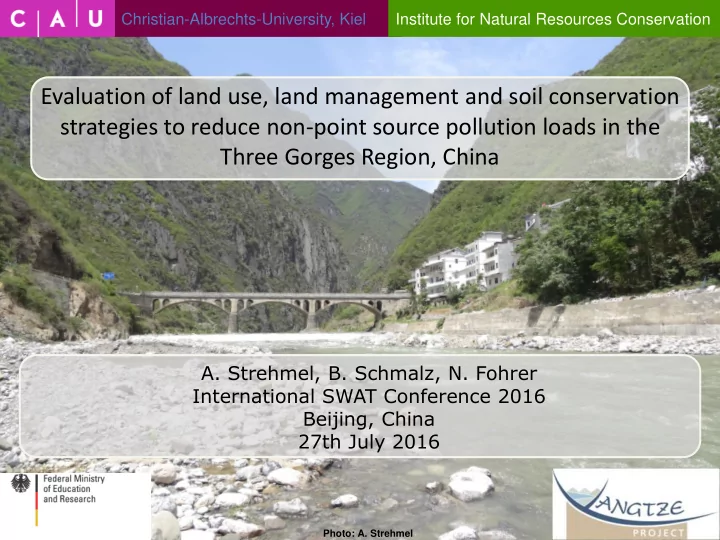
Evaluation of land use, land management and soil conservation strategies to reduce non-point source pollution loads in the Three Gorges Region, China

  • A. Strehmel, B. Schmalz, N. Fohrer

International SWAT Conference 2016 Beijing, China 27th July 2016

Photo: A. Strehmel

slide-2
SLIDE 2

Department of Hydrology and Water Resources Management – Strehmel et al. -2-

YANGTZE-GEO 2009 - 2015 Land use change, erosion, mass movements and diffuse matter inputs in the Three Gorges Region

Remote Sensing

Trier

Erosion

Tübingen

Landslides

Erlangen

Landslide Monitoring

DMT Essen

Diffuse Matter Inputs

Kiel Assessment of mass movements using geo- monitoring techniques Classification of land use and land use change assessment Assessment and analysis of soil erosion Assessment and analysis of landslides Analysis of sediment and phosphorus inputs using SWAT and HEC-RAS

Aim: Analysis of land use change, risk assessment of mass movements, soil erosion and diffuse inputs to rivers

slide-3
SLIDE 3

Department of Hydrology and Water Resources Management – Strehmel et al. -3-

The Three Gorges Dam in China

  • Impoundment of the Yangtze River in central China
  • Major land use changes in the Three Gorges Region (TGR) upstream of the

dam due to resettlements

Photos: A. Strehmel

Three Gorges Dam Three Gorges Region Yangtze River Catchment

slide-4
SLIDE 4

Department of Hydrology and Water Resources Management – Strehmel et al. -4-

Soil Erosion in the TGR

  • High soil erosion due to mountainous

terrain

  • Reclamation of agricultural land on

steep slopes

  • Lack of experience in establishing and

maintaining soil conservation measures

  • Consequence: High sediment loads

in rivers and streams, especially during strong rainfall events

Photo: S. Schönbrodt-Stitt Photo: S. Schönbrodt-Stitt

Xiangxi River 23rd May 2013

Photos: A. Strehmel

Xiangxi River 25th May 2013

slide-5
SLIDE 5

Department of Hydrology and Water Resources Management – Strehmel et al. -5-

Phosphorus Displacement

  • Phosphorus easily adsorbed to soil particles
  • Phosphorus as limiting factor for the aquatic

ecosystem of the Three Gorges Reservoir

  • Low flow velocities in the tributary valleys

→ accumulation of phosphorus → eutrophication

  • Eutrophication and algae blooms endanger

the aquatic ecosystem of the reservoir

Photo: A. Strehmel Photo: X. Jiang

slide-6
SLIDE 6

Department of Hydrology and Water Resources Management – Strehmel et al. -6-

Research Question

What are suitable management strategies to reduce diffuse sediment and phosphorus pollution? Evaluation of Agricultural Best Management Practices SWAT Modelling Approach Agricultural Management Soil Conservation Measures (Terraces) Current Situation in the TGR

slide-7
SLIDE 7

Department of Hydrology and Water Resources Management – Strehmel et al. -7-

Study Area: The Xiangxi (香溪) catchment

Area: ca. 3.200 km² Average slope: 24° Length of Xiangxi River: 94 km

slide-8
SLIDE 8

Department of Hydrology and Water Resources Management – Strehmel et al. -8-

  • Forest: 75%
  • Cropland: 10%
  • Shrubland: 8%
  • Orange orchards: 4%
  • Rest: 3%
  • Terraces as most

important soil conser- vation measure

2012

Land Use of the Xiangxi Catchment

Source: Buzzo (2013) Maximum-likelihood classification of Rapid-Eye imagery (RapidEye, 2012)

slide-9
SLIDE 9

Department of Hydrology and Water Resources Management – Strehmel et al. -9-

Agricultural Management Soil Conservation Measures (Terraces) Current Situation in the TGR

  • What is the current situation?
  • How to implement these information in SWAT?

Dynamics of non-point source pollution? (Total Phosphorus)

slide-10
SLIDE 10

Department of Hydrology and Water Resources Management – Strehmel et al. -10-

Field Mapping – Spring 2013

Geo-referenced photos using a GPS-equipped camera:

  • mostly from the car along the main rivers and valleys
  • also on some high plateaus
  • in total 2,500 geo-tagged photos

Photo: G. Buzzo

slide-11
SLIDE 11

Department of Hydrology and Water Resources Management – Strehmel et al. -11-

Farmer Interviews – Spring 2013

  • in total 15 semi-standardized interviews with farmers
  • in different agricultural zones of the catchment
  • Questions on: - Seeding and harvesting times
  • Crop rotations
  • Yields
  • Fertilizer use: when? what? how much?

Photo: G. Buzzo Photo: G. Buzzo Photo: A. Strehmel

slide-12
SLIDE 12

Department of Hydrology and Water Resources Management – Strehmel et al. -12-

Daily Total Phosphorus Sampling

Goal: Establish an idea on seasonal phosphorus dynamics in the Xiangxi catchment

slide-13
SLIDE 13

Department of Hydrology and Water Resources Management – Strehmel et al. -13-

Implementation of Agricultural Management

  • Analysis of the geo-referenced photos from the field campaigns
  • Derivation of sub-areas with uniform cultivation patterns

Data from farmer interviews to parameterize the land management

1 2 3 4 5

slide-14
SLIDE 14

Department of Hydrology and Water Resources Management – Strehmel et al. -14-

Terrace Condition Mapping

Goal: Determination of the average terrace condition per subbasin

3 partially collapsed 4 completely collapsed 1 Well maintained 2 Fairly maintained

Terrace mapping: 420 terraces for analysis

after Schönbrodt-Stitt et al., 2013

Classification of terrace conditions:

slide-15
SLIDE 15

Department of Hydrology and Water Resources Management – Strehmel et al. -15-

Terrace Condition Field Data

How to extrapolate the information

  • n the whole catchment?

Idea: Prediction of the average terrace condition in a subbasin by means of explanatory variables related to:

  • Topography
  • Land Use
slide-16
SLIDE 16

Department of Hydrology and Water Resources Management – Strehmel et al. -16-

Extrapolation of Terrace Conditions

Translation of terrace conditions into SWAT parameters (after Arabi et al., 2006):

* steeper 50% ** only agricultural land steeper than 20% slope is terraced Terrace Condition CN2 (add) P_USLE (absolute) Slope Length (relative) Slope Length (steep)* (relative) well maintained

  • 6

0.2

  • 40%
  • 20%

fairly maintained

  • 5

0.4

  • 30%
  • 15%

partially collapsed

  • 4

0.6

  • 20%
  • 10%

completely collapsed

  • 2

0.8

  • 10%
  • 5%

not terraced** 1.0

  • 0%
  • 0%

𝑈𝑓𝑠𝑠𝑏𝑑𝑓𝐷𝑝𝑜𝑒𝑗𝑢𝑗𝑝𝑜𝑡𝑣𝑐 = 𝑔 (𝐹𝑚𝑓𝑤𝑏𝑢𝑗𝑝𝑜; 𝑇ℎ𝑏𝑠𝑓 𝑝𝑔 𝐷𝑠𝑝𝑞𝑞𝑓𝑒 𝐸𝑠𝑧𝑚𝑏𝑜𝑒; 𝑇ℎ𝑏𝑠𝑓 𝑝𝑔 𝑃𝑠𝑏𝑜𝑕𝑓 𝑃𝑠𝑑ℎ𝑏𝑠𝑒𝑡)

slide-17
SLIDE 17

Department of Hydrology and Water Resources Management – Strehmel et al. -17-

Model Calibration & Validation

Calibration/Validation Nash-Sutcliffe-Efficiency 0.69/0.70 0.81/0.51 Kling-Gupta-Efficiency 0.81/0.75 0.77/0.59 Streamflow (daily) Sediment (monthly)

slide-18
SLIDE 18

Department of Hydrology and Water Resources Management – Strehmel et al. -18-

Validation of Phosphorus Dynamics

slide-19
SLIDE 19

Department of Hydrology and Water Resources Management – Strehmel et al. -19-

Scenarios for phosphorus fertilizer use:

Scenario Definitions

Phosphorus Application reduced by 15% Phosphorus Application reduced by 30% Phosphorus Application reduced by 45% Selective Reduction of Phosphorus Application Status quo: Current fertilizer usage scheme

Scenarios for terrace conditions:

Improvement

  • f conditions

by one category Deterioration

  • f conditions

by one category Catchment- wide well- maintained conditions Status quo: Current situation of terrace cond. Definition: Reduction of phosphorus application, so that at least 90% of yield per crop rotation is retained

slide-20
SLIDE 20

Department of Hydrology and Water Resources Management – Strehmel et al. -20-

Phosphorus Fertilizer Reduction Scenarios

  • 5.9%
  • 13.9%
  • 22.4%
  • 5.7%
slide-21
SLIDE 21

Department of Hydrology and Water Resources Management – Strehmel et al. -21-

Adjustment of Terrace Conditions - Sediment

  • 18.3%

+24.8%

  • 27.1%
slide-22
SLIDE 22

Department of Hydrology and Water Resources Management – Strehmel et al. -22-

Adjustment of Terrace Conditions – Total P

  • 16.3%

+17.9%

  • 24.6%
slide-23
SLIDE 23

Department of Hydrology and Water Resources Management – Strehmel et al. -23-

Crop-wise evaluation

Crop (Rotation) Area (km²) Soil Erosion (t/ha/a) total P release (kg/ha/a) Corn – Rapeseed 211.1 9.6 2.64 Orange Orchard 114.2 0.4 0.04 Potato – Sweet Potato – Cabbage 44.9 7.8 0.40 Tea Plantation 17.0 0.4 0.01 Rice 14.6 2.2 0.30 Catchment 3208.8 2.6 0.25 Cumulative curves for the corn-rapeseed rotation

  • High erosion rates on corn fields also confirmed in other studies

(e.g., Barton et al., 2005; Wei et al., 2014)

Corn Rapeseed Rapeseed

slide-24
SLIDE 24

Department of Hydrology and Water Resources Management – Strehmel et al. -24-

Conclusions

What are suitable management strategies to reduce diffuse sediment and phosphorus pollution in the TGR?

  • Investments in terrace construction and maintenance are more

effective measures than fertilizer reductions

  • Short-term: Preference of ‘Corn-Rapeseed’ rotation to existing terraces

with good conditions

  • Mid-term: Investment in programmes to develop and maintain terraced

agricultural land and to create incentives for farmers to abstain from corn cultivation

  • Mitigation strategies for diffuse matter inputs have to be seen in the

context of socio-economic developments of the TGR and in China

  • Economic importance of corn cultivation in the region as key to a

successful watershed management in the region

slide-25
SLIDE 25

Department of Hydrology and Water Resources Management – Strehmel et al. -25-

Thank you for your attention!

Contact: astrehmel@hydrology.uni-kiel.de

Photo: A. Strehmel

slide-26
SLIDE 26

Department of Hydrology and Water Resources Management – Strehmel et al. -26-

Backup

slide-27
SLIDE 27

Department of Hydrology and Water Resources Management – Strehmel et al. -27-

Implementation of Terraces

used for a multiple regression approach to predict terrace conditions

slide-28
SLIDE 28

Department of Hydrology and Water Resources Management – Strehmel et al. -28-

Implementation of Terraces

𝑈𝑓𝑠𝑠𝑏𝑑𝑓𝐷𝑝𝑜𝑒𝑗𝑢𝑗𝑝𝑜𝑡𝑣𝑐 = 𝑔 (𝐹𝑚𝑓𝑤𝑏𝑢𝑗𝑝𝑜; 𝑇ℎ𝑏𝑠𝑓 𝑝𝑔 𝐷𝑠𝑝𝑞𝑞𝑓𝑒 𝐸𝑠𝑧𝑚𝑏𝑜𝑒; 𝑇ℎ𝑏𝑠𝑓 𝑝𝑔 𝑃𝑠𝑏𝑜𝑕𝑓 𝑃𝑠𝑑ℎ𝑏𝑠𝑒𝑡)

Validation:

Subbasin 11 2.17

  • 1.17

18 2.79

  • 0.29

20 1.72 0.12 22 3.15 0.00 23 2.06

  • 0.31

24 2.75 0.02 27 2.86

  • 0.29

28 2.15 0.01 29 1.99 0.78 30 2.80 0.00 32 2.37 0.13 34 2.05

  • 0.22

35 2.87 0.63 36 2.39 0.51 38 2.45 0.25 39 2.30

  • 0.05

41 2.73

  • 0.30

42 2.34 0.19 Mean absolute error: 0.29 RMSE: 0.42 Predicted Terrace Condition Difference to Measured Condition

slide-29
SLIDE 29

Department of Hydrology and Water Resources Management – Strehmel et al. -29-

Parameters for SWAT Calibration

Streamflow Parameter File Type of value change Fitted value ESCO .bsn Replace value 0.61 CN2 .mgt Percent change

  • 14.5%

SURLAG .bsn Replace value 0.11 SLSUBBSN .hru Percent change

  • 40.7%

SOL_K(1) .sol Percent change

  • 13.8%

SOL_AWC(1) .sol Percent change

  • 8.0%

SOL_Z(1) .sol Percent change +27.9% ALPHA_BF .gw Replace value 0.08 GW_DELAY .gw Replace value 29.7 GW_REVAP .gw Replace value 0.20 GWQMN .gw Replace value 1291.25 ALPHA_BNK .rte Replace value 0.18 CH_K2 .rte Replace value 29.00 CH_N2 .rte Replace value 0.07 Sediment Parameter File Type of value change Fitted value USLE_P .mgt Percent change

  • 13.4%

USLE_K(1) .sol Percent change +19.5% LAT_SED .hru Replace value 154.5 SPCON .bsn Replace value 0.0016 SPEXP .bsn Replace value 1.05 Surface Runoff Lateral Flow Evapotranspiration Soil Water Groundwater Channel Landscape Channel Lateral Flow
slide-30
SLIDE 30

Department of Hydrology and Water Resources Management – Strehmel et al. -30-

Parameters for SWAT Calibration

Phosphorus Parameter File Type of value change Fitted value PSP .bsn Replace value 0.017 P_UPDIS .bsn Replace value 16.6 PPERCO .bsn Replace value 10.3 GWSOLP .gw Replace value 0.016 SOL_SOLP(1) .chm Replace value 0.059 SOL_ORGP(1) .chm Replace value 0.901 FRT_KG .mgt Percent change

  • 70.1%

AUTO_NAPP .mgt Percent change 0.183

slide-31
SLIDE 31

Department of Hydrology and Water Resources Management – Strehmel et al. -31-

Streamflow Calibration & Validation

Setup of four SWAT models: Calibration towards setup with land management and terraces

Streamflow (daily) NSE 0.69/0.70 0.69/0.70 0.69/0.70 0.69/0.70 KGE 0.81/0.75 0.81/0.75 0.81/0.75 0.81/0.75 PBIAS

  • 0.01/-1.25

0.07/-1.16

  • 0.43/-1.59
  • 0.36/-1.48

base model model with land management model with terraces model with management & terraces

Calibration/Validation

slide-32
SLIDE 32

Department of Hydrology and Water Resources Management – Strehmel et al. -32-

Sediment Calibration & Validation

Sediment (monthly) NSE 0.53/-0.60 0.58/-0.32 0.82/0.45 0.81/0.51 KGE

  • 0.13/-0.44
  • 0.07/-0.31

0.78/0.55 0.77/0.59 PBIAS

  • 59.55/-129.14
  • 57.41/-118.88

5.33/-26.87 5.54/-22.25

base model model with land management model with terraces model with management & terraces

Calibration towards setup with land management and terraces But: There are different calibration parameter sets showing only slightly lower model efficiencies than the terrace models → Equifinality problem → Process representation?

Calibration/Validation

slide-33
SLIDE 33

Department of Hydrology and Water Resources Management – Strehmel et al. -33-

Flow Duration Curve (Calibration Phase)

slide-34
SLIDE 34

Department of Hydrology and Water Resources Management – Strehmel et al. -34-

Long-Term Average Annual Sediment Graph

slide-35
SLIDE 35

Department of Hydrology and Water Resources Management – Strehmel et al. -35-

Water Balance on Agricultural Areas

slide-36
SLIDE 36

Department of Hydrology and Water Resources Management – Strehmel et al. -36-

Land Use Distribution in the Xiangxi Catchment

slide-37
SLIDE 37

Department of Hydrology and Water Resources Management – Strehmel et al. -37-

Hydrograph (Calibration Period)