SLIDE 1
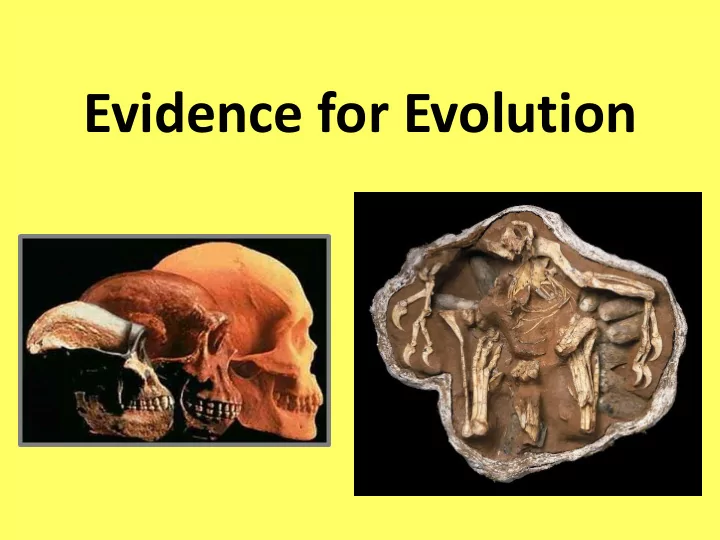
Evidence for Evolution
SLIDE 2
Scientific evidence of biological evolution uses information from geographical, geological, physical, chemical and mathematical applications. 1.A.4
SLIDE 3 Evidence of Biological Evolution
- Geographic – Distribution of living things on
Earth
- Geological – Examples include fossils
- Physical – Comparative Morphology/Embryology
- Chemical – Comparison of DNA nucleotide and
protein sequences
- Mathematical – Radiometric Dating of Fossils or
Molecular Clocks
SLIDE 4 Phylogenetics
- Evidence is then used to determine
evolutionary relationships between organisms and the evolutionary history of an organism (this is called phylogeny)
- Relationships and history are depicted in
diagrams known as phylogenetic trees Tree of Life Web Project
SLIDE 5
Phylogenetic Tree
SLIDE 6
Geographic Evidence
SLIDE 7 Geographic Evidence
- Distribution of living things around the globe
provides information about the past history of living things and the surface of the Earth (biogeography)
- Use biogeography to understand the evolution
- f a species
SLIDE 8
SLIDE 9
Evolution of the Camel Family
SLIDE 10 Madagascar’s Endemic Species
- Click on the hyperlink above to read about the
endemic species of Madagascar
SLIDE 11
Geological Evidence
SLIDE 12 Geological Evidence
- Examples include fossils and iron oxides in
rock
- Earth core samples show environmental
change over time
SLIDE 13 Geological Evidence (Fossils)
- Fossils can be dated by a variety of methods
that provide evidence for evolution
- Provide a record of early life and evolutionary
history
- Physical evidence of an organism that lived
long ago
SLIDE 14 Fossil Dating
- Law of superposition – “relative” age of fossils
SLIDE 15 Fossil Dating
- Determine the age
- f a fossil by finding
the age of the rock where the fossil is found (513-512 mya)
SLIDE 16 Fossil Dating
- Determine the absolute age of a fossil by
looking at the rate of decay of isotopes (radiometric dating)
- Carbon-14: half life of 5730 years
- Uranium-238: half life of 4.56 billion years
SLIDE 17
Carbon Dating
SLIDE 18
Physical Evidence
SLIDE 19 Physical Evidence
Physical evidence of evolution includes:
- Comparative Anatomy
- 1. Morphological Homologies
- 2. Vestigial Structures
- 3. Analogous Structures
- Comparative Embryology
SLIDE 20 Homologous Structures
- Homologous structures are structural features
that originated in a common ancestor
- Similar in structure but may differ in function
SLIDE 21
SLIDE 22 Vestigial Structures
- Vestigial structures are remnants of functional
structures that were once useful in the ancestor of the modern day organism
SLIDE 23 Analogous Structures (Homoplasies)
- Structures that shares a common function, but
are not similar in structure
- Demonstrates that species evolved
independently of one another, not related
- Result from convergent evolution
SLIDE 24
SLIDE 25 Comparative Embryology
- Comparison of embryos and embryo
development
- Evidence of common ancestry
SLIDE 26
Chemical Evidence
SLIDE 27 Chemical Evidence
- Biochemical and genetic similarities: DNA
nucleotide and protein sequences
- Show evidence for evolution and ancestry
- Analyze notable genetic similarities or differences
- All domains of life rely on the same genetic code
(this is evidence of common ancestry for ALL life)
SLIDE 28
DNA Sequence Alignment
Species of Beetles
SLIDE 29
SLIDE 30
Universal Genetic Code
SLIDE 31
Mathematical Evidence
SLIDE 32 Mathematical Evidence
- Molecular clocks use mutations to estimate
evolutionary time (assume that genetic mutations occur at a constant rate)
SLIDE 33 Molecular and genetic evidence from extant and extinct organisms indicates that all organisms on Earth share a common ancestral
1.D.2
SLIDE 34 Evidence for Relatedness of All Life
- Structural and functional evidence supports
the relatedness of all domains (Eukarya, Bacteria, Archaea
SLIDE 35 Structural and Functional Evidence
- DNA and RNA are carriers of genetic
information
- Genetic code is shared by all modern living
systems
- Conservation of metabolic pathways
SLIDE 36 Conservation of Metabolic Pathways
- Glycolysis is the MOST widespread metabolic
pathway among Earth’s organisms
- Suggests glycolysis evolved very early in life
SLIDE 37 Structural Evidence Supports the Relatedness of All Eukaryotes
- Cytoskeleton
- Membrane-bound organelles
- Linear chromosomes
- Endomembrane system (ER, Golgi, Nuclear
envelope)
SLIDE 38 HOX Genes
- Body plan genes in animals (common
ancestry)
SLIDE 39
Populations of organisms continue to evolve.
1.C.3
SLIDE 40 How do we know that evolution has
- ccurred in all species?
- Geological record of Earth’s history through
the study of fossils
- If the Earth has changed over time, then the
- rganisms which inhabit the Earth must have
the ability to evolve or they will die
SLIDE 41 Evolution Continues to Occur
- Mutations that cause chemical resistance:
- resistance to antibiotics (super cool video)
- resistance to pesticides and herbicides
- resistance to chemotherapy drugs
SLIDE 42
Pesticide Resistance
SLIDE 43 Emergent Diseases
- Mutations of existing viruses
- Spread of existing viruses from other animals