Evolution of the Chinese-born student population in Australia by - - PDF document

evolution of the chinese born student population in
SMART_READER_LITE
LIVE PREVIEW

Evolution of the Chinese-born student population in Australia by - - PDF document

Evolution of the Chinese-born student population in Australia by period and cohort: the post-1989 cohort versus recent cohorts (selected finding) Introduction Chinese-born population has a long history in Australia that is closely relevant


slide-1
SLIDE 1

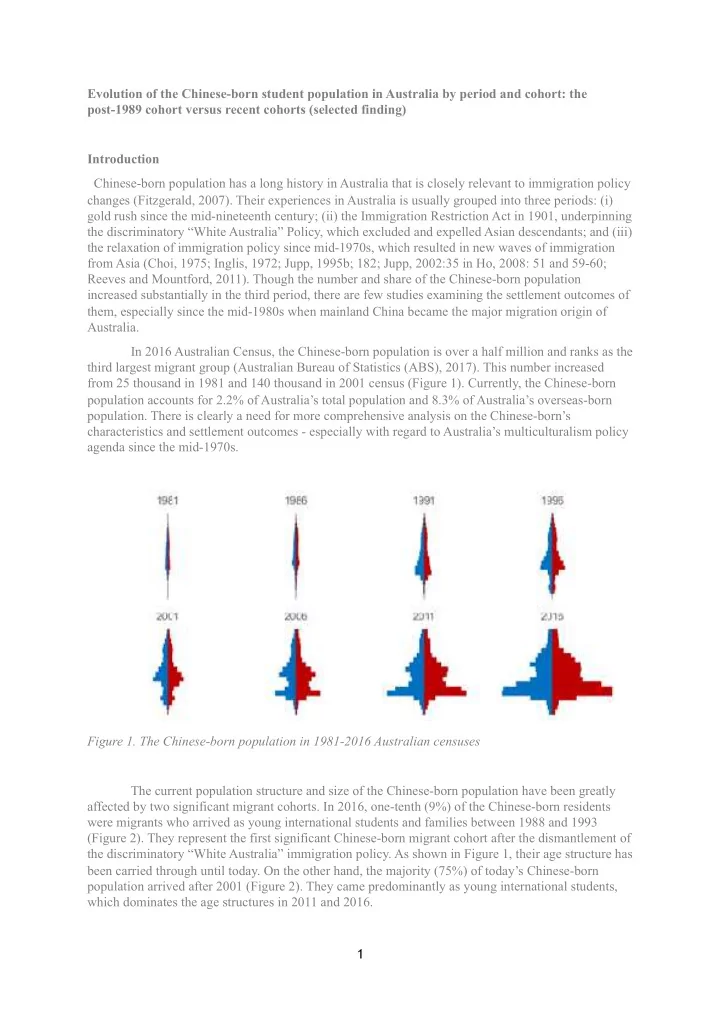
Evolution of the Chinese-born student population in Australia by period and cohort: the post-1989 cohort versus recent cohorts (selected finding) Introduction Chinese-born population has a long history in Australia that is closely relevant to immigration policy changes (Fitzgerald, 2007). Their experiences in Australia is usually grouped into three periods: (i) gold rush since the mid-nineteenth century; (ii) the Immigration Restriction Act in 1901, underpinning the discriminatory “White Australia” Policy, which excluded and expelled Asian descendants; and (iii) the relaxation of immigration policy since mid-1970s, which resulted in new waves of immigration from Asia (Choi, 1975; Inglis, 1972; Jupp, 1995b; 182; Jupp, 2002:35 in Ho, 2008: 51 and 59-60; Reeves and Mountford, 2011). Though the number and share of the Chinese-born population increased substantially in the third period, there are few studies examining the settlement outcomes of them, especially since the mid-1980s when mainland China became the major migration origin of Australia. In 2016 Australian Census, the Chinese-born population is over a half million and ranks as the third largest migrant group (Australian Bureau of Statistics (ABS), 2017). This number increased from 25 thousand in 1981 and 140 thousand in 2001 census (Figure 1). Currently, the Chinese-born population accounts for 2.2% of Australia’s total population and 8.3% of Australia’s overseas-born

  • population. There is clearly a need for more comprehensive analysis on the Chinese-born’s

characteristics and settlement outcomes - especially with regard to Australia’s multiculturalism policy agenda since the mid-1970s.

  • Figure 1. The Chinese-born population in 1981-2016 Australian censuses

The current population structure and size of the Chinese-born population have been greatly affected by two significant migrant cohorts. In 2016, one-tenth (9%) of the Chinese-born residents were migrants who arrived as young international students and families between 1988 and 1993 (Figure 2). They represent the first significant Chinese-born migrant cohort after the dismantlement of the discriminatory “White Australia” immigration policy. As shown in Figure 1, their age structure has been carried through until today. On the other hand, the majority (75%) of today’s Chinese-born population arrived after 2001 (Figure 2). They came predominantly as young international students, which dominates the age structures in 2011 and 2016. 1

slide-2
SLIDE 2
  • Figure 2. The Chinese-born population in 2016 Australian census: by period of arrival

Various studies suggest that the settlement behaviour and outcomes of migrants differ by age, birth cohort and migrant cohort (or migration period) (e.g. Pandit, 1997; Coughlan, 2008; Sander and Bell, 2016). However, few studies address the variations in permanent settlement behaviours and

  • utcomes across different migrant cohorts of the Chinese-born. More specifically, there are only a

handful of literature on the students who were affected by Tiananmen Incident-related immigration policies: not only in Australia where there were around 30,000, but also in the United States where the number was 53,000 (Birrell, 1994; Shu and Hawthorne 1996; Gao and Liu, 1998; Hugo, 2008; Orrenius et al., 2012). To understand the intra-birthplace variations, especially the settlement of the students who were affected by Tiananmen Incident-related policies and recent international students who became permanent residents in Australia, this study will compare the demographic, socio-economic and residential patterns of 1988-93 arrivals and 2001-06 arrivals. Using information from the Settlement Database, the two migrant cohorts are further narrowed down with age on arrival and education level to capture main characteristics of those international students who became permanents residents later

  • n.

The study explores how a major international migration flow from China to Australia evolved

  • ver time in response to political events, immigration or international student policies at both sides.

Other than examine international migration as a population redistribution process, this study investigates migration as a life course event by comparing migrants’ settlement outcomes over age, birth cohort and migrant cohort. There is an extensive literature investigating fertility patterns of immigrants in Australia, though little emphasis has been given to the Chinese-born. During 1977-1991, Chinese-born female immigrants, resembling migrants from many other non-English-speaking Asian countries, experienced considerably lower fertility in Australia than did the population in mainland China (Abbasi-Shavazi and McDonald, 2000: Figure 1). Aside from analysis on census variables, multistate life tables are constructed for different birth cohorts and migration periods to better understand the geographic movements and life course

  • pathways. The spatial distributions of Chines-born population, in particular the urban-rural

concentration and state level disparities, has been of great concern since the early migration period (Huck, 1968: 11-12; Inglis, 1972; Choi, 1975: 67-77 and Table 2.3; Kee and Huck, 1991; Jupp, 1995a; Ho and Coughlan, 1997: Table 6.6-6.9; Coughlan, 2008a and 2008b; Reeves and Mountford, 2011). Limited by data and techniques, it remains unclear in the existing literature what has been the pathway of migrants’ spatial movement, and how that differed between migrant cohorts. 2

slide-3
SLIDE 3

RESEARCH QUESTIONS The study answers the following questions:

  • 1. How have the demographic profiles, including age-sex structures, marriage and fertility changed

between 1989-93 and 2006-11 Chinese-born student-to-permanent resident populations in Australia?

  • 2. How do the settlement outcomes, including socio-economic status and spatial movement patterns

changed between 1989-93 and 2006-11 Chinese-born student-to-permanent resident populations in Australia? DATA AND METHODOLOGY Data of this study comes from two sources. First is the Settlement Database, an administrative database of permanent visa recipients. Second is Australian census data for year 2006, 2011, and 2016. The Settlement Database collects data on immigrants who received permanent visa or settlement pathway temporary visa after 1991. It is managed by the Department of Social Services and only records information from immigrants’ most current visa if they had not updated any status change ever since. Data items of the Settlement Database provides some useful information on migration history: for instance, country of birth, age on arrival, year of arrival, year of education, and visa subclass. Therefore it is a good source to identify the characteristics of the migrant cohort who was affected by Tiananmen Incident-related Australian immigration policy using the visa subclass

  • information. The dataset is used to narrow the two migrant cohorts down using year of arrival, age on

arrival and education level information to define the student-to-permanent resident population. However, because of the inconsistency on data updating, the Settlement Dataset is not a suitable source for comparative analysis over birth cohort and migrant cohort. Australian censuses are conducted every five years and represents one of the most comprehensive data sources on the overseas-born population. The proportion of Chinese-born population is 1.0% in 2006 census, 1.8% in 2011 census and 2.2% in 2016 census. These three most recent censuses are made publicly available online with the option to cross-tabulate most of the census data items. Using year of arrival, age at the census and education level variables, main characteristics of the 1988-93 and 2001-06 student-to-permanent resident cohorts can be captured in each of the three censuses. To compare the demographic, socio-economic and spatial patterns of the two migrant cohorts over the three censuses, variables including marital status, number of children ever born, citizenship, religious affiliation, language spoken at home, English language proficiency, labour force status, weekly income, and usual residence changes are collected from the census online tool TableBuilder. The study cross-tabulates census data to analyse family formation, fertility level, political and social integration of the two migrant cohort. To capture the Chinese students affected by Tiananmen Incident, the two migrant cohorts in the census are further narrowed down to two student-to- permanent resident cohorts by age on arrival (18-44) and education level (at least year 12). The age and education constrains are based on Settlement Database statistics. In the Settlement Database, the 1988-93 cohort is predominantly humanitarian visa recipients (71.8%) while the 2001-06 is mainly skilled visa recipients (67.1%). Further disaggregating the 1988-93 cohort humanitarian visa recipients by visa subclass, the majority of them are 815, 816, 817 and 818 visa recipients (90%). These visas were granted after 1993 mainly to mainland Chinese students and their families who arrived Australia in late 1980s and early 1990s in response to the 1989 Tiananmen Incident in Beijing (Ju Liu Sui Yue, 2014). Overall, 90% of the Chinese-born 815-818 visa recipients arrived Australia between 1988 and 1993. Of them, 83% of were aged 18-44 on arrival and 3

slide-4
SLIDE 4

83% received at least 12 years of education. These proportions are 80% and 82% in 2016 census,

  • respectively. In the United States, Orrenius et al. (2012) use Immigration and Naturalization Service

dataset, an administrative dataset of immigrants, to capture the age and educational characteristics of the policy-affected Chinese-born students. They then find this population in the census (where visa information is not available) and use their labour market performance to proximate that of the policy- affected students’. Given the size and age-education compositions are quite similar in the Settlement Database and Australian census, this study decides to take a similar approach. Eventually, the census is estimated to capture two-third of the policy-affected students. The 2001-06 cohort is narrowed down from all post-2001 arrivals. They represent the beginning of a steep increase of Chinese-born immigrants to Australia (Figure 2 and 3), which echoes a consistent annual growth of Chinese students’ overseas education statistics (Ministry of Education, 2017). Compared to all post-2001 arrivals, the length of residency and population size of 2001-06 cohort are more comparable to the 1988-93 cohort’s. When constraining them by same age on arrival (18-44) and education level (at least year 12) as with the 1988-93 cohort, the study eventually analyses two-thirds of both migrant cohorts in 2016 (Table 1). Table 1. Narrow down the two migrant cohorts to two student-to-permanent resident cohorts by age

  • n arrival and education level in 2016 census

To describe state/territory level spatial movement patterns of the two student-to-permanent resident cohorts, the study employs multistate life table method (Rogers, 1995). Australian state level mortality rates between 2006 and 2011 is used to approximate the mortality level of each state/

  • territory. The 2006-11 inter-state/territory usual residence transitions reported in 2011 census is used

to reflect the two cohorts’ spatial movements. SELECTED FINDINGS (i) Fertility level Children ever born statistics from the three census are used to measure the fertility levels. To reflect the fertility changes over time (dot, dash and bold lines) and differences between migrant cohorts (red and black lines), Figure 3 fixes the birth cohort by using age groups in 2006 as the horizontal axis. Since the two student-to-permanent resident cohorts were aged 18-44 on arrival, their ages in 2006 range from 18-49 for the 2001-06 cohort and 31-62 for the 1988-93 cohort. Note that the two cohorts have four overlapped age groups between age 30 and 49. Figure 3 shows that migration, as a life-course event, delays (interrupts) fertility, but in the long term boosts the fertility level of migrants from China. One the one hand, the fertility level of the 2006-11 cohort (the black lines) was very low in 2006 and quickly increased over the three censuses. It is very likely to be a result of migration-delay childbearing. On the other hand, comparing the two cohorts over the four overlapping age groups, the fertility level is lower in the 2006-11 cohort. Note that the 2006 to 2011 intercensal increment in the 30-39 age groups of 1988-93 cohort is partially due 88-93 arrivals 01-06 arrivals Two migrant cohorts 45,706 100% 79,965 100% aged 18-44 on arrival 36,738 80% 54,702 68% education level is year 12 or above 37,275 82% 69,056 86% student-to-permanent residents 30,526 67% 49,821 62% 4

slide-5
SLIDE 5

to change of female’s educational status, and that those birth cohorts aged 45-59 on 2006 might have been deeply affected by family planning policy in the home country.

  • Figure 3. Average numbers of children ever born to Chinese-born female in the two student-to-

permanent resident cohorts, data from 2006-2016 Australian censuses. (ii) Citizenship and language Two variables, the citizenship status and the spoken English proficiency, are examined to show indicative aspects of the two cohorts’ political and social inclusion. The proportional shares of the two cohorts are presented in Figure 4 and 5 for the two indicators, respectively. The 1988-93 migrants has a very high proportion (more than 90%) taking Australian citizenship. The proportion of 2001-06 migrants who take an Australian citizenship was 10% in 2006, with a maximum of five years residency in Australia. This fraction increased significantly over the ten years period and reached 57% in 2016 census. However, it is still much lower than the 1988-93 cohort’s. Given that year 2006 is 13-18 years after the first migrant cohort’s arrival, and that 2016 is 10-16 years after the second cohort’s arrival, their different behaviors in taking citizenship might be a combined result of stricter permanent visa requirement, that 1988-93 humanitarian visa recipients being affected by political event in China and that 2001-06 cohorts being more connected with the origin country.

  • Figure 4. Citizenship status of the two student-to-permanent resident cohorts, data from 2006-2016

Australian censuses. Three bars in each cluster stand for census year 2006, 2011 and 2016, left to right. 5

slide-6
SLIDE 6

In terms of English proficiency, the 2001-06 cohort outperformed the 1988-93 cohort. Notably, the 2001-06 cohort’s proficiency increased over time. It is an important signal of their integration into this English-speaking country. The difference between the two migrant cohorts, however, is also relevant to higher English language requirement for recent immigrants. Comparing the two indicative proportional shares, it looks like that the two migrant cohorts were integrated into Australia society in different ways.

  • Figure 5. Spoken English proficiency of the two student-to-permanent resident cohorts, data from

2006-2016 Australian censuses. Three bars in each cluster stand for census year 2006, 2011 and 2016, left to right. (iii) Inter-state/territory movements The inter-state/territory spatial movements of the two migrant cohorts are presented using multistate life table method. To have a full age schedule, all migrants arrived during the two periods, 1988-93 and 2001-06, with at least year 12 education at 2011 census are included when obtaining the inter- state/territory migration transitions. In order to better reflect the two student-to-permanent resident cohorts, only life expectancies for those aged 18-44 on arrival are analyzed. Specifically, those are the 1988-93 cohort aged 36-67 in 2011, and the 2001-06 cohort aged 23-54 in 2011. Only overlapping ages are compared to control for birth cohort effects. Figure 6 presents the shares of male’s multistate life expectancy at age 35. There are eight states and territories in Australia, but the results are only presented for five biggest ones due to sparse numbers in the rest three. The vertical axis lists the five states, representing the man’s residence state at age 35. The life expectancy shares of 1988-93 cohort and 2001-06 cohort are compared in pair depending on his current residence state at age 35. The horizontal bars stand for his life expectancy at age 35. The length of each colored bar are the proportional shares of his rest life in the labeled state. The figure shows that at age 35, males in both migrant cohorts are expected to spend most of the remaining lives in their current state (at age 35), except for those 2001-06 cohorts in SA. Generally speaking, the 2001-06 cohort male are more mobile than the 1988-93 cohort male. Regardless of the current state, they spend less of their rest life in the current residence state. Among all five big states, NSW has the highest retention rate for its Chinese-born student-to-permanent residents, while SA and QLD have the lowest. It is not presented here but females have similar patterns as males. 6

slide-7
SLIDE 7
  • Figure 6. Decompose the Chinese-born male’s multistate life expectancy at age 35 across eight

Australian states and territories, data from 2011Australian census. DISCUSSION In the existing literature, no particular attention has been given to Chinese-born migrants in different arrival cohorts. This study explores demographic, socio-economic and spatial differences between two significant student-to-permanent resident cohorts using census data. Some selected findings suggest that migration, as a life-course event, delays (interrupts) fertility of the Chinese-born migrants on the one hand. On the other hand, migration event boosts the fertility level of Chinese-born female migrants in Australia the long term. Given the different background and requirements to obtain permanent resident visa, the two cohorts integrated into Australia in different ways. The proportional shares of obtaining Australian citizenship is much higher in 1988-93 cohort, while the 2001-06 cohort performs better in English language proficiency. They performed differently in political and social inclusion in the receiving country. In terms of spatial movements, both cohorts will spend most of their remaining life in the current state (at age 35), but those from 2001-06 cohort are more mobile in inter-state/territory migration. The findings enhance our understanding of migration cohort and period effects, particularly in the context of Asians in Australia. It is informative to Australia’s immigration and multicultural policy and adds to the literature on Chinese migrant population around the world. REFERENCES

Abbasi-Shavazi, Mohammad Jalal and McDonald, Peter. (2000). Fertility and multiculturalism: immigrant fertility in Australia, 1977-1991. International Migration Review, 34(1): 215-242.

  • ABS. (2012). Reflecting a Nation: Stories from the 2011 Census, 2012–2013.
  • ABS. (2017). 2071.0 - Census of Population and Housing: Reflecting Australia - Stories from the Census, 2016.

7

slide-8
SLIDE 8

Choi, Ching-yan. (1975). Chinese migration and settlement in Australia, Sydney, Australia: Sydney University Press. Coughlan, James E. (2008a, December). Temporal variations in the spatial distribution of Australia’s Chinese

  • communities. Paper presented at the Re-imaging Sociology Conference of The Australian Sociological

Association, Melbourne, Australia. Coughlan, James E. (2008b). The changing spatial distribution and concentration of Australia’s Chinese and Vietnamese communities: an analysis of 1986-2006 Australian population census data. Journal of Population Research, 25(2): 161-182. Fitzgerald, John. (2007). Big white lie: Chinese Australians in white Australia. Sydney, Australia: University of New South Wales Press. Ho, Chooi Hon and Coughlan James E. (1997). The Chinese in Australia: immigrants from People’s Republic of China, Malaysia, Singapore, Taiwan, Hong Kong and Macau. In James E. Coughlan and Deborah J. McNamara (Eds.), Asians in Australia: patterns of migration and settlement (pp. 120-170). South Melbourne, Australia: Macmillan Education Australia. Ho, Christina. (2008). Migration and gender identity: Chinese women’s experiences of work, family and identity in Australia. Saarbrucken, Germany: VDM Verlag Dr. Muller. Huck, Arthur. (1968). The Chinese in Australia. Croydon, Victoria, Australia: Longmans of Australia Pty Limited. Hugo, Graeme. (2008). A changing diaspora: recent trends in migration between China and Australia. Chinese Southern Diaspora Studies, 2: 82-103. Inglis, Christine. (1972). Chinese in Australia. International Migration Review, 6(3): 266-281. Ju Liu Sui Yue. (2014). Ju Liu Sui Yue (Australia: Our Extended Dreams). Hong Kong: Xianggang Zhongguo Xin Wen Chu Ban She. Jupp, James E. (1995a). Ethnic and culture diversity in Australia. Retrieved from http://www.abs.gov.au/ ausstats/abs@.nsf/featurearticlesbytitle/49F609C83CF34D69CA2569DE0025C182?OpenDocument Jupp, James E. (1995b). From 'White Australia' to 'part of Asia': recent shifts in Australian immigration policy towards the region. International Migration Review, 29(1): 207-228. Kee, Pookong and Huck, Arthur. (1991). Immigrant second and third generation Chinese in Australia: a profile drawn from the 1986 census. Asian Studies Review, 14(3):41-71. Ministry of Education. (2017). Ministry of Education of the People’s Republic of China: Education Statistics. Retrieved from http://en.moe.gov.cn/ Pandit, Kavita. (1997). Cohort and period effects in U.S. migration: how demographic and economic cycles influence the migration schedule, Annuals of the Association of American Geographers, 87(3): 439-450. Reeves, Keir and Mountford, Benjamin. (2011). Sojourning and settling: locating Chinese Australian history. Australian Historical Studies, 42(1): 111-125. Rogers, Andrei. (1995) Multiregional Demography: Principles, Methods, and Extensions. London: John Wiley. Shu, Jing and Hawthorne, Lesleyanne. (1996). Asian student migration to Australia, International Migration, XXXIV, 1: 65-96.

8