Ex Vivo Profiling of PD-1 Blockade Using Organotypic Tumor Spheroids - - PowerPoint PPT Presentation

ex vivo profiling of pd 1 blockade using organotypic tumor
SMART_READER_LITE
LIVE PREVIEW

Ex Vivo Profiling of PD-1 Blockade Using Organotypic Tumor Spheroids - - PowerPoint PPT Presentation

Ex Vivo Profiling of PD-1 Blockade Using Organotypic Tumor Spheroids Developing a Functional Precision Medicine Platform for Immuno-Oncology Russell W. Jenkins, MD PhD Clinical Fellow/Instructor Massachusetts General Hospital Cancer Center


slide-1
SLIDE 1

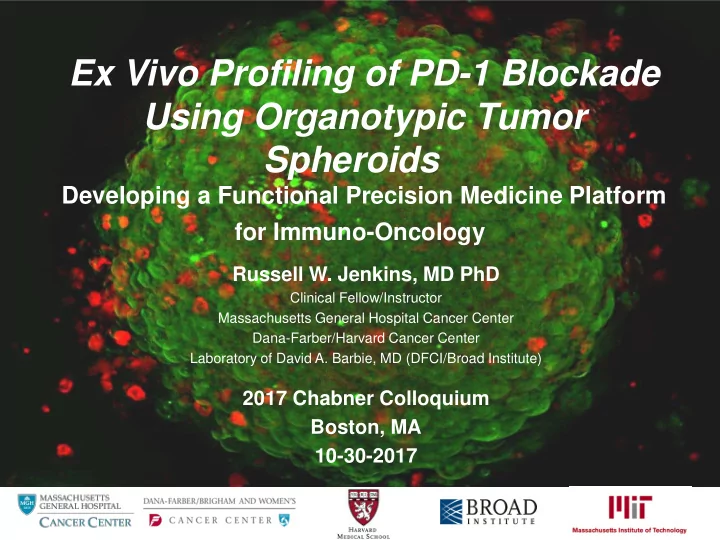
Ex Vivo Profiling of PD-1 Blockade Using Organotypic Tumor Spheroids

Developing a Functional Precision Medicine Platform for Immuno-Oncology

Russell W. Jenkins, MD PhD

Clinical Fellow/Instructor Massachusetts General Hospital Cancer Center Dana-Farber/Harvard Cancer Center Laboratory of David A. Barbie, MD (DFCI/Broad Institute)

2017 Chabner Colloquium Boston, MA 10-30-2017

slide-2
SLIDE 2

Disclosures

Russell W. Jenkins, MD has disclosed no relevant financial relationships.

slide-3
SLIDE 3
  • Despite the unprecedented success
  • f PD-1/PD-L1 blockade in

melanoma (and other cancers), innate resistance occurs in the majority of patients

– Robert et al. NEJM 2015 (KEYNOTE-006) – Reck et al. NEJM 2016 (KEYNOTE- 024)

  • Robust biomarkers to guide

treatment and drug development are lacking

– Nishino et al. Nat Rev Clin Onc 2017

  • There is a great unmet need to

develop functional precision medicine approaches to guide and accelerate translational efforts (novel IO agents, combos)

Confidential

Background – PD-1/PD-L1 axis in cancer

slide-4
SLIDE 4
  • Existing methods to assess anti-tumor

immune responses in patients rely on remote assessment in plasma/whole blood or static measurements from biopsies (DNA, RNA, IHC/IF)

  • Novel ex vivo systems (e.g. CTCs,

PDXs, organoids) have the potential to improve personalized cancer therapy, but lack features of the native tumor immune microenvironment, and often take several weeks to generate sufficient material for drug testing

– Friedman et al. Nat Rev Cancer 2015

Confidential

Background – Novel cancer models

slide-5
SLIDE 5

Background - Precision Medicine

  • “The essential job of precision medicine is to match the

right drugs to the right patients.”

  • Technologies that enable the ex vivo study of response

to anti-PD-1 and combination therapies would provide a major advance

Confidential

slide-6
SLIDE 6
  • Requirements for modeling immune

checkpoint blockade include:

– (1) Viable (fresh) tumor tissue – (2) Culture system that recapitulates the tumor microenvironment

  • 3D growth
  • model extracellular matrix

– (3) Immune cells: autologous, antigen- experienced immune cells to mimic the native tumor microenvironment (ideally from the tumor itself)

Confidential

Modeling the Immune Tumor Microenvironment

slide-7
SLIDE 7

Jenkins et al., Cancer Discovery, accepted DFCI US Patent WO2016112172A1

Isolation of organotypic tumor spheroids

MDOTS PDOTS

slide-8
SLIDE 8

MDOTS/PDOTS

Confidential

slide-9
SLIDE 9

MDOTS/PDOTS Patient- derived Murine- derived Tumor Specimen >100 μm S1 40-100 μm Flow cytometry Physical + enzymatic dissociation Sequential filtration <40 μm S2 S3 Microfluidic 3D Culture Bioplex Cytokine Profiling of Conditioned Media Serial Microscopy (Live/Dead Analysis)

Immune Cell Profiling of MDOTS

Confidential

slide-10
SLIDE 10

MDOTS Retain Autologous Immune Cells

Pat Lizotte, William Walker, Jiehui Deng

B16F10 MDOTS MC38 MDOTS

1) MDOTS from 2 different syngeneic implantable tumor models retain autologous lymphoid and myeloid cells 2) No significant difference in different spheroid fractions

Confidential

slide-11
SLIDE 11

Ex vivo 3D culture and cytokine/chemokine profiling

0.5 mm

Conditioned Medium

CD45 EpCAM

25 μm

slide-12
SLIDE 12

Ex Vivo Culture of MDOTS/PDOTS

slide-13
SLIDE 13

MDOTS respond to ex vivo PD-1 blockade

Amir Aref, Pat Lizotte, Elena Ivanova, Cloud Paweletz

Control Control Anti-PD-1 Anti-PD-1 Control Control Anti-PD-1 Anti-PD-1

slide-14
SLIDE 14

Intrinsic resistance to PD-1 blockade

Control Control Anti-PD-1 Anti-PD-1

GL621 (sensitive) CT26 (partially resistant) LLC (resistant) Response/resistance confirmed in additional models:

αPD-1 IgG MC38 B16F10

Live Dead

50 μm

slide-15
SLIDE 15

Tank-binding kinase 1 structure/function

Barbie et al, Nature 2009 Tu, Zhu et al., Cell Rep 2013 Yang et al., Cancer Immunol Res 2016

  • Key signaling kinase in innate immunity
  • Activates IRF3, NF-κB, autophagy
  • Co-opted by oncogenic KRAS

TBK1

Eck and Barbie Lab collaboration

slide-16
SLIDE 16

Compound 1

IC50 EC50 TBK1 1.0 nM 183 nM (251 nM*) IKKε 5.6 nM TBK1/IKKε TBK1/IKKε Tumor Cell T cell

CCL5, IL-6

Tumor Growth

IL-2, IFNγ

T cell activation

A Novel TBK1/IKKε inhibitor to Modulate the TME

Zhu et al. CD 2014 Yu et al. Nat Comm 2014

Susanna Stinson, David Dornan (Gilead Sciences)

Confidential

slide-17
SLIDE 17

TBK1/IKKε TBK1/IKKε Tumor Cell T cell

CCL5, IL-6

Tumor Growth

IL-2, IFNγ

T cell activation

Ex vivo identification of effective combination therapy

Live Dead Control αPD-1 + Cmpd1 50 μm

slide-18
SLIDE 18

Dual TBK1-PD1 inhibition is partially dependent on CD8 T cells

Tumor

MDOT S

Live/Dead Imaging (in device) Ex Vivo Culture (5 days) +/- Cmpd1, anti-PD-1, anti-CD8 Terminal Media Collection 23-plex murine BioPlex analysis

Confidential

slide-19
SLIDE 19

Patient-derived organotypic tumor spheroids

slide-20
SLIDE 20

Patient-derived tumor samples (PDOTS)

Serial ex vivo cytokine/chemokine profiling predicts in vivo MDSC infiltration and resistance Granulocytic MDSCs Monocytic MDSCs Malignant pleural effusion (thyroid cancer) Co-induction of immune-suppressive cytokines/chemokines ex vivo more generally associated with short PFS

slide-21
SLIDE 21
  • Ex vivo assessment of tumor immune response to PD-

1 blockade is possible

  • Further prospective validation is necessary to

determine the utility of this system as a predictive tool

  • Important potential of this system to identify and

personalize effective combination therapies

  • Co-targeting TBK1 with immune checkpoint blockade

may have clinical impact

Summary

slide-22
SLIDE 22

Barbie Lab David A. Barbie, MD Israel Canadas, PhD Tran Thai Shunsuke Kitajima, PhD Rohit Thummalapalli MIT Roger Kamm, PhD Vivek Sivathanu Broad Institute William Kim, PhD DFCI/Broad Institute Eli Van Allen, MD Diana Miao Meng Xiao He Alicia Smart Gilead Sciences David Dornan Susanna Stinson Massachusetts General Hospital Genevieve Boland, MD PhD Keith Flaherty, MD Hans Vitzthum Michal Barzily-Rokni, PhD Marc Hammond Mai Hoang, MD Viswanath Gunda, PhD Sareh Parangi, MD Ryan Sullivan, MD Don Lawrence, MD David Fisher, MD PhD BWH Adriano Piris, MD Wistar Institute Gao Zhang, PhD NJ Institute of Technology Tian Tian

Bruce Chabner, MD The organizers of the 2017 Chabner Colloquium

Our patients, their families, and the amazing clinical and clinical research support staff at DF/HCC (MGH, BWH, and DFCI)

DFCI/Belfer Center for Applied Sciences* Amir R. Aref, PhD* Cloud P. Paweletz, PhD Pat Lizotte, PhD Elena Ivanova, PhD Wei Huang, MD William Walker, Lauren Keogh, Bob Jones Mark Bittinger, PhD Sangeetha Palakurthi, PhD Dana-Farber Cancer Institute Kwok Wong, MD PhD* (now at NYU) Pasi Janne, MD PhD*

  • F. Stephen Hodi, MD

Gordon Freeman, PhD Michaela Bowden, PhD Willa Zhou Lisa Cameron, PhD (now at Duke) Hongye Liu, PhD Patrick Ott, MD James Cleary, MD PhD Charles Yoon, MD Jochen Lorch, MD Glenn Hanna, MD Manisha Thakuria, MD Nicole LeBoeuf, MD Guilherme Rabinowits, MD Brian C. Miller, MD PhD Thanh U. Barbie, MD William G. Richards, PhD Raphael Bueno, MD DF/HCC Medical Oncology Fellowship Ann LaCasce, MD

  • M. Dror Michaelson, MD PhD

Robert J. Mayer, MD T32 Training Grant Svenson Family Fellowship

Acknowledgements