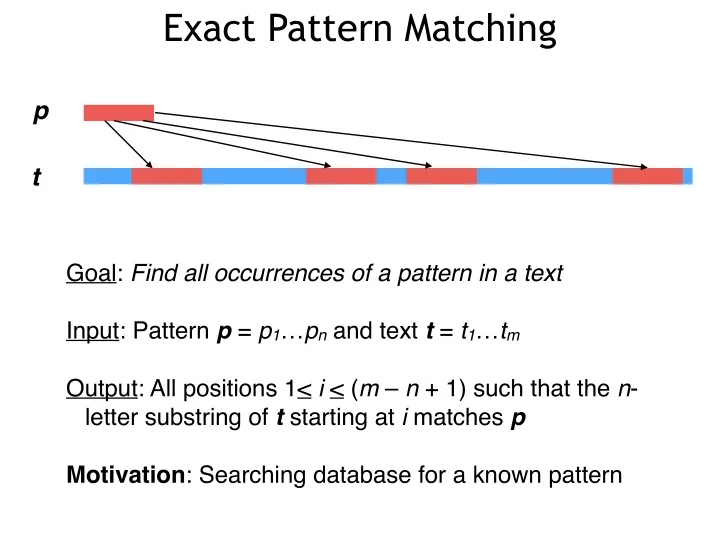
SLIDE 1
Goal: Find all occurrences of a pattern in a text Input: Pattern p = p1…pn and text t = t1…tm Output: All positions 1< i < (m – n + 1) such that the n- letter substring of t starting at i matches p Motivation: Searching database for a known pattern
Exact Pattern Matching
t p
SLIDE 2
- Naïve runtime: O(nm)
- How?
- On average, it should be close to O(m)
- Why?
- Can solve problem in O(m) time ?
- Yes, we’ll see how (in a later lecture)
Pattern Matching: Running Time
SLIDE 3
Naive algorithm is inefficient
SLIDE 4 Goal: Given a set of patterns and a text, find all occurrences
- f any of patterns in text
Input: k patterns p1,…,pk, and text t = t1…tm Output: Positions 1 < i < m where substring of t starting at i matches pj for 1 < j < k Motivation: Searching database for known multiple patterns
t p1 p2
Multiple Pattern Matching
SLIDE 5
- Solution: k “pattern matching problems”: O(kmn)
- Another Solution:
- Using “Keyword trees” => O(kn+nm) where n is
maximum length of pi
- Preprocess all k patterns to construct a “keyword
tree”
- Now, any given text, all occurrences of all patterns
can be found in time O(m)
Multiple Pattern Matching
SLIDE 6
Keyword tree approach
SLIDE 7
Keyword tree approach
SLIDE 8
Keyword tree approach
SLIDE 9
Keyword tree approach
SLIDE 10
Keyword tree approach
SLIDE 11
Keyword tree approach: Properties
SLIDE 12
Keyword tree: Construction
SLIDE 13
SLIDE 14
Keyword tree: Lookup of a string
How to check all occurrences in a text t?
SLIDE 15
- Build keyword tree in O(kn) time; kn is total length of
all patterns
- Start “threading” at each position in text; at most n
steps tell us if there is a match here to any pi
- O(kn + nm)
- We’re down from O(kmn) to this
- The next big idea, Aho-Corasick algorithm: O(kn + m)
Keyword tree approach: Complexity
SLIDE 16
Aho-Corasick algorithm: Key idea
HERSHE
Exploit the redundancy in the patterns
HERS SHE HE
SLIDE 17
Aho-Corasick algorithm: Key idea
HERSHE
Exploit the redundancy in the patterns
HERS SHE HE
SLIDE 18
Aho-Corasick algorithm
With failing edges and node labels
SLIDE 19
- Transition among the different nodes by following edges
depending on next character seen (say “h”)
- If outgoing edge with label “h”, follow it
- If no such edge, and are at root, stay
- If no such edge, and at non-root, follow dashes edge (“fail”
transition); DO NOT CONSUME THE CHARACTER (say “h”)
Rules
Consider text “hershe”