
SLIDE 1
CS206
The runtime stack
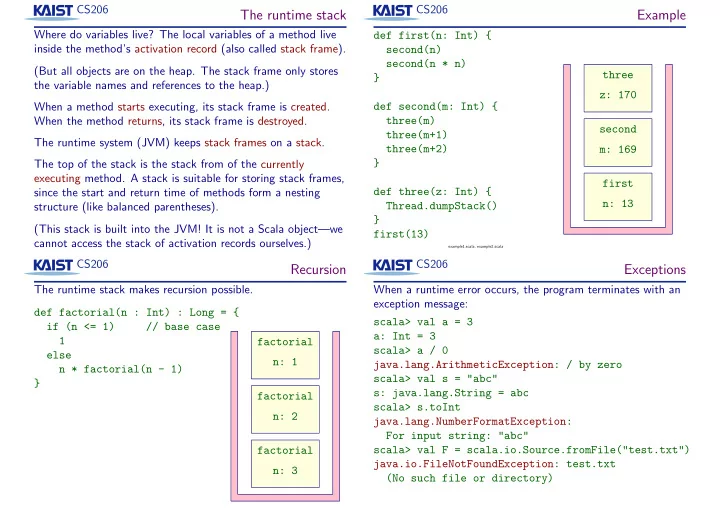
Where do variables live? The local variables of a method live inside the method’s activation record (also called stack frame). (But all objects are on the heap. The stack frame only stores the variable names and references to the heap.) When a method starts executing, its stack frame is created. When the method returns, its stack frame is destroyed. The runtime system (JVM) keeps stack frames on a stack. The top of the stack is the stack from of the currently executing method. A stack is suitable for storing stack frames, since the start and return time of methods form a nesting structure (like balanced parentheses). (This stack is built into the JVM! It is not a Scala object—we cannot access the stack of activation records ourselves.) CS206
Example
def first(n: Int) { second(n) second(n * n) } def second(m: Int) { three(m) three(m+1) three(m+2) } def three(z: Int) { Thread.dumpStack() } first(13) first n: 13 second m: 169 three z: 170
example1.scala, example2.scala