Ministry of the Environment and Climate Change
Excess Soil Engagement Group & Market Working Group Meeting - - PowerPoint PPT Presentation
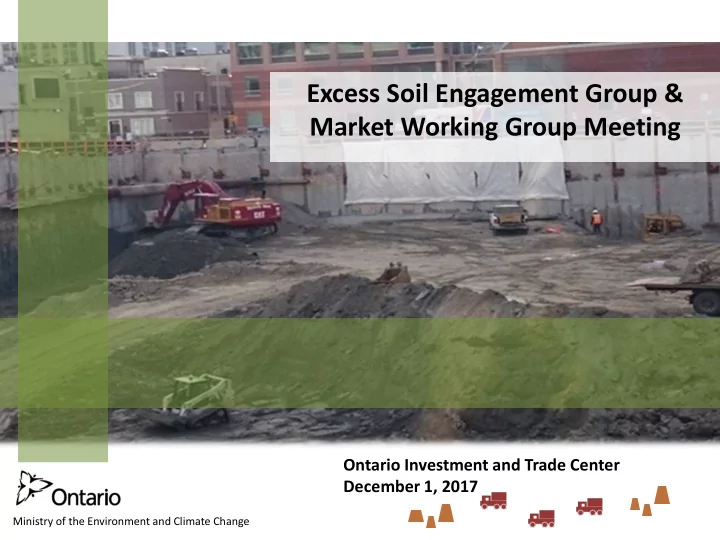
Excess Soil Engagement Group & Market Working Group Meeting Ontario Investment and Trade Center December 1, 2017 Ministry of the Environment and Climate Change Presentation Overview Proposed Revisions to Regulatory Package Update on
- Proposed Revisions to Regulatory Package
- Update on Framework Actions
- Program Needs and Delivery Considerations
- Prioritization Exercise
- Program Delivery Discussion and Activities
- Exit Poll
- Next Steps
Presentation Overview
2
(MOECC, Nov. 2016) (MOECC, Oct. 2017)
Proposed Excess Soil Regulatory Package posted for input on Environmental Registry - April 24 to June 23, 2017
- Clarification when excess soil is waste and ceases to be waste
– Clarifies excess soil would be designated waste and ceases to be waste if reused as per regulation – On-site reuse is not subject to waste requirements, off-site soil banks & processing require approvals
- Excess soil management plan required for certain development projects (source sites)
– Two triggers proposed requiring plan preparation: specific larger volumes, or if from an area that has or had a potentially contaminating activity – Specified contents of an excess soil management plan, to be prepared by a “Qualified Person” – Required characterization of excess soil source site as the basis for relocating soil, including specified sampling requirements in areas with potential contamination – Requiring identification of receiving sites (based on reuse standards) and tracking soil movement – Requiring registration of excess soil movements in a public registry
- Excess soil characterization requirements and guidance
- Excess soil reuse standards and approaches, standards based on land use
- Proposed minor amendments to align Ontario Regulation 153/04
– To align with excess soil proposal – To provide some flexibility on specific requirements (Modernization of Brownfields amendments)
- Proposed amendment to the Building Code pertaining to applicable law
3
Confidential
A Reminder - Overview of Proposed Regulatory Package
- 110 submissions received and 35+ meetings took place, key sectors commenting were municipal, CA’s,
industry, ENGOs, consultants, Indigenous communities and the public
- Comments and input received indicated general support for the proposed regulatory package
- The following key areas of interest and input are outlined below and described in further details in the
following slides: 1. Transition Requirements 2. Excess Soil Reuse Provisions 3. Excess Soil Haulers Approvals and Requirements 4. Approvals and Requirements for Liquid Soil 5. Triggers for an Excess Soil Management Plan 6. Exemptions from an Excess Soil Management Plan 7. Qualified Persons 8. Linkage to Building Code 9. Tracking System and Registry Requirements
- 10. Sampling Requirements
- 11. Reuse Standards and Receiving Site Rules
4
Key Themes Based on Input Received
Confidential
Transition Requirements
5
What We Proposed
- Transition provisions would be included that would take into consideration projects that are
substantially planned, approved or underway
- Proposed requirements could be transitioned in through practical implementation considerations
What We Heard
- Need for sufficient transition times to accommodate existing contracts and time required to
transition in projects underway suggestions range from 1 to 5+ years
- Need for adequate time for delivery of education, outreach and training of key sectors
Key Changes Under Consideration
- Modernization of Brownfields amendments could come into effect immediately upon filling
- Reuse standards, clarifying waste designation and approvals to come into effect Jan 1, 2020
- ESMP and registry requirements to come into effect Jan 1, 2021
- Some linked requirements may be phased in to align with in effect dates (e.g., Building Code
applicable law)
Confidential
What Was Proposed
- The proposed regulation would designate all excess soil as a waste when it leaves a project area
- Excess soil would cease to be a waste if deposited at a receiving site that is:
- 1. Is deposited in accordance with reuse standards and rules outlined in the document “Reuse of Excess Soil at
Receiving Sites” and key criteria are met (e.g., use may be for a purpose such as backfilling an excavation; receiving site is not being used solely or primarily for depositing excess soil, or
- 2. Governed by a site specific instrument or by-law, or
- 3. If moved between infrastructure projects with the same proponent
What We Heard
- Concerns about “waste” designation and related stigma for all excess soil, regardless of quantity and quality and
related unintended implications to restrict reuse opportunities
- Support for regulatory enforceability enabled by the waste designation
- Consider scoping waste designation
- Feedback that demonstrated it may have been unclear that on-site movement generally does not trigger designation
Key Changes Under Consideration
- Be clear that excess soil reused in a project area is not waste
- Rebranding “receiving sites” as “reuse sites” and “ soil processors ” and “soil banks” as “soil recycling facilities”
- Expanding the scope of excess soil movements between infrastructure projects to allow for public infrastructure
projects to move soil between sites that have different proponents
- Excess soil being relocated to a reuse site is not waste in transit (therefore if relocated appropriately would never be
designated waste)
- Remove limitation that the same proponent is needed for relocation between some infrastructure projects
(roads, water, sewer)
6
Proposed Excess Soil Reuse Provisions
Confidential
What We Proposed
- An excess soil hauling record would be required to be available with the truck (could be electronic) for
all hauled excess soils providing information on quality, quantity, source site, receiving site, time and date leaving and being deposited, and contacts for the sites
- Excess soil haulers to temporary excess soil storage sites (TESSS) and reuse sites DO NOT require an
approval
- Excess soil haulers going to Part V ECA approved facilities, such as landfills, excess soil banks and excess
soil processing sites DO require approvals
- Note: if hazardous waste, existing approvals would continue to apply
What We Heard
- Mixed reactions to proposed approach for hauling record, some felt it was too onerous
- Regarding approvals for haulers general support to provide regulatory clarity in this area
- Need for hauling template to guide this industry
- Suggestions to limit the need for approvals and requirements on this industry
Key Changes Under Consideration
- Reduce info in hauling record if not from site with an ESMP - focus on key details - source and receiver
info, date, etc.
- Remove proposed approval requirements for haulers going to excess soil banks, processing sites and
landfills; some permit by rule requirements
7
Excess Soil Haulers - Approvals and Requirements
Confidential
What We Proposed
- Liquid waste and vacuum truck soil must be managed as waste and would be required to obtain an approval
- Sediment, including from a storm water pond may be dewatered on-site and managed as excess soil, but if
moved offsite in liquid state must obtain an approval What We Heard
- Concerns about onerous approval requirements for vacuum truck industry and municipalities who move
liquid soil, including storm water pond sediments
- Often these materials were described as “clean” materials using potable water as the only additive and
should be treated as “uncharacterized”
- Clarity and flexibility needed in regulation to allow dewatering onsite and to move liquid soil to temporary
yards/storage locations for dewatering without an approval Key Changes Under Consideration
- Provide flexibility to allow liquid soil (only soil, not other debris) including vacuum trucks, stormwater pond
clean outs and dredging to be hauled to works yards , subject to rules, without an approval
- Clarity that all liquid soil slurry dewatering facilities (in the business of dewatering liquid soil) accepting
liquid soil from multiple sources be required to obtain an approval
- Clarify that on-site dewatering is permitted in certain circumstances without an approval
8
Approvals and Requirements for Liquid Soil
Confidential
Proposed Requirement for an Excess Soil Management Plan
9
What We Proposed
- Excess soil management plan required to be prepared prior to any excess soil leaving the project area, with
two key triggers for a source site owner to be required to prepare a Plan for a project: 1) Quantitative Trigger - if 1000m³ or greater of excess soil is to be moved off site 2) Qualitative Trigger - if excess soil is coming from an area with a current or known past potentially contaminating activity (i.e., an activity that may have caused contamination, such as fuel storage
- r industrial processing)
What We Heard
- Quantitative trigger is too low, may capture single residential and various smaller projects
- Overall, regulatory burden is high, some support for streamline ESMP for low risk projects
- It may be difficult to know if a potentially contaminating activity is on site
Key Changes Under Consideration
- Considering an increase in the quantitative trigger to 2000m3 to reduce burden on smaller sites but still
capture intended projects (condos, larger infrastructure)
- Revise qualitative trigger to align with sites requiring testing and Records of Site Condition and/or
remediation (e.g. industrial sites and garages, dry cleaners, and gas stations); this would clarify the trigger and when a qualified person is needed, including for smaller sites Confidential
Exemptions for an Excess Soil Management Plan
10
What We Proposed
- Exemptions from the need for a Plan included: emergencies; regular maintenance of infrastructure; 100 cubic
metres if taken directly to a waste disposal site; Crown land; infrastructure projects where proponent is the same; outside of a settlement area and does not include an area of potential environmental concern or specified industrial uses What We Heard
- Some support, particularly from municipal sector, but need for revised and clear definitions (e.g., regular
maintenance, settlement area)
- Concern about broad scope of Crown Land exemption (e.g., not intended to apply to all Crown holdings)
- Suggestion to expand infrastructure exemption, others indicated it should not encourage soil moving to airports
- r apply if infrastructure is inherently a PCA
Key Changes Under Consideration
- Clarification of maintenance of existing infrastructure - maintenance to include replace and repair, but not to
apply to increasing capacity or to realign infrastructure
- Refine language e.g., crown land and settlement areas to ensure intent for exemption in rural areas e.g.,
unorganized territories, where there is no areas of potential environmental concern or industrial lands
- Expand infrastructure exemption to also apply to movements between similar projects for roads, water and sewer
Confidential
Qualified Persons & Linkage to Building Code
11
Qualified Persons What Was Proposed
- Excess soil management plans would be prepared and certified by a qualified person (P. Eng. and P. Geo),
ensure QP as no direct or indirect interest in the project. What We Heard
- Concerns around QP performance; clarification needed of “direct and indirect interest”
- Focus QPs on key areas of expertise e.g., characterization, should not be required for registration
Key Change Under Consideration
- Clarify the scope of QP conflict provision e.g., does not have a direct or indirect interest solely because the QP
is an employee of the project proponent
- QP training, education, guidance and/or certification is considered a program priority (pm discussion)
- Focus QP role on professional decisions (sampling/analysis); registration should be proponent responsibility
Building Code What Was Proposed
- No person could construct a building, if the building includes shoring, unless an ESMP has been prepared and
registered, proposed as applicable law under the Building Code for 1000m³+ What We Heard
- Concerns around workload, timing (are permits after soil moves?), liability, and building official responsibility
Key Changes Under Consideration
- Proposed to take a phased in approach on these requirements
Confidential
Proposed Tracking System & Registry Requirements
12 Tracking System What We Proposed
- Ensure that a soil tracking system is developed and implemented, to enable the movement of excess soil to be tracked from the
time it is excavated within a project area to the time it reaches the final location where it is deposited. Including auditing procedures and record keeping. What We Heard
- Tracking system is too onerous, particularly for cleaner soil and onsite tracking at source site
- This section of the regulation overlaps with other requirements (e.g., hauling record)
Key Changes Under Consideration
- Reduce tracking requirement details - some details replaced by objectives, migrate other details such as tracking of on-site
movements into guidance Registry What Was Proposed
- Require, in an online registry, registration of key information (not full plan) e.g., that an ESMP was completed prior to any soil
leaving a project area, with periodic updates to registry
- Registry requirements proposed for some excess soil movements not subject to ESMP e.g., infrastructure projects, stormwater
pond maintenance 1000m³ + What We Heard
- Broad support for registry, receivers should register, updates are too frequent and therefore onerous
Key Changes Under Consideration
- Require larger receiving sites to register e.g., 10,000m³ or greater
- Reduce frequency of excess soil updates for ESMP’s and infrastructure projects from 28 to 60 days, other registry entries e.g.,
stormwater - reduce to one time entry
- Consider requiring larger receiving sites (e.g., 10,000m³ or greater) to register or compile records - volume, applicable quality,
source sites and to require QP oversight for these larger sites
- Add a new section on receiving site requirements e.g., agreements with source sites and receiving site certifications
e.g., quality, quantity, reuse and placement locations, increase record keeping requirements at receiving sites
Confidential
Sampling Requirements
What We Proposed
- Characterization requirements would be applicable to sites for which a Plan is required
- Key elements of the characterization required include a phase one environmental site assessment, a
sampling and analysis plan and an excess soil characterization report
- Sampling is mandatory in areas associated with a potentially contaminating activity or a past land use that
was industrial or specified commercial uses, such as gas stations
- Minimum sampling frequency and parameters provided with preference for in-situ sampling
What We Heard:
- Significant concerns about regulatory burden and cost
- Request for flexibility to use either in-situ sampling or stockpile sampling
- Concerns/misunderstanding that both in-situ and stockpile sampling are required
- Sampling too high for soil going to landfill
Key Changes Under Consideration
- Provide flexibility for QP to use either in-situ or stockpile sampling, at their discretion
- Sampling still mandatory, but sampling plan based on meeting key objectives and a few key requirements
such as minimums for sampling frequencies and minimum analytical parameters
- Move some details into guidance including the phase one ESA and reporting e.g., sampling and analysis
plan (note : phase one is still regulatory requirement, but details on how to do it would go to guidance)
- Clarify rules for soil going to landfill - demonstrate quality requires landfilling, and passes leachate test
- Align excess soil sampling requirements and other alignments with O. Reg. 153/04
13
Confidential
Proposed Reuse Standards and Receiving Site Rules
14
What We Proposed
- Excess soil movements would need to follow the applicable standard for a receiving site based on MOECC’s “Reuse of Excess
Soil at Receiving Sites” reuse standards and rules or via a site specific instrument or by-law
- Proposed reuse standards were modeled from brownfields redevelopment standards - land use and potability-based with
three volume categories: 1) up to 350m3 (can be justified by QP up to 1000m3) which are the same standards as the brownfields regulation, 2) up to 5000m3 and 3) infinite volumes
- Rules provided for reuse in certain circumstances: environmentally-sensitive areas; salt in soil; natural background;
agricultural land; and soil originating from an APEC
- Framework to allow for development of site specific standards through use of the MOECC Beneficial Reuse Assessment Tool
- r other risk assessments
What We Heard
- Greater drinking water protection required
- Concerns with impacts from salt impacted soils
- More flexibility is needed; attainment rules should apply to other tables
- Proposed standards are complex and onerous in some aspects
Key Changes Under Consideration
- Use two size tables (brownfields and infinite); medium size tables can still be generated through use of the Beneficial Reuse
Assessment Tool (BRAT)
- Expand attainment rules to be applicable to Tables 1-9
- Revise to restrict the reuse of salt impacted soil to only non-potable ICC sites and where salt will be applied in the future;
maintain setbacks from wells, water bodies and agricultural lands used for crops/pasture
- Where an issue contributing area for sodium and/or chloride has been identified in an approved source protection plan
under the Clean Water Act salt impacted soil will be prohibited from going to this area
- Revise part 5 of the ESA definition from significant groundwater recharge areas to highly vulnerable aquifers
Confidential
15
16
Delivering Ontario’s Excess Soil Management Policy Framework
The Excess Soil Management Policy Framework, 2016 has 2 overarching goals: 1. Protect human health and the environment from inappropriate relocation of excess soil 2. Enhance opportunities for the beneficial reuse of excess soil and reduce greenhouse gas emissions associated with the movement of excess soil MOECC's Excess Soil Management Policy Framework includes 21 key actions, some are complete, many are underway and a few are longer term. Recent efforts have resulted in completion of several actions:
- Establishing an Excess soil Engagement Group (20)
- Release of a fact sheet on excess soil brought to agricultural properties (11)
- Release of a municipal bylaw language tool (8)
- Legislative amendments to the Municipal Act to enable municipal site alteration bylaws
to apply in areas regulated by conservation authorities (7)
- Legislative amendments to the Aggregate Resources Act requiring record keeping for fill
being brought to licence and permitted aggregate sites (10)
- Development of excess soil policies in the Growth Plan for the Greater Golden
Horseshoe, Greenbelt Plan, and Oak Ridges Moraine Conservation Plan (15)
Confidential
17
Delivering Ontario’s Excess Soil Management Policy Framework
MOECC's Excess Soil Management Policy Framework includes a number of other actions that related to program delivery these include:
- Promoting improved excess soil management through policy, guidance and information
sharing on Planning Act approvals when planning for growth (3)
- Development of guidance for Qualified Persons (4)
- Consider approaches to encourage municipalities to identify appropriate areas for excess
soil storage and processing to encourage local reuse (6)
- Improvements to compliance and enforcement under the Municipal Act and the
Conservation Authorities Act (9)
- Development of supporting guidance to inform new regulatory requirements on sampling
and analysis (13)
- Develop guidance for smaller, lower risk source or receiving sites (14)
- Develop guidance for the consideration of excess soil in environmental assessment
processes for large scale infrastructure/other development projects (16)
- Support for pilot projects identifying opportunities for reuse (17)
- Update guidance for provincial projects (e.g., transportation and infrastructure) to ensure
alignment (19)
- Work with partners on market-based tools and programs to encourage reuse of excess
soil, including a registry of excess soil movements (21)
Confidential
18
EY Findings - Program Needs and Delivery Options
- The ministry engaged Ernst & Young (EY) in winter and spring 2017 to assess programs and provide
recommendations to support a sustainable excess soil market in Ontario, develop business requirements for an online registry and assess organizational models to deliver the programs and tools.
- EY assessed 16 jurisdictions and delivered a 2 part survey and 2 meetings with Ontario stakeholders
to assess various market based tools and programs and related organizational needs.
- EY identified program priorities to be delivered in partnership with government and external
partners, including:
- 1. Education and outreach to municipalities, receiving sites, haulers and Qualified Persons
- 2. Programs and training for Qualified Persons
- 3. Collection and management of data on excess soil movements
- 4. Developing and management of an online excess soil registry
- 5. Compliance-supportive programs, performance measures, auditing and reporting
- EY recommended establishing a new not-for-profit organization to deliver program priorities.
- EY suggested the new organization could become self-sustaining once revenue generating programs
are phased in. Based on their proposed roll-out, this would be in 4-5 years.
Confidential
19
Key Principles for Program Delivery
Based on feedback to date, the following proposed principles for program delivery have been developed for discussion today:
- Development and delivery of programs and an online registry should be self-sustaining in
the medium to long term.
- Programs should be developed and delivered in partnership with existing partners and
- rganizations who have a role and/or expertise in a particular program area e.g., ONEIA,
OHBA, RCCAO, OSRTF, OWMA, PEO, APGO, etc.
- Supporting tools and programs should be accessible to all parties involved in excess soil
management to promote transparency and to maximize uptake.
- All programs developed should align with the 2 overarching goals of the Excess Soil
Management Policy Framework - to protect human health and the environment from inappropriate relocation of excess soil while enhancing opportunities for beneficial reuse, including reduced greenhouse gas emissions.
- Programs should support innovative approaches and technologies to soil management.
Discussion Question - Are there any key principles we are missing or that require changes?
Confidential
20
Program Needs
Priority Programs Description of Needs
- 1. Compliance
MOECC will continue to play a core role in compliance of excess soil management. With the new excess soil reuse regulation this will include activities such as proactive audits, responding to complaints, and
- ther compliance actions such as education or issuing orders. Supporting programs for compliance could
include activities such as external audits, individual self reporting, broad awareness activities, reporting
- ut on progress and providing resource person(s) to answer questions on the regulation.
- 2. Enforcement
MOECC along with other ministries and municipalities will continue to play a key role in enforcing their existing instruments e.g., municipal by-laws and permits, MOECC ECA’s, MNRF aggregate permits, etc., and any new regulations. Supporting programs for enforcement could include use of the registry to flag enforcement concerns, broad reporting out on progress and providing resource person(s) to answer questions on implementation of the regulation by the various oversight bodies.
- 3. Guidance/BMPs
A variety of guidance and best management practices will need to be updated and developed to support the new regulation. This could include internal or external development and delivery of guidance and best practices targeted at the provincial or municipal level and/or specific to each sector involved.
- 4. Registry
MOECC is exploring options for delivery of a new online registry to track excess soil movements, this could be developed and/or delivered internally or externally. Programs supporting a registry could include customer service, data management and integrity, document completeness reviews, reporting, QP liaison, etc.
- 5. Outreach &
Education A variety of education and outreach will be needed to support the new excess soil reuse regulation. This includes outreach on updated provincial guidance such as the MOECC BMP and the MTO OPSS 180. Key sectors to target could include municipalities, QPs, haulers, source and receiving site owners, waste sites, key sector associations, as well as those overseeing temporary sites, including soil banks and processors. Education and outreach could also be utilized to promote local beneficial reuses and sharing innovations.
Confidential The next two slides provide a snap shot on the scope of needs of the priority programs which have been identified.
21
Program Needs
Priority Programs Description of Needs
- 6. Implementation &
Integration Assistance To support integration of the new regulation within existing approvals and local instruments, or processes such as planning or infrastructure processes, various oversight bodies will be involved in the development
- f key tools for implementation. This could include development and delivery of guidance, fact sheets
and/or education and outreach to support smooth integration.
- 7. Training
Training will be required for key parties involved and responsible for developing and delivering Excess Soil Management Plans, including QPs and source site owners. Other parties such as haulers may require targeted outreach and training. Training could include in person and/or remote webinars or other online training forums.
- 8. Qualified Person
Training and/or Certification There is great interest in providing ongoing programs for QP training and/or a voluntary certification for QPs around excess soil management. This could be developed and delivered internally and/or externally with key partners involved in QP oversight.
- 9. Reuse Innovation &
Pilots Any pilot projects and innovative approaches that support delivery of the Excess Soil Management Policy Framework are in scope for consideration. Current interests include reuse of storm water pond sediments/dredged materials, tracking, soil banking, etc.
- 10. Matching
“Soil dating” or matching can take place to promote local beneficial reuses. The online registry will be publicly available to promote transparency to all parties involved in excess soil management, and could include a matching service, or this could be a separate program service.
- 11. Certifications &
Other Incentives Aside from QP’s, certifications could be developed for verification sampling or a specific type of verification at the receiving site, source site or temporary sites, including soil banks and processors. Other incentives could be established to promote local beneficial reuse.
Confidential
22
Throughout the day feel free to visit the innovation hub brainstorm chart and provide your ideas
- n innovative pilot projects that should be considered for excess soil management. Post it notes
are provided at each table for this activity. There is no limit to the amount of innovative ideas you can add to the board throughout the day.
The Pilot Project - Innovation Hub
Confidential
23
Overview of Program Needs and Delivery Options
Discussion Question - Are there key program areas we have missed?
Priority Programs
- 1. Compliance
- 2. Enforcement
- 3. Guidance/BMPs
- 4. Registry
- 5. Outreach & Education
- 6. Implementation & Integration Assistance
- 7. Training
- 8. Qualified Person Training and/or Certification
- 9. Reuse Innovation & Pilots
- 10. Matching
- 11. Certifications & Other Incentives
- 12. Other Program Needs
Based on the EY findings, and input received from engagement on the regulatory proposal, framework and policy needs review the following key programs were identified.
Confidential
24
Please take a few minutes to place each of your five stickers on the priority programs and related timing on the chart in the room.
Cast Your Vote!
Priority Programs Short Term (Year 1) Medium Term (2-3 Years) Longer Term (4 Years +)
- 1. Compliance
- 2. Enforcement
- 3. Guidance/BMPs
- 4. Registry
- 5. Outreach & Education
- 6. Implementation & Integration Assistance
- 7. Training
- 8. Qualified Person Training and/or
Certification
- 9. Reuse Innovation & Pilots
- 10. Matching
- 11. Certifications & Other Incentives
- 12. Other Program Needs Identified
25
26
Program Delivery Activity 1 - Organizational Considerations
Instructions 1. Take 10 minutes to fill out the Activity 1 sheets at your table, responses are anonymous
- Sheets will then be collected for further analysis and consideration
2. Take 10 minutes and discuss the 2 program areas assigned to your table
- Assign a note taker and someone to report back on discussions
- Capture a range of perspectives at each table on the flip chart
- Answer the following questions when thinking through your 2 programs areas:
- Is there revenue potential Y/N? Is there willingness to pay Y/N?
- What type of organization should lead delivery e.g., Government, Agency, Not-
For-Profit, Private Sector, P3, Other?
- Are there existing organizations that could partner to support delivery?
3. 2-3 minute report back from each table on findings
- Based on the report back, facilitator to capture input on wall charts
Confidential
27
Program Delivery Activity 1 - Report Back
Recap on Priority Programs Revenue Potential Willingness to Pay Yes No Yes No
- 1. Compliance
- 2. Enforcement
- 3. Guidance/BMPs
- 4. Registry
- 5. Outreach & Education
- 6. Implementation & Integration
Assistance
- 7. Training
- 8. Qualified Person Training and/or
Certification
- 9. Reuse Innovation & Pilots
- 10. Matching
- 11. Certifications & Other Incentives
- 12. Other Program Needs
Recap on Priority Programs Government Agency Not-For-Profit Private Sector P3 Other
- 1. Compliance
- 2. Enforcement
- 3. Guidance/BMPs
- 4. Registry
- 5. Outreach & Education
- 6. Implementation & Integration Assistance
- 7. Training
- 8. Qualified Person Training and/or
Certification
- 9. Reuse Innovation & Pilots
- 10. Matching
- 11. Certifications & Other Incentives
- 12. Other Program Needs
Recap on Priority Programs Existing Organization To Support Delivery Who? Yes No
- 1. Compliance
- 2. Enforcement
- 3. Guidance/BMPs
- 4. Registry
- 5. Outreach & Education
- 6. Implementation & Integration Assistance
- 7. Training
- 8. Qualified Person training and/or
Certification
- 9. Reuse Innovation & Pilots
- 10. Matching
- 11. Certifications & Other Incentives
- 12. Other Program Needs
Confidential
28
Program Delivery Activity 2 - Organizational Structure
Instructions
- 1. Take 10 minutes to fill out the Activity 2 sheets at your table, responses are anonymous
- Sheets will then be collected for further analysis and consideration
- 2. Based on the program delivery considerations in activity 1, take 10 minutes and work with your
table to discuss the below questions
- Assign a note taker and someone to report back on discussions
- Capture a range of pros and cons and different perspectives on the flip chart
- 2. 2-3 minute report back from each table on findings
- Input will be captured on a group flip chart
Questions for Table Discussion: If an organization focused on soil programs is established:
- For which programs?
- How should it be funded?
- Should it be built on an existing organization or new?
- Timing - immediate or longer term?
- What parties should be involved in establishing/overseeing the
- rganization?
Confidential
29
Exit Poll Hand Out
30
Further Discussion - Pulling It All Together
- Further discussion on the proposed regulation and program delivery
- Open forum for group discussion and input
- Input will be captured on a group flip chart
Confidential
31
Exit Poll - Cast Your Vote!
Should a new organization be established to deliver excess soil programs? Yes No What is the most pressing short-term program need? Number 1 Priority Program
- 1. Compliance
- 2. Enforcement
- 3. Guidance/BMPs
- 4. Registry
- 5. Outreach & Education
- 6. Implementation & Integration Assistance
- 7. Training
- 8. Qualified Person Training and Certification
- 9. Reuse Innovation & Pilots
- 10. Matching
- 11. Certifications & Other Incentives
- 12. Other Program Needs Identified
Instructions Before you depart please cast your vote on the exit poll activity card
Confidential
Next Steps and Key Contacts
32
Next Steps
- Seek approvals to finalize regulation - early 2018
- Review input received on program delivery - late 2017/early 2018
- Continue to deliver on Ontario’s Excess Soil Management Policy Framework - ongoing
Further questions, thoughts or reflections? Please reach out to the excess soil team: Chris Lompart, Manager Laura Blease, Senior Policy Advisor Email: chris.lompart@ontario.ca Email: laura.blease@ontario.ca Phone: 416-314-7051 Phone: 416-325-8275 Sanjay Coelho, Senior Policy Analyst Email: sanjay.coelho@ontario.ca Phone: 416-326-5107
Confidential
33