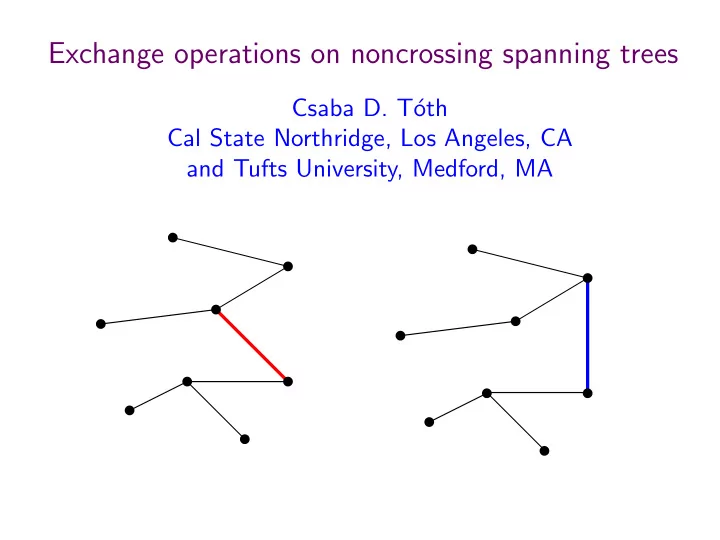
SLIDE 1 Exchange operations on noncrossing spanning trees
Csaba D. T´
Cal State Northridge, Los Angeles, CA and Tufts University, Medford, MA
SLIDE 2
Spanning Trees — Elementary Operations
There are nn−2 spanning trees on n labeled vertices [Cayley, 1889] Exchange property for graphic maroids: If T1 = (V, E1) and T2 = (V, E2) are spanning trees, ∀e1 ∈ E1 ∃e2 ∈ E2 : (V, E1 − e1 + e2) is a spanning tree. For n ≥ 4, there exist two edge-disjoint spanning trees. So the diameter of the exchange graph equals n − 1. abstract spanning tree = connected graph on n vertices that does not contain cycles.
SLIDE 3 Spanning Trees — Elementary Operations
For |S| = n, Ω(12.54n) ≤ max
|S|=n |T (S)| ≤ O(141.07n).
[Huemer and de Mier, 2015; Hoffmann et al. 2013] S = set of n points in general position in R2, T (S) = set of plane spanning trees on S. plane spanning tree = a straight-line spanning tree
- n n points in the plane, no two edges cross.
- The matroid exchange may introduce crossings!
- We restrict exchanges to plane spanning trees.
SLIDE 4 Spanning Trees — Elementary Operations
Let T1 = (S, E1) and T2 = (S, E2) be two trees in T (S). The operation that replaces T1 by T2 is
- an exchange if there are edges e1 and e2 such that
E1 \ E2 = {e1} and E2 \ E1 = {e2} (i.e., delete an edge e1 from E1 and insert a new edge e2).
- A compatible exchange is an exchange such that the
graph (S, E1 ∪ E2) is a noncrossing straight-line graph (i.e., e1 and e2 do not cross).
- A rotation is a compatible exchange such that e1 and
e2 have a common endpoint p = e1 ∩ e2.
- An empty-triangle rotation is a rotation such that the
edges of neither T1 nor T2 intersect the interior of the triangle ∆(pqr) formed by the vertices of e1 and e2.
- An edge slide is an empty-triangle rotation such that
qr ∈ E1 ∩ E2.
SLIDE 5
Spanning Trees — Elementary Operations
Exchange Compatible Exchange Rotation Empty-Triangle Rotation Edge Slide
SLIDE 6 Spanning Trees — Elementary Operations
Operation Single Operation Single Operation Upper Bound Lower Bound Exchange 2n − 4 ⌊ 3n
2 ⌋ − 5 [HHM+99]
Compatible Ex. 2n − 4 ⌊ 3n
2 ⌋ − 5
Rotation 2n − 4 [AF96] ⌊ 3n
2 ⌋ − 4
Empty-Tri. Rot. O(n log n) ⌊ 3n
2 ⌋ − 4
Edge Slide O(n2) [AR07] Ω(n2) [AR07] All five operations define connected transition graphs for every point set in general position. Current upper and lower bounds for the diameter
SLIDE 7 Spanning Trees — Simultaneous Operations
Upper and lower bounds for the diameter under simultaneous operations. Convex Position Empty-Tri. Rot. 4 3 Edge Slide O(log n) Ω(log n) Operation Simultaneous Simultaneous Upper Bound Lower Bound Exchange 1 1 Compatible Ex. O(log n) [AAH02] Ω(
log n log log n) [BRU+09]
Rotation O(log n) Ω(
log n log log n)
Empty-Tri. Rot. 8n Ω(log n) Edge Slide O(n2) [AR07] Ω(n)
SLIDE 8 Spanning Trees — Exchange Operation
Lower bound construction: It takes ⌊ 3n
2 ⌋ − 5 exchanges to
transform T1 to T2. [Hernando, Hurtado, M´ arquez, Mora, and Noy, 1999]
SLIDE 9 Spanning Trees — Exchange Operation
Lower bound construction: It takes ⌊ 3n
2 ⌋ − 5 exchanges to
transform T1 to T2. [Hernando, Hurtado, M´ arquez, Mora, and Noy, 1999] The same consturction gives a lower bound of ⌊ 3n
2 ⌋ − 4 for
rotation operations.
SLIDE 10
Spanning Trees — Exchange Operation
n − 2 exchanges can transform any plane graph into a star centered at the convex hull. ⇒ Diameter ≤ 2n − 4 [Avis & Fukuda, 1996]
SLIDE 11 Spanning Trees — Exchange Operation
n − 2 exchanges can transform any plane graph into a star centered at the convex hull. ⇒ Diameter ≤ 2n − 4 [Avis & Fukuda, 1996] Let v be a vertex on the convex hull. While T is not a star centered at v,
- v sees an entire edge ab.
- Rotate ab to av or bv.
v
SLIDE 12 Spanning Trees — Exchange Operation
n − 2 exchanges can transform any plane graph into a star centered at the convex hull. ⇒ Diameter ≤ 2n − 4 [Avis & Fukuda, 1996] Let v be a vertex on the convex hull. While T is not a star centered at v,
- v sees an entire edge ab.
- Rotate ab to av or bv.
a b v
SLIDE 13 Spanning Trees — Exchange Operation
n − 2 exchanges can transform any plane graph into a star centered at the convex hull. ⇒ Diameter ≤ 2n − 4 [Avis & Fukuda, 1996] Let v be a vertex on the convex hull. While T is not a star centered at v,
- v sees an entire edge ab.
- Rotate ab to av or bv.
a b v
SLIDE 14 Spanning Trees — Exchange Operation
n − 2 exchanges can transform any plane graph into a star centered at the convex hull. ⇒ Diameter ≤ 2n − 4 [Avis & Fukuda, 1996] Let v be a vertex on the convex hull. While T is not a star centered at v,
- v sees an entire edge ab.
- Rotate ab to av or bv.
a b v
SLIDE 15 Spanning Trees — Exchange Operation
n − 2 exchanges can transform any plane graph into a star centered at the convex hull. ⇒ Diameter ≤ 2n − 4 [Avis & Fukuda, 1996] Let v be a vertex on the convex hull. While T is not a star centered at v,
- v sees an entire edge ab.
- Rotate ab to av or bv.
a b v For n ≥ 3 points in convex position: diameter ≤ 23n
12 − 5.
[Lonner & T., 2018]
SLIDE 16 Spanning Trees — Empty-Triangle Rotation
Let ℓ be a halving line. Triangulate T. For every triangle ∆ along ℓ (in stabbing order),
crossed by ℓ is in T, then replace it with another edge of ∆. At most 3n empty-triangle rotations can remove all but one edges between the two halves. f(n) ≤ 3n + 2f(n/2) ⇒ Diameter is O(n log n)
SLIDE 17 Spanning Trees — Empty-Triangle Rotation
Let ℓ be a halving line. Triangulate T. For every triangle ∆ along ℓ (in stabbing order),
crossed by ℓ is in T, then replace it with another edge of ∆. At most 3n empty-triangle rotations can remove all but one edges between the two halves. f(n) ≤ 3n + 2f(n/2) ⇒ Diameter is O(n log n) ℓ
SLIDE 18 Spanning Trees — Empty-Triangle Rotation
Let ℓ be a halving line. Triangulate T. For every triangle ∆ along ℓ (in stabbing order),
crossed by ℓ is in T, then replace it with another edge of ∆. At most 3n empty-triangle rotations can remove all but one edges between the two halves. f(n) ≤ 3n + 2f(n/2) ⇒ Diameter is O(n log n) ℓ
SLIDE 19 Spanning Trees — Empty-Triangle Rotation
Let ℓ be a halving line. Triangulate T. For every triangle ∆ along ℓ (in stabbing order),
crossed by ℓ is in T, then replace it with another edge of ∆. At most 3n empty-triangle rotations can remove all but one edges between the two halves. f(n) ≤ 3n + 2f(n/2) ⇒ Diameter is O(n log n) ℓ
SLIDE 20 Spanning Trees — Empty-Triangle Rotation
Let ℓ be a halving line. Triangulate T. For every triangle ∆ along ℓ (in stabbing order),
crossed by ℓ is in T, then replace it with another edge of ∆. At most 3n empty-triangle rotations can remove all but one edges between the two halves. f(n) ≤ 3n + 2f(n/2) ⇒ Diameter is O(n log n) ℓ
SLIDE 21 Spanning Trees — Empty-Triangle Rotation
Let ℓ be a halving line. Triangulate T. For every triangle ∆ along ℓ (in stabbing order),
crossed by ℓ is in T, then replace it with another edge of ∆. At most 3n empty-triangle rotations can remove all but one edges between the two halves. f(n) ≤ 3n + 2f(n/2) ⇒ Diameter is O(n log n) ℓ
SLIDE 22 Spanning Trees — Empty-Triangle Rotation
Let ℓ be a halving line. Triangulate T. For every triangle ∆ along ℓ (in stabbing order),
crossed by ℓ is in T, then replace it with another edge of ∆. At most 3n empty-triangle rotations can remove all but one edges between the two halves. f(n) ≤ 3n + 2f(n/2) ⇒ Diameter is O(n log n) ℓ
SLIDE 23 Spanning Trees — Empty-Triangle Rotation
Let ℓ be a halving line. Triangulate T. For every triangle ∆ along ℓ (in stabbing order),
crossed by ℓ is in T, then replace it with another edge of ∆. At most 3n empty-triangle rotations can remove all but one edges between the two halves. f(n) ≤ 3n + 2f(n/2) ⇒ Diameter is O(n log n) ℓ
SLIDE 24 Spanning Trees — Empty-Triangle Rotation
Let ℓ be a halving line. Triangulate T. For every triangle ∆ along ℓ (in stabbing order),
crossed by ℓ is in T, then replace it with another edge of ∆. At most 3n empty-triangle rotations can remove all but one edges between the two halves. f(n) ≤ 3n + 2f(n/2) ⇒ Diameter is O(n log n) ℓ
SLIDE 25 Spanning Trees — Empty-Triangle Rotation
Let ℓ be a halving line. Triangulate T. For every triangle ∆ along ℓ (in stabbing order),
crossed by ℓ is in T, then replace it with another edge of ∆. At most 3n empty-triangle rotations can remove all but one edges between the two halves. f(n) ≤ 3n + 2f(n/2) ⇒ Diameter is O(n log n) ℓ
SLIDE 26 Spanning Trees — Empty-Triangle Rotation
Let ℓ be a halving line. Triangulate T. For every triangle ∆ along ℓ (in stabbing order),
crossed by ℓ is in T, then replace it with another edge of ∆. At most 3n empty-triangle rotations can remove all but one edges between the two halves. f(n) ≤ 3n + 2f(n/2) ⇒ Diameter is O(n log n) ℓ
SLIDE 27 Spanning Trees — Empty-Triangle Rotation
Let ℓ be a halving line. Triangulate T. For every triangle ∆ along ℓ (in stabbing order),
crossed by ℓ is in T, then replace it with another edge of ∆. At most 3n empty-triangle rotations can remove all but one edges between the two halves. f(n) ≤ 3n + 2f(n/2) ⇒ Diameter is O(n log n) ℓ
SLIDE 28 Spanning Trees — Empty-Triangle Rotation
Let ℓ be a halving line. Triangulate T. For every triangle ∆ along ℓ (in stabbing order),
crossed by ℓ is in T, then replace it with another edge of ∆. At most 3n empty-triangle rotations can remove all but one edges between the two halves. f(n) ≤ 3n + 2f(n/2) ⇒ Diameter is O(n log n) ℓ
SLIDE 29 Spanning Trees — Empty-Triangle Rotation
Let ℓ be a halving line. Triangulate T. For every triangle ∆ along ℓ (in stabbing order),
crossed by ℓ is in T, then replace it with another edge of ∆. At most 3n empty-triangle rotations can remove all but one edges between the two halves. f(n) ≤ 3n + 2f(n/2) ⇒ Diameter is O(n log n) ℓ
SLIDE 30 Simultaneous Empty-Triangle Rotation
Let ℓ be a halving line. Triangulate T. For every triangle ∆ along T (in stabbing order),
crossed by ℓ is in T, then replace it with another edge of ∆. At most 3n empty triangle rotations can remove all but one edges between the two halves. f(n) ≤ 3n + f(n/2) ⇒ Diameter is O(n) ℓ
SLIDE 31 Simultaneous Empty Triangle Rotations
logn(y)/2
Tree T1 contains a horizontal edge pq. Tree T2 is a star centered at r. p q r Ω(log n) simultaneous empty-triangle rotations are sometimes necessary:
SLIDE 32 Simultaneous Empty Triangle Rotations
logn(y)/2
Tree T1 contains a horizontal edge pq. Tree T2 is a star centered at r. p q r Ω(log n) simultaneous empty-triangle rotations are sometimes necessary:
SLIDE 33 Simultaneous Empty Triangle Rotations
logn(y)/2
Tree T1 contains a horizontal edge pq. Tree T2 is a star centered at r. p q r Ω(log n) simultaneous empty-triangle rotations are sometimes necessary:
SLIDE 34 Simultaneous Empty Triangle Rotations
logn(y)/2
Tree T1 contains a horizontal edge pq. Tree T2 is a star centered at r. p q r Ω(log n) simultaneous empty-triangle rotations are sometimes necessary:
SLIDE 35 Simultaneous Empty Triangle Rotations
logn(y)/2
Tree T1 contains a horizontal edge pq. Tree T2 is a star centered at r. p q r Ω(log n) simultaneous empty-triangle rotations are sometimes necessary:
SLIDE 36 Simultaneous Empty Triangle Rotations
logn(y)/2
Tree T1 contains a horizontal edge pq. Tree T2 is a star centered at r. p q r Ω(log n) simultaneous empty-triangle rotations are sometimes necessary:
SLIDE 37 Simultaneous Empty Triangle Rotations
logn(y)/2
Tree T1 contains a horizontal edge pq. Tree T2 is a star centered at r. p q r Ω(log n) simultaneous empty-triangle rotations are sometimes necessary:
SLIDE 38 Simultaneous Empty Triangle Rotations
logn(y)/2
Tree T1 contains a horizontal edge pq. Tree T2 is a star centered at r. p q r Ω(log n) simultaneous empty-triangle rotations are sometimes necessary:
SLIDE 39 Simultaneous Empty Triangle Rotations
logn(y)/2
Tree T1 contains a horizontal edge pq. Tree T2 is a star centered at r. p q r Ω(log n) simultaneous empty-triangle rotations are sometimes necessary:
SLIDE 40 Simultaneous Empty Triangle Rotations
logn(y)/2
Tree T1 contains a horizontal edge pq. Tree T2 is a star centered at r. p q r Ω(log n) simultaneous empty-triangle rotations are sometimes necessary:
SLIDE 41 Simultaneous Empty Triangle Rotations
logn(y)/2
Tree T1 contains a horizontal edge pq. Tree T2 is a star centered at r. p q r Ω(log n) simultaneous empty-triangle rotations are sometimes necessary:
SLIDE 42 Simultaneous Empty Triangle Rotations
logn(y)/2
Tree T1 contains a horizontal edge pq. Tree T2 is a star centered at r. p q r Ω(log n) simultaneous empty-triangle rotations are sometimes necessary:
SLIDE 43
Spanning Trees — Simultaneous Rotations
O(log n) simultaneous rotations can transform any plane graph into a star centered at the convex hull. ⇒ Diameter is O(log n)
SLIDE 44 Spanning Trees — Simultaneous Rotations
O(log n) simultaneous rotations can transform any plane graph into a star centered at the convex hull. ⇒ Diameter is O(log n) p p p p
- Let p be an extreme point.
- Assume p = (0, −∞)
by a projective trafo.
centered at p, Apply starify(p)
SLIDE 45 Spanning Trees — Simultaneous Rotations
O(log n) simultaneous rotations can transform any plane graph into a star centered at the convex hull. ⇒ Diameter is O(log n) p p p p
- Let p be an extreme point.
- Assume p = (0, −∞)
by a projective trafo.
centered at p, Apply starify(p)
SLIDE 46 Spanning Trees — Simultaneous Rotations
O(log n) simultaneous rotations can transform any plane graph into a star centered at the convex hull. ⇒ Diameter is O(log n) p p p p
- Let p be an extreme point.
- Assume p = (0, −∞)
by a projective trafo.
centered at p, Apply starify(p) e f Pe Pf
SLIDE 47 Spanning Trees — Simultaneous Rotations
O(log n) simultaneous rotations can transform any plane graph into a star centered at the convex hull. ⇒ Diameter is O(log n) p p p p
- Let p be an extreme point.
- Assume p = (0, −∞)
by a projective trafo.
centered at p, Apply starify(p) e f Pe Pf
SLIDE 48 Spanning Trees — Simultaneous Rotations
O(log n) simultaneous rotations can transform any plane graph into a star centered at the convex hull. ⇒ Diameter is O(log n) p p p p
- Let p be an extreme point.
- Assume p = (0, −∞)
by a projective trafo.
centered at p, Apply starify(p) e f Pe Pf
SLIDE 49 Spanning Trees — Simultaneous Rotations
O(log n) simultaneous rotations can transform any plane graph into a star centered at the convex hull. ⇒ Diameter is O(log n) p p p p
- Let p be an extreme point.
- Assume p = (0, −∞)
by a projective trafo.
centered at p, Apply starify(p)
SLIDE 50 Spanning Trees — Simultaneous Rotations
O(log n) simultaneous rotations can transform any plane graph into a star centered at the convex hull. ⇒ Diameter is O(log n) p p p p
- Let p be an extreme point.
- Assume p = (0, −∞)
by a projective trafo.
centered at p, Apply starify(p) starify(p) maintains a plane spanning tree. The sum of “discretre” horizontal extents all edges decreases by a factor of 1
2.
⇒ Algo. terminates after O(log n) moves.
SLIDE 51
Spanning Trees — Simultaneous Rotations
Each iteration of starify(p) can be implemented in at most 4 simultaneous rotations. p e Pe u v
SLIDE 52
Spanning Trees — Simultaneous Rotations
Each iteration of starify(p) can be implemented in at most 4 simultaneous rotations. p e Pe u v
SLIDE 53
Spanning Trees — Simultaneous Rotations
Each iteration of starify(p) can be implemented in at most 4 simultaneous rotations. p e Pe u v
SLIDE 54
Spanning Trees — Simultaneous Rotations
Each iteration of starify(p) can be implemented in at most 4 simultaneous rotations. p e Pe u v
SLIDE 55
Spanning Trees — Simultaneous Rotations
Each iteration of starify(p) can be implemented in at most 4 simultaneous rotations. p e Pe u v
SLIDE 56
Spanning Trees — Simultaneous Rotations
Each iteration of starify(p) can be implemented in at most 4 simultaneous rotations. p e Pe u v
SLIDE 57
Spanning Trees — Simultaneous Rotations
Each iteration of starify(p) can be implemented in at most 4 simultaneous rotations. p e Pe u v
SLIDE 58
Spanning Trees — Simultaneous Rotations
Each iteration of starify(p) can be implemented in at most 4 simultaneous rotations. p e Pe u v
SLIDE 59 Spanning Trees — Elementary Operations
Operation Single Operation Single Operation Upper Bound Lower Bound Exchange 2n − 4 ⌊ 3n
2 ⌋ − 5 [HHM+99]
Compatible Ex. 2n − 4 ⌊ 3n
2 ⌋ − 5
Rotation 2n − 4 [AF96] ⌊ 3n
2 ⌋ − 4
Empty-Tri. Rot. O(n log n) ⌊ 3n
2 ⌋ − 4
Edge Slide O(n2) [AR07] Ω(n2) [AR07] All five operations define connected transition graphs for every point set in general position. Current upper and lower bounds for the diameter
SLIDE 60 Spanning Trees — Simultaneous Operations
Upper and lower bounds for the diameter under simultaneous operations. Convex Position Empty-Tri. Rot. 4 3 Edge Slide O(log n) Ω(log n) Operation Simultaneous Simultaneous Upper Bound Lower Bound Exchange 1 1 Compatible Ex. O(log n) [AAH02] Ω(
log n log log n) [BRU+09]
Rotation O(log n) Ω(
log n log log n)
Empty-Tri. Rot. 8n Ω(log n) Edge Slide O(n2) [AR07] Ω(n)
SLIDE 61 Reconstuct Crossings from Plane Spanning Trees
Keller & Perles [2016]: Given the exchange graph on T (S), for some point set S, one can compute the intersection graph
- f the edges of K(S). In other words, the exchange graph
determines which pairs of edges of K(S) cross. S = set of n points in general position in R2, T (S) = set of plane spanning trees on S. K(S) = complete geometric graph on S.
SLIDE 62 Reconstuct Crossings from Plane Spanning Trees
Keller & Perles [2016]: Given the exchange graph on T (S), for some point set S, one can compute the intersection graph
- f the edges of K(S). In other words, the exchange graph
determines which pairs of edges of K(S) cross. S = set of n points in general position in R2, T (S) = set of plane spanning trees on S. K(S) = complete geometric graph on S. Oropeza & T. [2018]: Given the compatible exchange graph
- n T (S), for some point set S, one can compute the
intersection graph of the edges of K(S). In other words, the compatoble exchange graph determines which pairs of edges of K(S) cross.
SLIDE 63 Open Problems
Improve the diameter bounds for the “tree graphs.”
2n⌋ exchange operations enough to transform a
plane spanning tree to any other plane spanning tree?
- Is the diameter for empty-triangle rotation O(n)?
- Is the diameter for simultanous edge slides Θ(n), or
Θ(n2), or something in between? Transformation graphs for other variants:
- Is the space of plane spanning trees of max degee≤ k
connected under any or all of the five operations?
- If the edges have unique labels, can these operations
“shuffle” the labels arbitrarily?
SLIDE 64 Open Problems
Reconstruction of intersection pattens from “tree graphs.”
- Does the transition graph of rotations contain enough
informartion to reconstruct the intersection graph of the edges of K(S)?
- For finding a possible counterexample, we need to
generate finite point sets S1, S2 ⊂ R2 such that |S1| = |S2|, |T (S1)| = |T (S2)|, and the intersection patterns of K(S1) and K(S2) are different.
SLIDE 65
Thank you for your attention!