Exercise Program Planning 101 KICK IT UP A NOTCH! Joni Alonso - - PDF document

exercise program planning 101
SMART_READER_LITE
LIVE PREVIEW

Exercise Program Planning 101 KICK IT UP A NOTCH! Joni Alonso - - PDF document

8/31/2009 Exercise Program Planning 101 KICK IT UP A NOTCH! Joni Alonso B.S. HFS NCBTMB Health Program Specialist Components of a workout Components of a workout Warm-Up Warm-Up Conditioning 5-15 minutes Increases body


slide-1
SLIDE 1

8/31/2009 1

KICK IT UP A NOTCH!

Joni Alonso B.S. HFS NCBTMB Health Program Specialist

Exercise Program Planning 101

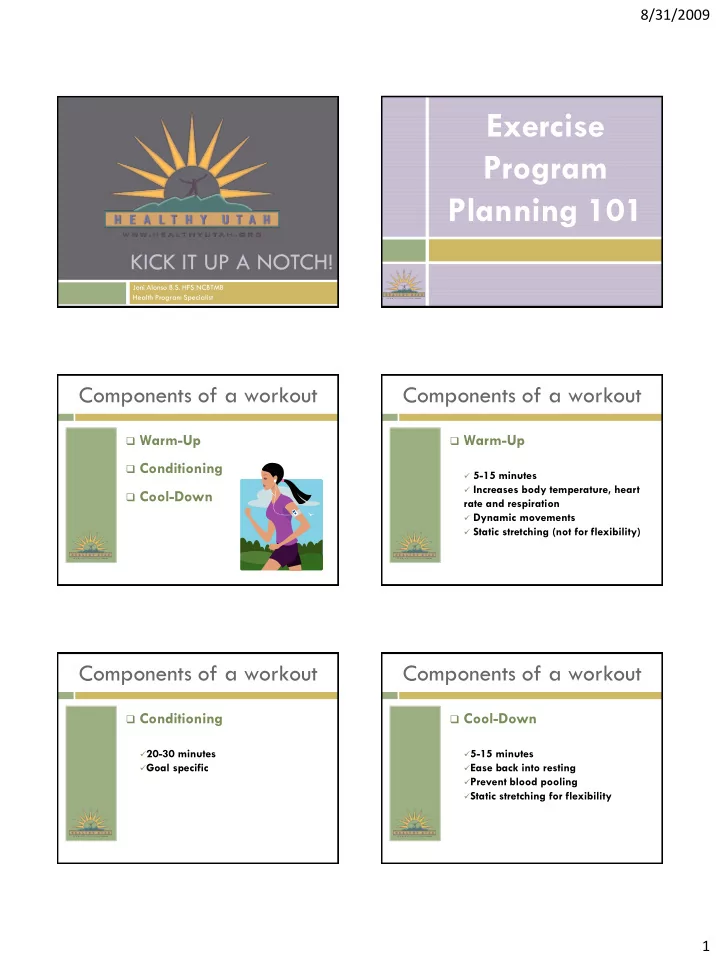
Components of a workout

 Warm-Up  Conditioning  Cool-Down

Components of a workout

 Warm-Up

 5-15 minutes  Increases body temperature, heart

rate and respiration

 Dynamic movements  Static stretching (not for flexibility)

Components of a workout

 Conditioning

20-30 minutes Goal specific

Components of a workout

 Cool-Down

5-15 minutes Ease back into resting Prevent blood pooling Static stretching for flexibility

slide-2
SLIDE 2

8/31/2009 2

FITT Formula

 Frequency

How often?

 Intensity

How hard?

 Time

How long?

 Type

What activity?

FITT Formula Example

 Frequency

5 times a week

 Intensity

65 % Max HR / 11-13 RPE

 Time

60 minutes

 Type

Jogging

Does This Make Sense?

Take Every Opportunity to “Kick it Up a Notch”!

Training Principles

Specificity

Specificity: or SAID principle “Specific Adaptations to Imposed Demands” or in

  • ther words, What you do is

what you get.

Overload

Overload: place a demand on the body greater than it is accustomed to. The body’s structures and functions respond and adapt to this demand.

  • Quantity

training volume = frequency X duration

  • Quality

training intensity

slide-3
SLIDE 3

8/31/2009 3

Adaptation

Adaptation: change in physiological function that

  • ccurs in response to training

during periods of rest and recovery.

Progression

Progression: connected to

  • verload. Training loads

should be small, controlled and flexible. Progression

  • ccurs with continued
  • verload and adaptation.

Which Pattern of Progression is best?

1 2 3 4 5 6 7 8 9 Training Load

Progression 1

1 2 3 4 5 6 7 8 9 Training Load

Progression 2

1 2 3 4 5 6 7 8 9 Training Load

Progression 3

Which Pattern of Progression is best?

1 2 3 4 5 6 7 8 9 Training Load

Progression 3 Overtraining is most likely to occur in individuals when large increases in training occur abruptly and when the rest and recovery periods are insufficient.

Progressive Overload

Gradual increase of load = gradual adaptation, which prevents overtraining, excess soreness & injury!

How do I progress?

slide-4
SLIDE 4

8/31/2009 4

Take the next challenge

“If you have a great ambition, take as big a step as possible in the direction of fulfilling it. The step may only be a tiny one, but trust that it might be the largest one possible for now” ~Mildred Mcafee

Take the next challenge

If you do not challenge your current state of ability you will only maintain what you currently have.

FITT Formula

 Frequency

Add no more than one day per week

 Intensity

Increase by no more than 10%

 Time

Increase by no more than 10%

 Type

May need to decrease other components

Progression

One FITT factor at a time

Prevent Plateaus

Too much time spent doing the same type of workout using the same equipment in the same environment can lead to a plateau. A plateau may be an early warning signal of

  • vertraining.

The Answer: Variety and Rest

Prevent Reversibility

Changes occurring with exercise are reversible Loss may begin within 48 hours of inactivity Greatest benefits retained by maintaining intensity Ex: If a person had to travel for 2 weeks and was unable to get in their 30-minute run 5 days a week, dropping to 20-minutes or 3 days a week while maintaining target heart rate or RPE will best help maintain current fitness level.

slide-5
SLIDE 5

8/31/2009 5

Cardiorespiratory Training

Physical Activity Guidelines for Americans

 300 minutes (5 hrs) per week of moderate

intensity, or 150 minutes (2.5 hrs) a week of vigorous activity, or an equivalent combination of both. 60-90 minutes of moderate activity

 Most effective amount of time to lose weight and

maintain it! Additional benefits beyond this point!

Up a Notch Up a Notch

Moderate Activity:

 Equivalent in effort to brisk walking  Ex: Walking briskly (3mph or faster), water

aerobics, biking (less than 10mph), doubles tennis, general gardening. Vigorous Activity:

 Equivalent in effort to running or jogging  Ex: Racewalking, jogging or running, swimming

laps, singles tennis, biking (10mph or faster), jumping rope, hiking uphill with a heavy backpack.

Up a Notch

Cross Training

 Adds variety  Increases benefits  Prevents overtraining  Balanced fitness

Up a Notch

Interval Training

 Bursts of higher intensity exercise combined

with moderate intensity recovery periods.

 Helps raise current ceiling or threshold  Effective method for fitness, speed

training, weight loss, etc.

Up a Notch

Interval Training

 Ratio Variations:

 5-1, 2-1, 1-1, 1-2, 1-5, etc.

 Method:

 HR  Speed  Grade/Resistance

Strength Training: Up a Notch

Physical Activity Guidelines for Americans

 Moderate or high intensity and involve all

major muscle groups on 2 or more days a week.

 Endurance – 12-15 repetitions  Strength – 8-12 repetitions

Your last repetition should be difficult to do without help!
slide-6
SLIDE 6

8/31/2009 6

Tools For Gauging Intensity

Rate of Perceived Exertion (RPE)

RPE SCALE

6 no exertion at all 7 very, very light 8 9 very light 10 11 fairly light 12 13 somewhat hard 14 15 hard 16 17 very hard 18 19 very, very hard 20 maximal Exertion

RPE and your Heart Rate

RPE SCALE Heart Rate 6 no exertion at all 60 bpm 7 very, very light 70 bpm 8 80 bpm 9 very light 90 bpm 10 100 bpm 11 fairly light 110 bpm 12 120 bpm 13 somewhat hard 130 bpm 14 140 bpm 15 hard 150 bpm 16 160 bpm 17 very hard 170 bpm 18 180 bpm 19 very, very hard 190 bpm 20 maximal Exertion 200 bpm

How does it relate?

RPE Zones

RPE SCALE

6 no exertion at all 7 very, very light 8 9 very light 10 11 fairly light 12 13 somewhat hard 14 15 hard 16 17 very hard 18 19 very, very hard 20 maximal Exertion

ENDURANCE TRAINING ZONE STRENGTH TRAINING ZONE

RPE Zones

RPE SCALE

11 fairly light 12 13 somewhat hard

ENDURANCE TRAINING ZONE

Cardiorespiratory Endurance Training 3-5 times per week 55% - 65% of Max Heart Rate Muscle Endurance Training 1-2 times per week 20% - 40% of 1RM

RPE Zones

RPE SCALE

15 hard 16 17 very hard

STRENGTH TRAINING ZONE

Cardiorespiratory Strength Training 3-5 times per week 75% - 85% of Max Heart Rate Muscle Strength Training1-2 times per week 60% - 80% of 1RM

slide-7
SLIDE 7

8/31/2009 7 VO2 Max

 Maximum level of aerobic power or the

maximum amount of oxygen that you are able to utilize during exercise by working muscles.

 The higher your VO2 max the greater your

potential in aerobic endurance activities.

 The test involves walking, running or

cycling until exhausting therefore is not appropriate for everyone.

 Sub max tests can estimate VO2 max with

less risk to the participant.

Optimize Your Workout

VO2 Max Benefits

 Accurate measure of cardiorespiratory

fitness

 Provides information to take training “Up

a Notch”

 Max Heart Rate  VO2 Max  Ventilatory Threshold

Optimize Your Workout

Improving VO2 Max

 Emphasize quality rather than quantity

  • f your training.

 High-intensity training 1-2 days/wk have

been shown to increase VO2 max.

 Intervals very effective  Include longer less intense workouts in

between for recovery.

Optimize Your Workout

Improving Ventilatory Threshold

 Based on overload principle  Studies show that long, intense workouts

as well as interval training can raise your threshold.

 Beginners have shown change by

training at 80% VO2 max (correlated HR).

Optimize Your Workout

1 Rep Max (1RM)

 Maximum amount of resistance you can

move a given number of times. 1RM = maximum weight lifted one time.

 Estimate 1RM – not as accurate but safer

for certain people

 Allows for specific training at

percentages of 1RM.

Optimize Your Workout

 Progressively Overload  FITT Formula  Incorporate Training Variations  Cross Training  Interval Training  New Activities  Optimize Your Workout  Gain knowledge to make your workouts

more efficient and effective.

Kick It Up a Notch

slide-8
SLIDE 8

8/31/2009 8

KICK IT UP A NOTCH!

QUESTIONS?