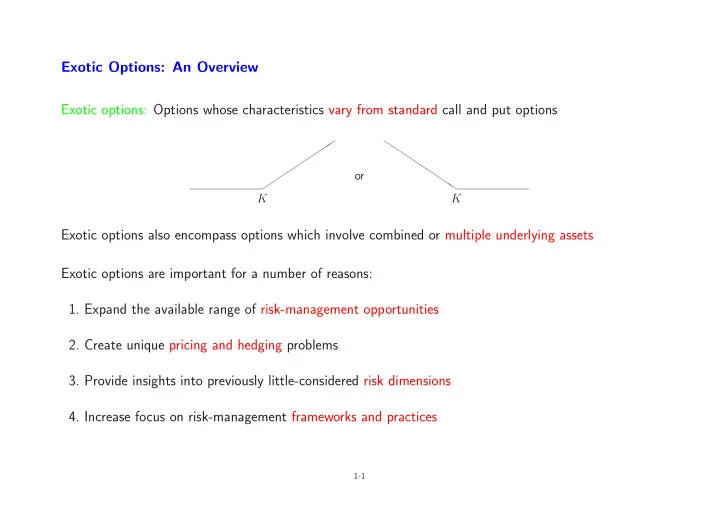
SLIDE 1 Exotic Options: An Overview Exotic options: Options whose characteristics vary from standard call and put options
✑✑✑✑✑✑✑✑ ✑
K
◗◗◗◗◗◗◗◗ ◗
K
Exotic options also encompass options which involve combined or multiple underlying assets Exotic options are important for a number of reasons:
- 1. Expand the available range of risk-management opportunities
- 2. Create unique pricing and hedging problems
- 3. Provide insights into previously little-considered risk dimensions
- 4. Increase focus on risk-management frameworks and practices
1-1
SLIDE 2 Evolution: The emergence of exotic options is driven by the overall evolution of risk management itself Key factors include:
- 1. Uncertainty/Volatility in asset markets
Example: At the onset of hostilities in the Middle East between Kuwait and Iraq, the oil markets were affected by enormous price disruptions
- 2. Increased focus on financial risk management
Example: Q-Cap allows for more precise hedging than standard options, thereby eliminating the possibility of overhedging (for a 23% cost saving)
- 3. Demand for highly customized risk-reward profiles
Example: CHOYS, a two factor spread option on the yields of two notes of different maturities
- 4. Development of option pricing and hedging technology
1-2
SLIDE 3
Product Developers: In 1991, the following 17 banks were identified by industry experts as innovative in terms of product development undertaken from a London base
Head office Barclays Bank England Chase Manhattan Bank U.S. Chemical Bank U.S. Citicorp Investment Bank U.S. Credit Suisse First Boston U.S. First National Bank of Chicago U.S. Goldman Sachs International U.S. Hambros Bank England Morgan JP Securities U.S. Head office Midland Montagu England Morgan Stanley U.S. National Westminster Bank England Noimura Bank International England Solomon Brothers International U.S. Societe Generale France Swiss Bank Corporation Switzerland Union Bank of Switzerland Switzerland
1-3
SLIDE 4
Key Players: Rankings in September 1993 and September 1994 for the ten most popular second-generation derivatives, including Asian (average) options, spread options, lookback options, barrier options, quanto options, and compound options
September 1993 Bankers Trust Union Bank of Switzerland Solomon Brothers JP Morgan Mitsubishi Finance Barclays Bank Credit Suisse Financial Products Merrill Lynch Morgan Stanley General Re Financial Products Swiss Bank Corporation Goldman Sachs Societe Generale September 1994 Bankers Trust Union Bank of Switzerland Solomon Brothers Swiss Bank Corporation Morgan Stanley JP Morgan Goldman Sachs Merrill Lynch Societe Generale Credit Suisse Financial Products
1-4
SLIDE 5 User Groups: Who are the users of exotic options?
- 1. Investors and asset managers
On the buy side to enhance the yield of their assets
Derivatives dealers are interested in option premiums
- 3. Nondealer financial institutions
Commercial banks or insurance companies use exotic options to deal with their asset and liability mismatches
Corporations aim to generate cost-effective funding and to create more appropriate hedge structures for their risk exposures
1-5
SLIDE 6 Example of Cost-Effective Funding: Benetton’s innovative funding campaign in July 1993 Five-year L200 billon Eurolira bond issue with knock-out warrants
- 1. Bond: (i) 4.5% annual coupon
(ii) yield to maturity of 10.54%
- 2. Warrant: (i) priced at L17,983
(ii) 63 warrants per bond (iii) conditional put strike price of L21,543 (iv) knock-out price of L24,353 (v) call strike price of L29,973 (vi) exercisable after three years
1-6
SLIDE 7 Example of Cost-Effective Funding (continued) What does the knock-out warrant provide?
- 1. Exposure to the upside performance of the ordinary share
- 2. While minimizing the downside risk that comes with holding an ordinary share through a
conditional money-back feature
- 3. At a 4% discount to the share price
How does it work? When an investor buys a warrant, he is
- 1. Buying an ordinary share
- 2. Selling the dividend cash flow associated with it
- 3. Buying a conditional put option at the strike price of L21,543
- 4. Selling a call option at the strike price of L29,973
1-7
SLIDE 8 Example of Cost-Effective Funding (continued) What happens on expiration?
- 1. Closing price of the share at maturity is less than or equal to L21,543
AND Share price has not at any time equaled or exceeded L24,353 One warrant will entitle the holder to receive L21,543
- 2. At maturity the share price exceeds L21,543
OR Closing share price has at any time prior to maturity equaled or exceeded L24,353 One warrant will entitle the holder to receive either (i) one ordinary share (or its cash equivalent)
1-8
SLIDE 9 Example of Hedging of Corporate Risk: DM-based company switching to US-based component supplier Costings were based on an exchange rate of 1.5000 DM/$ Any strengthening of the dollar will give rise to a material loss Total purchases for the year are projected to be $20 million, to be paid fairly evenly over the period To hedge this exposure, three alternatives have been suggested:
Problem: If the total purchases fall short of the projections, then they will have purchased more dollars than required and be at risk to a fall in the dollar
- 2. (A strip of) regular options
Problem: expensive and cumbersome
- 3. Average rate options (AVROs)
1-9
SLIDE 10 Example of Hedging of Corporate Risk: (continued) AN AVRO can be used to solve this problem as follows:
- 1. Twelve monthly payments for a total of $20 million
- 2. Projected total DM cost is 20 million × 1.5000
- 3. The risk is that the actual total DM cost turns out to be higher than projected
- 4. The company should purchase a dollar call/DM put AVRO
(i) A strike of 1.5000 (ii) On an amount of $20 million (iii) With 12 monitoring dates on the 12 projected payment dates
1-10
SLIDE 11 Key Applications: Exotic options can be used to serve the following objectives:
Example: Use of “best of” options to capture the return of that index which will have the best performance at the end of a period
- 2. Proprietary trading/positioning
- 3. Structured protection
Example: A gold mining company feels that protection against rising interest rates is only necessary when gold prices are falling It purchases an interest rate cap with an up-barrier in gold price
- 4. Premium reduction strategies
1-11
SLIDE 12
Example of Proprietary Positioning: Straddle vs double barrier box A client wants to take a position on the European currencies converging (volatility of exchange rate declines) Short a straddle: Simultaneously sell a call and a put, each struck at $100
✑✑✑✑✑✑✑✑ ✑◗◗◗◗◗◗◗◗ ◗
$100
The one-year straddle costs $11.58 The client makes all the $11.58 if the underlying stays at or near $100 at the end of the year However, the client will lose big if at the end of the year the underlying is far from $100 The client makes $11.58 to potentially lose an unlimited amount
1-12
SLIDE 13 Example of Proprietary Positioning (continued) Buy a double barrier box: Simultaneously buy (i) a double barrier call struck at $88 (ii) a double barrier put struck at $112 each with barriers at $88 and $112
$112 +
❅ ❅ ❅ ❅ ❅ ❅ ❅ ❅ ❅
$88 $112 + $88 $112 112 − 88 = $24
If the underlying has not touched either $88 or $112 throughout the year, the client gets $24 If the underlying touches either of these values, the double barrier pays nothing The client spends $4.30 to potentially earn $24
1-13
SLIDE 14 Example of Premium Reduction Strategies: “Is an expensive hedge better than no hedge at all? We would rather be unhedged than expensively hedged.” — a German corporate treasurer U.K. retailer Kingfisher survived the ERM breakdown relatively unscathed by using foreign currency basket options Traditionally, a corporate treasurer with a series of currency exposures could either hedge all the exposures separately or find a proxy currency or currencies through which to hedge the overall exposure
- 1. Hedging exposures individually is expensive
- 2. Finding proxies is difficult and imprecise
Basket options get around these problems They are a simple, inexpensive way to collect a series of identifiable foreign exchange risk positions and then hedge them with a single transaction
1-14
SLIDE 15 Building Blocks: We subdivide exotic-option instruments into a number of categories
- 1. Payoff modified options
Payoff under the contract is modified from the conventional return (either zero or difference between strike price and asset price) Examples: digital, contingent-premium, power options
- 2. Time/Volatility-dependent options
Options where the purchaser has the right to nominate a specific characteristic as a function of time Useful when there is some event which occurs in the short term which will then potentially affect
- utcomes further in the future
Examples: chooser, compound, forward start options
1-15
SLIDE 16 Building Blocks (continued)
- 3. Correlation-dependent/Multifactor options
A pattern of pay-offs based on the relationship between multiple assets (not just the price of single assets) Examples: basket, exchange, quanto, rainbow options
- 4. Path-dependent options
Payoffs are a function of the particular continuous path that asset prices follow over the life of the
Examples: average rate, average strike, barrier, one-touch, lookback options
1-16
SLIDE 17 Statistical Concepts: For a continuous random variable X with PDF f(x), we have
∞
−∞
x f(x) dx
X = Var(X) = E
2 = ∞
−∞
(x − µX)2f(x) dx If Y is a random variable defined by Y = g(X) for some function g, then E(Y ) = E
∞
−∞
g(x)f(x) dx It is easy to verify that Var(X) = E(X2) −
2, where E(X2) = ∞
−∞
x2f(x) dx Normal distribution: If X has a N(µ, σ2) distribution, then the PDF of X is f(x) = 1 σ √ 2π exp
2σ2
so that E(X) = µ and Var(X) = σ2
1-17
SLIDE 18
Statistical Concepts (continued)
−6 −4 −2 2 4 6 0.00 0.05 0.10 0.15 0.20
N(0,4)
x f(x) −6 −4 −2 2 4 6 0.0 0.1 0.2 0.3 0.4
N(0,1)
x f(x)
Standardization: Z = X − µ σ has a N(0, 1) distribution with PDF n(z) and CDF N(z) n(z) = 1 √ 2πe−z2/2 and N(z) = z
−∞
n(t) dt = z
−∞
1 √ 2πe−t2/2 dt The standard normal CDF is widely tabulated
1-18
SLIDE 19 Statistical Concepts (continued) Brownian motion: A [Markov] process with continuous time and continuous paths such that
- 1. B(0) = 0 [convention]
- 2. Bt1 − Bt0, . . . , Btn − Btn−1 (t0 < t1 · · · < tn) are independent [independent increments]
- 3. The distribution of Bt − Bs only depends on t − s [stationary increments]
- 4. Bt has a N(0, t) distribution [standard Gaussian]
- 5. t → Bt is continuous [continuous paths]
1-19
SLIDE 20 Black-Scholes Model: The underlying asset price St follows the geometric Brownian motion dSt = µStdt + σStdBt Equivalently St = S0 exp
2
Xt = ln St S0
2
Xt is normally distributed with mean (µ − σ2/2)t and variance σ2t Historical volatility: Sample asset prices S0, S1, . . . , Sn at regular intervals of length t Compute asset returns xj = ln(Sj/Sj−1) and estimate v2 = σ2t using ˆ v2 = 1 n
n
x2
j (MLE)
Estimate annualized volatility with ˆ σ = ˆ v/ √ t (e.g., ˆ σ = ˆ v √ 248 if t = 1 trading day) Implied volatility: That value of σ in the Black-Scholes formula (later) such that observed option price equals Black-Scholes price
1-20
SLIDE 21 Valuation: Exotic options (along with standard ones) can be priced using the following methods
- 1. Partial differential equations
Use arbitrage-free arguments to derive second-order PDEs satisfied by option prices Apply appropriate boundary conditions to solve the PDEs for option pricing formulas For example, the value of a European call option satisfies the PDE −rC + ∂C ∂t + rS∂C ∂S + 1 2σ2S∂2C ∂S2 = 0 with the boundary condition C(S, T) = (S − K)+ PDEs can be solved analytically or numerically using finite-difference methods Finite-difference approximations of the partial derivatives are used to rewrite the PDEs as finite-difference equations, which can solved by building a lattice on which approximate values of the desired variables are obtained
1-21
SLIDE 22 Valuation (continued)
- 2. Risk-neutral valuation (evaluating expected payoffs)
Under risk neutrality, the expected return of the underlying asset µ must equal r − q (where r = risk-free rate, domestic rate; q = dividend rate, foreign rate) The values of European options can be obtained by discounting the expected payoffs of the options at maturity by the risk-free rate r value = e−rTE
- payoffT
- For example, the price of a European call option is
e−rTE
= e−rT ∞
ln(K/S0)
(S0ex − K)f(x) dx which evaluates to the Black-Scholes formula C = S0e−qTN(d1) − Ke−rTN(d2)
1-22
SLIDE 23
Valuation (continued)
S 90 100 110 T 0.2 0.4 0.6 0.8 call price 5 10 15 20 25
Call option price C decreases with passage of time but increases with moneyness (as S increases)
1-23
SLIDE 24 Valuation (continued)
- 3. Monte Carlo simulations
Generate large numbers of numerically simulated realizations of random walks followed by the underlying asset prices (essentially normally distributed variables) Evaluate the terminal payoff (payoffT) of each sample path Average over all simulated values of payoffT and discount by risk-free rate r Compare with risk-neutral valuation: value = e−rTE
- payoffT
- Simulations are increasingly used to price path-dependent derivatives because products have
become more complex in nature and it is difficult to obtain closed-form solutions for many of them Variance-reduction techniques are often needed to efficiently reduce the standard error of the price estimates
1-24
SLIDE 25 Valuation (continued)
- 4. Lattice- and tree-based methods
We concentrate on the recombining tree model, where the total number of upward moves and that
- f downward moves determine a path completely
✦✦✦✦✦✦✦✦✦✦✦✦✦✦✦✦✦✦✦✦✦✦✦✦✦✦ ✦ ✦✦✦✦✦✦✦✦✦✦✦✦✦✦✦✦✦✦✦ ✦ ✦✦✦✦✦✦✦✦✦✦✦✦✦ ✦ ✦✦✦✦✦✦ ✦ ❛❛❛❛❛❛❛❛❛❛❛❛❛❛❛❛❛❛❛❛❛❛❛❛❛❛ ❛ ❛❛❛❛❛❛❛❛❛❛❛❛❛❛❛❛❛❛❛ ❛ ❛❛❛❛❛❛❛❛❛❛❛❛❛ ❛ ❛❛❛❛❛❛ ❛ r r r r r r r r r r r r r r r
S uS dS u2S udS d2S u3S u2dS ud2S d3S u4S u3dS u2d2S ud3S d4S
n-step tree ∆ = T/n u = eσ
√ ∆
d = 1/d p = er∆t − d u − d At the terminal date evaluate the payoff and work backwards to get the value at any node as p × valueu + (1 − p) × valued
1-25
SLIDE 26
Price Sensitivities: The sensitivity parameters are important in managing an option position Delta: The delta measures how fast an option price changes with the price of the underlying asset ∆ = ∂C ∂S = e−qTN(d1) It represents the hedge ratio, or the number of options to write/buy to create a risk-free portfolio Charm, given by ∂∆/∂T, is used as an ad hoc measure of how delta may change overnight Delta hedging is a trading strategy to make the delta of a portfolio neutral to fluctuations of the underlying asset price For example, the portfolio which is long/short one unit of a European call option and short/long ∆ units of the underlying asset is delta-neutral Long/short a call: S ↑ ⇒ ∆ ↑ so delta hedge by selling/buying more underlying asset Delta hedging does not protect an option position against variations in time remaining to maturity
1-26
SLIDE 27
Price Sensitivities (continued)
S 90 100 110 T 0.2 0.4 0.6 0.8 call delta 0.2 0.4 0.6 0.8
Long an ITM/ATM/OTM call: T ↓ ⇒ ∆ rises/holds/falls so sell/—/buy more underlying asset
1-27
SLIDE 28
Price Sensitivities (continued)
S 90 100 110 volatility 0.1 0.2 0.3 0.4 call delta 0.2 0.4 0.6 0.8
Effect of σ on ∆ similar to effect of T (intuition: in the ∆ formula there are terms σ2T and σ √ T)
1-28
SLIDE 29
Price Sensitivities (continued) Gamma: The gamma measures how fast the option’s delta changes with the price of its underlying asset Γ = ∂∆ ∂S = e−qTn(d1) Sσ √ T It is an indication of the vulnerability of the hedge ratio (large Γ equates to greater risk in option) Γ is highest for an ATM option and decreases either side when the option gets ITM or OTM Γ of an ATM option rises significantly when σ decreases and the option approaches maturity For delta-neutral strategies, a positive Γ allows profits when market conditions change rapidly while a negative Γ produces losses Two related risk measures are speed, given by ∂Γ/∂S and color, given by ∂Γ/∂T
1-29
SLIDE 30
Price Sensitivities (continued)
S 90 100 110 T 0.2 0.4 0.6 0.8 call gamma 0.01 0.02 0.03 0.04
Effect of σ on Γ (not shown) similar to effect of T
1-30
SLIDE 31
Price Sensitivities (continued) Theta: The theta measures how fast an option price changes with time to expiration Θ = ∂C ∂T = −qSe−qTN(d1) + rKe−rTN(d2) + σSe−qTn(d1) 2 √ T A large Θ indicates high exposure to the passage of time Θ is highest for ATM options with short maturity Vega: The vega measures how fast an option price changes with volatility V = ∂C ∂σ = Se−qTn(d1) √ T = σTS2Γ Positive V means option price is an increasing function of volatility Buying/Selling options is equivalent to buying/selling volatility V is highest for ATM long-term options
1-31
SLIDE 32
Price Sensitivities (continued)
S 90 100 110 T 0.2 0.4 0.6 0.8 call theta 5 10 15
The option buys loses Θ while the option writer “gains” it
1-32
SLIDE 33
Price Sensitivities (continued)
S 90 100 110 T 0.2 0.4 0.6 0.8 call vega 10 20 30
V is related directly to Γ via V = σTS2Γ
1-33
SLIDE 34
Summary: New generations of risk-management products, like traditional derivatives, continue to permit the separation, unbundling and ultimate redistribution of price risks in financial markets The increased capacity to delineate risks more precisely should, theoretically, improve the capacity of markets to redistribute and reallocate risks based on the economic value of the market risk, thus facilitating a more efficient allocation of economic resources
1-34