Expectation, moments Two elementary definitions of expected values: - - PDF document

expectation moments two elementary definitions of
SMART_READER_LITE
LIVE PREVIEW

Expectation, moments Two elementary definitions of expected values: - - PDF document

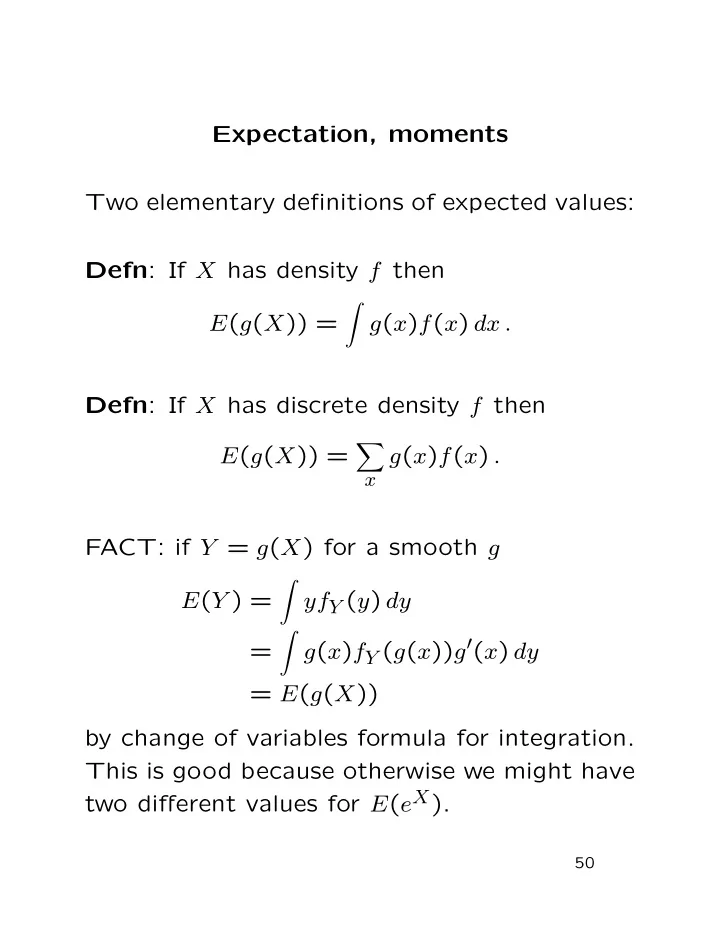
Expectation, moments Two elementary definitions of expected values: Defn : If X has density f then E ( g ( X )) = g ( x ) f ( x ) dx . Defn : If X has discrete density f then E ( g ( X )) = g ( x ) f ( x ) . x FACT: if Y = g ( X ) for a


slide-1
SLIDE 1

Expectation, moments Two elementary definitions of expected values: Defn: If X has density f then E(g(X)) =

  • g(x)f(x) dx .

Defn: If X has discrete density f then E(g(X)) =

  • x

g(x)f(x) . FACT: if Y = g(X) for a smooth g E(Y ) =

  • yfY (y) dy

=

  • g(x)fY (g(x))g′(x) dy

= E(g(X)) by change of variables formula for integration. This is good because otherwise we might have two different values for E(eX).

50

slide-2
SLIDE 2

Defn: X is integrable if E(|X|) < ∞ . Facts: E is a linear, monotone, positive oper- ator:

  • 1. Linear: E(aX +bY ) = aE(X)+bE(Y ) pro-

vided X and Y are integrable.

  • 2. Positive: P(X ≥ 0) = 1 implies E(X) ≥ 0.
  • 3. Monotone: P(X ≥ Y ) = 1 and X, Y inte-

grable implies E(X) ≥ E(Y ).

51

slide-3
SLIDE 3

Defn: The rth moment (about the origin) of a real rv X is µ′

r = E(Xr) (provided it exists).

We generally use µ for E(X). Defn: The rth central moment is µr = E[(X − µ)r] We call σ2 = µ2 the variance. Defn: For an Rp valued random vector X µX = E(X) is the vector whose ith entry is E(Xi) (provided all entries exist). Defn: The (p × p) variance covariance matrix

  • f X is

Var(X) = E

  • (X − µ)(X − µ)t

which exists provided each component Xi has a finite second moment.

52

slide-4
SLIDE 4

Moments and probabilities of rare events are closely connected as will be seen in a number

  • f important probability theorems.

Example: Markov’s inequality P(|X − µ| ≥ t) = E[1(|X − µ| ≥ t)] ≤ E

  • |X − µ|r

tr 1(|X − µ| ≥ t)

  • ≤ E[|X − µ|r]

tr Intuition: if moments are small then large de- viations from average are unlikely. Special case is Chebyshev’s inequality: P(|X − µ| ≥ t) ≤ Var(X) t2 .

53

slide-5
SLIDE 5

Example moments: If Z ∼ N(0, 1) then E(Z) =

−∞ ze−z2/2dz/

√ 2π = −e−z2/2 √ 2π

−∞

= 0 and (integrating by parts) E(Zr) =

−∞ zre−z2/2dz/

√ 2π = −zr−1e−z2/2 √ 2π

−∞

+ (r − 1)

−∞ zr−2e−z2/2dz/

√ 2π so that µr = (r − 1)µr−2 for r ≥ 2. Remembering that µ1 = 0 and µ0 =

−∞ z0e−z2/2dz/

√ 2π = 1 we find that µr =

  • r odd

(r − 1)(r − 3) · · · 1 r even .

54

slide-6
SLIDE 6

If now X ∼ N(µ, σ2), that is, X ∼ σZ + µ, then E(X) = σE(Z) + µ = µ and µr(X) = E[(X − µ)r] = σrE(Zr) In particular, we see that our choice of nota- tion N(µ, σ2) for the distribution of σZ + µ is justified; σ is indeed the variance. Similarly for X ∼ MV N(µ, Σ) we have X = AZ + µ with Z ∼ MV N(0, I) and E(X) = µ and Var(X) = E

  • (X − µ)(X − µ)t

= E

  • AZ(AZ)t

= AE(ZZt)At = AIAt = Σ . Note use of easy calculation: E(Z) = 0 and Var(Z) = E(ZZt) = I .

55