
SLIDE 1
Experimental Study on the Heat Transfer Characteristics of CNF Nanofluids during Quenching
Hundong Choi, Hyelyung Lee, Minjung Cho, Yeeun Cho, Kwon-yeong Lee* School of Mechanical and control Engineering, Handong Global University, Pohang, 151-742, Korea
*Corresponding author: kylee@handong.edu
- 1. Introduction
Quenching is the process of cooling a hot object rapidly by exposing it to a coolant. Quenching is important to the safety of a nuclear power plant such as the event of a loss-of-coolant accident (LOCA). The present study focuses on a CNF nanofluid, which is considered as highly strong, high thermal and chemical stable, high durable and semi-permanent product since it is a natural material from woods. Unlike other metallic nanofluids, it has the advantage of high dispersibility in water and increasing the critical heat flux up to 69.4% in 0.1 wt% CNF solutions when compared to CHF in pure water.[1] In quenching, an acceleration of the transition from film boiling to nucleate boiling is critical because the formation of the vapor blanket around the heated surface results in a considerate reduction in the cooling performance due to its low thermal conductivity. In response, many researchers have reported that nanofluids accelerates the transition from film boiling to nucleate
- boiling. They also found that the water-based nanofluids
increase the surface roughness and the wettability enhancement due to nanoparticle deposition, which is known to be one of the factors that enhances CHF
- enhancement. The nanoparticle deposition on the surface
prevents the formation of vapor film and results in quick quenching process.[2] Therefore, the purpose of this study is to confirm and observe the heat transfer characteristics on the cooling surface of CNF compared with DI water and seawater.
- 2. Methods and Results
2.1 Experiment setup
- Fig. 1. Experimental apparatus
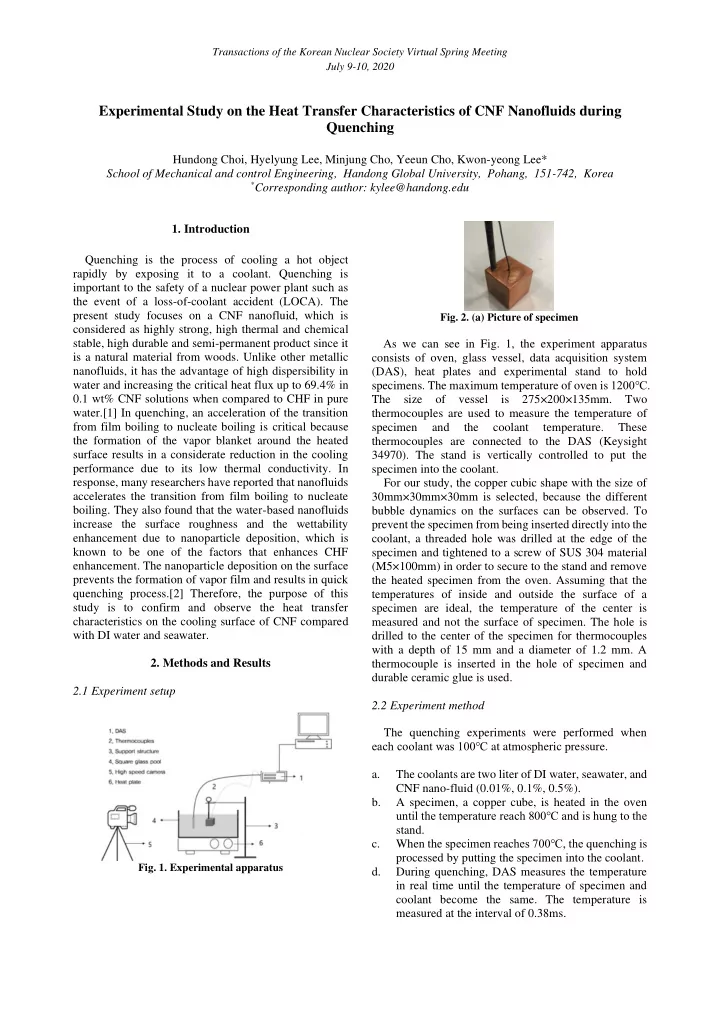
- Fig. 2. (a) Picture of specimen
As we can see in Fig. 1, the experiment apparatus consists of oven, glass vessel, data acquisition system (DAS), heat plates and experimental stand to hold
- specimens. The maximum temperature of oven is 1200℃.
The size
- f