
SLIDE 1
FRONT PAGE.pdf 1 01/06/2015 12:16
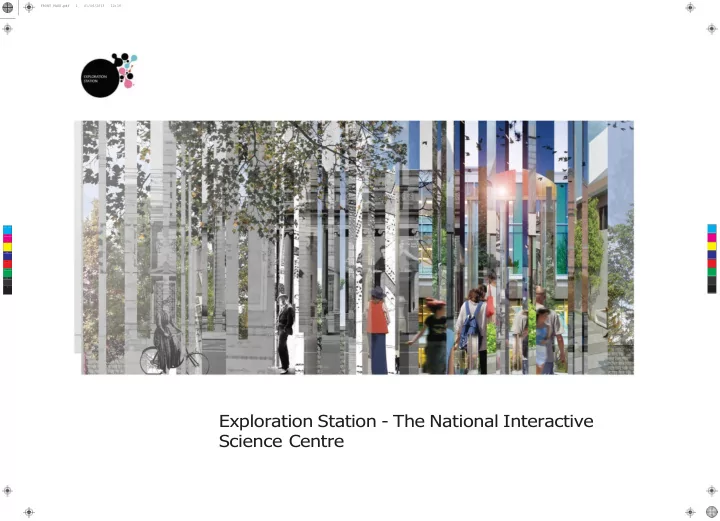
Exploration Station - The National Interactive Science Centre PAGE - - PowerPoint PPT Presentation
FRONT PAGE.pdf 1 01/06/2015 12:16 C M Y CM MY CY CMY K Exploration Station - The National Interactive Science Centre PAGE 1.pdf 1 01/06/2015 12:18 Ireland is alone among the member-states of the European Unionin not having a
FRONT PAGE.pdf 1 01/06/2015 12:16
PAGE 1.pdf 1 01/06/2015 12:18
page 2a.pdf 1 01/06/2015 12:23
PAGE 2.pdf 1 01/06/2015 12:18
Exploration Station will be the first such science centre in the Republic of Ireland. Exploration Station will target primarily children from 4 to 15, but also families, tourists and school groups, including teachers. It projects an average annual attendance in excess of 150,000; it will have a particular focus on ensuring ready access for people from educationally disadvantaged backgrounds.Though it will be aimed primarily at children, adults will derive benefit from experiencing its innovative exhibits. Centres of this kind exist in scores of countries in all continents and are the fastest-growing type of museum worldwide. Ireland stands out in the international community in not having such a resource. The experience of visiting will provide open-ended opportunities for making discoveries at the visitor’s own pace.The interactive exhibits and programmes will be complementary to the school curriculum and will be a year-round resource for informal learning. Creating, maintaining and operating a world-class institution of this type is a challenging prospect. It cannot be supported by trading income alone, as extensive international experience in the
and private donors as well as substantial trading income. Exploration Station is scheduled to open in late 2020 at a location in Dublin city centre provided and refurbished by the government. It will be a place where children's natural curiosity, imagination and creativity are stimulated as they are encouraged to explore and discover. Exploration Station will help young people develop the skills neces- sary in tomorrow’s world: critical thinking skills, ability to ask questions, willingness to take risks, ability to work in teams and share knowledge, and the development of creative, innovative approaches to solving problems. It will encourage young people to consider studies and careers in science and technology. Exploration Station will provide unique interdisciplinary exhibits and programmes, using leading- edge technology and on topics that relate to the school science curricula and beyond. It will be a model for the next generation of interactive museums, learning from the experience of the hundreds of science centres in Europe and beyond. Exploration Station will develop relationships with American and European children’s museums and science centres, building international networks for travelling exhibits and other sharing initiatives. Exploration Station will be housed in a well-located historic building, the north wing of the National Concert Hall on Earlsfort Terrace, in Dublin’s city centre, close to many other cultural institutions.The building will be reconfigured to accommodate learner-focused exhibitions and provide an outstanding and appealing resource for Irish families, educators, and visitors to Dublin.An award-winning team led by Ciaran O’Connor, State Architect, is currently designing the remodelling of the building. Exploration Station will have capital costs of approximately €50 million, of which €29 million is being provided by government, through the provision of the building (€12 million) and its redesign and refurbish- ment (€17 million).A Planetarium will cost €2 million and the design.The construction of other installa- tions are estimated at €15 million.Annual exhibit renewals will cost €4 million over the first ten-year period of operation from 2020.Exploration Station will have annual operating costs at €3.8 million in a steady-state situation, when revenue will be comprised
trading income (57%) and government support (43%); this ratio corresponds with the typical public support for science centres in Europe.
C M Y CM MY CY CMY K page 3a.pdf 1 01/06/2015 12:24
PAGE 3.pdf 1 01/06/2015 12:18
Exploration Station was established in the 1990s to promote the development, in collaboration with government, of a National Interactive Science Centre. It was born
to Ireland’s future performance as an economy and society.The people who came together to promote this initiative had diverse backgrounds, including formal and informal education, science, policy, communication and philanthropy.They saw that
ensure that increasing numbers of young people would choose to study and pursue careers in these areas.The need to encourage creative thinking and innovation in our young generation was also an objective.We considered that Ireland needed, at a national level, a very visible initiative to promote awareness of science, to excite young people with its possibilities and to provide an opportunity for hands-on involvement with practical scientific projects. A National Interactive Science Centre represents such an initiative. Centres of this kind exist in all other developed countries and in very many developing
fill this gap have been made over more than two decades by government advisory bodies, citizen organisations and prominent individuals. Exploration Station was formally approved by government in the 2000s for construction and operation through a public-private partnership but it was a casualty
industries. In the present phase, Exploration Station has been boosted by the designation in 2013
refurbish these premises for that purpose. Exploration Station:The National Interactive Science Centre aims to bridge the gap between formal and informal education, to promote science learning at all levels. It aims to assist in ensuring that science not only holds a central place in school curricula but is a focus of creative problem-solving and learning-by-do- ing. Through exhibitions, workshops and other activities, Exploration Station aims to integrate experiential learning and support materials provided by scientists and educators into a comprehensive learning resource for the public. Exploration Station will take its place alongside other cultural institutions with related aims and audiences, including some also in Dublin city centre, such as the Natural History Museum and Science Gallery. Explo- ration Station will collaborate with these institutions to minimise avoidable overlaps and maximise poten- tial synergies.
C M Y CM MY CY CMY K page 8a.pdf 1 07/06/2015 22:20
PAGE 8.pdf 1 07/06/2015 22:21
Exploration Station will have over 200 purpose-built exhibits allowing visitors to explore, investigate and discover in an informal way and at their own pace and level.The broad themes running across the exhibitions and activities reflect topics that are within the national science curriculum but are also of high general interest, and open up possibilities for exploring the science in the world around us, including, for example, in sport and music. The exhibits are designed to be open-ended with visitors interacting with them in a variety
inputs and following up visits to the centre with access to their acquired data. In some exhibits, visitors will use their own bodies to experience the concepts being demonstrated, setting them in motion directly. In many exhibits a range of themes can be explored; the exhibits on the human body works can also be used to explore forces and
at how one form of energy can be converted to other forms, while also introducing ideas around sustainable energy sources. There is an emphasis throughout on problem-solving and on designing and making. Detailed curriculum support notes and resources on all the exhibits will be developed for use by teachers and to support further activities.
C M Y CM MY CY CMY K page 5a.pdf 1 01/06/2015 12:24
PAGE 5.pdf 1 01/06/2015 12:19
The designated building, which formerly housed lecture rooms and other facilities of University College Dublin, are being redesigned to provide, among other elements:
exhibits
theatre
laboratory
A corporate space for hire by business for events, promotions and training days. The allocation of exhibit space, programme support space and amenity spaces was developed after extensive research with other child-centred facilities.The remainder of the building will be allocated for conference use, general public space, offices, storage and mechanical room, toilets, coat room/locker space and a lobby/orien- tation area. The centre will be designed for full access for the disabled visitor.
C M Y CM MY CY CMY K page 6a.pdf 1 01/06/2015 12:27
PAGE 6.pdf 1 01/06/2015 12:20
The programmes and activities in Exploration Station will be facilitated through:
and short theatre presentations to enhance exhibitions throughout the day;
during summer and other holidays;
disadvantaged children;
different parts of Ireland;
grandparents;
aged 14-15.
C M Y CM MY CY CMY K Page 7a.pdf 1 01/06/2015 12:28
PAGE 7.pdf 1 01/06/2015 12:20
The exhibits will be organised around several key themes: Explore Ourselves The human body, how it works, how we experience forces and how we interact with the world around us through our senses Explore Our Earth What shapes our world? Gravity, earth’s structure, global circulation of air, water and living interactions Explore Our Technology Engineering, robotics, construction, traffic and transport, codes and computer, and more Explore Our Frontiers Astronomy and other curiosity-driven science; scientific research and heritage in Ireland Explore More Augmented reality; information on visitors’ experiences with exhibits connecting to social media.
C M Y CM MY CY CMY K PAGE 8.pdf 1 01/06/2015 12:20
Exploration Station will have over 200 purpose-built exhibits allowing visitors to explore, investigate and discover in an informal way and at their own pace and level.The broad themes running across the exhibitions and activities reflect topics that are within the national science curriculum but are also of high general interest, and open up possibilities for exploring the science in the world around us, including, for example, in sport and music. The exhibits are designed to be open-ended with visitors interacting with them in a variety
inputs and following up visits to the centre with access to their acquired data. In some exhibits, visitors will use their own bodies to experience the concepts being demonstrated, setting them in motion directly. In many exhibits a range of themes can be explored; the exhibits on the human body works can also be used to explore forces and
at how one form of energy can be converted to other forms, while also introducing ideas around sustainable energy sources. There is an emphasis throughout on problem-solving and on designing and making. Detailed curriculum support notes and resources on all the exhibits will be developed for use by teachers and to support further activities.
C M Y CM MY CY CMY K page 9a.pdf 1 01/06/2015 12:32
PAGE 9.pdf 1 01/06/2015 12:21
The theme that cuts across all topic areas. It will be represented particularly in spaces for group work and for shows: 1.A state of the art digital planetarium – a first for Ireland, simulating travel through planets, comets, sun, stars, galaxies and black holes, the experience of space-flight, and digging into the Earth’s structure, or swimming through its oceans through specially produced 3-D shows; the 200-seat planetarium will also make a unique venue for corporate use, particularly for events such as high-tech product launches; 2.A science show theatre – spaces for shows with a high level of audience participation and featuring skilled science communicators who bring science to life, also available for drama performances, debates and talks; 3.A showcase laboratory for school groups coupled with a teachers’ support centre for professional develop- ment; many schools in Ireland are not in a position to carry out high- level technical experiments, yet this type of experimental science is key to inspiring interest in science;
trained staff will be available to help visitors in fun activities;
exploring topical issues that can attract considerable public interest and a high level of repeat visits.
. .
C M Y CM MY CY CMY K page 10a.pdf 1 01/06/2015 12:35
PAGE 10.pdf 1 01/06/2015 12:21
Exploration Station has children aged 4-15 as its primary target audience, both as members of visiting school groups and as members of families coming with their parents, siblings, grand-parents and
care-givers. Within this primary target group we identify transition-year students, aged 14-15, as a cohort with particular requirements as they begin to formulate choices about future education and careers. Beyond the primary target audience we also identify the following as target groups requiring specific attention: Families - parents, grandparents and other care-givers of children-visitors Teachers - pre-school, primary school, post-primary school and transition-year teachers Tourists - individuals, couples and families visiting Ireland or visiting Dublin from elsewhere in the country From the experience of science centres elsewhere, we can anticipate that Exploration Station will also attract members of other groups, including people curious about developments in science, and who wish to partici- pate in debates, talks and other events. Admission charges in the opening year, 2020, will average €13.
Exploration Station is projected to have an annual attendance of about 150,000.This was estimated taking into account comparisons with existing Dublin attractions, comparisons with similar institu- tions elsewhere, and demographic analysis. For example, total attendance at the National Concert Hall, adjoining the premises of Exploration Station, was over 315,000 in 2013 and is projected to increase to more than 400,000 with the addition of their 500- seat concert hall. In Boston, the Museum of Science, with over 1.5 million visitors, ranks as the top attraction in the city and the Museum of Children has a further 500,000-plus visitors.
C M Y CM MY CY CMY K page 11a.pdf 1 01/06/2015 12:41
PAGE 11.pdf 1 01/06/2015 12:21
The government, through the Office of Public Works, will provide the exhibit-ready facility at an estimated total cost of some €29 million - €12 million for the building, and €17 million for its refurbishment.The Office of Public Works’ staff time is not included in these figures but we estimate it at some €2 million. The construction will be to the highest standards and consistent with the objective of building a world-class children’s science centre.The cost of exhibit design, construction and renewal, and building fit out will total €15 million; the provision and equipping of the Planetarium is estimated at €2m.Annual exhibit renewal over the first ten years will total €4 million. A significant fund-raising campaign to launch Exploration Station will be put in place to raise private funds for exhibit design, exhibit fabrication, renewals and launch costs. Typically, trading income at 46% makes up the largest single portion of operating revenue.The Association of Science and Technology Centres surveyed its members world-wide to determine the breakdown of revenue sources and found: Source Trading Government Privat e All respondents 46.0 26.8 27.3 U.S. 46.0 24.1 29.6 Other countries 45.8 38.9 16.2
(As a Percentage of total income).
Exploration Station expects to generate its income from the following sources in its sixth year of operation: Trading Government Privat e Exploration Station 50 39 11 Trading income will consist of entrance fees, membership fees, café/retail income, and function rental.
. .
C M Y CM MY CY CMY K page 12a.pdf 1 01/06/2015 12:42
PAGE 12.pdf 1 01/06/2015 12:22
Dr. Daniel O’Hare, Board Chair: President Emeritus, Dublin City University, Michael M. Collins, Deputy Chair: Senior Counsel Ali Hewson:Volunteer for fund-raising and awareness campaigns, particularly the Chernobyl Children’s Charity, and Anti-Nuclear organizations Dr. Áine Hyland: Chair, Exploration Station National Advisory Committee; former Vice- President, Universi- ty College Cork Michael O’Doherty: Former State Architect, Office
Public Works Peter Brabazon (Designate by the Minister
Jobs Enterprise and Innovation): former Director, Discover Science and Engineering Programme Mindy Byrns O’Brien, Secretary
the Board: Founding board member, environmental attorney Frank Doonan: CEO, ERA Ireland Dr. Ian Hughes: Senior Policy Advisor, Department
Jobs, Enterprise and Innovation Cathy Moore: Journalism lecturer at Dublin City University. Former current affairs presenter and foreign reporter (TV and radio). Brian Redmond,Treasurer: Former Partner, Ernst and Young Executive Director: Seamus Bannon: Former Department Manager,Trade & Innovation, Forfas.