
SLIDE 1
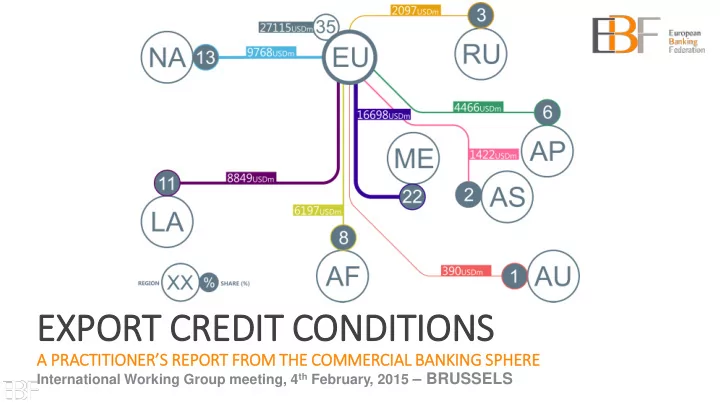
EXPORT CREDIT IT CONDITIONS
A PRACTITIONER’S REPORT FROM THE COMMERCIAL BANKING SPHERE
International Working Group meeting, 4th February, 2015 – BRUSSELS
EXPORT CREDIT IT CONDITIONS A PRACTITIONERS REPORT FROM THE - - PowerPoint PPT Presentation
EXPORT CREDIT IT CONDITIONS A PRACTITIONERS REPORT FROM THE COMMERCIAL BANKING SPHERE International Working Group meeting, 4 th February, 2015 BRUSSELS The European Ban ankin ing Federation facts & fig figures 32 national Member
A PRACTITIONER’S REPORT FROM THE COMMERCIAL BANKING SPHERE
International Working Group meeting, 4th February, 2015 – BRUSSELS
2
Plus 14 associated members, including Russia and Turkey Representing more than4,500 banks (major cross-border and small regional entities) Serving approximately400,000,000 customers with a network of more than200,000 branches Member banks are contributing to EU bank lending withEUR 23,200,000,000 in 2013 (80 % of bank lending in Europe)
3
related discussions with regulators, export-oriented corporates, ECAs and other banks
countries
Credits (Common Approaches), operational regulation (compliance, KYC, AML, sanctions etc.)
step 11 Feb discussion with cabinet of Mrs. Malmström, Commissioner for Trade
discussion with ECB 20 Feb
4
commercial bank’s balance sheet
sector experts, project finance specialists, middle office & others
2014 the exposure weighted default rate for the period from 2006 to 2012 is 0.35 %, EL 0.02 %
covered export credits anymore
promotion approaches (legal structure and governmental backing for ECA, scope of cover, sourcing requirements & other criteria for cover, policy wordings
5
„first“ oil crisis 1973 „second“ oil crisis 1980 / LatAm debt crisis 1982 transformation of Eastern European economies, from 1990 Current Financial and economic crisis, from 2007
Data provided by HERMES
6
* Export Credit data submitted by 18 banks and some ECAs to tagmydeals – covering approx. 60-80 % of the market as a whole
Total Export Credit volume registered in TXF data (FY 2014): 116,659.79 USDm*
7
Top 12 borrowing countries in export finance, considering the overall amount of every deal with at least one ECA or export finance tranche.
* Export Credit data submitted by 18 banks and some ECAs to tagmydeals – covering approx. 60-80 % of the market as a whole
8
* Export Credit data submitted by 18 banks and some ECAs to tagmydeals – covering approx. 60-80 % of the market as a whole
The arrows indicate a volume increase
9
ECAs and public authorities have done a lot to support MLT liquidity in Europe
financing sol
tions:13 of 20 markets surveyed have funded systems
tions: more common since the crisis, currently Belgium, France, Germany, Netherlands, Spain; securitisation guarantee model
Covered bo bonds: various - most active markets Austria, Belgium, France, Germany, UK
ublic capital mark arket t tr tran ansacti tions: active markets in France, Germany, UK
Direct t len ending: since crisis, available in 7 countries; in some cases SMEs only
CIRR: In EU – and more widely – there are marked differences in availability and terms. Arrangement provisions now under discussion
In Asia and US access to MLT liquidity was in general more stable during the recent crisis – but ECAs also offered/supported funding solutions (e.g. direct lending by US Eximbank, KEXIM, JBIC
10
50 100 150 200 250 300 350 400 450 500 550 1-Jan-07 1-Jan-08 1-Jan-09 1-Jan-10 1-Jan-11 1-Jan-12 1-Jan-13 1-Jan-14 1-Jan-15 ASW (in bps)
GER FRA Covered ESP SCANDI NED
Spreads for 5 years Funding costs over the crisis cycle
11
USD JBIC vs USD Japanese Banks Senior Unsecured
25 50 75 100 125 150 31-Dec-14 14-May-16 26-Sep-17 8-Feb-19 22-Jun-20 4-Nov-21 19-Mar-23 31-Jul-24 ASW (in bps) Japanese Banks $ Senior Unsecured JBIC $
Banks considered: Nomura (Baa1/BBB+/A-) Mizuho (-/A/A-) Bank of Tokyo-Mitsubishi (A1/A+/A) Sumitomo Mitsui (Baa2/A/A-)
12
USD PEFCO vs USD US Banks Senior Unsecured
25 50 75 100 125 150 31-Dec-14 14-May-16 26-Sep-17 8-Feb-19 22-Jun-20 4-Nov-21 19-Mar-23 31-Jul-24 ASW (in bps) US Banks $ Senior Unsecured PEFCO $
Banks considered: Bank of America (Baa2/A-/A) Merril Lynch (Baa2/A-/A) CitiGroup (Baa2/A-/A) Morgan Stanley (Baa2/A-/A) Goldman Sachs (Baa1/A-/A) JP Morgan (A3/A/A+) Wells Fargo (A2/A+/AA-
13
Maximum term - years Repayment of principal Repayment flexibility in case of timing imbalance[1] Cat I country
5 / 8.5 with prior notification Equal repayments. First repayment no later than 6 months from starting point, repayments no less frequently than every 6 months. First repayment of principal no later than 12 months from starting point of credit, repayments no less frequently than every 12
Cat II country
10 As above Repayment: as above; MWA: 5.25 – Sov; 6 – non-Sov
Rail [2]
12 - Cat I ; 14 - Cat II As above Repayment: as above; MWA: 6.25 - Cat I; 7.25 - Cat II
Nuclear
18 - main plant As above Repayment instalments: as above.
Climate change, renewable energy
15/18 [3] Below SDR10m: 5/8.5 - Cat I; 10 - Cat II As above First repayment of principal no later than 18 months from start, repayments no less frequently than every 12 months. MWA: 60% max. available tenor
Non-nuclear power
12 (more with prior notification) As above MWA: 6.25
Ships
12 Equal repayments. First repayment no later than 6 months of start, others at regular intervals of normally 6 and max.12 months.
Civil aircraft
12 – new; 15 - exceptionally Used aircraft: max 10 Equal repayments. First repayment no later than 3 months from start, repayments no less frequently than 3 months (or 6 for both after prior notification). With prior notification, final payment can be on a specified date.
Project finance
14 Among conditions for project finance terms: first repayment no later than 24 months after starting point; MWA: 7.25. Principal may be repaid in unequal instalments; principal& interest in less-frequent than semi-ann. instalments subject to conditions.
[1]“An imbalance in the timing of the funds available to the obligor and the debt service profile available under an equal, semi-annual
repayment schedule” – subject to various conditions including to Maximum Weighted Average term, and principal repayment schedule.
[2] Maximum repayment term cannot exceed the useful life of the asset. [3] Carbon capture and storage – 18 years; Fossil fuel substitution and Energy efficiency – 15 years.
14
average amount in mln. tenor in years
In various ECA Export Credits 2014 maximum tenors according to OECD arrangement have been used
* Export Credit data submitted by 18 banks and some ECAs to tagmydeals – covering approx. 60-80 % of the market as a whole
15
tenor in years 1 2 3 4 5 6 7 8 9 10 11 12 13 14 15 Defense Energy Oil Oil Petrochemicals, Defense Marine Infrastructure Transport Infrastructure Oil & Gaz Data provided by
PRI should be seen as complimentary option for MLT Export Credits
16
17
* combined cycle is under renewables
18
19
20
Repayment period 5 years Starting Point: Weighted mean delivery date Disbursement period Conclusion of loan agreement
after starting point Repayment in 10 semi-annual equal instalments
If the exporter has no responsibility for commissioning, the latest starting point is the actual date when the buyer takes physical possession of the goods, e.g.
to be evidenced by shippping/transport documents
21
Repayment period 10 years Starting Point: Readiness for operation Disbursement period Conclusion of loan agreement
after starting point
If the exporter has responsibility for commissioning, the latest starting point is at commissioning, e.g.
(capital goods and project services, complete plants and factories, EPC and construction contracts)
Repayment in 20 semi-annual equal instalments
22
Project finance
Door-to-door tenor
23
Shipping finance of 2 vessels
Door-to-door tenor
24
Project finance (LNG Terminal)
Door-to-door tenor
25
predictability of MLT financing solutions is very important - ECAs are considered as very predictable even in crisis scenarios or if the investment climate is going down
lifetime of goods or/and the amortisation period
Markets (especially if tenors tend to be > 10 years)
capex investments in high income countries due to a lack of commercial alternatives
transactions – especially if the sourcing is becoming more and more diverse
26
For more information: Ralph Lerch Chairman, Export Credit Working Group
European Banking Federation Avenue des Arts 56, B-1000 Brussels European Transparency Register ID number: 4722660838-23. +32 (0)2 508 37 11 | info@ebf-fbe.eu | @EBF_FBE www.ebf-fbe.eu
This presentation is based on substantial contributions from: Alfonso Olivas, TXF Dominik Kloiber, TXF Folko Wohlang, HERMES
Gina Fitzgerald, BPL Global Gerdpeter von Guretzky, SMS GmbH Florian Monschauer, Commerzbank Adrian Urbaczka, Commerzbank Benjamin Philippaerts, European Commission Elena Letemendia, EBF Many thanks to all of you!!!