
SLIDE 1
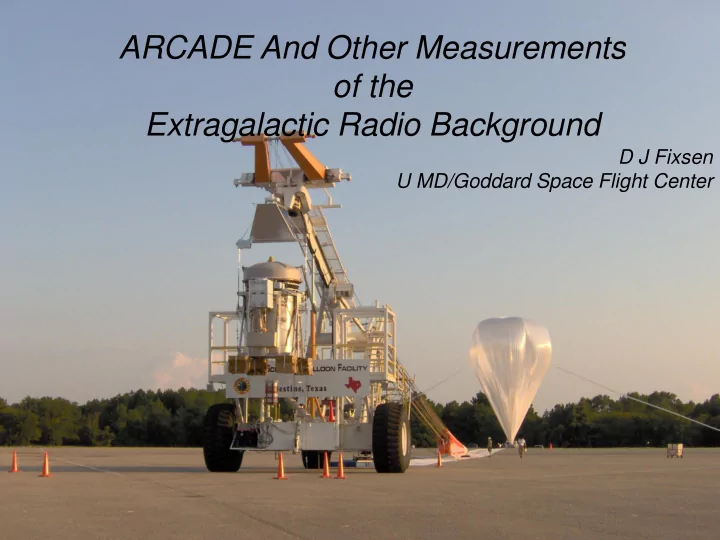
ARCADE And Other Measurements
- f the
Extragalactic Radio Background
D J Fixsen U MD/Goddard Space Flight Center
Extragalactic Radio Background D J Fixsen U MD/Goddard Space Flight - - PowerPoint PPT Presentation
ARCADE And Other Measurements of the Extragalactic Radio Background D J Fixsen U MD/Goddard Space Flight Center Cosmic Radio Background CMB Energy Density I (nW m -2 sr -1 ) 100 CIB COB 1 CXB 10 -2 CGB CRB 10 -4 10 20 10 25 10 7
D J Fixsen U MD/Goddard Space Flight Center
107 1010 1015 1020 1025 10-4 10-2 1 100
Energy Density I (nW m-2 sr-1) Frequency (Hz)
CMB CIB COB CXB CRB CGB
Cryogenic Differential Radiometers Antennas 12° FWHM Cosmic Microwave Background Galactic Emission Blackbody Calibrator Cold Helium Gas Pool 5000 Liter Bucket Dewar
2.7 K
Superfluid Liquid Helium
ARCADE is a thermal experiment, not a radiometric experiment! Six frequency bands: 3, 5, 8, 10, 30, 90 GHz Chop between horn and load at 75 Hz Load functions as transfer standard, but is black enough (>0.999) for absolute reference External calibrator (>0.99997) nulls any remaining instrument asymmetry and provides absolute temperature scale
Radiometric Performance
Thermal Performance
Successful thermal operations
Linear instrument model allows interpolation of sky temperature
Effect Uncertainty (mK) Instrument Emission 3.2 Calibrator Gradients 6.7 Thermometer Calibration 1.0 Atmosphere 0.2 Total 7.5
Error Budget at 3.15 GHz
Bin calibrated data by position on the sky
408 MHz Sky Map ARCADE data
Roger et al 1999 Maeda et al 1999 Haslam et al 1981 Reich & Reich 1986
Galactic latitude
Problem: Can't Use Frequency Dependence to Separate Galactic From Extragalactic Emission
Look For Extra-Galactic Residual Using Multiple Lines of Sight
T ~ csc (b) Latitude b
North Galactic hemisphere ARCADE TG = 0.499 0.030 K
= -2.56 0.04
GHz 1 ~
Gal G
T T
Error Bars x20 Error Bars x5
Scatter from longitudinal structure dominates uncertainty in fit
How Could We Detect Radio Halo? Correlate radio vs line emission!
Correlate ARCADE vs C+ 158 m line
ARCADE 3.15 GHz
Clear correlation T ~ Sqrt( C+ )
Estimated Galactic emission = <> (IC)1/2
ARCADE 3.15 GHz Haslam 408 MHz
Radio/C+ slope C+ Intensity in Selected Region
GHz
1 ) (
G
T T
G
T
= 0.498 0.028 K
= -2.55 0.03 North Galactic Pole
Simple models work well in best regions of the sky
Measured Radio Background Integrated Sources
Measured Background 6x Brighter Than Predicted
Gervasi et al. astro-ph/0803.4138
Model Technique Reference Position Amplitude (K) Index Amplitude (K) Index C+ NGP 0.49 0.10
0.94 0.14
csc(b) NGP 0.50 0.03
0.88 0.07
C+ SGP 0.30 0.05
1.13 0.08
csc(b) SGP 0.37 0.03
1.06 0.07
C+ Coldest 0.19 0.13
0.93 0.13
Galactic part agrees between methods, but varies patch to patch Extra-galactic part agrees over both methods and all patches
Mean 1.00 0.04 K 2 = 6.2 for 4 DOF Galactic Emission Extra-Galactic Emission Varies by factor 2.5 from patch to patch
Data Set TR (K) Index T0 (K) 2/DOF
LF+ARC+COBE 1.17 0.12
2.725 0.001 17.5/11 LF+ARC 1.10 0.16
2.732 0.005 15.2/10 LF+COBE 1.16 0.38
2.725 0.001 .68/2 ARC+COBE 1.17 0.14 (-2.60) 2.725 0.001 16.8/8 LF 1.15 0.50
2.81 0.7 .66/1 ARC 1.04 0.16 (-2.60) 2.732 0.004 14.4/7
Any combination of independent data sets gives the same answer Fit for CMB temperature plus radio amplitude & index
Frequency Wavelength Diameter Back Temp Precision Notes 3 GHz 10 cm 2 m 2.8 .6 mK ARCADE, Liq He 1.3 GHz 23 cm 6 m 3.3 5 mK Liquid Helium 610 MHz 49 cm 10 m 6.6 30 mK Liquid Helium 250 MHz 1.2 m 30 m 42 .4 K Liquid Nitrogen 110 MHz 2.7 m 75 m 334 3 K Room Temp 74 MHz 4 m 100 m 935 9 K Astronomy Band 38 MHz 7.9 m 200 m 5300 53 K Astronomy Band 25 MHz 12 m 300 m 16000 160 K Astronomy Band
CMB = 2.729 0.004 K
CMB = 2.729 0.004 K Radio background: T = 55 7 mK at 3.3 GHz 8 detection of extragalactic background What is this??
Perform identical analysis for full-sky low-frequency radio surveys
22 MHz (Roger et al. 1999) 45 MHz (Maeda et al 1999, Alvarez et al 1997) 408 MHz (Haslam et al. 1981) 1420 MHz (Reich & Reich 1986)
Combined ARCADE + Radio data TCMB = 2.732 0.005 K TR = 1.10 0.16 K = -2.62 0.04 2 = 15.2 for 10 DOF ARCADE TCMB consistent with COBE (approaching COBE precision!) Radio amplitude set by ARCADE Radio index set by low-freq surveys ARCADE by itself can not determine spectrum of background
Perform identical analysis for full-sky low-frequency radio surveys
22 MHz (Roger et al. 1999) 45 MHz (Maeda et al 1999, Alvarez et al 1997) 408 MHz (Haslam et al. 1981) 1420 MHz (Reich & Reich 1986)
Combined ARCADE + Radio data TCMB = 2.732 0.005 K TR = 1.10 0.16 K = -2.62 0.04 2 = 15.2 for 10 DOF ARCADE TCMB consistent with COBE (approaching COBE precision!) Radio amplitude set by ARCADE Radio index set by low-freq surveys ARCADE by itself can not determine spectrum of background Observed spectral index inconsistent with signature from reionization ( = -2.1)
Model Thermal Profile in Absorbing Cone
Pre-Flight Static Model Flight Thermometers
Thermal gradient from heat flow in absorber 21 thermometers sample actual gradient 97% of absorber volume within 10 mK of base Coupling to radiometers set by data, not model ARCADE is hugely over-populated with thermometers!
Data CMB Background
COBE 2.725 0.001
2.732 0.004 1.04 0.16 Radio 2.8 0.7 1.14 0.5
Agreement between ARCADE and independent data sets at higher & lower frequencies rules out gradient error
Combined ARCADE + COBE + Radio data TCMB = 2.725 0.001 K TR = 1.17 0.12 K = -2.60 0.04 2 = 17.5 for 11 DOF
COBE TCMB Background from Radio Surveys Background from Radio Surveys
North Polar Cap South Polar Cap Coldest Patch
408 MHz Survey
Multiple cross-checks on background
foregrounds vary by factor of 3
60 Estimates of Radio Background
Highly correlated in some "directions" Best-Fit Power-Law Model (including covariance)
GHz 1
) (
R
T T
TR = 1.17 0.12 K
= -2.60 0.04
Straight Fit To Sky Data TR = 0.97 0.14 K
= -2.56 0.04
Corrected For Radio Sources
Consistent Estimate of Radio Background
Log( LFIR ) Log(L1.5GHz )
Tight correlation between radio and IR emission Predict radio background associated with
Required Source Properties:
Need mechanism to break radio/IR correlation
Dwek & Barker 2002, APJ, 575, 7
Condon 1992, ARAA, 30, 575 Franceschini et al 2001, A&A, 378, 1
Difficult to produce radio-bright halo
Halo radius large compared to disk Large halo atypical for external galaxies
Halo can't contain C, H, or dust (!)
Source 3L 3H 8L 8H 10L 10H 30L 30H 90L 90H Notes Thermometer Cal 1.0 1.0 1.0 1.0 1.0 1.0 1.0 1.0 1.0 1.0 Verify using LHe transition Radiometer Cal 6.7 5.7 4.2 4.4 4.3 4.2 153 75 35 20 Calibrator Gradients Statistics 5.0 4.7 7.7 8.6 3.9 4.1 27 14 14 6.9 White noise plus 1/f Galaxy 5.3 4.9 0.6 0.6 0.4 0.4 0.0 0.0 0.0 0.0 Instrument Emission 3.2 1.7 11.0 12.7 0.9 0.7 1.3 1.4 5.2 5.1 Spreader bar Atmosphere 0.2 0.2 0.2 0.2 0.2 0.2 0.7 0.7 1.4 1.4 Quadrature Sum 10.5 9.1 14.1 16.0 6.0 6..0 155 76 38 22
In-flight video camera looks down at dewar Capture images of 3 GHz antenna 2 hours apart No nitrogen condensation visible on optics Pre-flight
13 . 11 . 2 with
S dS dN Integrated Radio Background dS S dS dN TR 2
2
Predicted: TR = 9 2 mK Observed: TR = 55 7 mK
Scale observed sources to 3.3 GHz
Observed Background is 6x brighter than expected!
Gervasi et al. astro-ph/0803.4138
Are There Any Loopholes?
Expect gradients linked to heat flow from absorber to aperture
Embedded thermometers measure actual in-flight gradients Two ways to model calibrator emission
Horn "Footprint" on Calibrator "Hot Spot"
"Cold Spot"
Mean: 13.55 K RMS: 0.64 K
408 MHz survey, Northern Hemisphere
Beware of bias: Coldest pixels are downward noise fluctuations!
Eigenvector decomposition of thermometer readout vs time
T T
Thermometer data: 21 rows x N samples 21 diagonal eigenvalues 21 eigenvectors: V VT = I
Use entire data set (even during moves) to define thermal modes Evaluate modes only during "quiet" data for radiometer calibration
Mode Origin Variance 1 Isothermal 99.9% 2 Front-back gradient 0.08% 3 & 4 Antenna "footprints" 0.02%
Radiometer calibration uses first 10 modes (99.996% of variance) Using more/fewer modes,
ARCADE calibrator is hugely
Singal et al. 2009, ApJ (submitted) arXiv:0901.0546
Singal et al. 2009, ApJ (submitted) arXiv:0901.0546
Singal et al. 2009, ApJ (submitted) arXiv:0901.0546
Spatial Structure: Use "Template" Model
i i i
Add offset 0() to match emission along some reference line of sight where total Galactic emission is known.
Synchrotron Template 408 MHz survey Free-Free Template C+ 158 m map
Frequency
synch ff
(GHz) mK / K mK nW-1 m2 sr 3.15 2.02 0.05 3.22 0.11 3.41 1.70 0.04 3.06 0.09 7.98 0.24 0.02 0.26 0.05 8.33 0.24 0.02 0.28 0.05 9.72 0.04 0.01 0.39 0.03 10.49 0.04 0.01 0.37 0.03 Spectral Index
Best-Fit Template Coefficients
Commanded Temperature Change
Fits prefer no CMB spectral distortions. New robust 2σ upper limits: μ<5.8x10⁻⁵, |Yff|<5.8x10⁻⁵
Parameter Power Law Power Law + Yff Yff only Power Law + μ T0 2.725 ± 0.001 2.725 ± 0.001 2.725 ± 0.001 2.725 ± 0.001 A 1.06 ± 0.11 1.00 ± 0.37
β
FF amplitude
0.54 ± 0.07
DOF 53 52 54 52 χ2 70.0 60.8 107.1 60.8 reduced χ2 1.15 1.17 1.98 1.17
Using ARC+LF+FIRAS
CMB baseline Temp at 1 GHz Power law index CMB spectral distortions
Parameter Power Law Power Law + Yff Yff only Power Law + μ T0 A β FF amplitude μ amplitude DOF χ2 reduced χ2
Frequency Calibrator Antenna Ref Load Amplifier 3 GHz
2731 134 1486 3 1987 48 1439 3
8 GHz
2710 116 1414 3 1474 3 1440 3
10 GHz
2728 111 1470 3 2840 158 1403 3
30 GHz
2728 111 1635 379 2290 737 1436 3
90 GHz
2724 108 2775 173 2970 349 2961 784
Component Temp and RMS Variation (mK)
Successful thermal operations
Linear instrument model allows interpolation of sky temperature
COBE: CMB is blackbody to 50 ppm Radio: Distortions could be 5% or more
Goal: Precise measurements of sky temperature to search for distortions from blackbody spectrum