
SLIDE 1
The logic of quantum mechanics - take II
Bob Coecke — arXiv:1204.3458
=
f f
=
f f f
ALICE BOB=
ALICE BOBf
=
notlike
Bob Alice does Alice
notlike
not Bob
meaning vectors of words pregroup grammar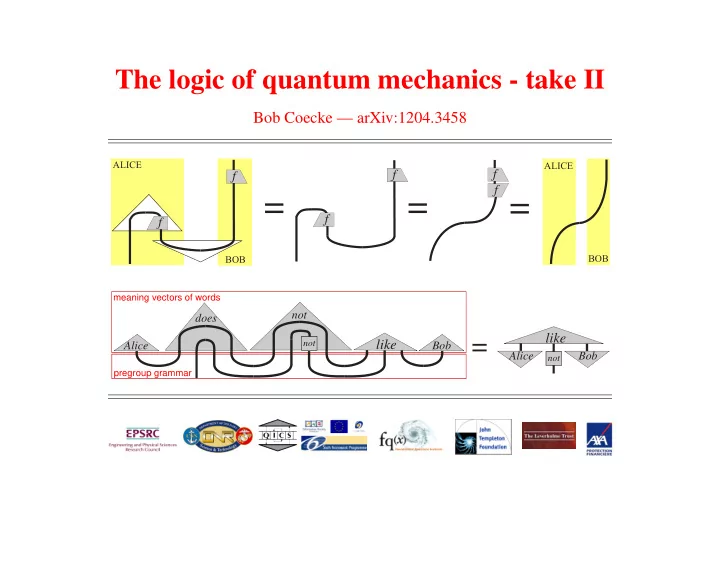
= = = f f BOB BOB meaning vectors of words not does like - - PowerPoint PPT Presentation
The logic of quantum mechanics - take II Bob Coecke arXiv:1204.3458 ALICE ALICE f f f f = = = f f BOB BOB meaning vectors of words not does like not like = Alice Bob Alice Bob not pregroup grammar An alternative
The logic of quantum mechanics - take II
Bob Coecke — arXiv:1204.3458
=
f f
=
f f f
ALICE BOB=
ALICE BOBf
=
notlike
Bob Alice does Alice
notlike
not Bob
meaning vectors of words pregroup grammar arXiv:1307.4038
arXiv:1204.3458
arXiv:1009.3786
arXiv:0908.1787
arXiv:0808.1032
arXiv:quant-ph/0510032
— CROCL ’99 —
— genesis —
— genesis — [von Neumann 1932] Formalized quantum mechanics in “Mathematische Grundlagen der Quantenmechanik”
— genesis — [von Neumann 1932] Formalized quantum mechanics in “Mathematische Grundlagen der Quantenmechanik” [von Neumann to Birkhoff 1935] “I would like to make a confession which may seem immoral: I do not believe absolutely in Hilbert space no more.” (sic)
— genesis — [von Neumann 1932] Formalized quantum mechanics in “Mathematische Grundlagen der Quantenmechanik” [von Neumann to Birkhoff 1935] “I would like to make a confession which may seem immoral: I do not believe absolutely in Hilbert space no more.” (sic) [Birkhoff and von Neumann 1936] The Logic of Quan- tum Mechanics in Annals of Mathematics.
— genesis — [von Neumann 1932] Formalized quantum mechanics in “Mathematische Grundlagen der Quantenmechanik” [von Neumann to Birkhoff 1935] “I would like to make a confession which may seem immoral: I do not believe absolutely in Hilbert space no more.” (sic) [Birkhoff and von Neumann 1936] The Logic of Quan- tum Mechanics in Annals of Mathematics. [1936 – 2000] many followed them, ... and FAILED.
— genesis — [von Neumann 1932] Formalized quantum mechanics in “Mathematische Grundlagen der Quantenmechanik” [von Neumann to Birkhoff 1935] “I would like to make a confession which may seem immoral: I do not believe absolutely in Hilbert space no more.” (sic) [Birkhoff and von Neumann 1936] The Logic of Quan- tum Mechanics in Annals of Mathematics. [1936 – 2000] many followed them, ... and FAILED.
— the mathematics of it —
— the mathematics of it — Hilbert space stuff: continuum, field structure of com- plex numbers, vector space over it, inner-product, etc.
— the mathematics of it — Hilbert space stuff: continuum, field structure of com- plex numbers, vector space over it, inner-product, etc. WHY?
— the mathematics of it — Hilbert space stuff: continuum, field structure of com- plex numbers, vector space over it, inner-product, etc. WHY? von Neumann: only used it since it was ‘available’.
— the physics of it —
— the physics of it — von Neumann crafted Birkhoff-von Neumann Quan- tum ‘Logic’ to capture the concept of superposition.
— the physics of it — von Neumann crafted Birkhoff-von Neumann Quan- tum ‘Logic’ to capture the concept of superposition. Schr¨
quantum theory is how quantum systems compose.
— the physics of it — von Neumann crafted Birkhoff-von Neumann Quan- tum ‘Logic’ to capture the concept of superposition. Schr¨
quantum theory is how quantum systems compose. Last 20 year discoveries: Schr¨
— the game plan —
— the game plan — Task 0. Solve: tensor product structure the other stuff = ???
— the game plan — Task 0. Solve: tensor product structure the other stuff = ??? i.e. axiomatize “⊗” without reference to spaces.
— the game plan — Task 0. Solve: tensor product structure the other stuff = ??? i.e. axiomatize “⊗” without reference to spaces. Task 1. Investigate which assumptions (i.e. which struc- ture) on ⊗ is needed to deduce physical phenomena.
— the game plan — Task 0. Solve: tensor product structure the other stuff = ??? i.e. axiomatize “⊗” without reference to spaces. Task 1. Investigate which assumptions (i.e. which struc- ture) on ⊗ is needed to deduce physical phenomena. Task 2. Investigate wether such an “interaction struc- ture” appear elsewhere in “our classical reality”.
COMPOSITION WITHOUT SPACES
A admits many states e.g. dirty, clean, skinned, ...
A admits many states e.g. dirty, clean, skinned, ...
B admits many states e.g. boiled, fried, deep fried, baked with skin, baked without skin, ...
A admits many states e.g. dirty, clean, skinned, ...
B admits many states e.g. boiled, fried, deep fried, baked with skin, baked without skin, ... Let A
f
✲ B
A
f ′
✲ B
A
f ′′
✲ B
be boiling, frying, baking.
A admits many states e.g. dirty, clean, skinned, ...
B admits many states e.g. boiled, fried, deep fried, baked with skin, baked without skin, ... Let A
f
✲ B
A
f ′
✲ B
A
f ′′
✲ B
be boiling, frying, baking. States are processes I := unspecified
ψ ✲ A.
A
g ◦ f✲C
be the composite process of first boiling A
f
✲ B and
then salting B
g ✲C.
A
g ◦ f✲C
be the composite process of first boiling A
f
✲ B and
then salting B
g ✲C. Let
X
1X ✲ X
be doing nothing. We have 1Y ◦ ξ = ξ ◦ 1X = ξ.
A ⊗ D
f⊗h✲ B ⊗ E
be boiling potato while frying carrot.
A ⊗ D
f⊗h✲ B ⊗ E
be boiling potato while frying carrot. Let C ⊗ F
x ✲ M
be mashing spice-cook-potato and spice-cook-carrot.
A ⊗ D
f⊗h
✲ B ⊗ E
g⊗k
✲ C ⊗ F
x ✲ M= A ⊗ D x◦(g⊗k)◦( f⊗h)
✲ M.
A ⊗ D
f⊗h
✲ B ⊗ E
g⊗k
✲ C ⊗ F
x ✲ M= A ⊗ D x◦(g⊗k)◦( f⊗h)
✲ M.
A ⊗ D
f⊗h
✲ B ⊗ E
g⊗k
✲ C ⊗ F
x ✲ M= A ⊗ D x◦(g⊗k)◦( f⊗h)
✲ M.
(1B ⊗ g) ◦ ( f ⊗ 1C) = (f ⊗ 1D) ◦ (1A ⊗ g)
A ⊗ D
f⊗h
✲ B ⊗ E
g⊗k
✲ C ⊗ F
x ✲ M= A ⊗ D x◦(g⊗k)◦( f⊗h)
✲ M.
(1B ⊗ g) ◦ ( f ⊗ 1C) = (f ⊗ 1D) ◦ (1A ⊗ g) i.e. boil potato then fry carrot = fry carrot then boil potato
A ⊗ D
f⊗h
✲ B ⊗ E
g⊗k
✲ C ⊗ F
x ✲ M= A ⊗ D x◦(g⊗k)◦( f⊗h)
✲ M.
(1B ⊗ g) ◦ ( f ⊗ 1C) = (f ⊗ 1D) ◦ (1A ⊗ g) i.e. boil potato then fry carrot = fry carrot then boil potato ⇒ Monoidal Category
BOXES AND WIRES
Roger Penrose (1971) Applications of negative dimensional tensors. In: Com- binatorial Mathematics and its Applications, 221–244. Academic Press. Andr´ e Joyal and Ross Street (1991) The Geometry of tensor calculus I. Ad- vances in Mathematics 88, 55–112.
— wire and box language —
f
Interpretation: wire := system ; box := process
— composing boxes —
— composing boxes — sequential composition:
g ◦ f ≡
g f
— composing boxes — sequential composition:
g ◦ f ≡
g f
parallel composition:
f ⊗ g ≡
f f g
— merely a new notation? —
— merely a new notation? —
(g ◦ f) ⊗ (k ◦ h) = (g ⊗ k) ◦ ( f ⊗ h)
f h g k f h g k
— merely a new notation? —
(g ◦ f) ⊗ (k ◦ h) = (g ⊗ k) ◦ ( f ⊗ h)
f h g k f h g k
peel potato and then fry it, while, clean carrot and then boil it
=
peel potato while clean carrot, and then, fry potato while boil carrot
QUANTUM PROCESSES
Samson Abramsky & BC (2004) A categorical semantics for quantum proto-
BC (2005) Kindergarten quantum mechanics. quant-ph/0510032
— quantitative metric —
f : A → B
f A B
— quantitative metric —
f †: B → A
f B A
— asserting (pure) entanglement — quantum classical =
— asserting (pure) entanglement — quantum classical =
⇒ introduce ‘parallel wire’ between systems: subject to: only topology matters!
— quantum-like — E.g.
Transpose:
f f
Conjugate:
f f
classical data flow? f
f f f
classical data flow? f
f
classical data flow? f
f
classical data flow? f
ALICE BOB
ALICE BOB
f
⇒ quantum teleportation
— symbolically: dagger compact categories —
tional statement between expressions in dagger com- pact categorical language holds if and only if it is derivable in the graphical notation via homotopy.
An equational statement between expressions in dag- ger compact categorical language holds if and only if it is derivable in the dagger compact category of fi- nite dimensional Hilbert spaces, linear maps, tensor product and adjoints.
— expressivity — Full-blown QM/QC course at Oxford: Quantum Computer Science – quantum circuits, MBQC, – quantum algorithms, – quantum cryptography, – quantum non-locality, ...
— expressivity — Full-blown QM/QC course at Oxford: Quantum Computer Science – quantum circuits, MBQC, – quantum algorithms, – quantum cryptography, – quantum non-locality, ... Lecture notes forthcoming as book (approx. 400 pp): Bob Coecke & Aleks Kissinger Picturing Quantum Processes Cambridge University Press
— kindergarten quantum mechanics: the experiment — Contest in problem solving between:
The children will win!
BC (2010) Quantum picturalism. Contemporary Physics 51, 59–83.
— what is logic? —
— what is logic? — Pragmatic option: Logic is structure in language.
— what is logic? — Pragmatic option: Logic is structure in language.
“Alice and Bob ate everything or nothing, then got sick.” connectives (∧, ∨) : and, or negation (¬) : not (cf. nothing = not something) entailment (⇒) : then quantifiers (∀, ∃) : every(thing), some(thing) constants (a, b) : thing variable (x) : Alice, Bob predicates (P(x), R(x, y)) : eating, getting sick truth valuation (0, 1) : true, false
(∀z : Eat(a, z) ∧ Eat(b, z)) ∧ ¬(∃z : Eat(a, z) ∧ Eat(b, z)) ⇒ S ick(a), S ick(b)
— what is logic? — Pragmatic option: Logic is structure in language.
“Alice and Bob ate everything or nothing, then got sick.” connectives (∧, ∨) : and, or negation (¬) : not (cf. nothing = not something) entailment (⇒) : then quantifiers (∀, ∃) : every(thing), some(thing) constants (a, b) : thing variable (x) : Alice, Bob predicates (P(x), R(x, y)) : eating, getting sick truth valuation (0, 1) : true, false
(∀z : Eat(a, z) ∧ Eat(b, z)) ∧ ¬(∃z : Eat(a, z) ∧ Eat(b, z)) ⇒ S ick(a), S ick(b)
This is about truth. What about genuine meaning?
A SLIGHTLY DIFFERENT LANGUAGE FOR NATURAL LANGUAGE MEANING
BC, Mehrnoosh Sadrzadeh & Stephen Clark (2010) Mathematical foundations for a compositional distributional model of meaning. arXiv:1003.4394
— the from-words-to-a-sentence process —
— the from-words-to-a-sentence process — Consider meanings of words, e.g. as vectors (cf. Google):
word 1 word 2 word n
— the from-words-to-a-sentence process — What is the meaning the sentence made up of these?
word 1 word 2 word n
— the from-words-to-a-sentence process — I.e. how do we/machines produce meanings of sentences?
word 1 word 2 word n
— the from-words-to-a-sentence process — I.e. how do we/machines produce meanings of sentences?
word 1 word 2 word n
— the from-words-to-a-sentence process — Information flow within a verb:
verb
subject subject
— the from-words-to-a-sentence process — Information flow within a verb:
verb
subject subject
Again we have:
— pregoup grammar — Lambek’s residuated monoids (1950’s): b ≤ a ⊸ c ⇔ a · b ≤ c ⇔ a ≤ c b
— pregoup grammar — Lambek’s residuated monoids (1950’s): b ≤ a ⊸ c ⇔ a · b ≤ c ⇔ a ≤ c b
a · (a ⊸ c) ≤ c ≤ a ⊸ (a · c) (c b) · b ≤ c ≤ (c · b) b
— pregoup grammar — Lambek’s residuated monoids (1950’s): b ≤ a ⊸ c ⇔ a · b ≤ c ⇔ a ≤ c b
a · (a ⊸ c) ≤ c ≤ a ⊸ (a · c) (c b) · b ≤ c ≤ (c · b) b Lambek’s pregroups (2000’s): a · −1a ≤ 1 ≤ −1a · a b−1 · b ≤ 1 ≤ b · b−1
— Lambek’s pregoup grammar —
A A A A A A A A
=
A A A A
=
A A A A
=
A A A A
=
A A A A
Jim Lambek mentioned this connection first to (to me) during a seminar on categorical quantum mechanics at McGill here in Montreal in 2004.
— Lambek’s pregoup grammar — For noun type n, verb type is −1n · s · n−1, so:
— Lambek’s pregoup grammar — For noun type n, verb type is −1n · s · n−1, so:
n · −1n · s · n−1 · n ≤ 1 · s · 1 ≤ s
— Lambek’s pregoup grammar — For noun type n, verb type is −1n · s · n−1, so:
n · −1n · s · n−1 · n ≤ 1 · s · 1 ≤ s
— Lambek’s pregoup grammar — For noun type n, verb type is −1n · s · n−1, so:
n · −1n · s · n−1 · n ≤ 1 · s · 1 ≤ s
— Lambek’s pregoup grammar — For noun type n, verb type is −1n · s · n−1, so:
n · −1n · s · n−1 · n ≤ 1 · s · 1 ≤ s
Diagrammatic type reduction:
n n s n n
— Lambek’s pregoup grammar — For noun type n, verb type is −1n · s · n−1, so:
n · −1n · s · n−1 · n ≤ 1 · s · 1 ≤ s
Diagrammatic meaning:
verb n n
flow flow flow flow
— algorithm for meaning of sentences —
— algorithm for meaning of sentences —
(word type 1) . . . (word type n) sentence type
— algorithm for meaning of sentences —
(word type 1) . . . (word type n) sentence type
f :: →
ii| ⊗ id ⊗
ii|
— algorithm for meaning of sentences —
(word type 1) . . . (word type n) sentence type
f :: →
ii| ⊗ id ⊗
ii|
f − → v 1 ⊗ . . . ⊗ − → v n
— − − − − → Alice ⊗ − − − → does ⊗ − − → not ⊗ − − → like ⊗ − − → Bob —
— − − − − → Alice ⊗ − − − → does ⊗ − − → not ⊗ − − → like ⊗ − − → Bob —
Alice
not
like
Bob
meaning vectors of words
not
grammar
does
— − − − − → Alice ⊗ − − − → does ⊗ − − → not ⊗ − − → like ⊗ − − → Bob —
Alice
like
Bob
meaning vectors of words grammar not
— − − − − → Alice ⊗ − − − → does ⊗ − − → not ⊗ − − → like ⊗ − − → Bob —
Alice
like
Bob
meaning vectors of words grammar not
— − − − − → Alice ⊗ − − − → does ⊗ − − → not ⊗ − − → like ⊗ − − → Bob —
Alice
like
Bob
meaning vectors of words grammar not
=
not
like
Bob Alice
— − − − − → Alice ⊗ − − − → does ⊗ − − → not ⊗ − − → like ⊗ − − → Bob —
Alice
like
Bob
meaning vectors of words grammar not
=
not
like
Bob Alice
=
not
like
Bob Alice
Using:
=
like like
=
like like
CLASSICAL DATA i.e. BASIS
WIRES?
SPIDERS!
B.C. and D. Pavlovic – arXiv:quant-ph/0608035 B.C., D. Pavlovic and J. Vicary – arXiv:0810.0812 B.C., E.O. Paquette and D. Pavlovic – arXiv:0904.1997 B.C. and S. Perdrix – arXiv:1004.1598
— spiders — ‘spiders’ =
m
....
such that, for k > 0:
m+m′−k
.... .... .... ....
= .... ....
Coecke, Pavlovic & Vicary (2006, 2008) quant-ph/0608035, 0810.0812
— spiders — ‘(co-)mult.’ =
m
....
such that, for k > 0:
m+m′−k
.... .... .... ....
= .... ....
— spiders — ‘(co-)mult.’ =
m
....
such that, for k > 0:
m+m′−k
.... .... .... ....
= .... ....
— spiders — ‘cups/caps’ =
m
....
such that, for k > 0:
m+m′−k
.... .... .... ....
= .... ....
Coecke, Pavlovic & Vicary (2006, 2008) quant-ph/0608035, 0810.0812
MATING AND FIGHTING SPIDERS
B.C. and R. Duncan – arXiv:0906.4725
— decorated spiders —
— decorated spiders —
for spider multiplication with conjugate as inverse.
m
....
α
m
.... .... .... ....
α β
=
m
....
α+β
— complementary spiders —
— complementary spiders —
BC & Ross Duncan (2008) Interacting quantum observables. ICALP’08 & New Journal of Physics 13, 043016. arXiv:0906.4725
— complementary spiders —
BC & Ross Duncan (2008) Interacting quantum observables. ICALP’08 & New Journal of Physics 13, 043016. arXiv:0906.4725
— universality —
ical language, is universal for computing with qubits.
their Euler angle decomposition yield all unitaries: ΛZ(γ) ◦ ΛX(β) ◦ ΛZ(α) = γ α β . 1 0 0 0 0 1 0 0 0 0 0 1 0 0 1 0 = .
— completeness II —
described graphical calculus with phases restricted to
π 2-multiples, is complete for qubit stabiliser fragment
angle decomposition of the Hadamard gate.
— spiders — Bob = (the) man whom Alice hates = Bob
— spiders — Bob = (the) man whom Alice hates = Bob
— spiders — Bob = (the) man whom Alice hates = Bob